Exploratory laparotomy is a critical surgical procedure used to diagnose and treat abdominal pathologies when non-invasive methods fail to provide a definitive diagnosis. This open abdominal surgery allows surgeons to visually and manually inspect the abdominal cavity, identify underlying conditions, and perform necessary interventions.
Given its invasive nature, understanding the correct Current Procedural Terminology (CPT) codes for exploratory laparotomy is essential for accurate medical billing, insurance claims, and compliance with healthcare regulations. This article provides an in-depth analysis of CPT coding for exploratory laparotomy, surgical techniques, indications, and postoperative care, ensuring comprehensive knowledge for surgeons, medical coders, and healthcare administrators.
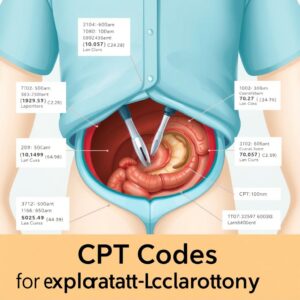
CPT Codes for Exploratory Laparotomy
2. What is an Exploratory Laparotomy?
An exploratory laparotomy is a surgical procedure where a large incision is made in the abdomen to examine the internal organs for disease, trauma, or unexplained symptoms. Unlike minimally invasive techniques (e.g., laparoscopy), this procedure provides direct access, making it invaluable in emergencies like internal bleeding, perforated organs, or abdominal trauma.
Key Features:
-
Diagnostic & Therapeutic: Used for both diagnosis and immediate treatment.
-
Open Surgery Approach: Involves a midline vertical or transverse incision.
-
High-Risk Cases: Often performed in life-threatening conditions.
3. Indications for Exploratory Laparotomy
| Condition | Reason for Laparotomy |
|---|---|
| Acute Abdomen | Severe pain of unknown origin |
| Trauma (Blunt/Penetrating) | Internal bleeding or organ injury |
| Bowel Perforation | Suspected hole in intestines |
| Tumor Resection | Suspected cancer requiring biopsy |
| Postoperative Complications | Adhesions, abscesses, or leaks |
4. CPT Codes for Exploratory Laparotomy
Accurate CPT coding ensures proper reimbursement and compliance. The primary CPT codes include:
Primary CPT Codes
| CPT Code | Description |
|---|---|
| 49000 | Exploratory laparotomy, without biopsy |
| 49002 | Exploratory laparotomy with biopsy |
| 49010 | Reopening of recent laparotomy |
Modifiers & Additional Codes
-
-22 (Increased Procedural Services): Used if the procedure is more complex.
-
-51 (Multiple Procedures): Applied if additional surgeries are performed.
-
ICD-10 Codes: Must align with diagnosis (e.g., K35.80 for acute appendicitis).
5. Preoperative Preparation
-
Patient Evaluation: Blood tests, imaging (CT/MRI), and consent.
-
NPO Status: Fasting for 8+ hours before surgery.
-
Antibiotic Prophylaxis: To prevent infections.
6. Surgical Technique
Step-by-Step Procedure
-
Incision: Midline vertical (most common) or transverse.
-
Exploration: Systematic examination of organs (liver, spleen, intestines).
-
Intervention: Repair, resection, or drainage as needed.
-
Closure: Suturing in layers to prevent herniation.
Potential Complications
-
Infection
-
Bleeding
-
Adhesions
-
Organ Damage
7. Postoperative Care and Recovery
-
Hospital Stay: 3–7 days depending on complexity.
-
Pain Management: IV opioids transitioning to oral meds.
-
Activity Restrictions: No heavy lifting for 6–8 weeks.
8. Cost and Insurance Considerations
| Factor | Estimated Cost |
|---|---|
| Surgical Fees | $5,000–$15,000 |
| Hospital Stay | $2,000–$10,000/day |
| Anesthesia | $1,000–$3,000 |
Insurance coverage varies; prior authorization may be required.
9. Comparative Analysis: Laparotomy vs. Laparoscopy
| Factor | Laparotomy | Laparoscopy |
|---|---|---|
| Incision Size | Large (10–20 cm) | Small (0.5–1 cm) |
| Recovery Time | 4–8 weeks | 1–2 weeks |
| Risk of Infection | Higher | Lower |
10. Case Studies and Clinical Outcomes
-
Case 1: Trauma patient with splenic rupture—successful repair.
-
Case 2: Unexplained abdominal pain—diagnosed with ovarian torsion.
11. Conclusion
Exploratory laparotomy remains a vital surgical intervention for diagnosing and treating abdominal emergencies. Proper CPT coding (49000, 49002) ensures accurate billing, while meticulous surgical technique minimizes complications. Understanding preoperative and postoperative protocols enhances patient outcomes.
12. FAQs
Q1: What is the difference between CPT 49000 and 49002?
-
49000: Exploratory laparotomy without biopsy.
-
49002: Includes biopsy or tissue sampling.
Q2: How long does recovery take?
-
Typically 4–8 weeks, depending on complications.
Q3: Can laparoscopy replace exploratory laparotomy?
-
In some cases, but laparotomy is preferred for complex or emergency cases.