If you’re reviewing an older medical chart, handling a historical insurance claim, or simply trying to understand a past diagnosis, you’ve likely encountered the term “ICD-9 code for hyperlipidemia.” While the healthcare world has fully transitioned to the ICD-10 system, knowledge of the older ICD-9 codes remains crucial for interpreting decades of medical data.
This guide will provide you with a clear, thorough, and reliable explanation of the ICD-9 coding for hyperlipidemia. We’ll break down the specific codes, what they meant in clinical practice, and how that information translates in today’s modern coding environment. Our goal is to make this complex topic accessible, whether you’re a medical professional, a student, or a patient researching your health history.
Think of ICD-9 as the language used to describe diseases for over three decades. Understanding that language is key to unlocking the past narrative of a patient’s health, particularly for a chronic, common condition like hyperlipidemia—an elevation of fats (lipids) in the blood, such as cholesterol and triglycerides.
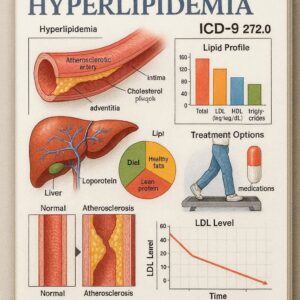
ICD-9 Code for Hyperlipidemia
Understanding the ICD-9 Coding System
Before we dive into the specific codes for hyperlipidemia, it’s helpful to understand the system they came from. The International Classification of Diseases, 9th Revision, Clinical Modification (ICD-9-CM) was the standard diagnostic coding tool used in the United States from 1979 until October 1, 2015.
Its primary purposes were to:
-
Translate medical diagnoses and procedures into universal alphanumeric codes.
-
Facilitate the billing and reimbursement process between healthcare providers and insurers.
-
Enable the collection of national health statistics and epidemiological research.
The structure of an ICD-9 code is relatively simple. It consists of three to five digits:
-
The first three digits represent the category of the disease (e.g., “272” for disorders of lipoid metabolism).
-
A decimal point follows the third digit.
-
The fourth and sometimes fifth digits provide greater specificity about the etiology, anatomic site, or severity of the condition.
Quotation from a Medical Coder: “ICD-9 was like using a short dictionary. It got the point across, but often lacked the precision we needed. Coding hyperlipidemia in ICD-9 told us what it was, but ICD-10 often tells us why or how severe it is.”
The transition to ICD-10-CM in 2015 was a monumental shift, expanding the number of codes from around 14,000 in ICD-9 to over 68,000 in ICD-10. This allowed for vastly improved specificity in describing a patient’s condition, which enhances patient care, public health tracking, and the accuracy of reimbursement.
The Specific ICD-9 Code for Hyperlipidemia
In the ICD-9-CM system, diagnoses related to high cholesterol and triglycerides were found under a broader category. The primary ICD-9 code for hyperlipidemia fell under category 272: Disorders of lipoid metabolism.
It’s critical to note that there was not a single, standalone code. Instead, hyperlipidemia was classified using several codes within the 272 series, each specifying a different type of lipid abnormality. The correct code was chosen based on the patient’s laboratory results and physician diagnosis.
Here is the breakdown of the most commonly used ICD-9 codes for hyperlipidemia conditions:
Breakdown of Key ICD-9 Codes (272.x)
-
272.0 – Pure hypercholesterolemia: This code was used for patients with isolated high levels of low-density lipoprotein (LDL) cholesterol, often referred to as “bad” cholesterol. It included diagnoses like familial hypercholesterolemia and elevated LDL without other lipid abnormalities.
-
272.1 – Pure hyperglyceridemia: This code applied to patients with isolated high triglycerides. It was distinct from mixed hyperlipidemias where both cholesterol and triglycerides were elevated.
-
272.2 – Mixed hyperlipidemia: This was one of the most frequently used codes. It designated a condition where both cholesterol and triglyceride levels were elevated. A common example is Fredrickson Type IIb hyperlipoproteinemia.
-
272.3 – Hyperchylomicronemia: This referred to a rarer condition marked by extremely high triglyceride levels due to elevated chylomicrons, often associated with a risk of pancreatitis.
-
272.4 – Other and unspecified hyperlipidemia: This was a catch-all code. It was used for types of hyperlipidemia not specified elsewhere (e.g., combined hyperlipidemia not fitting the “mixed” definition) or when a physician’s documentation simply stated “hyperlipidemia” without further specification.
Important Note for Readers: When reviewing old records, “272.4” is very common. It indicates that the documentation at the time did not specify the exact type of hyperlipidemia, which was a limitation of both the coding system and common clinical practice before ICD-10 mandated greater detail.
Comparative Table: ICD-9 vs. ICD-10 for Hyperlipidemia
This table illustrates the significant increase in specificity when moving from the old system to the new one.
| Aspect | ICD-9-CM (Legacy System) | ICD-10-CM (Current System) |
|---|---|---|
| Code Structure | 3-5 digits, starting with 272.x | 5-7 characters, starting with E78.x |
| Primary Code for High Cholesterol | 272.0 (Pure hypercholesterolemia) | E78.0 (Pure hypercholesterolemia) |
| Specificity | Limited. Broad categories (pure, mixed, unspecified). | Highly detailed. Includes laterality, cause, and associations. |
| Example of Specificity | 272.2 covers all “Mixed hyperlipidemia.” | E78.2 is for “Mixed hyperlipidemia,” but you can also code separately for hypertriglyceridemia (E78.1) or use E78.4 for “Other hyperlipidemia” with additional characters for specifics. |
| Coding for “Unspecified” | 272.4 (Other and unspecified hyperlipidemia) | E78.5 (Hyperlipidemia, unspecified) |
| Number of Relevant Codes | Approximately 5-10 core codes. | Dozens of codes, allowing for precise description of familial history, drug-induced hyperlipidemia, and more. |
Clinical and Administrative Significance of the Code
The assignment of a 272.x code was not just an administrative formality. It carried significant weight in both clinical management and the operational aspects of healthcare.
From a clinical perspective, the code placed a formal label on the patient’s condition, triggering specific care pathways. A diagnosis of 272.0 (Pure hypercholesterolemia), especially if familial, would lead to aggressive LDL-lowering strategies, potentially with earlier use of statin medications. A code of 272.1 (Pure hyperglyceridemia) would shift the focus towards dietary management of carbohydrates and alcohol, and possibly different medication classes like fibrates.
From an administrative and billing perspective, the ICD-9 code for hyperlipidemia was the cornerstone of justifying medical necessity. It was this code that told the insurance company why certain services were provided.
-
It justified ordering lipid panels.
-
It supported the prescription of cholesterol-lowering medications.
-
It was essential for reimbursement for office visits focused on managing this chronic condition.
Without the correct 272.x code on a claim form, services could be denied as not medically necessary. Furthermore, these codes were aggregated to help public health officials understand the prevalence and economic impact of lipid disorders on a national scale.
Common Documentation Associated with Code 272.x
When a coder assigned a 272.x code, they relied on specific information in the medical record:
-
Laboratory Reports: Lipid panel results showing elevated Total Cholesterol, LDL, Triglycerides, or low HDL.
-
Physician’s Diagnosis: Clear statements like “hypercholesterolemia,” “mixed hyperlipidemia,” or “high triglycerides.”
-
Treatment Plans: Documentation of prescribed statins, fibrates, or dietary counseling.
-
Family History: Notes about familial hyperlipidemia, which could point to a 272.0 code.
The Transition from ICD-9 to ICD-10 for Hyperlipidemia
The shift from ICD-9 to ICD-10 on October 1, 2015, was a major event in U.S. healthcare. For hyperlipidemia, it meant moving from the 272.x series to the E78.x series in ICD-10-CM, which falls under “Endocrine, nutritional and metabolic diseases.”
The transition was more than a simple code swap; it was an upgrade in descriptive power. Where ICD-9 had a handful of codes, ICD-10 provided a more nuanced set of options.
Why was this transition necessary?
-
Clinical Precision: ICD-10 allows for distinguishing between different types of familial hypercholesterolemia, hyperlipidemia due to drugs, and other specific variants.
-
Improved Data Quality: Better codes lead to better data on patient outcomes, treatment effectiveness, and disease epidemiology.
-
Accurate Reimbursement: More specific coding reduces ambiguity and ensures providers are reimbursed appropriately for the complexity of care provided.
Mapping Example:
-
An old record with ICD-9 272.2 (Mixed hyperlipidemia) would most directly map to ICD-10 E78.2 (Mixed hyperlipidemia).
-
However, the coder would review the record to see if a more specific ICD-10 code was now supported. Could it be further specified? The transition was an opportunity to clarify and improve the diagnostic data.
Helpful List: Reasons to Understand ICD-9 Codes Today
Historical Record Review: To accurately interpret patient charts created before 2015.
Longitudinal Studies: Medical research tracking health trends over decades relies on consistent understanding of old and new codes.
Legal and Insurance Audits: Old claims and medical-legal cases may hinge on the meaning of the ICD-9 code used at the time.
Bridging Care: Understanding a patient’s past diagnosis details helps inform their current and future care plans.
Practical Guide: Finding and Interpreting the Code in Records
If you are looking at an old medical bill (a CMS-1500 or UB-04 form), diagnosis code field will list a code like 272.0. In a clinical progress note, the diagnosis list at the top or bottom often contained these codes.
Step-by-Step Interpretation:
-
Locate the Code: Find the 3-5 digit number, usually following the term “Diagnosis” or “Dx.”
-
Check for 272: If it starts with 272, you know it’s related to a lipid disorder.
-
Identify the Subcategory: Look at the digit after the decimal.
-
.0 = Primarily high cholesterol.
-
.1 = Primarily high triglycerides.
-
.2 = High levels of both.
-
.4 = Unspecified type.
-
-
Contextualize with the Record: Read the associated notes and lab data to understand the severity and treatment.
Common Pitfalls to Avoid:
-
Don’t Assume Specificity: Code 272.4 (unspecified) is very common. It doesn’t mean the patient didn’t have a real condition, only that it wasn’t documented with granularity.
-
Don’t Confuse with Procedural Codes: ICD-9 diagnosis codes (like 272.x) describe what is wrong. Separate procedural codes (CPT or ICD-9 procedure codes) describe what was done to treat it.
-
Code Updates: Remember that the code reflects the knowledge and documentation at a specific point in time. A patient’s diagnosis may have become more specific in later years under ICD-10.
Associated Conditions and Comorbidities
Hyperlipidemia is rarely an isolated condition. In the ICD-9 era, it was commonly coded alongside other diagnoses, painting a picture of a patient’s overall metabolic health and cardiovascular risk. Coders would list multiple ICD-9 codes to reflect this complexity.
Frequent Comorbidities Coded with 272.x:
-
401.x – Essential hypertension: The combination of high blood pressure and high cholesterol significantly amplifies cardiovascular risk.
-
250.xx – Diabetes mellitus: Diabetes severely disrupts lipid metabolism, often leading to a pattern of high triglycerides and low HDL (diabetic dyslipidemia).
-
414.xx – Other forms of chronic ischemic heart disease: This includes coronary artery disease (CAD). Hyperlipidemia is a primary causative factor for CAD.
-
V45.81 – Postprocedural status, Aortocoronary bypass status: Or V45.82 – Percutaneous transluminal coronary angioplasty status. These codes indicate a history of heart procedures, for which hyperlipidemia management is a critical part of secondary prevention.
This pattern of comorbidity coding helped create a “risk profile” for the patient. Insurers and providers could use this data to gauge the expected need for services and the intensity of required management. It underscored the importance of treating hyperlipidemia not as a lone number on a lab report, but as a key component of a broader metabolic syndrome and cardiovascular disease continuum.
Importance for Medical Research and Epidemiology
The collective data generated by the use of ICD-9 code 272.x for over 35 years forms an invaluable treasure trove for public health research. Epidemiologists have used this coded data to answer critical questions about population health.
Key insights derived from ICD-9 hyperlipidemia data include:
-
Tracking Prevalence: Researchers could observe the dramatic rise in the diagnosis of hyperlipidemia from the 1980s through the 2010s, reflecting both a true increase in the condition and greatly improved screening practices.
-
Evaluating Treatment Impact: By analyzing trends in hyperlipidemia codes alongside codes for heart attacks (410.xx) and strokes (430-438), scientists could assess the real-world effectiveness of widespread statin use.
-
Identifying Disparities: Data could be broken down by age, gender, and geographic region to identify populations with disproportionate burdens of disease, guiding public health interventions.
-
Historical Comparisons: The long, consistent use of ICD-9 provides a stable baseline against which the effects of new policies, drugs, or dietary trends can be measured.
While ICD-10 data now offers finer detail, the ICD-9 dataset remains the backbone of our understanding of 20th and early 21st-century lipid epidemiology. It tells the story of how hyperlipidemia transformed from a poorly understood laboratory finding to a central, modifiable target in the fight against heart disease.
Legal and Compliance Considerations
The use of ICD-9 codes, including those for hyperlipidemia, was governed by strict rules to ensure accurate billing and prevent fraud. Even though the system is now legacy, understanding these rules is important for handling historical records.
Key principles that applied to coding 272.x:
-
Medical Necessity: The core rule. The services billed (office visit, lab test, medication) must have been medically necessary for the treatment or diagnosis of the condition represented by the code (e.g., 272.2).
-
Specificity: Coders were required to use the most specific code available based on the physician’s documentation. If a provider documented “mixed hyperlipidemia,” the coder was obligated to use 272.2, not the less specific 272.4.
-
Documentation Linkage: The code on the claim form had to be clearly supported by a corresponding diagnosis in the patient’s medical record. An auditor should be able to easily find the link.
Consequences of Incorrect Coding:
-
Claim Denials: If an insurer deemed the ICD-9 code inappropriate for the service, they would reject payment.
-
Audits and Recoupments: Government payers like Medicare and private insurers could audit records and demand repayment for services they determined were not properly justified.
-
Legal Penalties: In cases of deliberate, systematic misuse of codes to inflate reimbursement (fraud), providers faced severe penalties, including fines and exclusion from federal healthcare programs.
Important Note on Compliance: When dealing with old records for current purposes (e.g., a disability claim), it is essential to interpret the ICD-9 code within the context of the documentation standards and clinical practices of the time. What might be considered “unspecified” by today’s ICD-10 standards was often the standard of care in the ICD-9 era.
Conclusion
Navigating the legacy ICD-9 code for hyperlipidemia, centered on the 272.x series, is essential for accurately interpreting decades of medical history. These codes—from 272.0 for pure high cholesterol to 272.4 for unspecified types—formed the foundational language for diagnosing, treating, and researching lipid disorders. While the superior specificity of ICD-10 has replaced it, understanding ICD-9 remains vital for reviewing historical records, ensuring proper billing audits, and appreciating the evolution of cardiovascular disease management. This knowledge bridges the past to the present, ensuring continuity and clarity in patient care and medical data analysis.
Frequently Asked Questions (FAQ)
Q1: What is the most common ICD-9 code I’ll see for high cholesterol?
A: You will most frequently encounter 272.0 for isolated high cholesterol (pure hypercholesterolemia) and 272.2 for mixed hyperlipidemia (high cholesterol and high triglycerides). The code 272.4 (unspecified) is also very common in older records where the type was not detailed.
Q2: I have an old bill with code 272.9. What does that mean?
A: Code 272.9 falls under the same “272” category but is specifically for “Unspecified disorder of lipoid metabolism.” It was used when a provider documented a lipid disorder but did not specify hyperlipidemia, hypolipidemia, or another type. It is a less common but valid ICD-9 code from that era.
Q3: How do I convert an old ICD-9 code for hyperlipidemia to a modern ICD-10 code?
A: There is no automatic 1-to-1 conversion. You must review the original medical documentation. The general mapping is 272.x to E78.x. For example, 272.0 maps to E78.0, and 272.2 maps to E78.2. However, a coder would use the record to see if a more specific ICD-10 code is now warranted based on the available information.
Q4: Why is it important to know about ICD-9 codes if they are no longer used?
A: Medical records have a long lifespan. Patients have histories that stretch back before 2015, clinical research studies analyze long-term trends, and legal or insurance matters may involve old claims. Understanding ICD-9 is key to accurately interpreting this vast amount of historical health data.
Q5: Did the ICD-9 code indicate how severe the hyperlipidemia was?
A: No, a significant limitation of the ICD-9 system for hyperlipidemia was its lack of severity specification. The code 272.2 for mixed hyperlipidemia could apply to someone with mildly elevated levels or someone with severely elevated levels. The actual numerical lab values and clinical notes were needed to gauge severity.
Additional Resources
For those seeking to delve deeper into historical coding or understand the transition to modern systems, the following authoritative resources are invaluable:
-
Centers for Medicare & Medicaid Services (CMS): The CMS website maintains archives and crosswalks between ICD-9 and ICD-10. Their “ICD-10” section provides official general equivalence mappings (GEMs).
-
National Center for Health Statistics (NCHS): As the U.S. guardian of the ICD classification, the NCHS offers the official guidelines and historical information for both ICD-9-CM and ICD-10-CM.
-
American Health Information Management Association (AHIMA): This professional organization for medical coders offers articles, whitepapers, and educational materials on coding best practices, including the historical context of ICD-9.
-
AHA Coding Clinic for ICD-9-CM (Archive): While no longer published, these archived issues from the American Hospital Association are the definitive source for official coding advice and guidelines as they existed during the ICD-9 era. Medical libraries often retain these archives.
Disclaimer: This article is for informational and educational purposes only. It is based on historical coding practices and is not a substitute for current professional medical coding advice, clinical guidance, or the official ICD-10-CM coding guidelines. For accurate coding and billing, always consult the most current official resources and, when necessary, a certified professional coder.
Date: December 31, 2025
Author: The Web Health Archives Team