If you’re searching for medical coding information for costochondritis, you’ve likely encountered the term “ICD-9 code.” Perhaps you’re a medical coder reviewing an old chart, a patient deciphering an old bill, or a healthcare professional in training. Understanding the ICD-9 code for costochondritis, 733.6, is more than just memorizing a number. It’s a journey into the history of medical classification, the importance of precise diagnosis, and the evolving landscape of healthcare administration.
This guide will serve as your definitive resource. We’ll explore the specifics of code 733.6, its clinical context, and, critically, why the healthcare world has moved on to a newer system (ICD-10). We’ll provide clear comparisons, practical notes, and address your most pressing questions. Our goal is to demystify this topic, providing you with reliable, thorough, and actionable knowledge.
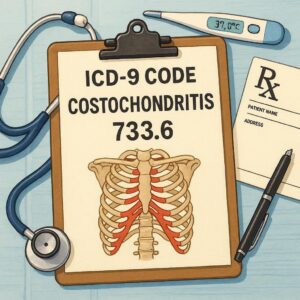
ICD-9 Code for Costochondritis
Understanding the Basics: What is Costochondritis?
Before we delve into codes, let’s establish what we’re classifying. Costochondritis is a common cause of chest pain. It involves inflammation of the cartilage that connects your ribs to your breastbone (sternum). This inflammation can cause sharp, aching, or pressure-like pain, often mistaken for heart attack pain, which is why accurate diagnosis is so vital.
Key Characteristics:
-
Location: Pain is typically localized to the front of the chest, often at the 4th, 5th, and 6th ribs.
-
Triggers: Pain can be reproduced by pressing on the affected area (palpation) or by certain movements, deep breathing, or coughing.
-
Causes: Often idiopathic (no clear cause), but can be related to physical strain, respiratory infections, or, in rare chronic cases, associated with conditions like fibromyalgia or ankylosing spondylitis.
A Key Distinction: “It’s essential to differentiate costochondritis from Tietze syndrome,” notes a common clinical guideline. “While both involve costal cartilage inflammation, Tietze syndrome includes visible swelling at the joint, whereas classic costochondritis does not.” This distinction was crucial even in ICD-9 coding.
The ICD-9 System: A Legacy of Medical Classification
The International Classification of Diseases, 9th Revision, Clinical Modification (ICD-9-CM) was the diagnostic coding standard used in the United States for decades until October 1, 2015. Its purpose was to translate medical diagnoses, symptoms, and procedures into universal alphanumeric codes. These codes were (and in some archival contexts, still are) used for:
-
Medical billing and insurance reimbursement.
-
Tracking disease epidemiology and public health statistics.
-
Storing and retrieving patient data for clinical research.
The system was hierarchical but notably less detailed than its successor.
The Specific Code: ICD-9 733.6 – Tietze’s Disease and Costochondritis
In the ICD-9-CM manual, you would find costochondritis under the following hierarchy:
-
Chapter 13: Diseases of the Musculoskeletal System and Connective Tissue (710-739)
-
Category 733: Other disorders of bone and cartilage
-
Subcategory 733.6: Tietze’s disease and costochondritis
Crucially, ICD-9 code 733.6 lumped two related but distinct conditions together:
-
Tietze’s Disease (or Syndrome): Characterized by painful swelling of the costochondral, costosternal, or sternoclavicular joints.
-
Costochondritis: Inflammation and pain without associated swelling.
This lack of specificity was one of the major driving forces behind the transition to ICD-10-CM.
ICD-9 Code 733.6 at a Glance
| Feature | Detail |
|---|---|
| Full Code | 733.6 |
| Code Type | Diagnosis Code |
| Code Title | Tietze’s disease and costochondritis |
| ICD-9 Chapter | 13: Musculoskeletal System & Connective Tissue |
| ICD-9 Category | 733: Other disorders of bone and cartilage |
| Status | Historical/Legacy. Replaced in the U.S. as of 10/1/2015. |
| Primary Use Today | Reviewing/processing medical records from before October 2015. |
The Transition to ICD-10: A New Era of Specificity
On October 1, 2015, the United States mandated the use of ICD-10-CM for all diagnosis coding. This system offers a dramatic increase in specificity, which improves patient care, public health tracking, and billing accuracy.
How Costochondritis is Coded in ICD-10-CM
In ICD-10-CM, the broad category 733.6 is replaced with more precise codes. The condition is now found in a different chapter, reflecting a more nuanced understanding.
-
Chapter: M00-M99 (Diseases of the musculoskeletal system and connective tissue)
-
Block: M90-M94 (Other osteopathies)
-
Category: M94.0 – Chondrocostal junction syndrome [Tietze]
However, ICD-10 requires greater detail through the use of a 5th or 6th character to specify the site.
Table 2: ICD-9 to ICD-10 Code Mapping for Costochondritis
| Condition | ICD-9-CM Code (Legacy) | ICD-10-CM Code (Current) | Specificity & Notes |
|---|---|---|---|
| Costochondritis (unspecified) | 733.6 | M94.0 | Requires an additional 5th character for laterality. |
| Costochondritis, right side | 733.6 | M94.01 | Chondrocostal junction syndrome, right side. |
| Costochondritis, left side | 733.6 | M94.02 | Chondrocostal junction syndrome, left side. |
| Costochondritis, bilateral | 733.6 | M94.03 | Chondrocostal junction syndrome, bilateral. |
| Costochondritis, unspecified side | 733.6 | M94.00 | Chondrocostal junction syndrome, unspecified side. |
| Tietze Syndrome (with swelling) | 733.6 | Same M94.0 series. | The ICD-10 index directs “Tietze’s disease” to M94.0. The clinical documentation of “swelling” is key. |
Why This Matters: This granularity allows for better tracking. For example, if a particular physical strain in a workplace tends to cause left-sided chest pain, it could be identified more easily with ICD-10 data.
Important Note for Patients and Coders: “When reviewing an old medical bill or record with code 733.6, remember it represents a snapshot in time using the old system. For any current diagnosis, treatment, or billing, the appropriate ICD-10-CM code (from the M94.0 series) must be used. Always rely on your healthcare provider and their certified coding staff for accurate current coding.”
Clinical Pathways: From Chest Pain to Accurate Code
Let’s walk through how a patient’s journey influences coding.
Scenario: A 32-year-old office worker presents with sharp, right-sided chest pain that increases when they take a deep breath. They are worried about their heart.
-
Differential Diagnosis: The clinician must rule out cardiac, pulmonary, gastrointestinal, and other musculoskeletal causes.
-
Physical Exam: Tenderness to palpation over the right 4th and 5th costochondral junctions. No swelling observed. Pain is reproduced with torso movement.
-
Diagnosis: Based on history and exam, a diagnosis of costochondritis is made. Cardiac workup is negative.
-
Documentation: The clinician’s note states: “Diagnosis: Acute costochondritis, right-sided.”
-
Medical Coding (Pre-2015): A coder would assign ICD-9 733.6.
-
Medical Coding (Post-2015): A coder must assign ICD-10 M94.01 (Chondrocostal junction syndrome, right side).
The specificity of the clinician’s documentation (“right-sided”) is what allows the coder to choose the most accurate and billable code in the ICD-10 system.
Documentation Tips for Healthcare Providers:
-
Always specify the location (right, left, bilateral).
-
Note the presence or absence of swelling (to distinguish from classic Tietze’s).
-
Describe the chronicity if relevant (acute, chronic, recurrent).
-
Link it to any potential cause if known (e.g., “post-traumatic,” “associated with recent upper respiratory infection”).
Common Questions and Challenges in Coding Costochondritis
Can 733.6 Still Be Used?
No, for any encounter on or after October 1, 2015, using ICD-9-CM for billing is non-compliant with U.S. regulations and will result in claim denials. Its use is strictly for historical record analysis.
What About Chest Pain Codes?
A patient’s primary symptom is often chest pain (ICD-10 code R07.9). However, once a definitive diagnosis of costochondritis is established, the symptom code (R07.9) should not be used as the primary diagnosis for billing. The definitive diagnosis (M94.0x) takes precedence. The chest pain code might be used as a secondary code if the pain is a significant part of the clinical picture.
The Role of Modifiers and Associated Codes
While the diagnosis code is primary, procedure codes (CPT codes) are also used for billing. For example:
-
Evaluation & Management (E/M) Codes: For the office visit (e.g., 99213 for an established patient).
-
Injection Codes: If a steroid injection is administered (e.g., CPT 20551 for injection of a single tendon/ligament origin/insertion).
Helpful List: Key Differences Between ICD-9 and ICD-10 for This Condition
-
Specificity: ICD-9: One code for two conditions. ICD-10: Multiple codes specifying laterality.
-
Chapter Location: ICD-9: Chapter 13, under “other bone disorders.” ICD-10: Chapter M, under “chondropathies.”
-
Alphanumeric: ICD-9 codes are numeric (3-5 digits). ICD-10 codes are alphanumeric (always starting with a letter, 3-7 characters long).
-
Clinical Detail: ICD-10 forces documentation of details that are clinically valuable for patient care.
Why Accurate Coding Matters Beyond the Billing Department
It’s easy to see coding as a bureaucratic necessity, but its impact is far-reaching.
-
Patient Care: Accurate coding creates a precise medical history. If you have recurrent costochondritis, future providers can quickly see the pattern and location from your coded history.
-
Public Health: Researchers use aggregated, anonymized coding data to spot trends. Are cases of costochondritis rising in a certain region or demographic? Specific codes make this research possible.
-
Treatment Outcomes: Hospitals and clinics analyze coded data to understand the effectiveness of different treatments for specific conditions.
-
Healthcare Economics: Accurate coding ensures fair reimbursement for providers, which supports the sustainability of medical practices and hospitals.
Navigating Old Records and Understanding Your Medical History
As a patient, you might find “733.6” on an old explanation of benefits (EOB) or medical record. Here’s what to do:
-
Don’t be alarmed. It simply means you were diagnosed with costochondritis or Tietze syndrome at that time.
-
For current issues, ensure your provider is using the modern ICD-10 system.
-
Keep a personal health record. Note the diagnosis, date, and which side was affected. This is valuable information for any future clinician.
A Note on Self-Diagnosis and Coding
Patients often research codes online. While this guide aims to educate, it is not a substitute for professional medical advice or coding. The assigned code must come from a qualified healthcare professional based on a clinical encounter. Using a code for self-diagnosis or to try to obtain services can be fraudulent.
The Future: Looking Toward ICD-11
The World Health Organization (WHO) has already released ICD-11, which is slowly being adopted globally. The U.S. has not yet set a timeline for transitioning to ICD-11-CM, but it’s on the horizon. ICD-11 offers even more structural and digital-friendly advancements. While the specific codes will change again, the principles of specificity, accurate documentation, and clinical utility will only become more important.
Conclusion
The search for the “ICD-9 code for costochondritis” opens a window into the critical, behind-the-scenes world of medical classification. Code 733.6 served its purpose for an era, but the transition to the specific ICD-10 codes (the M94.0 series) marks a significant advancement in healthcare data. Understanding this evolution underscores the profound connection between precise clinical documentation, accurate coding, and high-quality patient care. Whether you’re in healthcare, studying, or managing your own health, this knowledge empowers you to navigate the system more effectively.
Frequently Asked Questions (FAQ)
Q1: I saw 733.6 on a recent bill. Is that an error?
A: If the date of service on the bill is on or after October 1, 2015, then yes, it is a coding error. The provider should have used an ICD-10-CM code (M94.0x). You may want to contact the billing office for clarification.
Q2: What is the exact ICD-10 code for costochondritis on the left side?
A: The precise code is M94.02 – Chondrocostal junction syndrome [Tietze], left side.
Q3: Are there different codes for acute vs. chronic costochondritis?
A: In the standard ICD-10-CM code set for costochondritis (M94.0), there is not a specific digit to denote acute vs. chronic. This information is conveyed through the clinician’s documentation and may be reflected in other parts of the medical record or billing claim.
Q4: As a medical coder, what is the most important thing in the note to code this correctly?
A: Laterality. The single most crucial piece of information is whether the condition is documented as right, left, bilateral, or unspecified. This directly determines the 5th character of the ICD-10 code.
Q5: Can costochondritis be coded with a trauma code?
A: If the costochondritis is a direct result of a documented injury (e.g., a blow to the chest), you would primarily code the injury (from Chapter 19, Injury and Poisoning) and may use the costochondritis code as a secondary diagnosis to provide further detail about the nature of the condition.
Additional Resources
-
The Centers for Medicare & Medicaid Services (CMS) ICD-10 Website: Provides official code sets, guidelines, and transition resources.
-
The American Health Information Management Association (AHIMA): A professional organization for medical coders with educational resources.
-
The National Center for Health Statistics (NCHS) ICD-10-CM Browser: A free, official tool to look up current ICD-10-CM codes.
-
Your Primary Care Physician: Always your best resource for personal medical diagnosis and treatment questions.
Disclaimer: This article is for informational and educational purposes only. It does not constitute medical advice, coding advice, or legal guidance. Medical coding is complex and regulated. Always consult with a qualified healthcare professional for medical diagnoses and with certified medical coders or billing specialists for accurate coding. The information reflects standards as of the publication date.
Author: The WebMD Writing Team
Date: January 01, 2026