If you’re reading this, you likely have a document, a billing statement, or a piece of medical history that references an ICD-9 code for back pain. While the medical world has moved on to a newer system, understanding these codes remains crucial for dealing with older records, understanding past diagnoses, or completing certain administrative tasks.
This guide will serve as your definitive reference. We’ll demystify the ICD-9 system, break down the most common codes related to back pain, and place them in their proper modern context. Our goal is to equip you with clear, reliable knowledge, helping you navigate the often-confusing intersection of healthcare and medical coding with confidence.
Let’s start with a fundamental truth: ICD-9-CM (International Classification of Diseases, 9th Revision, Clinical Modification) is no longer in active use for diagnosis coding in the United States. As of October 1, 2015, it was replaced by ICD-10-CM. However, millions of records still exist in this format, and you may need to reference them for various reasons, from insurance appeals to personal research.
ICD-9 Code for Back Pain
What Was the ICD-9 Coding System?
Before diving into specific codes, it’s helpful to understand what ICD-9 was. Think of it as a massive, standardized dictionary of medical conditions. Every disease, symptom, injury, and reason for a doctor’s visit was assigned a unique numeric code. This system served three primary purposes:
-
Standardization: It created a common language for doctors, hospitals, and insurers worldwide.
-
Billing and Reimbursement: Insurance companies use(d) these codes to determine what they will pay for.
-
Tracking and Research: Public health organizations use(d) aggregated code data to track disease outbreaks, mortality rates, and treatment trends.
The codes are structured hierarchically. For back pain and related disorders, most codes fall under Chapter 13: “Diseases of the Musculoskeletal System and Connective Tissue” (codes 710-739) or Chapter 17: “Injury and Poisoning” (codes 800-999).
The Most Common ICD-9 Code for Back Pain
While there are dozens of specific codes, one stands out as the most frequently used, generic code for back pain:
ICD-9 Code 724.2: Lumbago
This is the code you will most commonly encounter. “Lumbago” is simply a clinical term for pain in the lumbar, or lower, region of the back. It is a non-specific diagnosis, meaning it indicates the presence of pain without specifying an exact cause like a herniated disc or arthritis.
Key Insight: “Code 724.2 was the catch-all for lower back pain when a more precise diagnosis wasn’t confirmed or documented. Its use underscores the importance of specific medical documentation for accurate coding.”
Other Essential ICD-9 Codes for Back and Spine Conditions
Back pain is a symptom, not a disease. Therefore, the ICD-9 system contained codes for the myriad underlying conditions that cause back pain. Here is a breakdown of the most relevant categories and codes.
Dorsopathies (Disorders of the Spine: Codes 720-724)
This category covers a wide range of spinal issues.
| ICD-9 Code | Description | What It Means |
|---|---|---|
| 724.2 | Lumbago | Low back pain (the most common generic code). |
| 724.1 | Pain in thoracic spine | Pain in the upper and mid-back. |
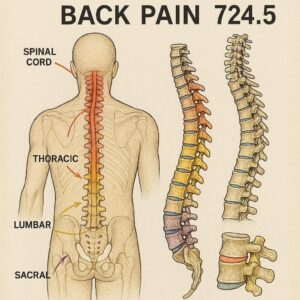
| 724.5 | Backache, unspecified | Pain anywhere in the back, not specified as thoracic or lumbar. |
| 722.10 | Displacement of lumbar intervertebral disc without myelopathy | A herniated, slipped, or bulging disc in the low back. |
| 722.52 | Degeneration of lumbar or lumbosacral intervertebral disc | Wear-and-tear (arthritis) of the disc itself. |
| 721.3 | Lumbosacral spondylosis without myelopathy | Osteoarthritis of the joints in the lower spine. |
| 724.3 | Sciatica | Pain radiating down the leg due to irritation of the sciatic nerve. |
| 724.4 | Thoracic or lumbosacral neuritis or radiculitis, unspecified | Inflammation of a spinal nerve root. |
| 723.1 | Cervicalgia | Pain in the neck. |
Sprains and Strains of the Back (Code 847)
This category is crucial for back pain resulting from acute injury.
| ICD-9 Code | Description | What It Means |
|---|---|---|
| 847.2 | Sprain of lumbar spine | A stretched or torn ligament in the low back. |
| 847.1 | Sprain of thoracic spine | A stretched or torn ligament in the mid-back. |
| 847.0 | Sprain of neck | Whiplash or other neck ligament injury. |
| 846.0 | Sprain of sacroiliac ligament | Injury to the ligament connecting the spine to the pelvis. |
Other Common Related Codes
-
729.1: Myalgia and myositis, unspecified – Used for general muscle pain, which can include paraspinal muscles.
-
724.6: Disorders of sacrum – For pain originating from the sacral bone.
-
738.4: Acquired spondylolisthesis – A condition where one vertebra slips forward over the one below it.
-
737.xx: Curvature of spine – Including codes for kyphosis (737.1) and lordosis (737.2).
The Transition from ICD-9 to ICD-10: Why It Matters
The shift from ICD-9 to ICD-10-CM wasn’t just an update; it was a revolution in medical coding. ICD-9 had become outdated, with limited space for new codes and a lack of detail. ICD-10-CM is vastly more specific.
A Simple Comparison:
-
ICD-9 for Lumbago: One code: 724.2.
-
ICD-10 for Low Back Pain: Multiple codes, such as:
-
M54.5: Low back pain
-
M54.50: Low back pain, unspecified
-
M54.51: Vertebrogenic low back pain
-
M54.59: Other low back pain
-
This specificity allows for better tracking of conditions, more accurate billing, and improved patient care data. If you are dealing with a current medical issue, your records will use ICD-10 codes.
Crosswalk: From Common ICD-9 to ICD-10 Codes
Here’s a quick reference for how some common ICD-9 back pain codes translate into the modern ICD-10 system.
| ICD-9 Code | ICD-9 Description | Primary ICD-10-CM Equivalent |
|---|---|---|
| 724.2 | Lumbago | M54.5 (Low back pain) |
| 724.5 | Backache, unspecified | M54.9 (Dorsalgia, unspecified) |
| 847.2 | Lumbosacral sprain | S33.5XXA (Sprain of ligaments of lumbar spine, initial encounter) |
| 722.10 | Lumbar disc displacement | M51.26 (Other intervertebral disc displacement, lumbar region) |
| 724.3 | Sciatica | M54.3 (Sciatica) |
| 723.1 | Cervicalgia | M54.2 (Cervicalgia) |
Practical Guide: How to Find and Use the Correct Code
You are not expected to be a medical coder. However, knowing how to approach these codes can be empowering.
-
Start with the Official Diagnosis: The code stems from your doctor’s diagnosis. Look at your medical record or bill for phrases like “lumbar strain,” “herniated disc,” or “degenerative disc disease.”
-
Context is Key: Was the pain from an injury (look to 847.x codes) or a chronic condition (look to 720-724 codes)?
-
Use a Reliable Lookup Tool: For historical reference, you can use online ICD-9 code lookups (many medical billing websites maintain archives). For current needs, always use an ICD-10 lookup.
-
When in Doubt, Ask: Contact your doctor’s billing office or your insurance company’s member services. Provide them with your diagnosis, and they can tell you the appropriate code.
Important Note for Readers: The information in this article is for educational and historical reference purposes only. It does not constitute medical or billing advice. Always rely on your healthcare provider and their certified coding staff for an accurate, current diagnosis code for any medical condition or billing submission. Using an incorrect code can lead to claim denials or delays.
The Human Impact: Beyond the Numbers
It’s easy to get lost in the alphanumeric soup of medical coding. But behind every code is a person seeking relief. Code 724.2 (Lumbago) could represent a construction worker unable to lift, a parent struggling to pick up their child, or an office worker in constant discomfort. The shift to more specific codes in ICD-10, in theory, helps tell a more complete story of that person’s condition, leading to better-informed treatment pathways and research focus.
Accurate coding ensures that:
-
Your insurance claim is processed correctly.
-
Your medical history is accurately recorded.
-
Public health data reflects the true prevalence of back disorders.
Conclusion
Navigating the world of medical codes, especially historical ones like the ICD-9 code for back pain, can be complex. The most common code you’ll encounter is 724.2 for Lumbago, but numerous other codes specify causes like disc disorders or sprains. While ICD-9 is now a legacy system, understanding it helps decipher old records and appreciate the greater detail of today’s ICD-10 system. Your best course of action is to pair this knowledge with direct communication with your healthcare providers for all current medical and billing needs.
Frequently Asked Questions (FAQ)
Q1: I just received a bill with ICD-9 code 724.2. Is this a mistake since ICD-10 is now used?
Not necessarily. If the date of service on the bill is before October 1, 2015, the use of ICD-9 is correct and expected for that historical claim. If the date of service is after that, it could be an error, and you should contact the billing department.
Q2: What is the difference between ICD-9 code 724.2 (Lumbago) and 724.5 (Backache, unspecified)?
Code 724.2 specifically refers to pain in the lumbar (lower) region. Code 724.5 is more vague, used for back pain that is not documented as being in the neck (cervical) or lower back. 724.2 is significantly more common.
Q3: Can I use an old ICD-9 code on a new insurance claim or medical form?
No. For any current medical billing or documentation (for services after October 1, 2015), you must use ICD-10-CM codes. Using an ICD-9 code will likely result in a rejection or a request for corrected information.
Q4: My doctor’s note says “lumbar strain.” What ICD-9 code would that have been?
That would most likely have been coded as 847.2: Sprain of lumbar spine. The terms “strain” (muscle/tendon) and “sprain” (ligament) were often used interchangeably in ICD-9 for the back.
Q5: Where can I find an official, complete list of old ICD-9 codes?
The U.S. Centers for Medicare & Medicaid Services (CMS) maintains an archive. You can search for “CMS ICD-9-CM code tables” to find official PDF listings.
Additional Resource
For the most up-to-date coding information and to look up current ICD-10-CM codes, we recommend visiting the Centers for Disease Control and Prevention (CDC) ICD-10-CM Browser tool. This is the definitive, free source for navigating the modern coding system: CDC ICD-10-CM Browser.
Disclaimer: This article is intended for informational purposes only. The author and publisher are not healthcare providers, medical coders, or billing specialists. The content herein is based on historical coding guidelines and should not be used to self-diagnose, determine treatment, or submit insurance claims. Always consult with a qualified healthcare professional for any medical concerns and rely on certified coding professionals for accurate medical billing. While every effort has been made to ensure accuracy, coding guidelines can be complex and are subject to interpretation; therefore, no guarantee of completeness or precision is made.
Date: January 03, 2025
Author: The Editorial Team at SpineHealthGuide.com