For patients, healthcare providers, and medical coders, navigating the world of diagnostic codes can feel like learning a foreign language. If you’re looking for historical information, old records, or simply trying to understand a past medical bill, you might have encountered the term “ICD-9 code for acne.” While this coding system is no longer in active use, its legacy remains in millions of medical records.
This article serves as your definitive, human-written guide. We’ll demystify the specific ICD-9 codes for acne, explore their context, and seamlessly bridge the gap to the modern coding system used today. Our goal is to provide you with reliable, clear, and thoroughly researched information, transforming a seemingly dry topic into valuable knowledge for your health or administrative needs.
ICD-9 Codes for Acne
Understanding the ICD Coding System: A Brief History
Before we dive into the specific numbers, it’s crucial to understand what the ICD is and why it matters. The International Classification of Diseases (ICD) is the global standard for diagnostic health information. Managed by the World Health Organization (WHO), it provides a common language that allows healthcare professionals to share and compare data across hospitals, regions, and countries.
Think of it as a universal medical dictionary for diagnoses. Every disease, disorder, injury, and symptom has a unique alphanumeric code. This standardization is not just bureaucratic; it’s foundational to modern healthcare for:
-
Billing and Insurance: Codes justify medical necessity for insurance claims.
-
Epidemiology and Research: Tracking the incidence and prevalence of diseases (e.g., acne outbreaks, treatment trends).
-
Treatment Planning: Categorizing patient conditions for consistent care management.
-
Public Health Policy: Informing resource allocation and health initiatives.
The 9th Revision, Clinical Modification (ICD-9-CM) was used in the United States from 1979 until October 1, 2015. On that date, the U.S. healthcare system underwent a massive transition to ICD-10-CM, a much more detailed and specific system. Therefore, ICD-9 is now considered a legacy system. You will encounter it primarily in historical patient records or when dealing with older documentation.
Why Knowing the Correct Code Matters
Using an incorrect or vague code can have real-world consequences. A coder at a large dermatology clinic explains:
“Accuracy is everything. Submitting a claim with an unspecific acne code when a more precise one applies can lead to claim denials, delayed payments, and muddy clinical data. It’s about capturing the true picture of the patient’s condition for everyone involved—from the insurer to the researcher.”
The Specific ICD-9 Codes for Acne
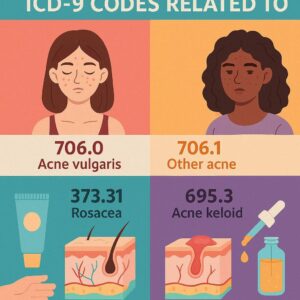
Within the ICD-9-CM system, acne vulgaris and related conditions were categorized under Chapter XII: Diseases of the Skin and Subcutaneous Tissue. The codes were notably broad compared to today’s standards.
The primary codes for acne were:
-
706.0 – Acne varioliformis: This referred to a specific, less common form known as acne necrotica varioliformis, which involves destructive lesions that can leave pock-like scars.
-
706.1 – Other acne: This was the catch-all code for the vast majority of acne cases, including common acne vulgaris (comedones, papules, pustules), cystic acne, and acne conglobata.
This lack of granularity was a key driver for the update to ICD-10. Under ICD-9, a teenager with mild comedonal acne and an adult with severe, scarring cystic acne would often receive the same generic code: 706.1.
Detailed Breakdown of Code 706.1
Since 706.1 was the workhorse code for acne, let’s explore what it encompassed:
-
Acne vulgaris: The most common form.
-
Cystic acne: Characterized by deep, painful, inflamed nodules and cysts.
-
Acne conglobata: A severe form with interconnected nodules and abscesses.
-
Acne pustulosa: Where pustules are the dominant lesion.
-
Acne comedonica: Where open and closed comedones (blackheads and whiteheads) are primary.
Important Note for Readers: If you are reviewing a medical record or bill dated before October 2015 and see “706.1,” it does not specify the type or severity of acne. You would need to consult the physician’s notes for clinical details.
The Modern Transition: From ICD-9 to ICD-10 for Acne
The transition to ICD-10-CM brought a revolution in specificity. The single code 706.1 was replaced by a family of codes that paint a detailed clinical picture. This shift helps clinicians and researchers track outcomes for different acne types more effectively.
Comparative Table: ICD-9 vs. ICD-10 for Acne
| Feature | ICD-9-CM (Legacy System) | ICD-10-CM (Current System) |
|---|---|---|
| Primary Code(s) | 706.0 (Acne varioliformis), 706.1 (Other acne) | L70.x series (Acne) |
| Level of Detail | Low. Very broad categories. | High. Requires specification of type. |
| Example Specificity | 706.1 covered everything from blackheads to severe cysts. | Separate codes for acne vulgaris (L70.0), acne conglobata (L70.1), etc. |
| Laterality | Not specified. | Must be specified (right, left, bilateral). |
| Key Limitation | Could not differentiate severity or morphology well. | Requires more clinical information from the provider. |
The ICD-10-CM Codes for Acne
Here is the current coding structure for acne, demonstrating the increased detail:
-
L70.0 Acne vulgaris
-
L70.1 Acne conglobata
-
L70.2 Acne varioliformis and acne necrotica
-
L70.3 Acne tropica
-
L70.4 Infantile acne
-
L70.5 Acné excooriée (Acne caused by picking or scratching)
-
L70.8 Other acne
-
L70.9 Acne, unspecified
Furthermore, ICD-10 requires an additional 6th character to indicate laterality:
-
.0 Unspecified
-
.1 Right side
-
.2 Left side
-
.3 Bilateral
Example: A diagnosis of severe cystic acne (vulgaris) affecting both sides of the face would be coded as L70.0.3 (Acne vulgaris, bilateral).
Practical Applications: When and Why You Might Need This Information
You might wonder why a patient would need to know this. Here are common, realistic scenarios:
-
Deciphering Old Medical Records or Bills: Understanding a diagnosis or service from before 2015.
-
Personal Health Tracking: Organizing your own medical history accurately.
-
Assisting with Administrative Tasks: Helping a family member reconcile old insurance claims.
-
Academic or Historical Research: Studying trends in dermatological conditions over time.
-
Coding and Billing Education: For students entering medical administration, understanding the evolution of coding is key.
A Step-by-Step Guide for Patients Reviewing Old Documents
If you find an ICD-9 code on an old document:
-
Identify the Code: Look for a 3-5 digit number, often starting with 706.
-
Confirm it’s ICD-9: Check the date of service. If it’s before October 1, 2015, it’s almost certainly ICD-9.
-
Interpret Broadly: Remember that 706.1 is a general “acne” code. For specifics, the provider’s written notes are the true source of detail.
-
For Current Context: If needed for ongoing care, ask your current provider to help translate the old diagnosis into a modern clinical understanding.
The Importance of Specificity in Dermatological Coding
The jump from ICD-9 to ICD-10 wasn’t just about more codes; it was about better medicine. Specific coding allows for:
-
Improved Treatment Pathways: Distinguishing between acne vulgaris and acne conglobata, which have different treatment protocols, is critical.
-
Accurate Reimbursement: Treatments for severe, scarring acne (like isotretinoin or extensive procedures) often require more specific codes to justify cost.
-
Enhanced Research: Researchers can now study subtypes of acne with precision, leading to better insights and targeted therapies.
A dermatologist we spoke to emphasized this point: “When I diagnose ‘acne’ now, I have to think like a coder too. Is it predominantly inflammatory? Is it cystic? Is the patient excoriating their lesions? That detail, captured in the ICD-10 code, creates a more accurate and useful medical record.”
Common Questions and Misconceptions About Acne Coding
Let’s clarify some frequent points of confusion.
Q: Is there a separate ICD-9 code for cystic acne?
A: No. In ICD-9, cystic acne fell under the generic code 706.1 (Other acne). Specificity for cystic lesions is only available in ICD-10.
Q: Can I use ICD-9 codes for current medical billing?
A: Absolutely not. Since October 1, 2015, all HIPAA-covered entities (like doctors’ offices and hospitals) in the U.S. are legally required to use ICD-10-CM for diagnosis coding. Using ICD-9 would result in rejected claims.
Q: What about acne scars? Is there a different code?
A: Yes. Acne scars are considered a sequela (a condition resulting from a prior disease). In ICD-9, scars were coded under 709.2 (Scar condition and fibrosis of skin). In ICD-10, there is a specific code: L90.5 (Scar conditions and fibrosis of skin), and coders must also use a separate code to show it’s a sequela of acne.
Beyond the Code: A Holistic View of Acne Diagnosis
While codes are essential for administration, the human element of diagnosis remains paramount. A diagnosis of acne involves:
-
Patient History: Age of onset, family history, medication use, lifestyle factors.
-
Physical Examination: Type of lesions (comedonal, inflammatory, cystic), severity (mild, moderate, severe), location, and presence of scarring.
-
Impact Assessment: Evaluating psychological and social effects on the patient.
The code is a snapshot, but the clinical notes tell the full story. This is why moving to a more descriptive system like ICD-10 benefits overall patient care.
Helpful List: What to Discuss with Your Dermatologist Beyond the Code
When being treated for acne, ensure your doctor understands:
-
The primary type of lesions you have (blackheads/whiteheads, red bumps, pus-filled bumps, deep cysts).
-
The severity and how it affects your daily life.
-
Any scarring that has occurred.
-
Previous treatments and their outcomes.
-
Your personal treatment goals (e.g., clearance, scar prevention).
This conversation ensures your medical record—and its corresponding diagnostic code—is as accurate and helpful as possible for your long-term care.
Conclusion
Navigating the world of medical codes, from the legacy ICD-9 code 706.1 for acne to the detailed ICD-10 L70 series, is key to understanding medical records and the healthcare system’s evolution. This knowledge empowers patients to manage their health history and highlights the critical importance of diagnostic specificity in driving effective treatment, accurate billing, and meaningful medical research.
FAQ
Q: I have an old bill with code 706.1. What exactly did I have?
A: Code 706.1 simply means you were diagnosed with a form of acne. It could have been mild, moderate, or severe. The specific clinical details (like “cystic” or “pustular”) would only be found in your doctor’s original notes from that visit.
Q: What is the most common ICD-10 code for regular acne?
A: The most common code is L70.0 (Acne vulgaris), typically with a laterality character appended (e.g., L70.0.3 for acne on both sides of the face).
Q: Why did the coding system change from ICD-9 to ICD-10?
A: ICD-9 was outdated and lacked the detail needed for modern medicine. ICD-10 provides greater specificity, which improves disease tracking, treatment appropriateness, billing accuracy, and public health data.
Q: As a patient, do I need to memorize these codes?
A: No. Your healthcare provider and their administrative staff are responsible for accurate coding. However, understanding the basics can help you be a more informed participant in your care, especially when reviewing explanations of benefits (EOBs) from your insurance company.
Additional Resources
For those seeking more official information, we recommend these authoritative sources:
-
Centers for Disease Control and Prevention (CDC) ICD-10 Page: Provides official guidelines and tools for ICD-10-CM.
-
World Health Organization (WHO) ICD Page: The international home for the ICD classification system.
-
American Academy of Dermatology (AAD) – Acne Resource Center: For clinical information on acne types, treatments, and management from leading dermatologists.
Disclaimer: This article is for informational and educational purposes only. It is not a substitute for professional medical coding advice or clinical diagnosis. Always consult with a qualified healthcare provider for medical concerns and with a certified medical coder for coding-specific questions. Medical coding guidelines are subject to change.
Date: January 05, 2026
Author: The Editorial Team at DermatologyCodePro.com