If you’re navigating older medical records, insurance forms, or simply curious about how healthcare systems classify common ailments, you might have come across the term “ICD-9 code for sore throat.” While the ICD-9 system is a legacy classification, understanding it remains crucial for historical data analysis, certain billing processes, and grasping the evolution of medical documentation.
This guide will provide a thorough, original exploration of ICD-9 code 462 for acute pharyngitis (the technical term for sore throat). We’ll delve into what the code meant, how it was used, and most importantly, how it translates to the modern ICD-10 system. Our goal is to give you a reliable, clear, and comprehensive reference that demystifies this specific piece of medical coding.
ICD-9 Code for Sore Throat
What is the ICD-9 Coding System?
Before we get to the specific code, let’s establish what ICD-9 was. The International Classification of Diseases, 9th Revision (ICD-9) was a system used worldwide to code diagnoses, symptoms, and procedures. For nearly four decades, it served as the universal language for doctors, hospitals, and insurance companies.
“The ICD system is the foundation for the identification of health trends and statistics globally, and is the international standard for reporting diseases and health conditions.” – World Health Organization (WHO)
Think of it as a massive, detailed dictionary where every possible health issue has a corresponding numeric code. This standardization allowed for consistent record-keeping, streamlined billing, and the collection of vital public health statistics. The ICD-9-CM (Clinical Modification) was the version used in the United States for diagnostic coding until October 1, 2015.
Why Is Understanding Legacy Codes Still Important?
You might wonder why we’re discussing a retired system. The transition to ICD-10 didn’t erase history. Millions of patient records, archival studies, and historical health data are still cataloged under ICD-9 codes. Professionals in medical research, health informatics, and medical billing auditing often need to understand these codes to interpret past data accurately. Furthermore, some disability or insurance claims related to past treatments still reference these older codes.
The Specific ICD-9 Code for Sore Throat
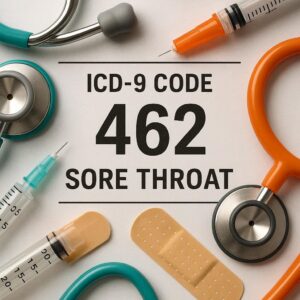
In the ICD-9-CM system, the most general and commonly used code for a common sore throat was 462.
-
ICD-9-CM Code: 462
-
Description: Acute pharyngitis
-
Code Type: Diagnosis Code
“Pharyngitis” is the medical term for inflammation of the pharynx—the part of the throat behind the mouth and nasal cavity. The designation “acute” means it is a sudden onset condition, typically lasting a short period, as opposed to a chronic, long-term issue.
What Conditions Did ICD-9 Code 462 Cover?
Code 462 was a broad category used for a sore throat caused by common viral infections. When a physician diagnosed a patient with a non-specific viral sore throat, this was the default code. It generally encompassed symptoms like:
-
Pain or scratchiness in the throat
-
Pain that worsens with swallowing
-
Red and swollen-looking throat upon examination
-
Possibly accompanied by mild fever or fatigue
A Critical Distinction: Sore Throat vs. Strep Throat in ICD-9
This is where medical coding becomes precise. A sore throat caused by the common cold virus is different from one caused by the Streptococcus bacteria (strep throat). ICD-9 had separate codes for these distinct etiologies.
Code 462 (acute pharyngitis) was primarily for viral causes. In contrast, strep throat, a bacterial condition, had its own specific code.
-
ICD-9-CM Code for Strep Throat: 034.0
-
Description: Streptococcal sore throat
This distinction was critical for treatment and billing. Strep throat requires antibiotics, while viral pharyngitis does not. Coding accuracy directly impacted treatment tracking, public health monitoring of streptococcal infections, and appropriate reimbursement for more complex bacterial testing and treatment.
Important Note for Readers: This distinction underscores a key principle in medical coding: specificity. Even in the older ICD-9 system, coders were required to use the most precise code available based on the physician’s documentation. Never assume a single code covers all variations of a symptom.
Comparative Table: ICD-9 Codes for Throat Conditions
The table below illustrates how ICD-9 differentiated between various throat-related diagnoses. This specificity, while expanded greatly in ICD-10, was already a fundamental part of the system.
| ICD-9 Code | Description | Common Cause | Key Characteristics |
|---|---|---|---|
| 462 | Acute pharyngitis | Viral (e.g., rhinovirus, adenovirus) | General sore throat, often with cold symptoms. |
| 034.0 | Streptococcal sore throat | Bacterial (Streptococcus pyogenes) | Severe pain, fever, possible white patches on tonsils. |
| 463 | Acute tonsillitis | Viral or Bacterial | Inflammation specifically of the tonsils, often swollen. |
| 464.0 | Acute laryngitis | Viral, overuse, irritation | Inflammation of the voice box (larynx), leads to hoarseness. |
| 487.1 | Influenza with respiratory manifestations | Influenza virus | Sore throat is one of many symptoms including high fever, body aches, and cough. |
The Transition from ICD-9 to ICD-10: A New Era of Specificity
On October 1, 2015, the United States healthcare system mandated a transition from ICD-9-CM to ICD-10-CM. This wasn’t just an update; it was a massive expansion in detail and precision.
Why the Change?
ICD-9 had run out of space for new codes and lacked the detail needed for modern medicine, value-based care, and precise public health tracking. ICD-10 provides a much larger code set, allowing for greater specificity regarding the cause, location, and severity of a condition.
Mapping ICD-9 462 to ICD-10 Codes
There is no single, direct one-to-one translation for ICD-9 code 462 in ICD-10. Instead, it maps to a range of more specific codes. This reflects the modern requirement for detailed documentation. The general equivalent falls under category J02, but the exact code depends on the documented cause.
Primary ICD-10 Codes for Acute Pharyngitis:
-
J02.9: Acute pharyngitis, unspecified (This is the closest general equivalent to ICD-9 462).
-
J02.0: Streptococcal pharyngitis (replacing ICD-9 034.0).
-
J02.8: Acute pharyngitis due to other specified organisms (used when a specific pathogen other than strep is identified).
This increase in specificity is dramatic. For example, laterality (which side of the body is affected) and exact etiology now play a role in code selection in related categories.
Detailed Comparison Table: ICD-9 vs. ICD-10 for Sore Throat
| Aspect | ICD-9-CM | ICD-10-CM | Impact of Change |
|---|---|---|---|
| General Sore Throat Code | 462 (Acute pharyngitis) | J02.9 (Acute pharyngitis, unspecified) | Code structure changed from numeric to alphanumeric. |
| Specificity for Cause | Limited; separate code only for strep (034.0). | Highly specific. Codes exist for streptococcal (J02.0), viral, and other specified causes. | Improves tracking of disease outbreaks and treatment outcomes. |
| Number of Codes | 1 primary code for generic viral pharyngitis. | Dozens of potential codes depending on cause, chronicity, and complications. | Enables more precise billing and richer data for research. |
| Example of Detail | Code 463 for “Acute tonsillitis.” | ICD-10 has separate codes for acute tonsillitis, recurrent tonsillitis, and chronic tonsillitis. | Allows for better management of patients with recurrent conditions. |
The Practical Importance of Accurate Sore Throat Coding
Why does this level of detail matter? Accurate coding transcends simple administration; it has real-world implications.
-
Patient Care: Correct coding ensures a patient’s medical history is accurately recorded. If a patient has recurrent sore throats, a detailed history using specific codes can help a new doctor identify patterns and recommend appropriate specialist care (e.g., an ENT).
-
Billing and Reimbursement: Insurance companies use diagnosis codes to determine if a claimed service (like a throat culture or a doctor’s visit) was medically necessary. An unspecified code may lead to delays or denials.
-
Public Health Surveillance: Accurate coding is how health authorities track epidemics. A spike in codes for streptococcal pharyngitis in a region can alert public health officials to a potential outbreak.
-
Medical Research: Researchers rely on aggregated, coded data to study disease patterns, treatment effectiveness, and health outcomes across populations. Specific codes yield more reliable research.
How a Sore Throat Diagnosis Gets Coded: A Step-by-Step Look
Let’s walk through the journey of a code from the doctor’s office to a patient’s record.
-
Patient Presentation: You visit your doctor with a sore throat.
-
Clinical Examination: The doctor examines your throat, checks for fever, and may feel your neck for swollen lymph nodes.
-
Diagnostic Decision: Based on the exam:
-
If it appears viral, they diagnose “acute viral pharyngitis.”
-
If strep is suspected, they may perform a rapid strep test or culture. If positive, the diagnosis is “acute streptococcal pharyngitis.”
-
-
Documentation: The physician documents the exact diagnosis in your chart/medical record.
-
Coding: A medical coder (or coding software) reviews the documentation and assigns the corresponding ICD-10 code (e.g., J02.9 or J02.0).
-
Application: This code is then used for billing your insurance and is added to your permanent health record for future reference.
Common Misconceptions and Pitfalls in Throat-Related Coding
-
Misconception 1: “Sore throat” and “strep throat” are the same code. As we’ve seen, they have always been distinct.
-
Misconception 2: Tonsillitis and pharyngitis are interchangeable. They refer to inflammation in different, albeit adjacent, structures (tonsils vs. pharynx). They have separate codes.
-
Pitfall: Under-documentation. If a physician simply documents “sore throat,” the coder is forced to use an “unspecified” code (J02.9), which is less ideal for data quality and can sometimes affect reimbursement.
-
Pitfall: Assuming chronicity. A recurrent or persistent sore throat may be coded as “chronic pharyngitis” (J31.2), which is different from “acute pharyngitis.”
Conclusion
The legacy ICD-9 code for a common sore throat was 462, representing acute pharyngitis. Its detailed counterpart for strep throat was 034.0. While the ICD-9 system has been replaced by the far more granular ICD-10, understanding these codes is key to interpreting decades of medical data. The evolution from a single code to a detailed classification system highlights the healthcare industry’s drive toward precision, which ultimately enhances patient care, refines public health strategies, and supports the complex ecosystem of medical administration. Always remember that behind every code is a clinical story, and accuracy in coding ensures that story is told correctly.
Frequently Asked Questions (FAQ)
Q: Can doctors still use ICD-9 codes today?
A: No. For all outpatient and inpatient services provided on or after October 1, 2015, the use of ICD-10-CM codes is mandatory for diagnosis coding in the United States. ICD-9 is only relevant for historical records or claims related to dates of service prior to that.
Q: I have an old medical bill with code 462. What should I do?
A: This is normal for services rendered before October 2015. If you are researching or disputing an old bill, understanding that 462 means “acute pharyngitis” or sore throat can be helpful. The code itself is likely correct for the time period.
Q: What is the most common ICD-10 code for a sore throat now?
A: The most common general code is J02.9 – Acute pharyngitis, unspecified. However, a more specific code like J02.0 – Streptococcal pharyngitis should be used if a strep test is positive.
Q: Why are there so many more ICD-10 codes than ICD-9 codes?
A: ICD-10 was designed to capture much more clinical detail, including laterality, cause, severity, and encounter type (initial vs. subsequent). This provides better data for care management and public health.
Q: Where can I find the official, current list of ICD-10 codes?
A: The U.S. Centers for Medicare & Medicaid Services (CMS) and the Centers for Disease Control and Prevention (CDC) maintain the official ICD-10-CM files. You can access them via the CDC’s website: CDC ICD-10-CM Browser.
Disclaimer: This article is for informational and educational purposes only. It is not intended as medical advice or as a substitute for professional medical coding guidance. Medical coding is a complex field that requires certified expertise. Always rely on qualified medical coders and current, official coding manuals and software for any clinical, billing, or administrative purposes. The information reflects guidelines as of the date of publication, January 06, 2026.