Navigating the world of medical coding can feel like learning a new language. If you’re reviewing older medical records, dealing with historical data, or simply trying to understand a past diagnosis, you might encounter the ICD-9 system. A common search is for the ICD-9 code for allergic reaction. This article serves as your definitive, original guide to that very topic.
We’ll explore the specific codes, break down their meanings, and place them in the context of modern healthcare. While the ICD-9 system is no longer in active use, understanding it is crucial for historical accuracy, continuity of care, and handling legacy documents. Our goal is to transform complex coding information into clear, actionable knowledge you can trust.
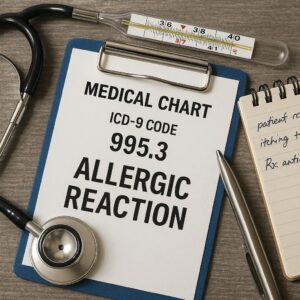
ICD-9 Code for Allergic Reaction
A Brief History: What Was ICD-9?
Before we dive into the specific code, let’s set the stage. The International Classification of Diseases, 9th Revision (ICD-9) was the standard diagnostic coding system used in the United States from 1979 until September 30, 2015. On October 1, 2015, the healthcare system transitioned to ICD-10, a much more detailed and modern classification.
Why it matters: “Medical coding is the backbone of healthcare data. Understanding past systems like ICD-9 is not about living in history, but about accurately interpreting it,” notes a health information management specialist. “It ensures patient stories are consistent across decades.”
If you are dealing with records from 2015 or earlier, you are likely looking at ICD-9 codes. For any current medical documentation or billing, ICD-10 is now the required standard.
The Primary ICD-9 Code for Allergic Reaction
The core ICD-9 code for a general, unspecified allergic reaction is:
995.3 – Allergy, unspecified
This code falls under a broader category:
-
Chapter 17: Injury and Poisoning (800–999)
-
Subcategory 995: Certain adverse effects not elsewhere classified
Code 995.3 was typically used for systemic allergic reactions where the specific cause or precise manifestation wasn’t documented in greater detail. It served as a catch-all for reactions that didn’t fit into more specific subcategories.
Important Note for Readers: This information is provided for historical reference and understanding. It must not be used for coding current patient encounters, medical billing, or clinical documentation after October 1, 2015. Always use the current ICD-10-CM code set for active healthcare operations.
Beyond the Generic: Specific ICD-9 Allergy Codes
One of the limitations of ICD-9 was its lack of specificity. However, it did have more precise codes for common allergic scenarios. Here’s a breakdown of key codes related to allergic reactions.
Common Allergic Reaction Codes in ICD-9
| ICD-9 Code | Code Description | Typical Use Case |
|---|---|---|
| 995.0 | Other anaphylactic shock | For severe, life-threatening systemic reactions (anaphylaxis). |
| 995.1 | Angioneurotic edema | For reactions involving swelling, like hives (urticaria) or swelling under the skin. |
| 995.2 | Unspecified adverse effect of drug, medicinal and biological substance | For drug allergies where the specific type of reaction wasn’t specified. |
995.3 |
Allergy, unspecified | The general code for allergic reactions. |
| 995.6 | Anaphylactic shock due to adverse food reaction | Specifically for severe reactions to food. |
| 995.7 | Other adverse food reactions | For non-anaphylactic food allergies or intolerances. |
| 477.9 | Allergic rhinitis, cause unspecified | For hay fever or seasonal allergies affecting the nose. |
| 693.1 | Dermatitis due to food taken internally | For skin reactions caused by food ingestion. |
| 692.9 | Contact dermatitis, unspecified cause | For skin reactions from contact with an allergen like poison ivy or nickel. |
As you can see, while 995.3 was the primary “allergic reaction” code, a coder would choose a more specific number if the documentation supported it.
The Critical Transition: From ICD-9 to ICD-10 for Allergies
The shift to ICD-10 was a monumental change, especially for conditions like allergies. Where ICD-9 offered a handful of codes, ICD-10 provides hundreds, allowing for incredible detail.
Why the Change Was Necessary
-
Lack of Detail: ICD-9 couldn’t specify the allergen, laterality, or encounter type (initial vs. subsequent).
-
Outdated Terminology: It didn’t reflect modern medical practices.
-
Limited Space: The structure was simply full, with no room for new codes.
ICD-9 vs. ICD-10: A Side-by-Side Comparison for Allergic Reaction
| Feature | ICD-9-CM (Historical) | ICD-10-CM (Current) |
|---|---|---|
| Primary General Code | 995.3 (Allergy, unspecified) |
T78.40XA (Allergy, unspecified, initial encounter) |
| Specificity | Low. Limited codes for broad categories. | Extremely High. Codes specify allergen, manifestation, and encounter. |
| Allergen Identification | Rarely included in the code itself. | Central to the code. Separate codes for foods (fish, nuts, milk), drugs, venom, etc. |
| Manifestation | Sometimes had separate codes (e.g., 995.1 for edema). | Often combined in a single code or linked via combination coding rules. |
| Number of Codes | Dozens related to allergies. | Hundreds of specific allergy codes. |
| Structure | Mostly 3-5 digits, numeric. | 3-7 characters, alphanumeric, with a consistent chapter structure. |
Mapping the Old to the New: What Would 995.3 Be Today?
There is no perfect 1-to-1 match because ICD-10 demands more information. The closest equivalent to the old 995.3 in ICD-10 depends on the clinical details:
-
If the allergen is known:
-
Food: Codes from
T78.0-(Anaphylaxis due to food) orL27.2(Skin rash from food). -
Drug: Codes from
T88.7-(Adverse drug reaction, not elsewhere classified). -
Venom:
T63.44-(Anaphylaxis due to hornet, wasp, bee sting).
-
-
If the allergen is not specified: The ICD-10 code would be
T78.40XA(Allergy, unspecified, initial encounter). The “X” in the 7th character placeholder is a specific requirement of the ICD-10 system for this code family, and the “A” denotes an initial encounter.
This level of detail in ICD-10 leads to better patient care, more accurate public health tracking, and improved research data.
How to Navigate Historical Records with ICD-9 Codes
If you’re a patient, researcher, or professional dealing with old records, here’s a practical approach.
For Patients:
-
Don’t panic if you see
995.3on an old bill or record. It simply means you were diagnosed with an allergic reaction. -
Look for accompanying notes or the patient description area of the record. This often states the suspected cause (e.g., “reaction to penicillin”).
-
For current care, always inform your provider of your known allergies in plain language. The historical code is less important than your actual health history.
For Medical and Research Professionals:
-
Identify the Era: Confirm the date of service. Pre-Oct 2015 = ICD-9.
-
Decode the Number: Use a legacy ICD-9 dictionary or database to translate the numeric code.
-
Seek Context: Never rely on the code alone. Cross-reference the full clinical documentation (doctor’s notes, nursing assessments) to understand the specifics of the case.
-
Map for Analysis: If compiling data, develop a consistent mapping strategy (e.g., all
995.xcodes might map to the broaderT78.4-category in ICD-10 for trend analysis).
Common Pitfalls to Avoid
-
Assuming Specificity: Code
995.3does not tell you what the patient is allergic to. -
Using for Current Coding: This is the biggest legal and financial risk. Using outdated codes for current billing is non-compliant.
-
Misinterpreting Severity:
995.3could represent anything from mild hives to a significant reaction. The code itself doesn’t indicate severity.
Practical Lists: What You Need to Remember
Key Takeaways for the ICD-9 Allergy Code
-
The main ICD-9 code for an allergic reaction was
995.3. -
ICD-9 was replaced by ICD-10 on October 1, 2015.
-
ICD-9 codes are historical and should not be used for current medical practice.
-
Always consult the full medical record, not just the code, for accurate information.
Steps to Take If You Find an ICD-9 Code on Your Record
-
Note the Date: Is it from before 2015? If yes, it’s a historical document.
-
Identify the Code: Write down the full number (e.g., 995.3, 995.1).
-
Read the Narrative: Look at the doctor’s notes for context on the cause and symptoms.
-
Update Your Current Records: Ensure your present-day healthcare providers have a clear, plain-language list of your allergies.
Conclusion
Understanding the ICD-9 code for allergic reaction, primarily 995.3, is key to interpreting pre-2015 medical history but irrelevant for modern care. The transition to ICD-10 brought necessary detail, linking specific allergens to precise reactions for improved treatment and safety. When reviewing old records, always seek the full story behind the code to ensure accurate health information.
Frequently Asked Questions (FAQ)
Q: Can a doctor still use the ICD-9 code 995.3 today?
A: No. As of October 1, 2015, all healthcare providers covered by the Health Insurance Portability and Accountability Act (HIPAA) in the U.S. are required to use ICD-10-CM for diagnosis coding. Using ICD-9 would result in claim denials and compliance issues.
Q: I saw code 995.0 on an old record. Is that worse than 995.3?
A: Potentially, yes. Code 995.0 was for “Other anaphylactic shock,” which indicates a severe, life-threatening systemic allergic reaction. Code 995.3 was more general and could be used for less severe reactions. However, always review the medical notes for the complete clinical picture.
Q: How do I find out what my old allergy code means in modern terms?
A: The best course of action is to request a copy of the full medical record from that encounter from your healthcare provider’s records department. The diagnosis description or physician’s notes will explain the reaction. You can then provide that clear history to your current doctor.
Q: Are there free resources to look up old ICD-9 codes?
A: Yes. The U.S. Centers for Disease Control and Prevention (CDC) maintains an archive of the ICD-9-CM code set. You can search their online tools for official definitions. (See Additional Resource link below).
Q: If I’m doing historical research, is it okay to group all 995.x codes together?
A: For very high-level trend analysis, it might be necessary, but you lose significant clinical nuance. A better practice is to group them cautiously (e.g., severe reactions [995.0, 995.6] vs. general/unspecified reactions [995.3, 995.7]) and always transparently document your grouping methodology.
Additional Resource
-
CDC ICD-9-CM Archive: For authoritative, historical reference, you can visit the CDC’s official ICD-9-CM browser tool. This allows you to search the complete, legacy code set for accurate definitions. [Link to: https://www.cdc.gov/nchs/icd/icd-9-cm.htm]
Disclaimer:
This article is for informational and educational purposes only. It is not a substitute for professional medical coding advice, clinical guidance, or official coding resources. Medical coding is complex and regulated. For accurate coding of any current healthcare service, consult the official ICD-10-CM guidelines and work with a certified medical coder. The author and publisher disclaim any liability for errors or actions taken based on this content.
Date: January 07, 2026
Author: The Web Health Archives Team