Navigating the world of medical billing and coding can feel like deciphering a complex foreign language. For patients and healthcare professionals dealing with historical records or specific legacy systems, understanding older coding systems remains crucial. One of the most common gynecological issues documented under the International Classification of Diseases, 9th Revision (ICD-9) was abnormal uterine bleeding. If you’re looking for clarity on this topic, you’ve come to the right place.
This guide will provide a thorough, reliable, and original exploration of the ICD-9 coding for abnormal uterine bleeding. We’ll move beyond a simple code lookup to explain the context, importance, and nuances of this classification. Our goal is to empower you with knowledge, whether you’re a medical coder reviewing old charts, a patient understanding your history, or a student learning about medical terminology evolution.
Let’s begin by answering the core question directly.
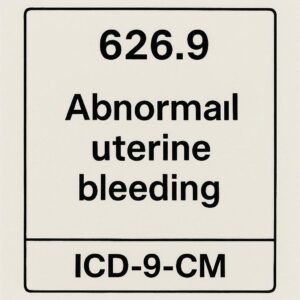
ICD-9 Code 626.9 for Abnormal Uterine Bleeding
What Was the ICD-9 Code for Abnormal Uterine Bleeding?
The primary ICD-9 code for a general diagnosis of abnormal uterine bleeding was 626.9.
This code resided within the ICD-9-CM (Clinical Modification) index, which was the system used for medical billing and record-keeping in the United States until October 1, 2015.
-
Category 626: Falls under “Disorders of menstruation and other abnormal bleeding from female genital tract.”
-
Code 626.9: Specifically denotes “Unspecified disorder of menstruation and other abnormal bleeding from female genital tract.”
It’s vital to understand the word “unspecified” here. In medical coding, precision is paramount. While 626.9 served as a general catch-all, the ICD-9 system offered many more specific codes to describe the exact nature of the bleeding. Using the most specific code possible was always the standard for accurate clinical documentation and proper billing.
Important Note: The ICD-9-CM system was officially replaced by ICD-10-CM on October 1, 2015. For services and diagnoses after this date, ICD-10 codes are required. However, knowledge of ICD-9 remains essential for dealing with historical patient records, certain insurance appeals, and understanding the foundation of current coding practices.
Understanding the ICD-9 Coding System: A Brief Background
To appreciate code 626.9, we need to understand its home. The ICD is a global health information standard managed by the World Health Organization (WHO). The 9th Revision (ICD-9) was published in the 1970s and adopted in the U.S. in 1979.
The system is hierarchical and numeric:
-
3-digit codes are the core categories (e.g., 626 – Menstrual disorders).
-
4th and 5th digits provide greater specificity (e.g., 626.2 – Excessive or frequent menstruation).
-
The codes are organized by body system and disease type, making it a logical, if sometimes limited, framework.
The transition to ICD-10 was necessary because ICD-9’s 13,000 codes could no longer keep up with modern medical advancements. ICD-10-CM offers over 68,000 codes, allowing for incredible detail regarding laterality, severity, and specific clinical circumstances.
Breaking Down Code 626.9 and Its Specific Neighbors
Code 626.9 was a non-specific code, often used as a placeholder or when the clinician’s documentation lacked detail. However, the true power of coding lies in specificity. The ICD-9-CM manual contained a full spectrum of codes under category 626 to paint a precise clinical picture.
Common Specific ICD-9 Codes for Abnormal Uterine Bleeding
Here is a comparative table of the most frequently used codes related to abnormal uterine bleeding under ICD-9.
| ICD-9 Code | Code Description | Clinical Scenario / What It Means |
|---|---|---|
| 626.0 | Absence of menstruation (Amenorrhea) | Used when periods have stopped (primary or secondary amenorrhea). |
| 626.1 | Scanty or infrequent menstruation (Oligomenorrhea) | Periods that are unusually light or occur at intervals greater than 35 days. |
| 626.2 | Excessive or frequent menstruation (Menorrhagia) | The classic code for heavy menstrual bleeding, either in volume (excessive) or frequency. |
| 626.3 | Puberty bleeding | Abnormal bleeding associated with the onset of puberty. |
| 626.4 | Irregular menstrual cycle | Cycles that vary significantly in length and timing. |
| 626.5 | Ovulation bleeding | Bleeding that occurs specifically at the time of ovulation (mid-cycle). |
| 626.6 | Metrorrhagia | Irregular, intermenstrual bleeding occurring between expected periods. |
| 626.7 | Postcoital bleeding | Bleeding that occurs after sexual intercourse. |
| 626.8 | Other specified disorders | This included diagnoses like dysmenorrhea (painful periods) which is also listed elsewhere. |
| 626.9 | Unspecified disorder | The general code used when the type of abnormal bleeding is not documented in detail. |
When Was 626.9 Used?
A physician or coder might have used 626.9 in situations such as:
-
Initial patient encounter where the full diagnostic workup was not yet complete.
-
Documentation that simply stated “abnormal uterine bleeding” without qualifying it as menorrhagia, metrorrhagia, etc.
-
Certain administrative or screening contexts where a highly specific diagnosis was not the focus.
However, for treatment and reimbursement, more specific codes were strongly preferred. For instance, heavy bleeding (626.2) could lead to different treatment pathways and had different billing implications compared to irregular bleeding (626.4) or postcoital bleeding (626.7).
The Clinical Context: What is Abnormal Uterine Bleeding (AUB)?
To code a condition, one must understand it. Abnormal Uterine Bleeding is a broad term covering any variation from the normal menstrual cycle in terms of:
-
Regularity: How often it occurs.
-
Frequency: The time between cycles.
-
Duration: How long it lasts.
-
Volume: How heavy the flow is.
Common Causes of Abnormal Uterine Bleeding
The PALM-COEIN classification system (developed by the International Federation of Gynecology and Obstetrics) helps categorize causes, and many align with specific ICD-9 codes:
-
Polyps (AUB-P)
-
Adenomyosis (AUB-A)
-
Leiomyoma (Fibroids) (AUB-L) – *ICD-9 218.x*
-
Malignancy & Hyperplasia (AUB-M) – *ICD-9 233.2, 621.3*
-
Coagulopathy (AUB-C) – *ICD-9 286.x, 287.x*
-
Ovulatory Dysfunction (AUB-O) – This is where many 626.x codes live
-
Endometrial (AUB-E)
-
Iatrogenic (AUB-I) – Caused by medications like blood thinners or IUDs
-
Not yet classified (AUB-N)
This illustrates that “abnormal uterine bleeding” is a symptom, not a final diagnosis. The coder’s job was to translate the physician’s final diagnosis into the most accurate numerical code.
The Critical Transition: From ICD-9 to ICD-10-CM
On October 1, 2015, the healthcare landscape in the U.S. changed with the mandatory shift to ICD-10-CM. This was not a simple update; it was a complete overhaul designed to capture vastly more clinical detail.
How ICD-10 Differs for Abnormal Uterine Bleeding
In ICD-10, the single code 626.9 was replaced by a much more nuanced set of codes. The general equivalent in ICD-10 is N93.9 – Abnormal uterine and vaginal bleeding, unspecified.
However, the specificity required in ICD-10 is far greater. Coders must now know:
-
The type of bleeding: Heavy (N92.0), Irregular (N92.1), Ovulation (N92.3), etc.
-
The timing: Related to the menstrual cycle (N92 series) or occurring postmenopausally (N95.0).
-
Laterality: For some related conditions.
-
Specific trimester: If bleeding occurs in pregnancy (O20.-, O46.-).
Example of Increased Specificity:
-
ICD-9: 626.2 (Excessive menstruation)
-
ICD-10: Could be N92.0 (Excessive and frequent menstruation with regular cycle) or N92.4 (Excessive bleeding in the premenopausal period).
Why Knowledge of ICD-9 Still Matters in 2026
You might wonder why we’re discussing a retired system.
-
Historical Medical Records: Patient charts dating before 2015 are coded in ICD-9. Understanding these codes is essential for continuity of care, legal reviews, and longitudinal studies.
-
Insurance and Legal Cases: Appeals or audits for services rendered before 2015 require ICD-9 knowledge.
-
Foundational Learning: Understanding the limitations of ICD-9 helps appreciate the logic and detail of ICD-10 and the future ICD-11.
-
Older Software Systems: Some niche or legacy systems may still reference ICD-9 architecture.
Practical Application: Coding Scenarios and Examples
Let’s walk through some hypothetical patient cases from the ICD-9 era to see how coding decisions were made.
Scenario 1: The Initial Visit
-
Patient Presentation: A 35-year-old woman presents to her OB/GYN stating, “My periods have been very heavy and lasting over 10 days for the past 4 months.”
-
Physician Documentation: “Patient presents with complaints of heavy prolonged menstrual bleeding. Evaluation scheduled. Preliminary diagnosis: Abnormal uterine bleeding.”
-
Appropriate ICD-9 Code: 626.9 (Unspecified disorder). While the patient describes menorrhagia, the physician’s documented diagnosis is non-specific. The coder must use what is documented.
Scenario 2: The Specific Diagnosis
-
Follow-up: After ultrasound, the same patient is found to have a submucosal uterine fibroid.
-
Physician Documentation: “Menorrhagia due to uterine leiomyoma.”
-
Appropriate ICD-9 Codes:
-
626.2 (Excessive menstruation) – This is the symptom/manifestation code.
-
218.0 (Submucous leiomyoma of uterus) – This is the underlying cause code. In billing, 626.2 would likely be listed as the primary reason for the encounter.
-
Scenario 3: Irregular Bleeding
-
Patient Presentation: A 28-year-old woman reports bleeding or spotting between her regular periods.
-
Physician Documentation: “Diagnosis: Metrorrhagia.”
-
Appropriate ICD-9 Code: 626.6 (Metrorrhagia). This is a specific code, so 626.9 would be incorrect.
Key Takeaways and Best Practices for Historical Codes
-
Specificity is King: The golden rule of medical coding, in any system, is to use the most specific code available based on the physician’s documentation.
-
Documentation is Everything: Codes are derived from clinical notes. Clear, precise physician documentation directly enables accurate coding.
-
626.9 Was a Nonspecific Code: It served a purpose but was never the ideal choice if more clinical detail was known and recorded.
-
ICD-9 is a Legacy System: For current practice, ICD-10-CM is the required standard. Always verify the applicable coding system based on the date of service.
-
Context Matters: The code tells part of the story. Always review the full clinical record to understand the patient’s health journey.
Conclusion
Understanding the ICD-9 code 626.9 for abnormal uterine bleeding requires more than memorizing a number; it involves grasping its place within a retired yet foundational coding system. This code served as a general marker for a common gynecological symptom, but its true utility was unlocked through more specific sibling codes that detailed the exact nature of the bleeding. While modern medicine has transitioned to the far more detailed ICD-10-CM, proficiency with ICD-9 remains a valuable skill for interpreting historical data, ensuring accurate long-term patient records, and appreciating the evolution of medical classification.
Frequently Asked Questions (FAQ)
Q: Is ICD-9 code 626.9 still used today?
A: No, not for current medical billing or diagnoses in the United States. It was replaced by the ICD-10-CM system on October 1, 2015. It is only relevant for services provided before that date or when analyzing historical records.
Q: What is the equivalent ICD-10 code for 626.9?
A: The closest general equivalent is N93.9 – Abnormal uterine and vaginal bleeding, unspecified. However, ICD-10 strongly discourages unspecified codes and offers many specific alternatives (e.g., N92.0 for heavy menstrual bleeding).
Q: I’m looking at an old medical bill from 2014 with code 626.9. What does it mean?
A: It means that during that encounter in 2014, your healthcare provider diagnosed you with a non-specific disorder of menstruation or abnormal bleeding. For more details, you would need to consult the actual clinical notes from that visit.
Q: Why are there so many codes for what seems like the same problem?
A: Abnormal bleeding can have many different patterns (heavy, irregular, intermenstrual) and causes (fibroids, hormonal issues, etc.). Specific codes allow for better tracking of public health trends, more accurate billing, and clearer communication between providers.
Q: As a patient, do I need to know these codes?
A: Not necessarily, but having a basic understanding can empower you when reviewing your medical records or bills. It helps you see how your symptoms are classified in the healthcare system.
Additional Resources
For those seeking to delve deeper into medical coding or current classifications, we recommend the following authoritative resources:
-
Centers for Medicare & Medicaid Services (CMS) ICD-10-CM Official Guidelines: https://www.cms.gov/medicare/coding-billing/icd-10-codes (For current coding standards)
-
American College of Obstetricians and Gynecologists (ACOG) – Patient Education on Heavy Menstrual Bleeding: https://www.acog.org/womens-health/faqs/heavy-menstrual-bleeding (For clinical understanding)
-
World Health Organization (WHO) ICD-11 Browser: https://icd.who.int/browse11/l-m/en (To see the future of disease classification)
Disclaimer: This article is for informational and educational purposes only. It is not a substitute for professional medical coding advice, clinical guidance, or treatment. Medical coding is a complex field governed by official guidelines that change over time. For accurate coding of any medical service, consult the current official ICD-10-CM coding manuals, payer-specific policies, and a certified professional coder. For medical concerns, always consult a qualified healthcare provider.
Date: January 07, 2026
Author: The Web Writer Team