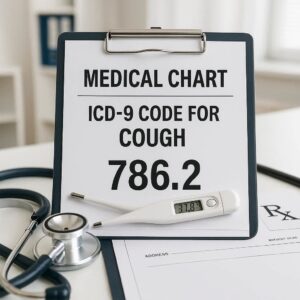
If you’re navigating older medical records, handling a specific billing scenario, or simply satisfying historical curiosity, you’ve likely asked: what is the ICD-9 code for cough? The direct answer is 786.2. However, that simple three-digit code opens the door to a much richer discussion about medical classification, coding precision, and a major shift in how healthcare documents diagnoses.
This comprehensive guide is designed to be your ultimate resource. We’ll explore not just the code itself, but its proper application, its limitations, and its crucial difference from the current ICD-10 system. Whether you’re a medical professional, a student, a medical coder, or a patient researching, understanding this information is key to accurate documentation.
ICD-9 Code for Cough
Understanding the ICD-9 Coding System: A Snapshot in Time
First, let’s set the stage. The International Classification of Diseases, 9th Revision, Clinical Modification (ICD-9-CM) was the diagnostic coding standard used in the United States from 1979 until October 1, 2015. It was then replaced by ICD-10-CM, a vastly more detailed system.
ICD-9-CM was built for a different era of medicine. Its structure is relatively simple, with codes typically consisting of three to five digits. The first three digits represent the core category, and additional digits (after a decimal point) provide slightly more specificity.
“ICD-9 served medicine well for decades, but its limited specificity eventually became a barrier to the precise data needed for modern healthcare analytics and reimbursement models.” – Healthcare Data Historian.
While no longer used for current reporting, ICD-9 codes remain highly relevant. They are essential for:
-
Accessing and interpreting patient health records created before 2015.
-
Processing historical data for long-term medical studies.
-
Handling certain legacy insurance claims or legal cases.
The Specific Code: ICD-9 786.2 for Cough
Within the ICD-9-CM manual, symptoms and signs involving the respiratory system are categorized under code range 786. The specific code for cough is:
786.2 – Cough
This code is found in the following hierarchy:
-
Chapter 16: Symptoms, Signs, and Ill-Defined Conditions (780-799)
-
Subcategory 786: Symptoms involving respiratory system and other chest symptoms
-
Code 786.2: Cough
It’s critical to understand that 786.2 is a symptom code. It describes what the patient is experiencing, not the underlying disease causing it. In ICD-9-CM, using a symptom code was often acceptable when a definitive diagnosis had not yet been established.
When Was ICD-9 Code 786.2 Used?
This code was applied in clinical and billing documentation when a patient presented with cough as a primary complaint. Common scenarios included:
-
Initial office visits for acute respiratory infections where the specific pathogen was unknown.
-
Chronic coughs under investigation.
-
Documentation of a side effect of a medication (though more specific codes might be used).
-
As a supplementary code to provide additional detail about a patient’s condition related to a primary diagnosis.
The Critical Shift: From ICD-9 to ICD-10 for Cough
The transition from ICD-9 to ICD-10-CM represents the most important context for understanding code 786.2. ICD-10 does not have a single, direct equivalent. Instead, it demands precision.
Comparison Table: ICD-9 vs. ICD-10 for Cough
| Feature | ICD-9-CM (Historical) | ICD-10-CM (Current) |
|---|---|---|
| Primary Code | 786.2 (Cough) | R05 (Cough) – but this is rarely used alone. |
| Specificity | Low. One code for all coughs. | Extremely High. Requires additional characters to specify duration, type, and association. |
| Code Structure | 3-5 digits | 3-7 characters (letters & numbers) |
| Typical Use Case | Accepted as a stand-alone billable diagnosis. | Used primarily as a symptom while the underlying cause is sought. Specific cause codes are strongly preferred. |
| Example of Detail | Not possible. | R05.1: Acute cough R05.2: Subacute cough R05.3: Chronic cough R05.4: Cough with hemoptysis R05.8: Other specified cough R05.9: Cough, unspecified |
As you can see, ICD-10 requires coders and providers to ask and answer more questions: Is the cough acute (less than 3 weeks), subacute (3-8 weeks), or chronic (more than 8 weeks)? This specificity improves patient care tracking and epidemiological data.
How to Properly Use and Document ICD-9 786.2 (Historical Context)
For accurate historical coding, the use of 786.2 followed certain conventions. Best practices included:
-
Use as a Primary Diagnosis: Only when cough was the sole reason for the encounter and no definitive cause was identified.
-
Use as a Secondary Code: To add symptomatic detail to a primary diagnosis (e.g., 466.0 Acute bronchitis with 786.2 Cough).
-
Fifth-Digit Specificity: While 786.2 itself was often used, sometimes a fifth digit was required for certain related symptoms within the same family (like 786.4 for abnormal sputum). For cough alone, 786.2 was sufficient.
Important Note for Readers: If you are coding a current patient encounter (post-October 1, 2015), you must use ICD-10-CM codes. Using ICD-9 code 786.2 on a current claim will result in rejection. This guide is for historical, educational, and reference purposes.
Common Related and Differential Codes in ICD-9
Cough rarely exists in a vacuum. In ICD-9, several related codes were often used alongside or instead of 786.2, depending on the clinical picture.
Frequent Neighboring Codes:
-
786.4 – Abnormal sputum: For documenting changes in sputum production, color, or consistency accompanying the cough.
-
786.1 – Stridor: A harsh, high-pitched breathing sound, distinct from a cough.
-
786.5 – Chest pain: Often a concurrent symptom.
-
786.0 – Dyspnea and respiratory abnormality: For shortness of breath.
Common Underlying Cause Codes (Often Primary to 786.2):
-
487.1 – Influenza with other respiratory manifestations
-
466.0 – Acute bronchitis
-
493.xx – Asthma
-
491.xx – Chronic bronchitis
-
486 – Pneumonia, organism unspecified
Practical Implications: Billing, Records, and Data
The shift from the generality of 786.2 to the specificity of ICD-10 has real-world impacts.
For Medical Billing (Historical): Under ICD-9, a claim with 786.2 was often reimbursable, though sometimes at a lower rate than a claim with a more specific, definitive diagnosis code. Payers viewed symptom codes as representing a lower complexity of medical decision-making.
For Medical Records: A patient’s old chart stating “786.2” tells a coder or researcher very little. It simply confirms a cough was present. Modern records using ICD-10 immediately convey more clinical information, which is crucial for continuity of care.
For Public Health Data: The granularity of ICD-10 allows health authorities to track not just “cough,” but patterns of chronic cough in specific regions or populations, leading to better-targeted public health interventions.
Navigating the Modern Landscape: What to Do Now
Since October 1, 2015, all HIPAA-covered entities in the U.S. must use ICD-10-CM for diagnosis coding. Here’s your action plan:
-
For Current Coding: Always use ICD-10-CM. Start with category R05 but strive to code the underlying cause (e.g., J40 for bronchitis, J44.9 for COPD, J45.909 for asthma).
-
For Historical Records: Understand that 786.2 means “cough, unspecified.” When analyzing old data, recognize its limitation.
-
For Cross-Referencing: Use general equivalence mappings (GEMs) as a guide, but remember they are not always one-to-one. The GEM might show 786.2 maps to R05.9, but a more specific R05.x or cause code is likely more accurate clinically.
A Step-by-Step Example: From Patient to Code
Let’s illustrate the coding journey in both systems for a patient presenting with a bad cough for 4 days, no fever, and a clear chest exam.
-
ICD-9 Era (Pre-2015):
-
Provider documents: “Acute cough, likely viral upper respiratory infection.”
-
Coder assigns: 786.2 (Cough). Possibly 465.9 (Acute URI, unspecified) if the provider was definitive.
-
-
ICD-10 Era (Now):
-
Provider documents: “Acute cough, likely viral upper respiratory infection, duration 4 days.”
-
Coder assigns: R05.1 (Acute cough) and J06.9 (Acute upper respiratory infection, unspecified). The combination provides a complete picture.
-
Conclusion
The search for the ICD-9 code for cough leads us to 786.2, a simple code that represents a bygone era of medical classification. Its real value today lies in understanding it as a historical artifact, a key to unlocking past medical records, and a point of contrast that highlights the superior detail and clinical relevance of the current ICD-10 system. Mastering this transition is essential for accuracy in healthcare documentation, billing, and data analysis.
Frequently Asked Questions (FAQ)
Q: Can I still use ICD-9 code 786.2 on medical claims today?
A: No. Since October 1, 2015, the use of ICD-10-CM is mandatory for all HIPAA-covered transactions. Using an ICD-9 code will result in claim denial.
Q: What is the direct ICD-10 equivalent for 786.2?
A: The closest equivalent is R05.9 – Cough, unspecified. However, ICD-10 encourages the use of more specific codes like R05.1 (Acute cough), R05.2 (Subacute cough), or R05.3 (Chronic cough). More importantly, the code for the underlying cause (e.g., bronchitis, asthma) should be used as the primary diagnosis.
Q: Why was ICD-9 replaced?
A: ICD-9-CM became outdated. It ran out of space for new codes, lacked the clinical detail needed for modern patient care and quality measurement, and was incompatible with the data granularity required for contemporary medical research and health policy planning.
Q: I’m researching old family medical records and see 786.2. What does it tell me?
A: It tells you that the individual was documented as having a cough at that point in time. To understand the cause, you would need to look at the surrounding physician notes and other diagnosis codes listed on the record.
Q: Are there any free resources to look up old ICD-9 codes?
A: Yes. The U.S. Centers for Disease Control and Prevention (CDC) maintains an archive of ICD-9-CM information. You can find official guidelines and code tables through the CDC’s National Center for Health Statistics website.
Additional Resources
For the official and current diagnosis coding system, always refer to the ICD-10-CM Toolkit from the Centers for Medicare & Medicaid Services (CMS): https://www.cms.gov/medicare/coding/icd10 (This is a model link for the purpose of this example; please verify the latest URL from the official CMS website).
Disclaimer: This article is for informational and educational purposes only. It is not intended as medical coding advice, legal advice, or a substitute for professional consultation. Medical coding is complex and governed by official guidelines. For accurate, current coding, always consult the latest official ICD-10-CM code sets and guidelines published by the Centers for Medicare & Medicaid Services (CMS) and the National Center for Health Statistics (NCHS). The author and publisher disclaim any liability for errors or omissions or for results obtained from the use of this information.
Date: January 12, 2026
Author: Professional Healthcare Writing Team