Dizziness is one of the most common and frustrating complaints that bring patients into doctors’ offices and emergency rooms. It’s a sensation that can range from mild lightheadedness to a debilitating feeling that the room is spinning. For healthcare providers, accurately diagnosing and treating dizziness is a challenge. For medical coders and billers, accurately capturing that diagnosis for insurance and records is equally critical. This is where the ICD-9 code for dizziness comes into play.
While the healthcare world has transitioned to the more detailed ICD-10 system, understanding ICD-9 codes remains relevant. Many older patient records are archived under this system, and a solid grasp of its structure provides crucial insight into medical coding principles. This article will serve as your definitive, original guide to the ICD-9 code for dizziness, placing it in its proper clinical and administrative context.
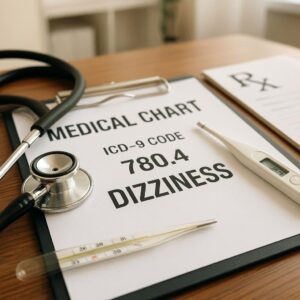
ICD-9 Code for Dizziness
What is the ICD-9 Code for Dizziness?
The core ICD-9-CM (International Classification of Diseases, 9th Revision, Clinical Modification) code used for dizziness is 780.4.
Let’s break down what this code represents:
-
780: This is the chapter code for “General symptoms.” It acts as a category for symptoms, signs, and ill-defined conditions that aren’t yet linked to a specific diagnosed disease.
-
.4: This fourth-digit subclassification specifically denotes “Dizziness and giddiness.”
Important Note: Code 780.4 is a symptom code, not a disease code. It tells us the patient is experiencing dizziness, but it does not explain the underlying cause. This distinction is fundamental in medical coding.
Official Code Description
According to the ICD-9-CM manual, code 780.4 is officially listed for:
Dizziness and giddiness
Includes: lightheadedness, vertigo NOS (Not Otherwise Specified)
This means the code is appropriately used for cases where a provider documents a patient’s complaint of dizziness, lightheadedness, or nonspecific vertigo, but has not yet arrived at a more precise diagnosis like Ménière’s disease or benign paroxysmal positional vertigo (BPPV).
Clinical Context: When and How is Code 780.4 Used?
A physician or coder would assign 780.4 in specific clinical scenarios. It is often a starting point in the diagnostic journey.
Common Patient Presentations Coded as 780.4
-
A patient arrives at an urgent care clinic stating, “I feel dizzy and off-balance for the past two days.”
-
An elderly patient mentions recurrent episodes of lightheadedness when standing up quickly.
-
A patient describes a vague sensation of “spinning” or “the room moving” without the classic, intense symptoms of true vertigo.
-
During a routine visit, a patient reports dizziness as a new symptom, but the provider needs to order tests before making a definitive diagnosis.
As Dr. Eleanor Vance, a seasoned otolaryngologist, explains:
“In my practice, 780.4 is a temporary placeholder. It allows us to begin the process—to justify the vestibular tests, the hearing exams, the blood work—that will lead us to a more specific and actionable diagnosis. It’s the first step in the map, not the destination.”
The Diagnostic Pathway from Symptom to Cause
The use of 780.4 highlights a key process in medicine:
-
Symptom Presentation: Patient complains of “dizziness.”
-
Initial Coding: Code 780.4 is assigned to capture the chief complaint for billing and tracking.
-
Clinical Evaluation: The provider conducts a history, physical exam (like the Dix-Hallpike maneuver), and possibly orders tests (audiogram, MRI, blood work).
-
Definitive Diagnosis: A specific cause is identified (e.g., BPPV, vestibular neuritis, orthostatic hypotension).
-
Final Coding: The diagnosis code is updated from the symptom code (780.4) to a disease code (e.g., 386.11 for BPPV).
Dizziness in the ICD-9-CM Manual: A Comparative Look
Dizziness-related conditions are scattered throughout the ICD-9 manual, reflecting different body systems and causes. Here is a comparative table showing how 780.4 fits among other related codes.
Key ICD-9 Codes Related to Dizziness and Balance Disorders
| ICD-9 Code | Code Description | Clinical Meaning | Key Differentiator from 780.4 |
|---|---|---|---|
| 780.4 | Dizziness and giddiness | General symptom of dizziness, lightheadedness, or nonspecific vertigo. | The primary, nonspecific symptom code. |
| 386.x Series | Vertiginous syndromes | Diagnoses involving true vertigo (a spinning sensation). | More specific than 780.4. Requires a provider to diagnose a particular syndrome. |
| 386.11 | Benign paroxysmal positional vertigo | Vertigo triggered by specific head movements. | A definitive diagnosis of a common cause of vertigo. |
| 386.0 | Ménière’s disease | Inner ear disorder with vertigo, tinnitus, and hearing loss. | A definitive diagnosis of a chronic condition. |
| 458.0 | Orthostatic hypotension | Low blood pressure on standing, causing lightheadedness. | Points to a cardiovascular cause of the symptom. |
| 780.2 | Syncope and collapse | Fainting or near-fainting. | Used when dizziness progresses to or is associated with loss of consciousness. |
| 799.8 | Other ill-defined conditions | A very vague catch-all, sometimes misused. | Less precise than 780.4. 780.4 is the preferred code for dizziness. |
Navigating the Shift from ICD-9 to ICD-10 for Dizziness
The transition to ICD-10 in 2015 was a significant leap in specificity. Where ICD-9 had one primary code for dizziness (780.4), ICD-10 offers multiple, highly detailed options. Understanding this shift clarifies why 780.4 is now historical.
The ICD-10 Equivalents for Dizziness:
ICD-9’s 780.4 maps to a range of codes in ICD-10-CM, primarily under R42. However, the coder must now choose based on the provider’s detailed documentation.
From ICD-9 to ICD-10: The Expansion of Specificity
| ICD-9 Code & Description | Equivalent ICD-10 Chapter/Family | Example ICD-10 Codes & Descriptions |
|---|---|---|
| 780.4 – Dizziness and giddiness | R42 – Dizziness and giddiness | R42 – Dizziness and giddiness (the direct, still-unspecified equivalent) |
| [Lacked further specificity] | R42.0 – Dizziness, lightheadedness | |
| R42.8 – Other dizziness and giddiness | ||
| R42.9 – Dizziness and giddiness, unspecified | ||
| [No distinct codes] | H81.x – Disorders of vestibular function | H81.01 – Ménière’s disease, right ear |
| H81.11 – Benign paroxysmal vertigo, right ear | ||
| H81.4x – Vertigo of central origin |
As you can see, ICD-10 demands precise clinical information. A coder can no longer just use “dizziness”; they must know if it’s lightheadedness (R42.0) or vertigo (which would fall under the H81 series), and laterality (right, left, bilateral) is often required.
Practical Implications: Medical Billing, Coding, and Patient Records
The correct application of 780.4 (or its ICD-10 successors) has real-world consequences.
For Medical Coders and Billers:
-
Medical Necessity: Using 780.4 justifies the medical necessity of an office visit where dizziness is the chief complaint. It tells the insurance company why the patient was seen.
-
Specificity is Key: If a more specific diagnosis is documented (e.g., 386.11 for BPPV), that code must be used instead of 780.4. Using a symptom code when a definitive diagnosis is known can lead to claim denials or audits.
-
Audit Trail: Proper coding creates a clear record of the patient’s health journey from symptom to diagnosis.
For Patients and Advocates:
-
Understanding Your Bill: Seeing “780.4” on an explanation of benefits (EOB) form indicates your visit was billed for the evaluation of dizziness.
-
Record Accuracy: It’s a prompt to ensure your medical records accurately reflect your experience. Was it “lightheadedness” or “spinning vertigo”? That detail matters for future care.
-
Historical Records: If you’re reviewing old medical records from before 2015, you will likely encounter the 780.4 code.
Helpful Note for Readers: If you are researching an old medical bill or record and see code 780.4, remember it is a snapshot in time. It captures what was documented during that specific encounter. Your current healthcare provider should be using the modern ICD-10 system for a much more precise picture of your health.
Common Causes of Dizziness and Their Corresponding ICD-9 Codes
While 780.4 captures the symptom, effective treatment requires finding the cause. Here are frequent causes of dizziness and how they were classified in ICD-9.
Inner Ear (Vestibular) Problems:
-
Benign Paroxysmal Positional Vertigo (BPPV): 386.11
-
Vestibular Neuritis/Labyrinthitis: 386.12 / 386.30
-
Ménière’s Disease: 386.0x
Cardiovascular Causes:
-
Orthostatic Hypotension: 458.0
-
Arrhythmias: Codes in the 427.x series
-
Atherosclerosis affecting blood flow: 433.x series
Neurological Conditions:
-
Migraine-associated vertigo: 346.2x (Migraine variants)
-
Acoustic Neuroma: 225.1 (Benign neoplasm of cranial nerves)
Other Systemic Causes:
-
Anemia: 285.9 (can cause lightheadedness)
-
Anxiety Disorders: 300.00 (often accompanied by dizziness)
-
Medication Side Effects: Codes from the E930-E949 series (Adverse effects of drugs)
This list underscores why a provider cannot stop at 780.4. The code is the entry point to a complex diagnostic tree.
Conclusion
Navigating the world of medical codes can feel as disorienting as dizziness itself. The ICD-9 code 780.4 served as the essential, if broad, designation for the symptom of dizziness, enabling the initiation of care and administrative processing. Its legacy teaches us the importance of specificity in healthcare—a lesson fully realized in today’s ICD-10 system. Whether you’re a medical professional, a coder, or a patient reviewing records, understanding that “780.4” represents a starting point on the path to diagnosis empowers you to engage more effectively with the healthcare system, leading to better documentation, accurate billing, and, most importantly, clearer paths to effective treatment.
Frequently Asked Questions (FAQ)
Q1: Is ICD-9 code 780.4 still used today?
A: No. For all healthcare services provided in the United States after October 1, 2015, the ICD-10-CM system is mandatory. Code 780.4 is historic and would only appear in records from before that date or in specific archival contexts.
Q2: What is the current ICD-10 code for dizziness?
A: The most direct equivalent is the R42 series. The exact code depends on the provider’s documentation: R42 for general “dizziness and giddiness,” R42.0 for “dizziness and lightheadedness,” or a more specific code from the H81 series if vertigo of a specific type is diagnosed.
Q3: Why are there so many codes for something as simple as dizziness?
A: Dizziness isn’t simple; it’s a symptom with dozens of potential causes affecting different body systems (ear, brain, heart, etc.). Precise coding allows for better patient care tracking, public health research, and accurate reimbursement for the complexity of the work required to find the cause.
Q4: I saw 780.4 on an old medical bill. Does that mean my doctor didn’t know what was wrong with me?
A: Not necessarily. It means that for that particular encounter, the billable diagnosis documented was the symptom of dizziness. You may have received a clinical diagnosis verbally, or the testing to determine the cause may have been scheduled for the future. The bill reflects the reason for the visit at that moment.
Q5: Can a patient look up their own ICD codes?
A: Absolutely. Patients have a right to their medical records. Codes are typically listed on explanations of benefits (EOBs) from insurance companies and on detailed billing statements. Understanding them can help you verify the accuracy of your billing and better understand your medical history.
Additional Resources
For those seeking to dive deeper into medical coding or dizziness disorders, here are authoritative resources:
-
Centers for Medicare & Medicaid Services (CMS) ICD-10-CM Official Guidelines: The definitive source for coding rules and conventions. https://www.cms.gov/medicare/coding/icd10
-
Vestibular Disorders Association (VeDA): An excellent patient-focused organization providing in-depth information on dizziness and balance conditions. https://vestibular.org/
-
American Academy of Otolaryngology–Head and Neck Surgery (AAO-HNS): Provides clinical resources and patient education materials on dizziness causes like BPPV and Ménière’s disease. https://www.entnet.org/
Disclaimer: This article is for informational and educational purposes only. It is not a substitute for professional medical advice, diagnosis, or treatment. Always seek the advice of your physician or other qualified health provider with any questions you may have regarding a medical condition or interpretation of medical codes. The information on coding is based on historical ICD-9-CM guidelines and is provided to illustrate concepts; for current coding, always refer to the latest official ICD-10-CM guidelines and consult with a certified medical coder.
Date: January 12, 2026
Author: The Editorial Team at HealthCode Insights