If you’re searching for the ICD-9 code for dry eyes, you’re likely navigating older medical records, dealing with a legacy billing system, or simply trying to understand a past diagnosis. While the healthcare world has moved on to a newer coding system, knowing about ICD-9 remains important for historical context and accurate record-keeping.
In this comprehensive guide, we’ll explore the specific ICD-9 code for dry eyes, explain why the coding system changed, and show you its modern equivalent. We’ll also dive into what dry eye syndrome really is, how it’s diagnosed, and why precise coding matters more than you might think. Whether you’re a patient, a medical coder, a student, or just curious, this article will be your definitive resource.
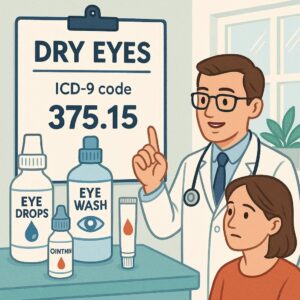
ICD-9 Code for Dry Eyes
What Was the ICD-9 Code for Dry Eyes?
The International Classification of Diseases, 9th Revision, Clinical Modification (ICD-9-CM) was the standard system for diagnosing and billing in the United States for decades. Within this system, specific codes represented every conceivable medical condition.
For dry eyes, the designated code was:
ICD-9-CM Code: 375.15
Let’s break down what this code signified:
-
375: This is the parent code for “Disorders of the lacrimal system.” This category covers issues related to tear production and drainage.
-
.15: This extension specifically denotes “Tear film insufficiency, unspecified,” which is the clinical terminology for dry eye syndrome.
It’s crucial to remember that ICD-9-CM was officially retired in the United States on October 1, 2015. It was replaced by ICD-10-CM, a far more detailed and modern system. Today, any active medical billing, insurance claims, or new patient records must use ICD-10 codes. Code 375.15 is now primarily relevant for accessing or interpreting records created before the transition.
The Transition from ICD-9 to ICD-10: Why It Matters
The shift from ICD-9 to ICD-10 wasn’t just an administrative update; it was a necessary leap forward in healthcare data. ICD-9 contained about 14,000 codes, which sounds like a lot until you see that ICD-10-CM has over 68,000. This expansion allows for incredible specificity.
“The move to ICD-10 was essential for capturing the complexity of modern medicine. It allows us to code with a precision that improves patient care, enhances public health tracking, and streamlines the billing process.” – Common sentiment among healthcare administrators.
Here’s a simple comparison of the two systems for dry eyes:
| Feature | ICD-9-CM | ICD-10-CM |
|---|---|---|
| Specific Code | 375.15 (Tear film insufficiency, unspecified) | H04.12- (Dry eye syndrome) |
| Level of Detail | Very general. One code for all dry eyes. | Highly specific. Requires additional digits to specify laterality and type. |
| Laterality | Not specified. | Must specify right eye, left eye, or both. |
| Etiology | Not detailed. | Can specify Sjögren’s syndrome-related (M35.01) or other causes. |
| Number of Codes | 1 primary code | Dozens of possible combinations |
As you can see, ICD-10 paints a much clearer picture of the patient’s condition, which leads to better treatment plans and more accurate data for research.
The Modern Equivalent: ICD-10 Code for Dry Eye Syndrome
In the current ICD-10-CM system, dry eye syndrome has its own dedicated category. The base code is H04.12-.
However, this code is incomplete on its own. It requires a 5th digit to specify which eye is affected:
-
H04.121 – Dry eye syndrome of right lacrimal gland
-
H04.122 – Dry eye syndrome of left lacrimal gland
-
H04.123 – Dry eye syndrome of bilateral lacrimal glands
-
H04.129 – Dry eye syndrome of unspecified lacrimal gland
Furthermore, if the dry eye is a manifestation of an underlying systemic disease like Sjögren’s syndrome, that condition (coded as M35.01) would be listed as the primary code, with the dry eye code as a secondary manifestation.
Important Note for Readers: If you are looking at a current medical bill or diagnosis, you should see an ICD-10 code like H04.123, not the old 375.15. If you see 375.15, you are likely viewing a document from before October 2015.
A Deep Dive into Dry Eye Syndrome (Keratoconjunctivitis Sicca)
Understanding the code is one thing, but understanding the condition it describes is far more important. Dry eye syndrome, or keratoconjunctivitis sicca (KCS), is a common and often chronic condition where the eyes do not produce enough tears, or the tears evaporate too quickly.
Common Symptoms:
-
A stinging, burning, or scratchy sensation
-
Sensitivity to light
-
Eye redness
-
A feeling of having something in your eyes (foreign body sensation)
-
Difficulty wearing contact lenses
-
Blurred vision or eye fatigue
-
Paradoxically, watery eyes (the eye’s reflex response to irritation)
Primary Causes and Types:
-
Aqueous-Deficient Dry Eye: The lacrimal glands don’t produce enough of the watery component of tears.
-
Evaporative Dry Eye: More common. The meibomian glands in the eyelids are dysfunctional and don’t produce the oily layer of the tear film, causing tears to evaporate too fast.
-
Mixed Dry Eye: A combination of both of the above.
Key Risk Factors:
-
Age: Dry eyes are a natural part of aging.
-
Sex: Women are more likely to develop dry eyes, especially due to hormonal changes.
-
Screen Time: Prolonged computer or smartphone use reduces blink rate.
-
Environmental Conditions: Dry, windy, or smoky climates.
-
Medical Conditions: Autoimmune diseases (Sjögren’s, rheumatoid arthritis, lupus), diabetes, thyroid issues.
-
Medications: Antihistamines, decongestants, blood pressure medications, antidepressants.
-
Contact Lens Wear: Long-term use can contribute to dryness.
The Critical Importance of Accurate Medical Coding
You might wonder, “Why does the specific code number matter so much?” Accurate medical coding is the silent backbone of healthcare. Here’s how it impacts you:
-
Patient Care: Specific codes help your doctor track the progression and severity of your condition over time.
-
Insurance Billing & Reimbursement: Insurance companies require precise ICD-10 codes to approve claims and authorize treatments (like prescription eye drops or specialized procedures like LipiFlow).
-
Medical Research: Accurate, aggregated coding data helps researchers identify trends, study treatment effectiveness, and understand the prevalence of diseases like dry eye syndrome.
-
Public Health: Health agencies use this data to track disease outbreaks and allocate resources effectively.
Using an outdated or incorrect code can lead to claim denials, delayed treatments, and muddied health data.
Diagnosis and Treatment Pathways
Diagnosis typically involves a comprehensive eye exam, which may include:
-
Schirmer’s Test: Measures tear production.
-
Tear Break-Up Time (TBUT): Measures how quickly tears evaporate.
-
Slit-Lamp Examination: To evaluate the quality of the tear film and check for damage to the eye surface.
Treatment is tailored to the cause and severity and can range from over-the-counter artificial tears and lifestyle changes (like using a humidifier) to prescription anti-inflammatory drops, punctal plugs, and advanced gland therapies.
Frequently Asked Questions (FAQ)
Q1: Can I still use the ICD-9 code 375.15 for billing today?
A: No. As of October 1, 2015, all HIPAA-covered entities (like doctors, hospitals, and insurers) in the U.S. are required to use ICD-10-CM codes for billing and reporting. Using ICD-9 will result in claim rejection.
Q2: I found code 375.15 on my old medical record. What should I do?
A: Nothing needs to be done. It simply confirms your diagnosis was recorded before the 2015 transition. For any ongoing or new care, your provider will use the appropriate ICD-10 code.
Q3: Is there just one ICD-10 code for dry eyes?
A: No. There is a family of codes. The most common is H04.12-, but you must specify which eye(s) are affected (e.g., H04.123 for both eyes). Other codes exist for dry eyes linked to specific diseases.
Q4: Where can I find the official, current code sets?
A: The U.S. Centers for Medicare & Medicaid Services (CMS) and the National Center for Health Statistics (NCHS) are the official publishers of ICD-10-CM. The CDC website hosts a public access portal.
Q5: Does dry eye syndrome have different names in medical terms?
A: Yes. The most common clinical term is Keratoconjunctivitis Sicca (KCS). Your doctor may also refer to it as Dry Eye Disease (DED) or Ocular Surface Disease.
Conclusion
The journey from ICD-9 code 375.15 to the detailed ICD-10 family of codes for dry eye syndrome reflects the evolution of healthcare towards greater precision. While 375.15 is a piece of medical history, understanding its modern equivalents empowers patients and ensures accurate diagnosis, treatment, and billing for this common and often complex condition. Proper coding is not just about numbers—it’s a fundamental part of effective and efficient healthcare.
Additional Resource:
For the most up-to-date and official ICD-10-CM code look-up tool, visit the CMS ICD-10-CM Official Guidelines and Resources page: https://www.cms.gov/medicare/coding/icd10
Disclaimer: This article is for informational and educational purposes only and does not constitute medical advice or professional coding consultation. Always consult with a qualified healthcare provider for diagnosis and treatment, and rely on certified medical coders and the latest official code sets for accurate billing. Information is current as of the publication date, January 12, 2026.