Navigating the world of medical coding can feel like learning a new language. For patients, caregivers, and even healthcare professionals dealing with historical records, understanding the codes used to describe conditions like diverticulitis is crucial. While the healthcare industry has transitioned to a newer coding system, the International Classification of Diseases, Ninth Revision (ICD-9) remains relevant for interpreting older medical documents, billing records, and insurance claims.
This guide will provide a clear, comprehensive, and reader-friendly explanation of the ICD-9 codes for diverticulitis. We’ll break down what these codes mean, why accurate coding matters, and how the system has evolved. Our goal is to demystify this technical topic, empowering you with the knowledge to better understand medical paperwork and the history of this common digestive condition.
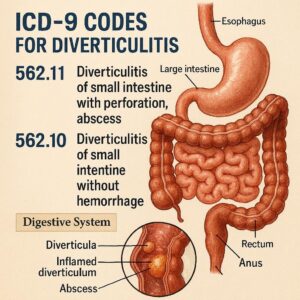
ICD-9 Codes for Diviculitis
What is an ICD-9 Code?
Before we dive into the specific code for diverticulitis, let’s establish what an ICD-9 code is. The ICD is a global standard for diagnosing and classifying diseases, maintained by the World Health Organization (WHO). The 9th Revision was the system used in the United States for diagnosing and billing purposes from 1979 until October 1, 2015.
Think of an ICD-9 code as a precise medical shorthand. Instead of writing out a long, descriptive diagnosis like “acute inflammation of diverticula in the colon with bleeding,” a healthcare provider would assign a specific numerical code. This standardization allows for:
-
Clear Communication: Ensures all healthcare providers understand the exact diagnosis.
-
Efficient Billing: Insurance companies use these codes to process claims and determine coverage.
-
Tracking and Research: Public health officials use aggregated code data to track disease trends and outcomes.
Key Takeaway: “ICD-9 codes were the essential linguistic backbone of healthcare administration for over three decades, translating complex medical conditions into a universal numeric language for record-keeping, billing, and epidemiological study.”
The Specific ICD-9 Code for Diverticulitis
Diverticulitis has its own dedicated family of codes within the ICD-9 system. The primary codes fall under the broader category “562 – Diverticula of Intestine.”
Here are the two most critical ICD-9 codes you will encounter for diverticulitis:
-
ICD-9 Code 562.11: Diverticulitis of colon (without mention of hemorrhage)
-
This is the standard code for acute or chronic diverticulitis. It indicates inflammation and infection of one or more diverticula (small pouches) in the colon wall. The “without mention of hemorrhage” specifies that there is no active bleeding noted at the time of diagnosis.
-
-
ICD-9 Code 562.13: Diverticulitis of colon with hemorrhage
-
This code is used when the diverticulitis is complicated by bleeding from the affected diverticulum. This is a more severe presentation and requires specific clinical and coding attention.
-
Breakdown of the Code Structure
Understanding the structure helps clarify its meaning:
-
562: The first three digits represent the parent category: Diverticula of Intestine.
-
.1: The fourth digit specifies the type: Diverticulitis (as opposed to .0 for diverticulosis).
-
1 or 3: The fifth digit provides crucial detail about complications: 1 for without hemorrhage, 3 for with hemorrhage.
Related and Important ICD-9 Codes
A diagnosis rarely exists in a vacuum. Often, other codes are used alongside the primary diverticulitis code to paint a complete clinical picture. Here are some related codes you might see:
-
562.10: Diverticulosis of colon without mention of hemorrhage (The precursor condition, where pouches exist but are not inflamed).
-
562.12: Diverticulosis of colon with hemorrhage
-
567.22: Peritonitis (due to diverticulitis) (A serious complication where infection spreads to the abdominal lining).
-
569.83: Perforation of intestine (Another severe complication).
-
998.59: Other postoperative infection (Potentially used if infection occurs after surgical intervention).
-
V64.41: Laparoscopic surgical procedure converted to open procedure (Relevant for surgical treatment cases).
Comparative Table: ICD-9 Codes for Diverticular Disease
This table provides a quick-reference overview of the key codes within the ICD-9 “562” family.
| ICD-9 Code | Diagnosis Description | Clinical Meaning |
|---|---|---|
| 562.10 | Diverticulosis of colon without hemorrhage | Presence of diverticula (pouches) in the colon wall, no active inflammation or infection. |
| 562.11 | Diverticulitis of colon without hemorrhage | Inflammation/infection of diverticula, without noted bleeding. The most common code for acute diverticulitis. |
| 562.12 | Diverticulosis of colon with hemorrhage | Presence of diverticula with active bleeding, but without noted inflammation. |
| 562.13 | Diverticulitis of colon with hemorrhage | Inflammation/infection of diverticula complicated by active bleeding. A more severe presentation. |
Why Accurate ICD-9 Coding Was (And Is) Critical
Even though ICD-9 is no longer used for current billing, its accuracy remains vital for several reasons:
-
Historical Patient Records: A patient’s lifelong medical history may be documented in ICD-9. Correct interpretation is essential for understanding past complications, surgical history, and disease patterns.
-
Insurance and Legal Claims: Old insurance disputes, disability claims, or legal cases rely on the accuracy of the ICD-9 codes assigned at the time of service.
-
Clinical Research: Long-term studies on diverticulitis outcomes, treatment efficacy, and epidemiology often rely on historical data coded in ICD-9.
-
Reimbursement: For claims submitted before October 2015, the ICD-9 code directly determined whether a provider was paid appropriately for the care rendered.
Important Note for Readers: If you are reviewing an old medical bill or record and see ICD-9 code 562.11 or 562.13, you now know it specifically refers to a diagnosed episode of diverticulitis. The fifth digit is crucial—it tells you whether bleeding was part of the complication picture.
The Transition from ICD-9 to ICD-10: What Changed?
On October 1, 2015, the U.S. healthcare system mandatorily transitioned from ICD-9 to ICD-10-CM (Clinical Modification). This shift was monumental, moving from about 14,000 codes to over 70,000. The change was necessary to accommodate modern medicine’s need for greater specificity.
For diverticulitis, the coding became significantly more detailed. Where ICD-9 had essentially two main codes, ICD-10 has multiple, specifying:
-
Exact Location: Diverticulitis of the small intestine (K57.30-) vs. large intestine (K57.40-, K57.50-).
-
Complication Type: With perforation, abscess, bleeding, or without complication.
-
Laterality: For some codes, specifying the affected side of the colon.
Example: A case of “Acute diverticulitis of the sigmoid colon with perforation and abscess” has a highly specific ICD-10 code, whereas in ICD-9 it would likely have been coded as 562.11 with an additional code for perforation (569.83).
Why This Matters to You
If you are looking at a medical record from 2015 or earlier, you will see ICD-9 codes. For any record after that date, you will see the more granular ICD-10 codes. Understanding this transition helps you contextualize the information you’re reading and know which coding “language” is being used.
A Step-by-Step Guide to How the Code Was Used
Let’s walk through the typical journey of an ICD-9 code for diverticulitis in the historical healthcare workflow:
-
Patient Presentation: A patient arrives with severe left lower abdominal pain, fever, and elevated white blood cell count.
-
Physician Diagnosis: After examination and a CT scan, the physician diagnoses “acute diverticulitis without evidence of bleeding.”
-
Documentation: The physician documents this diagnosis clearly in the patient’s chart and progress notes.
-
Code Assignment: A medical coder (or the physician) reviews the clinical documentation and translates the diagnosis into the correct ICD-9 code: 562.11.
-
Claim Submission: The code 562.11 is placed on the insurance claim form (historically, the HCFA-1500 or UB-04) alongside codes for the procedures performed (like a CT scan or office visit).
-
Adjudication: The insurance payer receives the claim, reviews the ICD-9 code 562.11 to verify it justifies the medical necessity of the billed services, and then processes payment.
Common Questions and Misconceptions About ICD-9 and Diverticulitis
-
“Does the ICD-9 code tell me how severe my diverticulitis was?”
-
Partially. Code 562.13 (with hemorrhage) indicates a more severe complication than 562.11. However, the code itself doesn’t grade mild vs. severe inflammation. That detail was in the physician’s notes.
-
-
“Can I use an ICD-9 code for a current doctor’s visit?”
-
No. As of October 1, 2015, all claims must use ICD-10-CM codes. ICD-9 is obsolete for current billing.
-
-
“I see a code 562.10 on an old record. Did I have diverticulitis?”
-
Not necessarily. Code 562.10 is for diverticulosis—the presence of pouches without inflammation. This is a very common, often asymptomatic condition. It is not the same as diverticulitis (562.11).
-
-
“Who was responsible for choosing the correct code?”
-
Ultimately, the healthcare provider is responsible for the accuracy of the diagnosis. Trained medical coders then assign the code based on the provider’s documentation. Incorrect coding could lead to claim denials or audits.
-
Conclusion
Understanding the ICD-9 code for diverticulitis—primarily 562.11 and 562.13—provides a window into the history of medical administration and your own personal health records. These codes served as the critical link between a patient’s diagnosis, their medical documentation, and the healthcare reimbursement system for decades. While now replaced by the more precise ICD-10 system, familiarity with ICD-9 remains valuable for interpreting past medical events, ensuring the accuracy of historical data, and appreciating the evolution of modern medical coding.
Frequently Asked Questions (FAQ)
Q: I found code 562.11 on an old bill from 2010. What does that mean?
A: It means you were diagnosed with and received treatment for diverticulitis (inflammation of colon pouches) during that encounter, and there was no noted bleeding associated with it at that time.
Q: What is the difference between ICD-9 code 562.11 and ICD-10 code K57.30?
A: ICD-9 562.11 is a general code for colon diverticulitis. ICD-10 K57.30 is much more specific, indicating “diverticulitis of small intestine without perforation or abscess without bleeding.” They are not direct equivalents. The transition to ICD-10 allowed for coding the precise location and type of complication.
Q: Can a patient have both diverticulosis and diverticulitis codes?
A: In a single encounter, typically no. A coder would assign the code that represents the reason for the visit—usually the acute condition (diverticulitis). Diverticulosis might be listed as a secondary or historical condition, but 562.11 inherently implies the presence of diverticula.
Q: Why is it important for patients to understand these codes?
A: It empowers you to be an active participant in your healthcare. When you can read and understand your medical bills and records, you can verify their accuracy, ask informed questions, and ensure your medical history is correctly documented.
Additional Resources
For those seeking more detailed information on current coding and diverticulitis, we recommend visiting the official Centers for Disease Control and Prevention (CDC) page on ICD-10: https://www.cdc.gov/nchs/icd/icd10.htm. This resource provides the most authoritative and up-to-date information on the coding system currently in use.
Disclaimer: This article is for informational and educational purposes only. It is based on historical coding data and is not a substitute for professional medical coding advice, legal counsel, or medical treatment. While every effort has been made to ensure accuracy, coding guidelines are complex and subject to specific payer rules and clinical circumstances. For interpretation of personal medical records or coding for billing, please consult with a certified medical coder or healthcare provider.
Date: January 15, 2026
Author: The Professional Web Writer Team