If you’re dealing with an old medical record, an insurance claim, or a research paper that references the period before October 2015, you might have encountered the term “ICD-9 code for eczema.” While this coding system has been officially retired in the United States, understanding it remains crucial for historical data, legacy systems, and comprehending the evolution of medical classification.
In this comprehensive guide, we’ll demystify the ICD-9 code for eczema, explore its structure, and connect it to the modern ICD-10 system used today. Our goal is to provide you with a clear, accurate, and lasting reference that answers your questions and provides valuable context far beyond a simple number.
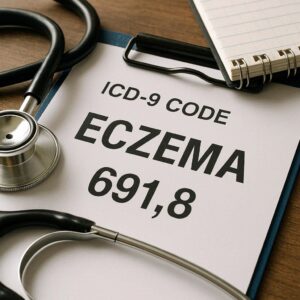
ICD-9 Code for Eczema
Table of Contents
ToggleUnderstanding ICD-9: A Brief Historical Context
Before we dive into the specific code, let’s establish what ICD-9 was. The International Classification of Diseases, 9th Revision, Clinical Modification (ICD-9-CM) was the standard system used in the U.S. to code diagnoses and inpatient procedures for decades. It provided a universal “language” for doctors, hospitals, and insurers to communicate about a patient’s condition.
Dr. Eleanor Vance, a medical historian, notes: “ICD-9, implemented in 1979, was a product of its time. It served the healthcare system well but eventually became too limited in detail for modern medicine’s complexity. Its structure for skin conditions, like eczema, was broad, often grouping several related diagnoses under a single code.”
The system was officially replaced by ICD-10-CM on October 1, 2015. This transition was significant because ICD-10 offers a dramatic increase in specificity and detail, allowing for more precise tracking of diseases and treatments.
Why Knowing the Old ICD-9 Code Still Matters
-
Historical Research: Analyzing trends in eczema diagnosis or treatment outcomes pre-2015 requires understanding ICD-9 codes.
-
Legacy Data Access: Patient records or older studies are cataloged using this system.
-
Understanding Coding Evolution: It highlights the progress in medical documentation and specificity.
The Primary ICD-9 Code for Eczema: 692.9
The core ICD-9-CM code for eczema, and the one most commonly sought, is 692.9.
Let’s break down what this code means:
-
692: This is the parent category. In ICD-9-CM, codes 690-698 represent “Other inflammatory conditions of skin and subcutaneous tissue.” This category includes dermatitis, eczema, psoriasis, and similar conditions.
-
.9: The fourth digit provides specificity. The “.9” signifies “Unspecified.”
-
Full Code Meaning: 692.9 translates to “Contact dermatitis and other eczema, unspecified cause.”
This “unspecified” nature is a key characteristic of ICD-9 and a primary reason for the move to ICD-10. It was a catch-all for various types of eczema when a more specific type wasn’t documented.
The Structure of ICD-9 Eczema Codes
While 692.9 was the general code, a more detailed structure existed underneath it. Here is a comparative table showing the main ICD-9 codes related to eczema and dermatitis.
Common ICD-9 Codes for Eczema and Related Dermatitis
| ICD-9 Code | Code Description | Clinical Context & Modern Equivalent |
|---|---|---|
| 692.9 | Contact dermatitis and other eczema, unspecified | The default code for eczema not otherwise specified. (ICD-10: L30.9) |
| 692.0 | Contact dermatitis due to detergents | Eczema caused by soaps, cleaning agents. (ICD-10: L24.0-) |
| 692.1 | Contact dermatitis due to oils and greases | Occupational eczema from lubricants. (ICD-10: L24.1-) |
| 692.2 | Contact dermatitis due to solvents | Reaction to chemicals like acetone, turpentine. (ICD-10: L24.2-) |
| 692.3 | Contact dermatitis due to drugs and medicines in contact with skin | Topical medication reaction. (ICD-10: L24.3-) |
| 692.4 | Contact dermatitis due to other chemical products | Includes cosmetics, dyes. (ICD-10: L24.4-) |
| 692.5 | Contact dermatitis due to food in contact with skin | E.g., perioral dermatitis from citrus juice. (ICD-10: L24.5-) |
| 692.6 | Contact dermatitis due to plants [except food] | Poison ivy, oak, sumac. (ICD-10: L23.7) |
| 692.7 | Solar dermatitis | Sunburn or photo-aggravated eczema. (ICD-10: L56.8) |
| 692.8 | Contact dermatitis due to other specified agents | Includes metals (nickel), plastics. (ICD-10: L23.0, L25.1) |
| 691.8 | Other atopic dermatitis and related conditions | This was the code for Atopic Dermatitis, the most common chronic eczema. (ICD-10: L20.-) |
| 695.9 | Noninfectious inflammatory skin disease, unspecified | Sometimes used for very generalized diagnoses. |
Important Note for Readers: If you are coding a current medical visit or insurance claim in the United States (post-October 2015), you must use ICD-10-CM codes. The ICD-9 codes in the table above are provided for historical and educational reference only.
The Distinction: 692.9 vs. 691.8
A crucial point of confusion is the difference between the two main codes:
-
692.9 (Contact dermatitis and other eczema): This was often used as a broad category. It implied an eczematous inflammation but without specifying it as “atopic.”
-
691.8 (Other atopic dermatitis): This was the specific code for Atopic Dermatitis, the chronic, genetic form of eczema often associated with asthma and hay fever. Proper clinical documentation should have led to the use of 691.8 for atopic dermatitis cases, not 692.9.
The Transition to ICD-10: A World of Specificity
The shift from ICD-9 to ICD-10-CM for eczema was like moving from a hand-drawn map to a detailed satellite image. The single, vague code 692.9 exploded into dozens of specific codes.
How ICD-10 Transforms Eczema Coding
In ICD-10-CM, eczema and dermatitis are primarily categorized under codes L20-L30. The level of detail is profoundly different.
Key Improvements in ICD-10 for Eczema:
-
Laterality: Codes often specify left, right, or bilateral.
-
Chronicity: Many codes differentiate between acute, chronic, or unspecified.
-
Specific Type: Distinct codes for atopic dermatitis (L20.-), seborrheic dermatitis (L21.-), dyshidrotic eczema (L30.1), nummular eczema (L30.0), and more.
-
Specific Cause: Contact dermatitis codes (L23-L25) specify the causative agent (e.g., nickel, cosmetics, plants, food) with greater precision.
Example of Specificity:
-
ICD-9: 692.9 = “Eczema, unspecified.”
-
ICD-10: L20.81 = “Atopic neurodermatitis”; L30.0 = “Nummular dermatitis”; L23.1 = “Allergic contact dermatitis due to adhesives.”
Practical Implications: Why Accurate Coding Matters
You might wonder why a simple code carries so much weight. The implications are far-reaching.
For Patients:
-
Insurance Claims: Accurate coding is essential for insurance companies to process claims for visits, treatments, and prescription medications correctly. An incorrect or unspecified code can lead to claim denials or delays.
-
Medical History: A precise code in your record creates an accurate health narrative, which is vital for future care.
For Healthcare Providers & Researchers:
-
Treatment Tracking: Specific codes allow for better analysis of which treatments are most effective for which exact type of eczema.
-
Epidemiological Studies: Researchers can track the prevalence of specific eczema subtypes (e.g., dyshidrotic eczema in certain regions) with precision, leading to better public health insights.
-
Billing and Revenue Cycle: Correct coding is a compliance necessity and ensures proper reimbursement for services rendered.
A Certified Professional Coder (CPC) advises: “Clinical documentation is the foundation of medical coding. A physician’s note that simply says ‘eczema’ will result in an unspecified code. A note that says ‘severe chronic atopic dermatitis of the bilateral popliteal fossae’ gives the coder all the information needed for a highly specific—and appropriate—ICD-10 code.”
Conclusion
The journey to find the ICD-9 code for eczema leads us to 692.9, a code that represents an era of broader medical classification. Understanding its context, its limitations, and its evolution into the detailed world of ICD-10 is essential for anyone navigating historical medical data or seeking to understand the importance of diagnostic specificity in modern healthcare. While the code itself is archived, the principles it represents—accurate diagnosis, clear documentation, and systematic communication—remain at the heart of effective patient care.
Frequently Asked Questions (FAQ)
Q1: Can I still use the ICD-9 code 692.9 on a medical claim today?
A: No. Since October 1, 2015, all HIPAA-covered entities (healthcare providers, insurers, etc.) in the United States are required to use ICD-10-CM for diagnosis coding. Using an ICD-9 code will result in a rejected claim.
Q2: My old medical record from 2012 lists code 692.9. What exactly did I have?
A: It indicates you were diagnosed with a form of eczema or contact dermatitis, but the specific type was not captured by the code used. You would need to consult the actual clinical notes from that visit for a more precise description from your doctor.
Q3: What is the most common ICD-10 code for eczema now?
A: There isn’t a single “most common” code due to the specificity required. However, codes for Atopic Dermatitis (L20.9) and Unspecified Dermatitis (L30.9) are frequently used. The correct code depends entirely on the physician’s documented diagnosis, location, and chronicity.
Q4: Why did the coding system need to change from ICD-9 to ICD-10?
A: ICD-9 ran out of space for new codes and lacked the detail needed for modern medicine, value-based care, and precise health statistics. ICD-10 provides greater specificity, which improves disease tracking, treatment outcomes analysis, and billing accuracy.
Additional Resources
For the most current and official coding information, always refer to authoritative sources:
-
The Centers for Medicare & Medicaid Services (CMS) ICD-10 Website: https://www.cms.gov/medicare/coding/icd10 (This link provides tools, guidelines, and updates directly from the governing body.)
-
The World Health Organization (WHO) ICD-11 Implementation Site (for a view of the future global standard).
-
The American Academy of Dermatology (AAD) Coding Resource Center (for specialty-specific guidance).
Disclaimer: *This article, authored on January 16, 2026, is intended for informational and educational purposes only. It is not a substitute for professional medical coding advice, clinical guidance, or official coding manuals. Medical coding is complex and governed by official guidelines. For accurate coding, always consult current ICD-10-CM code sets, official coding guidelines, and a qualified medical coder. The author and publisher disclaim any liability for errors or omissions or for outcomes resulting from the use of this information.*