If you’re dealing with medical records, billing, or historical data, you might find yourself searching for the ICD 9 code for end stage renal disease. While the healthcare world has moved on to the ICD-10 coding system, understanding the old ICD-9 codes remains crucial. These codes are still relevant for analyzing older patient records, processing legacy insurance claims, or conducting retrospective research.
This guide will provide you with a comprehensive, clear, and reliable reference for the ESRD ICD-9 code. We’ll explore not just the code itself, but its context, proper application, and how it translates into our modern coding system. Our goal is to make this technical topic accessible and useful, whether you’re a seasoned medical coder, a healthcare administrator, or a patient curious about your own medical history.
ICD-9 Code for End-Stage Renal Disease
Table of Contents
ToggleUnderstanding ICD-9 and Its Historical Context
Before we dive into the specific code, let’s set the stage. The International Classification of Diseases, 9th Revision, Clinical Modification (ICD-9-CM) was the diagnostic coding standard used in the United States for decades until October 1, 2015. On that date, the U.S. transitioned to ICD-10-CM, a much more detailed and modern system.
Think of ICD-9 as an older, simpler filing system. It used codes that were typically 3 to 5 digits long to represent diseases, symptoms, and procedures. While it served its purpose for many years, it lacked the specificity needed for today’s complex healthcare, reimbursement, and data analysis needs.
Why It Still Matters: “Although we now use ICD-10, a significant portion of active patient histories and longitudinal studies are built on ICD-9 data. Correctly interpreting these legacy codes is fundamental to understanding a patient’s complete medical journey,” notes a healthcare data archivist.
So, when you encounter an ICD-9 code, you’re likely looking at a record from before late 2015, or a system that hasn’t fully converted historical data.
The Shift to Specificity: From ICD-9 to ICD-10
The transition wasn’t just about changing numbers; it was about expanding our ability to describe medical conditions with precision. Where ICD-9 had a single code for a broad condition, ICD-10 often has dozens of codes specifying laterality, severity, cause, and other clinical details.
The Primary ICD-9 Code for End-Stage Renal Disease
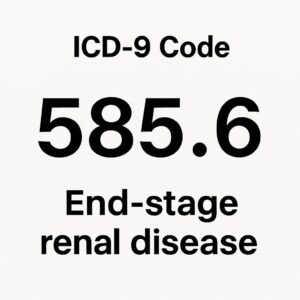
Without further ado, the primary ICD-9-CM diagnosis code for End-Stage Renal Disease is:
585.6
Let’s break down what this code signifies:
-
585: This is the parent code for “Chronic kidney disease (CKD).”
-
.6: This fifth digit subclassification specifically denotes “End stage renal disease.”
Important Note: Code 585.6 is used independently. It represents the condition of ESRD itself, meaning the patient has permanent kidney failure requiring dialysis or a kidney transplant to sustain life.
How This Code Was Used in Medical Records and Billing
In the ICD-9 era, 585.6 was a critical code for several reasons:
-
Diagnosis Validation: It formally documented the patient’s condition in their chart.
-
Billing and Reimbursement: It was essential for justifying claims for dialysis treatments, transplant evaluations, related medications (like Epogen), and other ESRD-specific services to insurance companies and Medicare.
-
Epidemiological Tracking: It allowed public health officials to track the prevalence and impact of ESRD at a population level.
Essential Coding Considerations and Related ICD-9 Codes
Rarely does a patient have only one medical code. ESRD is almost always accompanied by underlying causes and related complications. Proper coding in the ICD-9 system required listing these related codes to paint a complete clinical picture.
Common Underlying Cause Codes (Often Listed First)
The condition that led to kidney failure was frequently coded as the primary diagnosis. Here are the most common ones:
-
250.4x – Diabetes with renal manifestations: This was one of the most frequent primary codes, with the fifth digit specifying diabetes type (e.g., 250.40 for Type 2).
-
401.x – Essential hypertension: High blood pressure is a major cause of CKD leading to ESRD.
-
403.x – Hypertensive chronic kidney disease: For hypertension directly linked to renal failure.
-
582.x – Chronic glomerulonephritis: Various forms of this kidney inflammation.
-
583.x – Chronic nephritic syndrome: Other chronic kidney disorders.
Common Co-existing Condition & Complication Codes
These codes would be added to describe the full scope of the patient’s illness:
-
276.5 – Volume depletion: For dehydration.
-
276.7 – Hyperpotassemia (Hyperkalemia): High potassium levels, a dangerous ESRD complication.
-
285.2 – Anemia in chronic kidney disease: The lack of erythropoietin from the kidneys causes severe anemia.
-
275.4 – Disorders of calcium metabolism: Including hyperparathyroidism.
-
V45.1 – Renal dialysis status: A V-code (for circumstances influencing health status) indicating the patient is on dialysis.
-
V42.0 – Kidney transplant status: A V-code indicating the patient has a transplanted kidney.
Coding Scenario Example (ICD-9 Era):
A patient with Type 2 diabetes admitted for hemodialysis and management of hyperkalemia might have had the following codes assigned:
-
250.40 – Diabetes with renal manifestations, type II
-
585.6 – End stage renal disease
-
276.7 – Hyperpotassemia
-
V45.1 – Renal dialysis status
Comparative Table: ICD-9 vs. ICD-10 for ESRD
This table highlights the dramatic increase in specificity with the transition to ICD-10.
| Feature | ICD-9-CM (Legacy System) | ICD-10-CM (Current System) |
|---|---|---|
| Primary Code for ESRD | 585.6 (single code) | N18.6 (but requires additional 5th/6th digits) |
| Specificity | Low. One code for all ESRD. | Very High. Codes specify stage of CKD, cause, and transplant status. |
| Code Structure | 3-5 digits | 3-7 alphanumeric characters |
| Example of Specificity | 585.6 covers all ESRD. | N18.6 is invalid alone. Must use, for example: • N18.6 – End stage renal disease Must be combined with a code for the cause: • E11.22 – Type 2 diabetes with diabetic chronic kidney disease |
| Transplant Status | Handled with a separate V-code: V42.0 | Embedded in the code. Z94.0 is an additional code, but the dialysis dependence is specified. |
Key Takeaway: “ICD-10 requires a coder to ask ‘why’ and ‘what stage.’ Instead of just what the disease is, we now code the full clinical story. For ESRD, this means always linking it to its etiology,” explains a certified professional coder (CPC).
Why the Transition to ICD-10 Was Critical for ESRD Care
The move from the generic 585.6 to the detailed ICD-10 system has had real-world benefits:
-
Improved Patient Care: More precise data helps identify patterns and outcomes for specific sub-groups of ESRD patients (e.g., those with diabetes vs. hypertension).
-
Better Research: Epidemiologists can now study the disease with far greater granularity.
-
Accurate Reimbursement: Payments can be more closely tied to the actual complexity and cause of the patient’s condition.
-
Resource Planning: Healthcare systems can better plan for the needs of their ESRD population based on detailed cause data.
A Practical Guide for Handling ICD-9 Codes Today
You might be asking, “If we use ICD-10 now, why do I need to know this?” Here are common scenarios:
-
Processing Old Claims or Appeals: Insurance disputes or audits for services rendered before 2015 will reference ICD-9 codes.
-
Reviewing Historical Patient Records: A patient’s long-term history, including the initial date of ESRD diagnosis, is in ICD-9.
-
Data Migration Projects: When transferring old electronic health record (EHR) data to new systems, understanding the old codes is essential for accurate mapping.
-
Research Studies: Any long-term study spanning the 2015 transition will contain both ICD-9 and ICD-10 data.
Helpful List: Steps to Map an ICD-9 Code to ICD-10
If you have an old code and need to understand its modern equivalent:
-
Identify the ICD-9 code (e.g., 585.6).
-
Use a reputable crosswalk tool provided by the Centers for Medicare & Medicaid Services (CMS) or the CDC.
-
Understand it’s not always 1-to-1: One ICD-9 code often maps to multiple ICD-10 codes. You’ll need clinical context from the old record to choose the correct, specific ICD-10 code.
-
Consult coding guidelines: The context matters—was the patient on dialysis? Had they received a transplant?
Important Note for Readers: Never guess when converting codes for an active billing or clinical purpose. Always use official tools and, when in doubt, consult a certified medical coder. Using an incorrect code can lead to claim denials, audit flags, or inaccurate patient data.
Conclusion
Navigating medical codes can be complex, but understanding the ICD-9 code for end stage renal disease (585.6) is a key piece of historical medical knowledge. While the healthcare industry now uses the more precise ICD-10 system, the legacy ICD-9 code remains vital for interpreting older records, handling past claims, and conducting longitudinal research. By grasping this code, its related conditions, and its modern equivalents, you equip yourself to better manage data, understand patient history, and appreciate the evolution of medical classification.
Frequently Asked Questions (FAQ)
Q1: Can I still use the ICD-9 code 585.6 for billing today?
A: No. For all healthcare services provided on or after October 1, 2015, you must use ICD-10-CM codes. Using ICD-9 will result in immediate claim rejection.
Q2: I see “CKD 5” or “CKD Stage 5” in an old note. Is that the same as ESRD?
A: Yes. Chronic Kidney Disease Stage 5 is clinically synonymous with End-Stage Renal Disease. In ICD-9, both would be coded as 585.6.
Q3: How do I code a patient with ESRD who has a kidney transplant in ICD-9?
A: You would use two codes: 585.6 for the ESRD and V42.0 to indicate the transplant status. The medical record should clarify that the ESRD is the condition that necessitated the transplant.
Q4: Where can I find official, free resources to look up these codes?
A: The Centers for Disease Control and Prevention (CDC) maintains the official ICD-9-CM and ICD-10-CM archives. The CMS website also provides General Equivalence Mappings (GEMs) between the two systems.
Additional Resources
For the most authoritative and up-to-date information on coding, please refer to these official sources:
-
CDC ICD-9-CM Archive: https://www.cdc.gov/nchs/icd/icd9cm.htm
-
CMS ICD-10 Resources: https://www.cms.gov/medicare/coding/icd10
-
National Kidney Foundation (Patient-Focused Information): https://www.kidney.org
Disclaimer: This article is for informational and educational purposes only. It is not a substitute for official coding guidelines, payer-specific rules, or professional medical coding advice. Always consult the most current official coding manuals and resources for accurate billing and clinical documentation.
Date: January 19, 2026
Author: The Professional Web Writer Team