If you’re researching the ICD 9 code for eating disorder, you’ve likely encountered a medical document, an old insurance form, or historical health data that still uses this older coding system. While the healthcare world has moved on to ICD-10, understanding these legacy codes is crucial for interpreting past records, handling billing disputes, or conducting longitudinal research.
This guide will serve as your definitive resource. We’ll demystify the ICD-9 coding system for eating disorders, provide clear tables for reference, explain the critical transition to ICD-10, and emphasize why accurate diagnostic coding is far more than just administrative paperwork—it’s a cornerstone of effective patient care.
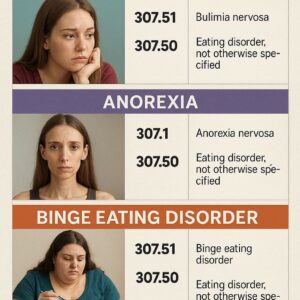
ICD-9 Codes for Eating Disorders
Understanding the ICD-9 Coding System: A Brief Background
Before we dive into specific codes, let’s establish what ICD-9 is and why it matters.
The International Classification of Diseases, 9th Revision, Clinical Modification (ICD-9-CM) was the standard diagnostic coding system used in the United States from 1979 until October 1, 2015. Its primary purposes were to:
-
Standardize Diagnoses: Provide a universal language for diseases, symptoms, and health problems.
-
Enable Billing and Reimbursement: Serve as the foundation for insurance claims and payment systems.
-
Track Public Health: Facilitate the collection of data on disease prevalence and mortality rates.
As our understanding of mental health and eating disorders evolved, the limitations of ICD-9 became apparent. Its codes were less specific and detailed than what modern medicine required, which directly led to its replacement.
A Note on Historical Context: “Using ICD-9 codes today is like using a older map of a city. It will show you the main roads and landmarks, but it won’t have the new neighborhoods, street names, or detailed points of interest that a current map provides. For accurate, modern navigation in healthcare, we need the updated map—ICD-10.”
The Primary ICD-9 Codes for Eating Disorders
In the ICD-9-CM system, most eating disorders were categorized under the code 307.5. This was a broad “catch-all” category that required an additional digit for specificity. This lack of granularity was one of the key drivers for creating ICD-10.
Here is the primary breakdown:
ICD-9 Code 307.5: “Other and unspecified disorders of eating”
This parent code required a fourth digit to specify the disorder:
-
307.50 – Eating disorder, unspecified: Used when a provider identified an eating disorder but did not specify the type (e.g., Anorexia Nervosa, Bulimia Nervosa). This was often a temporary diagnosis during initial assessment.
-
307.51 – Bulimia nervosa: This was the specific code for Bulimia Nervosa, characterized by recurrent episodes of binge eating followed by compensatory behaviors like self-induced vomiting, laxative misuse, or excessive exercise.
-
307.52 – Pica: The code for the persistent eating of non-nutritive, non-food substances (e.g., dirt, paper, soap) over a period of at least one month.
-
307.53 – Rumination disorder: Used for the repeated regurgitation of food, which may be re-chewed, re-swallowed, or spit out.
-
307.54 – Psychogenic vomiting: This code was for vomiting related to psychological factors rather than a gastrointestinal condition.
-
307.59 – Other: This code captured other feeding disorders of infancy or childhood that didn’t fit the above categories.
Crucially Missing: Anorexia Nervosa. You might notice a significant omission. In a distinct quirk of the ICD-9 system, Anorexia Nervosa was not listed under 307.5. Instead, it was found in an entirely different chapter.
ICD-9 Code 307.1: “Anorexia nervosa”
Anorexia Nervosa was classified separately under code 307.1, within a category for “Other and unspecified special symptoms or syndromes, not elsewhere classified.” This separation of Anorexia from other eating disorders was clinically inconsistent and is rectified in ICD-10.
Comparative Table: ICD-9 Codes for Eating Disorders
| Disorder | ICD-9-CM Code | Notes |
|---|---|---|
| Anorexia Nervosa | 307.1 | Listed separately from other eating disorders. |
| Bulimia Nervosa | 307.51 | A sub-code of the broader 307.5 category. |
| Eating Disorder, Unspecified | 307.50 | Used for an eating disorder where the specific type is not yet determined. |
| Pica | 307.52 | A sub-code of the broader 307.5 category. |
| Rumination Disorder | 307.53 | A sub-code of the broader 307.5 category. |
| Psychogenic Vomiting | 307.54 | A sub-code of the broader 307.5 category. |
| Other Specified Eating Disorder | 307.59 | Captured disorders like Avoidant/Restrictive Food Intake Disorder (ARFID) before it had its own code. |
The Transition from ICD-9 to ICD-10: Why It Matters
On October 1, 2015, the United States mandated a transition from ICD-9-CM to ICD-10-CM. This was not a simple update; it was a monumental shift that expanded the number of codes from around 14,000 to over 68,000. The change was driven by the need for:
-
Greater Specificity: ICD-10 allows for detailed coding of severity, etiology, and manifestation.
-
Improved Clinical Detail: Better captures the complexity of modern diagnoses.
-
Enhanced Data for Research: Provides richer data for tracking outcomes and epidemiology.
-
Alignment with Global Standards: Brings the U.S. in line with the rest of the world, which adopted ICD-10 years earlier.
For eating disorders, this meant moving from a handful of non-specific codes to a dedicated, logically organized chapter.
ICD-10-CM Codes for Eating Disorders (Current Standard)
Eating disorders are now cohesively grouped under code range F50.- in the “Mental, Behavioral and Neurodevelopmental disorders” chapter.
| Disorder | ICD-10-CM Code | Description & Specificity |
|---|---|---|
| Anorexia Nervosa | F50.0- | Subtypes for restrictive (F50.01) or binge-eating/purging type (F50.02). |
| Bulimia Nervosa | F50.2- | Requires specification of remission status (e.g., F50.21 for in remission). |
| Binge-Eating Disorder | F50.81 | This is a major addition. BED was not a distinct diagnosis in ICD-9. |
| Avoidant/Restrictive Food Intake Disorder (ARFID) | F50.82 | Another critical addition, addressing a gap in ICD-9 for children/adults with restrictive eating not driven by body image. |
| Pica | F50.8 | Now includes specifiers for different substances (e.g., F50.83 for Pica in adults). |
| Rumination Disorder | F98.21 | Still classified with other onset disorders in childhood. |
| Other Specified Feeding or Eating Disorder (OSFED) | F50.89 | Replaces the vague “307.59” for cases like atypical anorexia or purging disorder. |
| Unspecified Feeding or Eating Disorder | F50.9 | The equivalent of the old “307.50.” |
Important Note for Readers: “If you are dealing with a current medical record, insurance claim, or treatment plan from 2016 onward, you should be looking for ICD-10 codes (F50.-). ICD-9 codes are largely historical. However, understanding the old code helps you make sense of older records and appreciate the progress in diagnostic clarity.”
The Critical Importance of Accurate Diagnostic Coding
Why does this coding alphabet soup matter to patients, families, and clinicians? Accurate coding is not a bureaucratic exercise.
-
For Patients: It ensures your diagnosis is correctly communicated to insurance companies, which is vital for securing coverage for therapy, nutritional counseling, and medical monitoring. An incorrect or unspecified code can lead to claim denials.
-
For Treatment Providers: Precise coding guides treatment planning. The clinical approach for Anorexia Nervosa (F50.01) differs from that for ARFID (F50.82). Coding drives the collection of outcome data that proves which treatments are most effective.
-
For Public Health: Accurate, specific codes allow researchers and policymakers to understand the true prevalence of eating disorders, identify at-risk populations, and allocate resources for prevention and treatment programs. The addition of BED and ARFID codes in ICD-10, for example, has led to a dramatic increase in recognized cases and research funding.
Navigating Medical Records and Insurance with Historical ICD-9 Codes
You may need to navigate old ICD-9 codes in several scenarios:
-
Reviewing Pre-2016 Medical Records: Your or a family member’s old records will use ICD-9.
-
Addressing an Old Insurance Dispute: A claim from before the transition may reference 307.1 or 307.51.
-
Conducting Historical Research: Studies looking at trends over decades must bridge the ICD-9/ICD-10 gap.
What to do:
-
Use Conversion Tools: Many online “crosswalks” or “mapping tools” exist (like the one maintained by the CDC) to translate an ICD-9 code to its closest ICD-10 equivalent.
-
Consult a Professional: Medical billing specialists or your healthcare provider’s office can help interpret old codes.
-
Focus on the Narrative: Remember, the diagnostic code is a shorthand. The most important information is in the clinician’s written assessment and notes within the record.
The Future: A Glimpse at ICD-11
The World Health Organization (WHO) has already released the ICD-11, which further refines the classification of eating disorders. The U.S. will eventually transition to ICD-11-CM, though a date is not yet set. ICD-11 continues the trend of increasing precision and clinical utility, ensuring diagnostic tools keep pace with scientific understanding.
Conclusion
Understanding the ICD 9 code for eating disorder—primarily 307.1 for Anorexia and 307.5x for others—provides a key to unlocking historical health data and appreciating the evolution of mental health diagnosis. The transition to ICD-10’s detailed F50.- codes marks a significant advancement in recognizing the spectrum and severity of these life-threatening conditions. While ICD-9 is a relic of the past, grasping its structure empowers patients and professionals to better manage care, navigate insurance, and contribute to a more accurate picture of eating disorders in our society.
Frequently Asked Questions (FAQ)
Q: I have an old bill with code 307.50. What does that mean?
A: Code 307.50 meant “Eating Disorder, Unspecified.” Your provider had diagnosed an eating disorder but had not specified the type (like Anorexia or Bulimia) on that particular claim. This was common during initial evaluations.
Q: Can doctors still use ICD-9 codes today?
A: No. For diagnoses made on or after October 1, 2015, all HIPAA-covered entities (healthcare providers, hospitals, insurers) in the U.S. are required to use ICD-10-CM codes. Using ICD-9 would result in claim rejection.
Q: Why was there no separate ICD-9 code for Binge-Eating Disorder?
A: Binge-Eating Disorder (BED) was not formally recognized as a distinct diagnosis until the DSM-5 was published in 2013. ICD-9, which closed for updates years earlier, did not include it. Its inclusion in ICD-10 (as F50.81) was a major step forward in validating and treating this condition.
Q: How do I find out what my current diagnosis code is?
A: You can ask your treating clinician directly. You can also check the “Explanation of Benefits” (EOB) statement from your insurance company after an appointment; it will list the diagnosis codes submitted by your provider.
Additional Resources
-
CDC ICD-10-CM Official Guidelines: https://www.cdc.gov/nchs/icd/icd-10-cm.htm – The authoritative source for current coding rules.
-
National Eating Disorders Association (NEDA): https://www.nationaleatingdisorders.org/ – For support, information, and treatment resources.
-
ICD-9 to ICD-10 Crosswalk Tool (CMS): A useful tool for mapping old codes to new ones (available through the Centers for Medicare & Medicaid Services website).
Disclaimer: This article is for informational purposes only and is not a substitute for professional medical advice, diagnosis, or treatment. Always seek the advice of your physician or other qualified health provider with any questions you may have regarding a medical condition or diagnostic codes. Medical coding is complex and context-dependent; always rely on qualified coding professionals for definitive interpretation.
Date: January 19, 2026
Author: The Health Data Guide Team