If you’re navigating medical records, billing, or simply trying to understand an old diagnosis, encountering the term “ICD-9 code for fatigue” can be surprisingly complex. Fatigue is one of the most common and nebulous symptoms in all of medicine. It’s a feeling we all experience, yet when it becomes a medical complaint, assigning it a precise code is less straightforward than you might think.
The International Classification of Diseases, 9th Revision (ICD-9) was the official system for coding diagnoses and procedures in the United States for decades until its retirement on October 1, 2015. Despite this transition, understanding ICD-9 codes remains crucial. Millions of historical patient records are archived using this system, and medical professionals, researchers, and billing specialists still need to reference it for continuity of care and legacy data analysis.
This guide will serve as your definitive resource. We’ll explore the specific ICD-9 code for fatigue, unravel the critical distinctions in how it’s applied, and place it in the context of modern medical coding. Our goal is to provide clarity, accuracy, and a deep understanding that goes beyond a simple number.
ICD-9 code for fatigue
Understanding the ICD-9 Framework and Fatigue’s Place Within It
First, let’s set the stage. The ICD-9 system is a vast, hierarchical catalog of thousands of codes, each representing a specific disease, symptom, condition, or external cause of injury. Its primary purposes are to standardize medical terminology for global health tracking and to facilitate billing and insurance reimbursement.
Fatigue, in the ICD-9 world, is classified as a symptom or a sign. This is the most important concept to grasp. It is not typically considered a disease in itself but rather an indication that something else might be wrong. Consequently, its coding follows specific rules that prioritize underlying causes.
The Core Philosophy: ICD-9 coding operates on the principle of specificity. When possible, you code the known, definitive diagnosis, not just the symptom. The code for fatigue is primarily used when fatigue is the chief complaint and no more specific underlying condition has been identified yet.
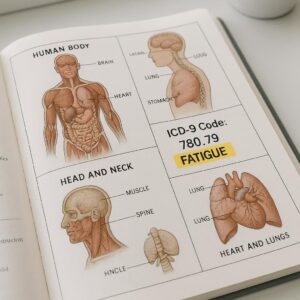
The Primary ICD-9 Code for Fatigue: 780.79
After searching through the voluminous ICD-9 manual, you will find the most direct code for general fatigue:
ICD-9 Code 780.79: Other malaise and fatigue
Let’s break down what this code signifies:
-
780: This is the chapter for “Symptoms, Signs, and Ill-Defined Conditions.” It’s the catch-all category for problems that are not yet attributed to a specific disease.
-
.7: This specifies “Malaise and fatigue.”
-
.79: “Other malaise and fatigue” is the residual subcategory for fatigue that doesn’t fit more specific descriptions.
When is 780.79 Used?
This code is appropriately used in situations such as:
-
A patient presents with persistent, debilitating tiredness, and after a preliminary evaluation, no immediate cause (like anemia, thyroid disorder, or sleep apnea) is confirmed.
-
Chronic fatigue is documented as a significant ongoing issue, even while investigating potential root causes.
-
In medical billing for an encounter where the assessment and management focus was on the symptom of fatigue itself.
Critical Distinction: Fatigue as a Primary vs. Secondary Diagnosis
This is where medical coding becomes nuanced. The simple act of writing “fatigue” in a chart does not automatically trigger code 780.79. Coders must follow strict sequencing rules.
The Golden Rule: Code First the Underlying Condition.
If a definitive cause for the fatigue is known or suspected, that condition gets the primary code. Fatigue may then be listed as an additional secondary code if it is a significant factor in the patient’s care.
| Clinical Scenario | Primary ICD-9 Code (First-listed) | Secondary ICD-9 Code (May be added) | Rationale |
|---|---|---|---|
| Patient with diagnosed hypothyroidism complaining of fatigue. | 244.9 – Unspecified hypothyroidism | 780.79 – Other malaise and fatigue | The disease (hypothyroidism) is the cause of the symptom. The disease is coded first. |
| Patient with major depressive disorder where fatigue is a core symptom. | 296.2x – Major depressive disorder, single episode | 780.79 – Other malaise and fatigue | The mental health disorder is the established diagnosis. Fatigue is a recognized component. |
| Patient presents with profound tiredness; labs show severe iron-deficiency anemia. | 280.9 – Iron deficiency anemia, unspecified | 780.79 – Other malaise and fatigue | The anemia is the confirmed medical cause of the fatigue. |
| Patient complains of 6 months of extreme exhaustion. Workup is ongoing, no cause yet found. | 780.79 – Other malaise and fatigue | None | Fatigue is the active, unexplained chief complaint. It is the primary diagnosis for the encounter. |
Important Note for Readers: “In medical coding, the story of the patient encounter dictates the codes. We never code in a vacuum. The physician’s documentation must support the linkage between a symptom like fatigue and a underlying disease for us to code both. When in doubt, the coder must query the provider for clarification.” – A common principle in professional medical coding practice.
Related and Important ICD-9 Codes for Fatigue-Like Conditions
Fatigue can wear many masks. The ICD-9 system had specific codes for more precise descriptions of energy-depleting conditions. Using these more specific codes when applicable was always preferred.
-
780.71 – Chronic fatigue syndrome: This is a distinct and serious diagnosis characterized by at least six months of severe, disabling fatigue not improved by rest, and accompanied by a specific set of additional symptoms (e.g., post-exertional malaise, cognitive dysfunction). It is not the same as general fatigue.
-
780.72 – Functional quadriplegia: This refers to a lack of movement or energy to move without a physical neurological cause, often due to severe weakness or psychiatric conditions.
-
780.93 – Memory loss, insomnia, fatigue: This code bundles these three symptoms, which often co-occur, particularly in conditions like depression or certain neurological disorders.
-
300.5 – Neurasthenia: An older term, still in ICD-9, for a condition marked by chronic mental and physical fatigue, often associated with stress or emotional conflict.
-
Fatigue in specific contexts: Codes from other chapters could be used for fatigue due to a known cause, such as ****
-
263.9 – Unspecified protein-calorie malnutrition
-
276.6 – Fluid overload, exhaustion, or fatigue (e.g., in congestive heart failure)
-
V62.89 – Other specified psychosocial circumstances (like stress causing fatigue)
-
The Transition to ICD-10: A Major Shift in Specificity
On October 1, 2015, the healthcare system in the U.S. migrated from ICD-9 to ICD-10-CM. This was not a simple update; it was a monumental expansion in detail and specificity. The code for general fatigue was transformed.
ICD-10-CM Code for Fatigue: R53.83
This code resides in Chapter 18 (Symptoms, Signs, and Abnormal Clinical and Laboratory Findings). However, ICD-10 offers dramatically more granularity. A coder must now choose from:
-
R53.1 – Weakness
-
R53.81 – Other malaise
-
R53.83 – Other fatigue
-
R53.0 – Neoplastic (cancer-related) fatigue
-
R53.2 – Functional quadriplegia (similar to ICD-9 780.72)
-
R53.82 – Chronic fatigue, unspecified (distinct from Chronic Fatigue Syndrome, which is G93.3)
-
R53.83 – Other fatigue (this is the most direct equivalent to ICD-9’s 780.79)
The requirement to code the underlying cause first remains, but the options for describing the symptom itself are far more detailed.
Why Understanding ICD-9 for Fatigue Still Matters in 2026
You might wonder, with ICD-10 in place for over a decade, why delve into an obsolete system?
-
Historical Medical Records: A patient’s lifelong health record is a continuum. An old chart citing 780.79 provides immediate context about their medical history.
-
Legal and Disability Cases: Historical claims, workers’ compensation cases, or disability determinations often rely on ICD-9 codes used at the time of the original diagnosis.
-
Research Continuity: Longitudinal studies spanning the 2015 transition must be able to map and compare data from both coding eras to track disease trends over time.
-
Professional Knowledge: For medical historians, archivists, and seasoned healthcare professionals, this knowledge is part of the foundation of modern medical administration.
Practical Guide for Patients and Professionals
For Patients Reviewing Old Records:
If you see “780.79” on an old bill or chart, understand that it documented your complaint of fatigue at that time. It does not necessarily mean your doctor stopped looking for a cause. To understand the full picture, look for other codes listed alongside it or the physician’s notes describing any suspected or confirmed diagnoses.
For Medical Coders and Billers:
When handling old records, always use the coding system active at the date of service. Never “back-code” an old encounter into ICD-10. For current cases, remember the cardinal rule: specificity and etiology first. Query providers for clear documentation that links fatigue to a root cause, allowing for accurate and compliant coding under ICD-10.
For Healthcare Providers:
Clear documentation is the cornerstone of accurate coding. Instead of just noting “fatigue,” describe its characteristics (onset, duration, severity, aggravating/relieving factors) and, crucially, its relationship to other diagnoses (e.g., “fatigue attributed to uncontrolled diabetes” or “idiopathic chronic fatigue, workup pending”).
Conclusion
The search for the “ICD-9 code for fatigue” leads us to 780.79, but more importantly, it opens a window into the meticulous logic of medical classification. Fatigue is coded not as a standalone ailment but as a significant clue within a larger diagnostic puzzle. While ICD-9 has been succeeded by the more detailed ICD-10, its codes remain vital keys to unlocking decades of medical history, reminding us that accurate coding is fundamental to patient care, research, and the very architecture of modern healthcare.
FAQ: ICD-9 Code for Fatigue
Q1: Is ICD-9 code 780.79 the same as a diagnosis for Chronic Fatigue Syndrome (CFS)?
A: No, they are distinctly different. Code 780.79 is for general, unspecified fatigue. Chronic Fatigue Syndrome is a specific, complex disorder with strict diagnostic criteria and has its own dedicated ICD-9 code: 780.71. A diagnosis of CFS requires much more than just feeling tired.
Q2: I saw code 780.79 on an old medical bill. Does this mean my doctor didn’t find a cause for my tiredness?
A: Not necessarily. This code indicates that fatigue was a primary reason for your visit or a documented symptom during that specific encounter. It was often used while testing was ongoing or when fatigue was a managing feature of a known illness. The full medical record would provide more context.
Q3: Can code 780.79 be used with a mental health diagnosis like depression?
A: Yes, but with proper sequencing. In ICD-9 rules, if the fatigue is a direct symptom of the major depressive disorder, the depression code (e.g., 296.2x) would be listed first as the primary diagnosis. Code 780.79 could be added as a secondary code to emphasize the symptom’s impact, if supported by documentation.
Q4: What is the equivalent code for fatigue in the current ICD-10 system?
A: The most direct equivalent is R53.83 – Other fatigue. However, ICD-10 offers more specificity, with separate codes for weakness (R53.1), malaise (R53.81), and even cancer-related fatigue (R53.0).
Q5: Why is it important to code an underlying cause before the fatigue code?
A: This practice ensures accurate representation of the patient’s health status, drives appropriate treatment plans, and is crucial for correct insurance reimbursement. Billing for a symptom like fatigue without linking it to a covered, underlying condition can lead to claim denials.
Additional Resources
For those seeking to explore official coding guidelines and current practices, the authoritative source is the Centers for Medicare & Medicaid Services (CMS). You can access current ICD-10-CM code sets and official guidelines on their website: CMS ICD-10 Code Sets.
Disclaimer: This article is for informational and educational purposes only. It is not intended as medical advice or as a substitute for professional medical coding consultation. Medical coding is complex and governed by official guidelines. Always refer to the current, official ICD-10-CM code sets and guidelines for active coding, and consult with a certified professional coder for specific cases. For historical records, use the ICD-9 code set that was in effect at the time of service.
Date: January 21, 2026
Author: The Web Health Archive Team