Navigating the world of medical billing and clinical documentation can feel like learning a new language. At the heart of this system are diagnostic codes, which serve as a universal shorthand for diseases, symptoms, and procedures. For common skin conditions like folliculitis—an inflammation of the hair follicles—using the correct code is essential for accurate record-keeping, proper reimbursement, and effective patient care management. While the medical community has largely transitioned to a newer coding system, understanding the legacy ICD-9 code for folliculitis remains valuable for historical record review and a deeper appreciation of medical coding evolution.
This guide will provide a comprehensive look at the specific ICD-9 code used for folliculitis, explain its context, and clarify its relationship with the current ICD-10 system. Whether you’re a medical coder, a healthcare student, a provider, or a curious patient, this article will serve as your definitive reference.
ICD-9 Code for Folliculitis
Understanding ICD-9 and Its Place in Medical History
Before we pinpoint the specific code, it’s important to understand what ICD-9 is and why it still matters. The International Classification of Diseases, 9th Revision, Clinical Modification (ICD-9-CM) was the standard diagnostic coding system used in the United States from 1979 until October 1, 2015.
Think of it as a massive, organized library of codes where every conceivable health issue had its own unique “call number.” This system allowed hospitals, doctors, and insurance companies to communicate consistently about a patient’s diagnosis. The “Clinical Modification” (CM) part was specifically tailored for use in U.S. healthcare settings, adding more detail than the international base version.
“ICD-9-CM was the lingua franca of U.S. healthcare diagnostics for over three decades. While retired, its structure informs how we understand the organization of disease codes today.” – Health Information Management Specialist
On October 1, 2015, the U.S. healthcare system underwent a mandatory transition to ICD-10-CM, a vastly more detailed and modern system. This means that for all current medical encounters, ICD-10 codes are required. However, medical professionals may still encounter ICD-9 codes when reviewing older patient records or historical data. Understanding them is key to interpreting that longitudinal health information.
The Specific ICD-9 Code for Folliculitis
For folliculitis, the assigned ICD-9-CM code was 704.8.
Let’s break down what this code signifies within the ICD-9 structure:
-
704: This is the parent category. In ICD-9, codes starting with 704 fall under “Other diseases of hair and hair follicles.” This category explicitly excludes conditions like congenital hair disorders (codes 757.4) or certain inflammatory skin conditions categorized elsewhere.
-
.8: This fourth digit provides specificity. Code 704.8 represents “Other specified diseases of hair and hair follicles.”
This is a crucial point: 704.8 was a “catch-all” code for various hair follicle disorders not named elsewhere in the 704 series. Folliculitis was the most common condition reported under this code, but it also encompassed other issues.
What Conditions Were Coded Under ICD-9 704.8?
The code 704.8 was used for a range of follicular issues, including:
-
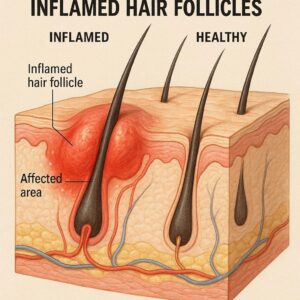
Folliculitis: General inflammation of hair follicles, often due to bacterial (especially Staphylococcus aureus), fungal, or viral infection, or from physical irritation (e.g., shaving, friction).
-
Perifolliculitis: Inflammation of the tissue around the hair follicle.
-
Sycosis: A deeper, more chronic form of folliculitis, particularly referring to sycosis barbae (barber’s itch) affecting the beard area.
-
Other specified follicular disorders not given a more specific code.
Important Note for Readers: In ICD-9, there was no dedicated, highly specific code for different types of folliculitis (e.g., bacterial vs. fungal, or by body location). The lack of specificity was a primary driver for the creation of ICD-10. All these variations typically defaulted to 704.8, with details left to the clinician’s narrative notes.
Comparative Table: ICD-9 vs. ICD-10 for Folliculitis
This table highlights the dramatic shift in specificity between the two coding systems.
| Feature | ICD-9-CM (Historical) | ICD-10-CM (Current) |
|---|---|---|
| Primary Code | 704.8 – Other specified diseases of hair and hair follicles | L73.9 – Follicular disorder, unspecified (but this is rarely used due to availability of specific codes) |
| Specificity | Low. One general code for multiple follicular conditions. | Very High. Dozens of codes specifying cause, location, and type. |
| Example for Bacterial Folliculitis on Arm | 704.8 | L73.82 – Folliculitis of trunk (if causative organism isn’t specified) or, more precisely, L73.81 – Pseudofolliculitis barbae or B95.62 + L73.8 for Methicillin-resistant Staph aureus (MRSA) as the cause. |
| Example for Fungal Folliculitis (Tinea barbae) | 704.8 | B35.0 – Tinea barbae and tinea capitis |
| Structure | 3-5 digits, mostly numeric. | 3-7 characters, alphanumeric. Allows for greater combination and detail. |
| Key Limitation | Lack of detail hindered clinical precision and data analysis for research/epidemiology. | Complexity requires more thorough documentation and coder training. |
Why the Transition to ICD-10 Was Necessary for Conditions Like Folliculitis
The move from ICD-9 to ICD-10 was not arbitrary. The limitations of ICD-9 code 704.8 perfectly illustrate the need for change:
-
Poor Clinical Detail: A code of 704.8 told you nothing about whether the folliculitis was on the scalp, face, or body, nor if it was caused by bacteria, a fungus, or a virus. This hampered detailed patient care tracking.
-
Inadequate Data for Public Health: Tracking outbreaks of specific types of folliculitis (e.g., community-acquired MRSA folliculitis) was nearly impossible with a single, generic code.
-
Imprecise Billing and Reimbursement: Treatments for a simple bacterial folliculitis versus a complex fungal folliculitis differ. ICD-9’s lack of specificity made it harder to justify the medical necessity of certain tests or treatments to insurance providers.
ICD-10’s granularity solves these issues, leading to better patient outcomes, more accurate public health data, and more appropriate reimbursement.
How Folliculitis is Coded in the Current System (ICD-10-CM)
Since ICD-9 is obsolete for current practice, it’s vital to understand how folliculitis is coded today. In ICD-10, folliculitis codes are primarily found in two chapters:
-
Chapter 12: Diseases of the skin and subcutaneous tissue (L00-L99)
-
L73: Other follicular disorders. This is the closest category to the old 704.8.
-
L73.8: Other specified follicular disorders. This requires a 5th digit for specificity (e.g., L73.81 Pseudofolliculitis barbae, L73.82 Folliculitis of trunk, L73.83 Folliculitis of arm, etc.).
-
L73.9: Follicular disorder, unspecified. (A generic code used only if no further detail is available).
-
-
-
Chapter 1: Certain infectious and parasitic diseases (A00-B99)
-
Many specific infectious causes of folliculitis have their own codes here. For example:
-
B08.1: Molluscum contagiosum (which can cause folliculitis)
-
B35.0: Tinea barbae (fungal folliculitis of the beard)
-
A49.0: Staphylococcal infection, unspecified site (often used with an additional code from Chapter 12).
-
-
The Golden Rule of ICD-10: Coding often requires multiple codes. You first code the most specific manifestation (e.g., L73.82 Folliculitis of trunk) and may add an additional code from Chapter 1 to specify the infectious agent (e.g., B95.62 for MRSA).
A Practical Guide for Different Audiences
For Medical Coders and HIM Professionals:
-
Historical Records: When analyzing records dated before October 1, 2015, you will see folliculitis coded as 704.8. Understand that this encompassed all types.
-
Current Coding: Never use 704.8 for current encounters. You must navigate to the specific L73.8- code based on the provider’s documentation of site (e.g., trunk, arm, leg). Always check the medical record for mention of a specific organism that might warrant an additional code from Chapter 1.
-
Documentation Query: If a provider only documents “folliculitis,” you may need to query for specificity of location to avoid using the unspecified code L73.9.
For Healthcare Providers (MDs, DOs, NPs, PAs):
-
Documentation is Key: To ensure accurate coding and billing, your clinical notes must be specific. Instead of “folliculitis,” document “folliculitis of the buttocks” or “acute bacterial folliculitis of the right lower extremity.” If a culture is performed, document the organism.
-
Understand the Impact: Your detailed notes directly enable the use of specific ICD-10 codes, which support appropriate reimbursement and contribute to valuable disease-specific data.
For Patients and the Curious Public:
-
Understanding Your Records: If you see “704.8” on an old medical bill or record, it simply means you were treated for a hair follicle inflammation, most likely folliculitis.
-
Current Bills: On newer statements, you will see longer, alphanumeric codes starting with “L73.” or “B35.” etc. This increased detail is for accuracy and does not necessarily indicate a more severe condition.
-
Empowerment: Knowing that codes exist for different types of folliculitis can encourage you to ask your provider for specifics about your own diagnosis, leading to better-informed care.
Conclusion
The legacy ICD-9 code 704.8 served as the general designation for folliculitis and other hair follicle diseases for decades, representing an era of broader, less-specific medical coding. Its successor, ICD-10-CM, has transformed diagnostic coding for this condition, introducing precise codes that specify location and etiology. This evolution from a single code to a detailed taxonomy underscores the advancement towards precision in healthcare documentation, enabling better patient care, richer data analysis, and more accurate health systems management.
Frequently Asked Questions (FAQ)
Q: Can I still use the ICD-9 code 704.8 today?
A: No. As of October 1, 2015, all HIPAA-covered entities in the United States (healthcare providers, insurers, etc.) are required to use ICD-10-CM codes for diagnosis reporting. Using ICD-9 for a current encounter would result in a billing rejection.
Q: I have an old medical record that just says “704.8.” How do I know what type of folliculitis I had?
A: The code itself doesn’t tell you. You would need to review the actual clinician’s notes from that encounter, which should describe the condition’s appearance, location, and any tests performed (like a culture). If you no longer have those notes, your provider’s office may be able to retrieve them from their archived records.
Q: What is the most common ICD-10 code for basic folliculitis?
A: There is no single “most common” code because it depends on location. However, codes like L73.82 (Folliculitis of trunk) or L73.83 (Folliculitis of arm) are frequently used. If the location isn’t specified, coders must default to L73.9 (Follicular disorder, unspecified).
Q: Why are ICD-10 codes so much more complicated?
A: The complexity is intentional and beneficial. The added detail allows for tracking the spread of specific diseases, improving public health research, justifying medical necessity for treatments, and ultimately leading to more personalized and effective patient care.
Additional Resources
For the most authoritative and up-to-date information on diagnostic codes, always refer to the official sources:
-
The Centers for Medicare & Medicaid Services (CMS) ICD-10-CM Official Guidelines: https://www.cms.gov/medicare/coding-billing/icd-10-codes
-
The World Health Organization (WHO) ICD-10 Online Browser: https://icd.who.int/browse10/2019/en
Disclaimer: This article is intended for informational and educational purposes only. It is not a substitute for professional medical coding advice, clinical guidance, or official coding resources. Medical coding is complex and governed by official guidelines that are updated regularly. Always consult the current year’s ICD-10-CM code set and official guidelines, along with your organization’s coding policies, for accurate code assignment. The author and publisher disclaim any liability for errors or omissions or for any outcomes related to the use of this information.
Date: January 21, 2026
Author: The Health Information Writer