If you’re a medical coder, a healthcare provider, or even a patient reviewing an old medical bill, you might be searching for information on ICD-9 codes for foot or ankle pain. While the ICD-9-CM code set was officially replaced by ICD-10-CM on October 1, 2015, understanding these legacy codes remains crucial for handling historical records, certain insurance claims, and specific research data.
This article serves as a definitive, original guide to the ICD-9 coding system for foot and ankle pain. We’ll break down the specific codes, explain their proper use, and provide essential context about the transition to ICD-10. Our goal is to offer you a reliable, clear, and thorough resource you can trust.
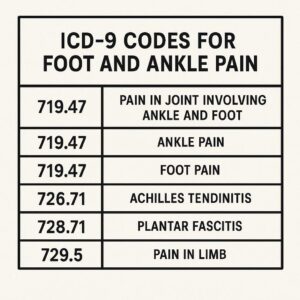
ICD-9 Codes for Foot and Ankle Pain
Understanding the ICD-9-CM System
The International Classification of Diseases, Ninth Revision, Clinical Modification (ICD-9-CM) was the standard system used in the United States to code diagnoses, symptoms, and procedures for decades. It provided a universal “language” for healthcare conditions, enabling consistent billing, tracking of public health trends, and medical research.
“ICD-9 was the backbone of medical data classification for over 30 years. While its specificity was limited compared to modern systems, understanding its structure is key to interpreting a vast archive of historical health information.” – Medical Archival Specialist
A critical limitation of ICD-9 for conditions like musculoskeletal pain was its lack of detail. Codes often represented broad categories, leaving less room for specifying laterality (left or right), exact anatomical site, or underlying etiology in a single code.
Primary ICD-9 Codes for Foot and Ankle Pain
The most common and general ICD-9 code for pain in the limbs was 729.5 – Pain in limb. This was a catch-all category for pain that couldn’t be classified more specifically elsewhere. However, for the foot and ankle, more precise codes were available and preferred for accurate documentation.
Here is a comparative table of the primary ICD-9 codes relevant to foot and ankle pain:
| ICD-9 Code | Code Description | Typical Use Case & Notes |
|---|---|---|
| 719.47 | Pain in joint; ankle and foot | The most specific and commonly used code for pain localized to the ankle joint or the joints of the foot (e.g., tarsal, metatarsophalangeal). |
| 729.5 | Pain in limb | A less specific code used when the pain was not clearly articular (joint-related) or when a more precise code didn’t apply. Often used for generalized foot pain or soft tissue pain. |
| 845.0 | Ankle sprain and strain | Used when the pain was directly attributed to a diagnosed ligamentous injury (sprain) or muscular/tendinous injury (strain) of the ankle. |
| 726.70 | Enthesopathy of ankle and tarsus, unspecified | For pain arising from the entheses (sites where tendons/ligaments attach to bone), such as in certain overuse injuries. Achilles tendinitis would often fall here. |
| 355.8 | Mononeuritis of lower limb, unspecified | Used for nerve pain (e.g., from compression neuropathies) manifesting as pain, burning, or tingling in the foot or ankle. |
Important Note for Readers: The selection of the correct code depended entirely on the physician’s documented diagnosis in the medical record. Coders could not infer a more specific code; they were bound by the clinical documentation.
Breaking Down Code 719.47: Pain in Joint, Ankle and Foot
Code 719.47 was the workhorse for articular pain in the lower extremity. Its structure within the ICD-9 system is insightful:
-
719: The parent category for “Other and unspecified disorders of joint.”
-
.4: The sub-category for “Pain in joint.”
-
.7: The extension specifying the site as “ankle and foot.”
This code was applicable regardless of the underlying cause—whether it was due to osteoarthritis, gout, post-traumatic pain, or an unspecified arthralgia. The lack of causal specificity is a key differentiator from ICD-10.
Documentation and Coding Best Practices in ICD-9
Accurate coding under ICD-9 relied on precise clinical documentation. Here are the elements that were crucial for selecting the right code:
-
Specific Site: Was the pain in the ankle joint, the heel, the forefoot, or generalized?
-
Laterality: While many ICD-9 codes did not specify left or right, some documentation still required it for billing clarity. The code itself (719.47) did not indicate side.
-
Etiology (Cause): Was the pain due to a sprain (845.0), arthritis (coded separately), or unspecified?
-
Manifestation: Was the primary issue pain, or was pain a symptom of a more definitive diagnosis (like fracture or infection)?
A Typical Coding Pathway:
A patient presents with lateral ankle pain after a twisting injury. The physician documents “acute lateral ankle sprain.” The coder would assign 845.00 (Ankle sprain, unspecified) or a more specific code if the grade or ligament was named. The pain is implied by the diagnosis.
Another patient presents with chronic, aching pain in the midfoot joints, with no recent trauma. The physician documents “pain in joints of foot.” The coder would assign 719.47.
The Transition from ICD-9 to ICD-10-CM
On October 1, 2015, the U.S. healthcare system mandated a transition to ICD-10-CM. This was a monumental shift that directly addressed the shortcomings of ICD-9, especially for orthopedic and musculoskeletal conditions.
Key Differences for Foot and Ankle Pain:
-
Dramatically Increased Specificity: ICD-10 uses codes that specify laterality, initial vs. subsequent encounter, and often the underlying cause.
-
Anatomical Precision: Instead of “ankle and foot,” ICD-10 has distinct codes for the ankle, foot, toe(s), and specific joints.
-
Etiology Integration: Many codes combine the symptom (pain) with the known cause.
ICD-9 to ICD-10 Crosswalk
The table below shows approximate mappings from the old ICD-9 codes to their much more specific ICD-10 counterparts. This illustrates the evolution in coding detail.
| ICD-9 Code & Description | Approximate ICD-10-CM Code & Description | Note on Increased Specificity |
|---|---|---|
| 719.47 – Pain in joint, ankle and foot | M25.57- – Pain in joint, ankle and foot | Requires a 7th character extension to specify laterality (e.g., M25.571 for right ankle/foot, M25.572 for left). |
| 729.5 – Pain in limb | M79.67- – Pain in foot and toes | Again, specifies laterality. Other limb pain may map to codes for arm or leg. |
| 845.0 – Ankle sprain | S93.40- – Sprain of unspecified ligament of ankle | ICD-10 codes are found in Chapter 19 (Injury). They require laterality and a 7th character for encounter type (initial, subsequent, sequela). |
| 726.70 – Enthesopathy | M76.6- – Achilles tendinitis | ICD-10 has unique codes for specific enthesopathies (e.g., plantar fasciitis is M72.2). |
Why Historical ICD-9 Knowledge Still Matters
You may wonder why we focus on an outdated system. Here are several practical reasons:
-
Medical Record Reviews: Patients and lawyers often review records from before 2015.
-
Long-Term Disability & Insurance Claims: Some claims span the transition date.
-
Research & Epidemiological Studies: Historical data spanning decades is coded in ICD-9.
-
Understanding Coding Evolution: It provides foundational knowledge for appreciating the structure and logic of modern ICD-10 coding.
Conclusion
Navigating the ICD-9 code for foot or ankle pain primarily leads to 719.47 for joint-related pain or 729.5 for more generalized limb pain, with specific injury codes like 845.0 for sprains. While this system was retired in 2015, its understanding is vital for interpreting older medical information. The transition to ICD-10-CM brought necessary granularity, allowing for precise coding of laterality, encounter, and etiology, ultimately leading to better patient data and care tracking.
Frequently Asked Questions (FAQ)
Q: Can I still use ICD-9 codes on medical bills today?
A: No. For all healthcare services provided on or after October 1, 2015, providers in the U.S. are required by law to use ICD-10-CM codes for diagnosis reporting. Claims submitted with ICD-9 codes for current services will be rejected.
Q: I have an old bill from 2014 with code 719.47. What does it mean?
A: It means your diagnosed condition was “pain in joint, ankle and foot.” There is no indication of left or right side, or the specific cause, within that code itself. You would need to refer to the original medical documentation for those details.
Q: How do I find the modern ICD-10 code for my condition?
A: Patients should always rely on their healthcare provider or the billing department to assign the correct diagnosis code. You can find general code information through reputable sources like the CDC’s ICD-10-CM browser or the American Academy of Professional Coders (AAPC).
Q: Was there a single “foot pain” code in ICD-9?
A: Not a perfect one. 719.47 was for joint pain. 729.5 was for general limb pain. For non-articular foot pain (like plantar fascia or heel pain), 726.70 (enthesopathy) or 729.5 were often used, depending on the documented diagnosis.
Additional Resources
For the most current and official coding information, please visit the Centers for Disease Control and Prevention (CDC) ICD-10-CM page: https://www.cdc.gov/nchs/icd/icd-10-cm.htm
Disclaimer: This article is for informational and educational purposes only. It is not a substitute for professional medical coding advice. Code assignment must be based on official coding guidelines and specific patient documentation. For definitive coding, consult the current ICD-10-CM code set and its official guidelines, or a certified professional coder.