If you’re searching for the “ICD-9 code for head injury,” you’re likely dealing with a historical medical record, an older insurance claim, or perhaps academic research. While the ICD-9-CM (International Classification of Diseases, 9th Revision, Clinical Modification) system was officially retired in the United States in 2015, understanding its structure remains crucial for navigating decades of medical data.
This guide will serve as your definitive resource. We’ll explore the specific ICD-9 codes used for head injuries, explain their logic, and place them in the context of modern medical coding. Our goal is to provide you with clear, accurate, and actionable information, transforming a potentially confusing jumble of numbers into a comprehensible system.
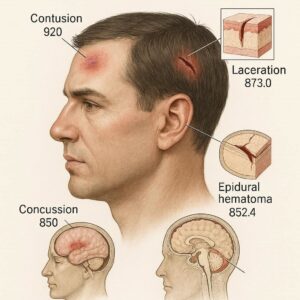
ICD-9 Codes for Head Injury
Table of Contents
ToggleThe Legacy of ICD-9: A System in Context
Before we dive into specific codes, it’s vital to understand what ICD-9 was and why it’s no longer in active use. Introduced in 1979, ICD-9-CM was the standard system for classifying diseases, injuries, and reasons for patient encounters for over 35 years. It assigned unique numeric codes to every diagnosable condition, creating a universal language for healthcare providers, insurers, and researchers.
Dr. Eleanor Vance, Health Informaticist: “ICD-9 was the backbone of health data for a generation. Its limitations in specificity, however, ultimately drove the necessary transition to ICD-10. Working with ICD-9 data today is an exercise in historical medical linguistics.”
The system was replaced by ICD-10-CM on October 1, 2015, due to several critical shortcomings:
-
Lack of Specificity: ICD-9 codes often could not describe the laterality (left, right, bilateral), severity, or exact nature of an injury in detail.
-
Outdated Terminology: It did not accommodate modern medical advances and new diagnoses.
-
Structural Limits: Its numeric structure simply ran out of space for new codes.
Important Note for Readers: If you are coding a current patient encounter or a recent injury, you must use ICD-10-CM. This article focuses on ICD-9 for historical, archival, or research purposes.
Decoding Head Injury in ICD-9: Categories and Specifics
In ICD-9, head injuries are primarily found in Chapter 17: “Injury and Poisoning,” which covers codes 800-999. The coding for head trauma is hierarchical, meaning you start with a broad category and add more digits for greater specificity.
The most general code for a head injury is 959.01 – Head injury, unspecified. However, this is a “catch-all” code used only when no more detailed information is available. Medical coders were required to be as specific as possible.
The primary codes for traumatic head injury fall under two major series:
-
800-804: Fracture of skull
-
850-854: Intracranial injury, including concussion
Let’s break these down with helpful tables.
Major ICD-9 Code Categories for Head Injury
| Code Range | Category Description | Key Details & Examples |
|---|---|---|
| 800 | Fracture of vault of skull | The “vault” is the top part of the skull. Codes specify if the fracture is closed (800.0-800.9) or open (800.1-800.9 with 5th digit). |
| 801 | Fracture of base of skull | The “base” is the bottom part. Similarly detailed by type (closed/open) and associated conditions like intracranial injury. |
| 803 | Other and unqualified skull fractures | For fractures not specified as vault or base. |
| 850 | Concussion | From mild (850.0) to unspecified (850.9). A key code for many common head injuries. |
| 851 | Cerebral laceration and contusion | More severe brain injuries involving physical tearing or bruising of brain tissue. |
| 852 | Subarachnoid, subdural, and extradural hemorrhage | Codes for different types of bleeding in the spaces surrounding the brain. |
| 854 | Intracranial injury of other and unspecified nature | For injuries that don’t fit the categories above. |
| 959.01 | Head injury, unspecified | Used only when no more specific information is documented. |
Specificity Through Digits: How ICD-9 Codes Were Built
ICD-9 codes could be 3, 4, or 5 digits long. The more digits, the more specific the description. Let’s use concussion as an example:
-
850 – Concussion (3-digit, general category)
-
850.0 – Concussion with no loss of consciousness (4-digit, more specific)
-
850.11 – Concussion, with loss of consciousness of 30 minutes or less (5-digit, most specific)
Common Specific ICD-9 Codes for Head Injury
| ICD-9 Code | Full Description | Typical Use Case |
|---|---|---|
| 850.0 | Concussion, without mention of loss of consciousness | Patient hits head, is dazed but never blacks out. |
| 850.11 | Concussion, with loss of consciousness of 30 minutes or less | Patient is knocked out for a few minutes after a fall. |
| 851.00 | Cerebral laceration and contusion, without mention of open intracranial wound, unspecified state of consciousness | Brain scan shows bruising or tearing, no detail on LOC. |
| 852.00 | Subarachnoid hemorrhage following injury, without mention of open intracranial wound, unspecified state of consciousness | Bleeding into the space filled with cerebrospinal fluid. |
| 800.0 | Closed fracture of vault of skull without mention of intracranial injury | Simple, non-compound skull fracture. |
| 801.0 | Closed fracture of base of skull without mention of intracranial injury | Fracture at the skull’s base, no brain injury noted. |
| 959.01 | Head injury, unspecified | Used only when clinical documentation is severely lacking. |
Key Differences Between ICD-9 and ICD-10 for Head Injury
Understanding why ICD-9 was replaced is easier when you see a direct comparison. ICD-10’s granularity is vastly superior for clinical care and data analysis.
ICD-9 vs. ICD-10 for a Concussion
| Aspect | ICD-9-CM | ICD-10-CM |
|---|---|---|
| Code Structure | Primarily numeric (850.11) | Alphanumeric (S06.0X1A) |
| Specificity | Limited. Mainly by length of loss of consciousness. | Extremely detailed. |
| Laterality | Not specified. | Built into the code (e.g., right, left, bilateral). |
| Episode of Care | Not specified. | Clearly indicated via 7th character (e.g., initial encounter, subsequent encounter, sequela). |
| Example Code | 850.11 (Concussion, LOC ≤ 30 min) | S06.0X1A – Concussion with loss of consciousness of 30 minutes or less, initial encounter. |
| Total Codes | ~20 codes directly for concussion/head injury. | Hundreds of combinations for traumatic brain injuries, allowing precise description. |
Coding Professional’s Insight: “With ICD-9, you were often painting with a broad brush. With ICD-10, you have a fine-tip pen. For a concussion, ICD-10 tells us which side was affected, how long the patient was out, and whether this is the first visit or a follow-up—all in one code. This depth changes everything for treatment tracking and outcomes research.”
Practical Guide: How to Find the Right ICD-9 Code
If you are tasked with identifying an ICD-9 code from an old record, follow this logical process:
-
Identify the Primary Injury: What is the core diagnosis? (e.g., Concussion, Skull Fracture, Brain Hemorrhage).
-
Consult the Documentation: Look for critical details in the clinical notes:
-
Type: Fracture (open/closed), hemorrhage (subdural, etc.), concussion.
-
Location: Vault or base of skull? Which lobe of the brain?
-
Severity: Was there loss of consciousness? If so, for how long?
-
Associated Conditions: Is there an open wound? Other injuries?
-
-
Navigate the Code Hierarchy: Start with the 3-digit category (e.g., 850 for concussion), then use the 4th and 5th digits to specify.
-
Use an Official Index: While online tools exist, for definitive historical work, refer to a physical or PDF copy of the *ICD-9-CM Official Guidelines for Coding and Reporting*.
Helpful List: Common Documentation Pitfalls to Avoid
-
Using 959.01 (Head injury, unspecified) when a more specific code is available in the record.
-
Confusing 850.x (Concussion) with 854.0 (Intracranial injury without skull fracture).
-
Miscoding the 5th digit for fractures, which is crucial for indicating open vs. closed injuries and complications.
-
Overlooking the need for an E-code (External Cause of Injury code from the 800-999 range) to describe how the injury occurred (e.g., fall, vehicle accident).
The Transition to ICD-10 and Why It Matters
The shift from ICD-9 to ICD-10 was not merely a bureaucratic update. It represented a fundamental leap in how healthcare data is captured. For head injuries, this means:
-
Better Patient Care: More precise codes lead to clearer communication among providers and more tailored treatment plans.
-
Enhanced Public Health Tracking: Researchers can now track the exact types and causes of brain injuries with far greater accuracy, informing prevention programs.
-
Improved Reimbursement Accuracy: Specific coding reduces claim denials and ensures providers are compensated appropriately for the complexity of care.
While you may be searching for an ICD-9 code today, understanding this evolution underscores the importance of precise medical documentation in any era.
Conclusion
Navigating the ICD-9 code for a head injury requires understanding its now-retired hierarchical system, where codes like 850.11 for concussion or 800.0 for skull fracture provided basic specificity. This legacy system, crucial for interpreting decades of medical data, was fundamentally limited and was replaced in 2015 by the far more detailed ICD-10-CM. Whether for historical analysis or completing old records, accuracy hinges on matching the precise clinical details to the most specific code available within the ICD-9 framework.
Frequently Asked Questions (FAQ)
Q: Can I still use ICD-9 codes for billing today?
A: No. As of October 1, 2015, all HIPAA-covered entities in the United States must use ICD-10-CM for diagnosis coding. Using ICD-9 will result in claim rejections.
Q: I have an old medical record that just says “head injury.” What code should I use?
A: In that case, the appropriate ICD-9 code would be 959.01 – Head injury, unspecified. However, this highlights the poor documentation practices that ICD-10 aimed to correct.
Q: Where can I find an official list of all ICD-9 codes?
A: The Centers for Medicare & Medicaid Services (CMS) maintains an archive of the ICD-9-CM Official Guidelines. You can find these and code tables on the CMS website or through reputable medical coding resource sites.
Q: Is there a simple crosswalk from ICD-9 to ICD-10 for head injuries?
A: There are general equivalency mappings (GEMs), but they are not one-to-one. Due to ICD-10’s greater detail, one ICD-9 code often maps to many possible ICD-10 codes. The correct ICD-10 code must be chosen based on the full clinical picture.
Q: Why was the ICD-9 system so limited?
A: It was designed in an earlier era of medicine. Its numeric structure (max 5 digits) and clinical assumptions could not keep pace with modern diagnostics, treatments, and the need for granular data for quality measurement and research.
Additional Resources
For those looking to delve deeper into historical coding or understand the current system, we recommend:
-
The CDC’s ICD-9-CM Archive: https://www.cdc.gov/nchs/icd/icd9cm.htm – The definitive government resource for archived ICD-9 information.
-
The American Health Information Management Association (AHIMA): https://www.ahima.org/ – The premier association for medical coding professionals, offering educational materials on coding fundamentals and transitions.
-
National Center for Health Statistics (NCHS) ICD-10-CM Page: https://www.cdc.gov/nchs/icd/icd-10-cm.htm – To understand the current coding standard that replaced ICD-9.
Date: January 28, 2026
Disclaimer: This article is for informational purposes only. Medical coding is complex and dynamic. Always consult the most current official coding manuals and a certified professional for accurate billing and clinical documentation.