Navigating the world of medical coding can feel like learning a new language. If you’re reviewing an old medical bill, researching a family history, or simply trying to understand a diagnosis from years past, you’ve likely encountered the term “ICD-9 code for heart failure.” While this coding system is no longer in active use, it remains a vital piece of medical and administrative history.
This guide will provide you with a clear, thorough, and reliable explanation of the ICD-9 codes related to heart failure. We’ll explore what these codes meant, why they were important, and how healthcare has transitioned to the modern ICD-10 system. Our goal is to turn complex coding information into accessible knowledge you can actually use.
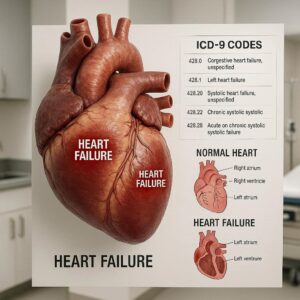
ICD-9 Code for Heart Failure
What Was the ICD-9 Coding System?
Before we dive into the specific codes, let’s set the stage. The International Classification of Diseases, 9th Revision, Clinical Modification (ICD-9-CM) was the standard system used in the United States to classify and code all diagnoses, symptoms, and procedures from 1979 until October 1, 2015.
Think of it as a massive, standardized dictionary for diseases. Every possible health condition was assigned a unique numeric code. This served critical purposes:
-
Billing and Insurance: Codes were essential for submitting claims to insurance companies.
-
Medical Records: They provided a shorthand for documenting a patient’s condition in their chart.
-
Tracking and Research: Public health officials used aggregated code data to track disease trends, like the prevalence of heart failure across the country.
On October 1, 2015, the U.S. healthcare system officially transitioned to ICD-10-CM, a much more detailed and modern system. However, understanding ICD-9 is still necessary for dealing with records from before that date.
The Specific ICD-9 Codes for Heart Failure
In the ICD-9 universe, heart failure fell under a larger category called “Diseases of the Circulatory System.” The specific code range for heart failure was 428.
This wasn’t just one code; it was a series of codes that allowed doctors to specify the type and nature of the heart failure. Here is the complete breakdown:
ICD-9 Code 428: Heart Failure
-
428.0: Congestive heart failure, unspecified. This was the most general code, used when the heart failure was described as “congestive” but no further detail was specified. Congestion refers to the backup of fluid into the lungs and other tissues.
-
428.1: Left heart failure. This code indicated failure of the left ventricle. This often leads to pulmonary edema (fluid in the lungs), causing shortness of breath.
-
428.2: Systolic heart failure. This specified that the problem was with the heart’s systolic function—its ability to contract and pump blood out to the body. It is often measured by a reduced ejection fraction (EF).
-
428.3: Diastolic heart failure. This code indicated a problem with the heart’s diastolic function—its ability to relax and fill with blood. The pumping strength might be preserved, but the chamber doesn’t fill properly.
-
428.4: Combined systolic and diastolic heart failure. This code was used when both pumping and filling functions were impaired.
-
428.9: Heart failure, unspecified. This was a catch-all code for when the type of heart failure (congestive, systolic, diastolic) was not documented.
Comparative Table: ICD-9 Codes for Heart Failure
| ICD-9 Code | Code Description | Clinical Meaning & Typical Presentation |
|---|---|---|
| 428.0 | Congestive heart failure, unspecified | General diagnosis of CHF with fluid buildup; symptoms like edema, fatigue, and shortness of breath. |
| 428.1 | Left heart failure | Failure of the left ventricle; primary symptom is often acute pulmonary edema and severe breathlessness. |
| 428.2 | Systolic heart failure (HFrEF) | Impaired contraction; heart can’t pump effectively. Diagnosed with low ejection fraction. |
| 428.3 | Diastolic heart failure (HFpEF) | Impaired relaxation; heart can’t fill properly. Ejection fraction is often preserved. |
| 428.4 | Combined systolic & diastolic failure | Both pumping and filling are compromised. A mixed presentation. |
| 428.9 | Heart failure, unspecified | Used when documentation lacks detail on the nature of the failure. |
Important Note for Readers: If you are looking at a current medical document or billing statement (from after October 1, 2015), it will not use ICD-9 codes. The information above is primarily for historical understanding or for dealing with older records.
Why the Transition to ICD-10 Was Necessary
The shift from ICD-9 to ICD-10 wasn’t just an administrative update; it was a necessary leap forward for patient care and precision. ICD-9 had become severely limited.
-
It Ran Out of Space: The structure could not accommodate new diseases or procedures.
-
Lacked Detail: A code like 428.0 for “congestive heart failure” told you very little about the cause, severity, or specific type, which is crucial for modern treatment plans.
-
Hindered Data Quality: Vague codes led to poor-quality health data, hampering research and public health initiatives.
As one healthcare policy analyst put it, *”Using ICD-9 in the 21st century was like trying to navigate a modern city with a paper map from the 1980s. It gave you a basic outline, but you’d miss all the new roads, traffic patterns, and important details needed to get where you’re going effectively.”*
The Modern Equivalent: ICD-10 Codes for Heart Failure
Today, heart failure is coded under category I50 in the ICD-10-CM system. The increase in specificity is dramatic. Where ICD-9 had 6 codes for heart failure, ICD-10 has over 20, allowing for incredibly precise documentation.
Here are some key examples of how the old general codes translate into the new, detailed ones:
-
ICD-9 428.0 (Unspecified CHF) might map to several ICD-10 codes depending on the chart details, such as I50.9 (Heart failure, unspecified).
-
ICD-9 428.2 (Systolic HF) now has specific codes like I50.21 (Acute systolic heart failure) or I50.22 (Chronic systolic heart failure).
-
ICD-9 428.3 (Diastolic HF) expands to codes like I50.31 (Acute diastolic heart failure) and I50.32 (Chronic diastolic heart failure).
-
ICD-9 428.4 (Combined HF) is now I50.41 (Acute combined heart failure) or I50.42 (Chronic combined heart failure).
Furthermore, ICD-10 introduces codes for very specific scenarios, such as I50.811 (Right heart failure due to left heart failure) and I50.83 (High output heart failure).
Helpful List: Key Differences Between ICD-9 and ICD-10 for Heart Failure
-
Specificity: ICD-10 specifies acuity (acute vs. chronic), type (systolic, diastolic, combined), and laterality.
-
Etiology: While the main codes don’t always include cause, ICD-10’s structure better allows for linking heart failure to underlying conditions like hypertension (I11.0) or kidney disease.
-
Number of Codes: ICD-9 offered ~6 options; ICD-10 offers over 20 just within the I50 category.
-
Code Format: ICD-9 codes were purely numeric (428.1). ICD-10 codes are alphanumeric, starting with a letter (I50.21).
Practical Implications: What This Means for You
You might wonder why this historical coding detail matters to you as a patient, caregiver, or researcher.
-
Understanding Old Records: If you are compiling or reviewing medical history from before 2015, you will see ICD-9 codes. This guide helps you decipher what they meant.
-
Appealing Old Bills: If disputing an old insurance claim, knowing the code and its correct application can be powerful.
-
Researching Family History: Understanding that a relative had “428.1 – Left heart failure” provides more insight than just “heart trouble.”
-
Appreciating Modern Care: The granularity of ICD-10 reflects modern medicine’s move toward personalized, precise treatment plans. Your doctor’s diagnosis is now captured with much greater accuracy.
A Crucial Reminder: Always consult with a healthcare professional or a certified medical coder for the interpretation of specific codes in a medical or billing context. This article is an educational guide, not professional medical or coding advice.
Conclusion
The ICD-9 code for heart failure, primarily within the 428 series, served as a foundational tool for decades of healthcare documentation. While now retired, it remains a key to unlocking the past, helping us understand historical medical data. The transition to the detailed ICD-10 system marks a significant advancement, enabling better patient care, more accurate billing, and richer health data for the future.
Frequently Asked Questions (FAQ)
Q: Can doctors still use ICD-9 codes today?
A: No. For all healthcare services provided on or after October 1, 2015, providers in the U.S. are required by law to use ICD-10-CM codes for diagnosis coding. ICD-9 is obsolete for current care and billing.
Q: I have an old bill with code 428.0. What does that mean?
A: Code 428.0 stood for “Congestive heart failure, unspecified.” It was used when a healthcare provider diagnosed you with congestive heart failure but did not specify further (e.g., whether it was systolic or diastolic) in the documentation sent to the billing department.
Q: How do I find out the current ICD-10 code for my heart failure?
A: Your current diagnosis code should be listed on any recent explanation of benefits (EOB) from your insurance company or on detailed billing statements from your healthcare provider. You can also ask your doctor’s office or the hospital’s medical records department for this information.
Q: Why are there so many more ICD-10 codes for heart failure?
A: ICD-10 codes capture much more clinical detail, such as whether the heart failure is acute or chronic, systolic or diastolic, and if it involves the right or left side of the heart. This specificity improves treatment planning, outcomes tracking, and medical research.
Additional Resources
-
The Centers for Medicare & Medicaid Services (CMS) ICD-10 Code Lookup Tool: A free, official resource to look up current ICD-10 codes. https://www.cms.gov/medicare/coding-billing/icd-10-codes
-
American Heart Association – Heart Failure Information: Authoritative patient-friendly information on symptoms, types, and treatment of heart failure. https://www.heart.org/en/health-topics/heart-failure
Disclaimer: The information contained in this article is for educational and informational purposes only and is not intended as medical or coding advice. Always seek the advice of your physician or other qualified health provider with any questions you may have regarding a medical condition or treatment. For specific coding guidance, consult a certified professional coder.
Author: The Web Health Research Team
Date: January 28, 2026