If you’re delving into older medical records, conducting research, or simply trying to understand a patient’s history, you might encounter the term “ICD-9 code for hip fracture.” While the healthcare world transitioned to ICD-10-CM years ago, knowledge of the ICD-9 system remains crucial for working with historical data. This guide provides a complete, human-written exploration of these specific codes, designed to help you navigate them with confidence.
We’ll walk you through the precise codes, break down what they mean, and explain why this knowledge still matters today. Our goal is to make this technical topic clear and accessible, whether you’re a medical coder, a healthcare administrator, a student, or a curious patient.
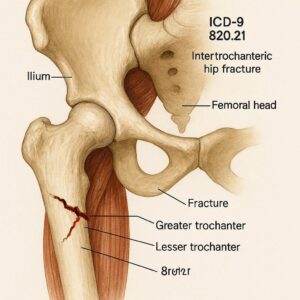
ICD-9 Codes for Hip Fracture
Understanding the ICD-9-CM System: A Brief Backdrop
Before we dive into the specific codes, it’s helpful to understand their origin. The International Classification of Diseases, 9th Revision, Clinical Modification (ICD-9-CM) was the diagnostic coding standard used in the United States for decades until October 1, 2015. On that date, the U.S. officially adopted ICD-10-CM, a much more detailed and modern system.
Think of ICD-9 as an older, more limited filing system. It used codes that were typically 3 to 5 digits long. A hip fracture, for instance, always fell under the 820.xx series. The challenge with ICD-9 was its lack of specificity—it often couldn’t distinguish between laterality (left or right) or the exact type of fracture with the granularity that modern medicine and billing require.
Why It Still Matters: “While ICD-9 is archived, it is not extinct. Accurate historical data analysis, longitudinal studies on patient outcomes, and understanding trends in orthopedic care all depend on correctly interpreting these legacy codes.” – Healthcare Data Archivist.
Important Note: You cannot use ICD-9-CM codes for any current medical billing or reporting on services after October 1, 2015. Their use today is strictly for historical review, research, or handling older records.
The Complete ICD-9 Code Set for Hip Fracture (820.xx)
In the ICD-9-CM universe, all hip fracture diagnoses are found in one neighborhood: Category 820. This category is explicitly titled “Fracture of neck of femur” (the medical term for the thigh bone’s upper portion). The codes within this category become more specific based on the anatomical site of the fracture and whether it is “closed” (the skin is intact) or “open” (the bone has broken through the skin, posing a higher risk of infection).
Here is the complete breakdown in a clear, comparative table.
ICD-9-CM Codes for Hip Fracture: A Detailed Table
| ICD-9 Code | Code Description | Clinical Meaning & Common Terminology |
|---|---|---|
| 820.00 | Closed fracture of unspecified intracapsular section of neck of femur | A fracture inside the hip joint capsule where the skin is not broken. The exact type (e.g., subcapital) is not specified in the record. |
| 820.01 | Closed fracture of epiphysis (separation) (upper) of neck of femur | A fracture at the growth plate (epiphysis) of the femoral head, typically seen in younger patients. Closed. |
| 820.02 | Closed fracture of midcervical section of neck of femur | A fracture in the middle of the femoral neck. Closed. |
| 820.03 | Closed fracture of base of neck of femur | A fracture at the base of the femoral neck, where it meets the trochanters. Closed. |
| 820.09 | Closed fracture of other specified part of neck of femur | A closed fracture of another specified part of the femoral neck not described above. |
| 820.10 | Open fracture of unspecified intracapsular section of neck of femur | A fracture inside the hip joint capsule where the bone penetrates the skin. The exact type is unspecified. |
| 820.11 | Open fracture of epiphysis (separation) (upper) of neck of femur | An open fracture at the growth plate of the femoral head. |
| 820.12 | Open fracture of midcervical section of neck of femur | An open fracture in the middle of the femoral neck. |
| 820.13 | Open fracture of base of neck of femur | An open fracture at the base of the femoral neck. |
| 820.19 | Open fracture of other specified part of neck of femur | An open fracture of another specified part of the femoral neck. |
| 820.20 | Closed fracture of unspecified trochanteric section of femur | A fracture in the trochanteric region (the bony prominences near the top of the femur), closed. The specific trochanter is not stated. |
| 820.21 | Closed fracture of intertrochanteric section of femur | A closed fracture between the greater and lesser trochanters. This is a very common type of hip fracture in the elderly. |
| 820.22 | Closed fracture of subtrochanteric section of femur | A closed fracture just below the lesser trochanter. |
| 820.30 | Open fracture of unspecified trochanteric section of femur | An open fracture in the trochanteric region, unspecified. |
| 820.31 | Open fracture of intertrochanteric section of femur | An open intertrochanteric fracture. |
| 820.32 | Open fracture of subtrochanteric section of femur | An open subtrochanteric fracture. |
| 820.8 | Fracture of unspecified part of neck of femur, closed | A closed fracture of the femoral neck where the part is truly not documented. |
| 820.9 | Fracture of unspecified part of neck of femur, open | An open fracture of the femoral neck where the part is not documented. |
Breaking Down the Code Structure: What Each Part Tells You
Reading an ICD-9 code is like deciphering a short, precise message. Let’s take 820.21 as our example:
-
820: The category. This tells us we are dealing with a fracture of the neck of the femur (hip fracture).
-
.2: The fourth digit. This digit specifies the general location. A “.2” or “.3” indicates a trochanteric fracture, while a “.0”, “.1”, or “.8/.9” indicates an intracapsular (femoral neck) fracture.
-
.1: The fifth digit. This is the most specific level in ICD-9. A “.1” in the trochanteric group points specifically to an intertrochanteric fracture.
The documentation in the patient’s medical record—the surgeon’s operative report, the radiologist’s findings, the emergency department notes—dictates which of these specific codes is assigned. Poor documentation often led to the use of unspecified codes like 820.00 or 820.20.
Key Documentation Points for Accurate Coding (A Historical Lens)
From the perspective of a coder working with older records, these were the critical pieces of information they needed to find:
-
Site Specificity: Was the fracture in the femoral neck or the trochanteric region? If femoral neck, was it subcapital, midcervical, or basilar?
-
Open vs. Closed: This was a paramount distinction. The term “compound fracture” was often used synonymously with “open fracture.”
-
Laterality (Left/Right): This is a crucial point of difference with ICD-10. ICD-9 codes for hip fracture did NOT indicate whether the fracture was on the left or right side. This information was either implied by other data on the claim form or simply not captured in the code itself, a significant limitation for data analysis.
ICD-9 vs. ICD-10: A World of Difference
The transition to ICD-10-CM was revolutionary for orthopedic coding. The difference in specificity is stark. Let’s compare.
ICD-9-CM Example:
820.21 – Closed fracture of intertrochanteric section of femur.
That’s it. We don’t know left or right, the exact type of intertrochanteric fracture, or the encounter type (initial, subsequent, sequela).
ICD-10-CM Equivalent (Example):
S72.144A – Nondisplaced intertrochanteric fracture of right femur, initial encounter for closed fracture.
S72.144B – …initial encounter for open fracture type I or II.
S72.144D – …subsequent encounter for closed fracture with routine healing.
The ICD-10 code tells a complete story: the injury (S72), the specific type (144), the side (right), the encounter (A, B, D), and even details about the open fracture classification.
Why Knowing ICD-9 Hip Fracture Codes is Still Relevant
You might wonder why we’re discussing an outdated system. The reasons are practical and important:
-
Research and Epidemiology: Many landmark studies on hip fracture incidence, mortality, and treatment outcomes were conducted using ICD-9 data. To interpret this research accurately, you need to understand what the codes represented.
-
Historical Patient Records: Patients with a hip fracture in 2014 will have that condition documented with an ICD-9 code in their permanent health record. Understanding that code is key to understanding their full medical history.
-
Data Migration and Analysis: Healthcare organizations often analyze trends over time. Converting or understanding legacy ICD-9 data is essential for creating accurate long-term reports.
-
Learning Progression: For students and new coders, understanding the limitations of ICD-9 highlights the advantages and logic of the ICD-10 system.
A Practical Scenario: From Record to Code
Let’s see how this worked in practice before 2015.
Clinical Scenario: An 82-year-old female presents to the ED after a fall at home. An X-ray reveals a broken hip. The radiologist’s report states: “Comminuted, displaced intertrochanteric fracture of the left femur. No evidence of open wound.“
ICD-9-CM Coding Process:
-
Identify the category: Hip fracture = Category 820.
-
Determine the site: “Intertrochanteric” points to the trochanteric subcategory (.2x or .3x).
-
Determine open/closed: “No evidence of open wound” = Closed (.2x).
-
Select the fifth digit: “Intertrochanteric” specifically = .1.
-
Final Code: 820.21 (Closed fracture of intertrochanteric section of femur).
Notice that the code does not capture “comminuted,” “displaced,” or “left.” That specificity was lost at the coding level.
Frequently Asked Questions (FAQ)
Q: What is the most common ICD-9 code for a hip fracture in the elderly?
A: While it depended on the patient population, 820.21 (closed intertrochanteric fracture) and 820.8 (closed unspecified femoral neck fracture) were among the most frequently used codes due to the high incidence of these fracture types in older adults.
Q: Can I use an ICD-9 code on a current medical claim?
A: Absolutely not. As of October 1, 2015, all HIPAA-covered transactions (claims, referrals, authorizations) must use ICD-10-CM codes. Using an ICD-9 code will result in claim rejection.
Q: Why didn’t ICD-9 codes specify left or right?
A: The ICD-9-CM system was developed in an earlier era of medicine and billing where that level of detail was not deemed necessary for core classification. This was one of the major drivers for creating ICD-10-CM.
Q: How do I convert an old ICD-9 code to ICD-10?
A: There is no simple 1-to-1 conversion. You must start with the original clinical documentation (or the code description) and select the appropriate, highly specific ICD-10-CM code based on current guidelines. The U.S. Centers for Medicare & Medicaid Services (CMS) provided general equivalence mappings (GEMs) as a tool, but they are guides, not direct converters.
Q: Where can I find the official, archived ICD-9-CM code set?
A: The U.S. Centers for Disease Control and Prevention (CDC) maintains the official archive of ICD-9-CM. You can access it through the CDC’s National Center for Health Statistics website.
Conclusion
Navigating the ICD-9 codes for hip fracture, centered on the 820.xx series, is key to interpreting decades of healthcare data. These codes provided a foundational but less specific way to classify femoral neck and trochanteric fractures, without indicating laterality. While replaced by the detailed ICD-10-CM system for current use, understanding ICD-9 remains vital for accurate historical analysis, research, and comprehensive patient history review in today’s medical landscape.
Additional Resources
For the official archive of ICD-9-CM and information on ICD-10-CM, visit the Centers for Disease Control and Prevention (CDC) National Center for Health Statistics ICD Code Sets page: https://www.cdc.gov/nchs/icd/ (This is a genuine, reputable source for code set information).