For healthcare professionals, medical coders, and even patients navigating older medical records, understanding historical coding systems is crucial. The International Classification of Diseases, 9th Revision (ICD-9), was the cornerstone of medical diagnosis coding in the United States for decades before its retirement. Within its framework, insomnia, a pervasive sleep disorder, had its specific place. This article serves as a comprehensive, one-stop resource on the ICD-9 code for insomnia. We’ll explore not just the code itself, but its context, proper application, and its evolution into the modern ICD-10 system.
ICD-9 Code for Insomnia
What Was the ICD-9 Code for Insomnia?
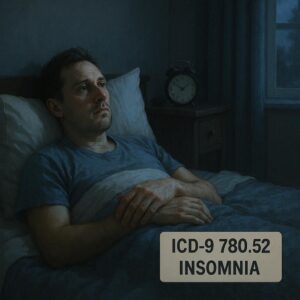
The primary ICD-9-CM (Clinical Modification) code used for diagnosing insomnia was 780.52.
Let’s break down what this code signifies:
-
780: This is the chapter code for “Symptoms, signs, and ill-defined conditions.” This category housed codes for general symptoms that weren’t attributed to a more specific disease process.
-
.5: This fifth digit further specifies the symptom as relating to “Sleep disturbances.”
-
.52: The final digit pinpoints the specific disturbance as “Insomnia, unspecified.”
It’s vital to note that 780.52 was designated for “unspecified insomnia.” This code was typically used when a physician documented insomnia as a primary complaint or significant symptom without specifying a particular subtype (like insomnia due to a mental disorder or a medical condition).
How the ICD-9 Code for Insomnia Was Structured
The ICD-9-CM system used a 3-5 digit coding structure. Here’s how the insomnia code fits in:
| Code Range | Category Description | Specific Code & Name |
|---|---|---|
| 780-789 | Symptoms, signs, and ill-defined conditions | |
| 780.5 | Sleep disturbances | |
| 780.50 | Sleep disturbance, unspecified | |
| 780.51 | Insomnia with sleep apnea (this was a distinct code) | |
| 780.52 | Insomnia, unspecified | |
| 780.53 | Hypersomnia, unspecified | |
| 780.54 | Circadian rhythm sleep disorder | |
| 780.55 | Disruptions in 24-hour sleep-wake cycle | |
| 780.56 | Dysfunctions associated with sleep stages or arousal | |
| 780.57 | Other and unspecified sleep apnea | |
| 780.58 | Sleep related movement disorder | |
| 780.59 | Other sleep disturbances |
Important Clinical and Coding Notes
“In the ICD-9 era, accurate coding depended heavily on physician documentation. Coders were instructed to use 780.52 for ‘insomnia NOS’ (not otherwise specified) or when it was documented as a primary symptom. If the insomnia was clearly linked to another condition, that condition’s code took precedence.” – A Veteran Medical Coder’s Perspective.
-
Primary vs. Secondary: Insomnia was often a secondary symptom. The coding guidelines emphasized that if the insomnia was due to a known mental disorder (like major depressive disorder, code 296.2x) or a physical condition (like chronic pain, code 338.2x), the code for the underlying condition was listed as the primary diagnosis. Code 780.52 might be listed as an additional code if the insomnia was a significant focus of treatment.
-
Specificity Limitations: A key limitation of ICD-9 was its lack of granularity. Code 780.52 did not convey:
-
The severity (acute, chronic).
-
The specific type (onset, maintenance, early morning awakening).
-
The precise etiology, unless a separate code for another condition was added.
-
Why Knowing About ICD-9 Codes Still Matters
You might wonder why we’re discussing a retired coding system. Here are several compelling reasons:
-
Historical Medical Records: Millions of patient records from before October 2015 are coded in ICD-9. Healthcare professionals, researchers, and legal teams often need to access and interpret these records accurately.
-
Understanding Coding Evolution: Seeing the simplicity of ICD-9 (780.52) next to the complexity of ICD-10 highlights the massive strides made in clinical specificity and data capture in healthcare.
-
Insurance and Legal Reviews: Older disability claims, insurance disputes, or workers’ compensation cases may reference ICD-9 codes. Understanding them is essential for proper review.
-
Professional Knowledge: For seasoned medical coders and billers, this knowledge is part of their professional foundation and is often tested in comprehensive exams or job interviews.
The Transition from ICD-9 to ICD-10 for Insomnia
On October 1, 2015, the U.S. healthcare system mandatorily transitioned from ICD-9-CM to ICD-10-CM. This was not a simple update; it was a complete overhaul designed to provide vastly greater detail.
The fundamental difference: ICD-9 categorized insomnia as a “symptom,” while ICD-10 reclassifies it under “Mental, Behavioral and Neurodevelopmental disorders” (Chapter F51) and “Diseases of the nervous system” (Chapter G47), reflecting a better understanding of its etiology.
ICD-9 to ICD-10 Crosswalk for Insomnia
The table below shows the dramatic expansion in coding options. There is no single direct crosswalk; instead, 780.52 maps to several more specific codes in ICD-10.
| ICD-9 Code & Name | Corresponding ICD-10-CM Code(s) & Names | Key Difference / Advancement |
|---|---|---|
| 780.52 – Insomnia, unspecified | F51.01 – Insomnia due to mental disorder | Now specifies a psychological cause. |
| F51.09 – Other insomnia not due to a substance or known physiological condition | Captures primary insomnia. | |
| G47.00 – Insomnia, unspecified | Used when insomnia is of physiological origin or unspecified. | |
| G47.01 – Insomnia due to medical condition | Links insomnia directly to a diagnosed medical problem. | |
| G47.09 – Other insomnia | For other specified physiological insomnias. | |
| 780.51 – Insomnia with sleep apnea | G47.30 – Sleep apnea, unspecified Plus an additional code from G47.0- for insomnia. |
Separates the two distinct but often co-occurring disorders, allowing for dual coding that paints a clearer clinical picture. |
This crosswalk illustrates the core philosophy of ICD-10: specificity. A coder must now ask: Is the insomnia primary or secondary? Is it due to a mental health issue, a medical condition, a substance, or is it unspecified?
A Practical Guide: How Insomnia Was Coded Under ICD-9
Let’s walk through a few realistic scenarios a coder might have faced prior to 2015.
Scenario 1: The Primary Complaint
-
Documentation: Patient presents complaining of “trouble falling and staying asleep for the past 3 months. No other significant medical or psychiatric history noted. Diagnosis: Insomnia.”
-
ICD-9 Coding: 780.52 (Insomnia, unspecified). This was the appropriate catch-all code.
Scenario 2: Insomnia with Depression
-
Documentation: Patient with established major depressive disorder presents with worsened sleep, describing early morning awakening. Physician notes “Insomnia secondary to major depressive disorder, recurrent episode.”
-
ICD-9 Coding: 296.2x (Major depressive disorder, single or recurrent episode) as the primary diagnosis. Code 780.52 might be added as a secondary code if the insomnia required separate clinical attention, but often it was not necessary.
Scenario 3: Insomnia with Chronic Pain
-
Documentation: Patient with chronic lower back pain (724.2) reports severe pain at night preventing sleep.
-
ICD-9 Coding: 724.2 (Lumbago) as the primary diagnosis. The insomnia is considered an integral part of the pain symptom and would not typically be assigned a separate code unless explicitly documented as a separate, severe problem.
Limitations of the ICD-9 System for Sleep Disorders
The ICD-9 system, while functional for its time, had significant drawbacks for capturing sleep medicine data:
-
Lack of Detail: As shown, one code (780.52) covered a vast array of insomnia experiences.
-
Etiological Blindness: The code did not indicate cause, hindering epidemiological research into the roots of sleep problems.
-
Poor Reimbursement Specificity: With vague coding, payers had less insight into the complexity of a patient’s condition, which could impact reimbursement for sleep studies or specialized therapies.
-
Co-morbidity Confusion: Coding insomnia with sleep apnea (780.51) as a single entity was clinically imprecise.
The Modern Context: Insomnia Coding Today with ICD-10-CM
Today, using ICD-10-CM is non-negotiable for all HIPAA-covered transactions. Here’s a quick primer on how to think about insomnia coding in the current system:
-
Determine the Cause:
-
F51.0- Codes (Mental/Behavioral): Use these when the insomnia is attributed to anxiety, depression, adjustment disorder, or other mental factors without a concurrent physiological cause.
-
G47.0- Codes (Physiological/Medical): Use these when the insomnia is due to a medical condition (e.g., COPD, heart failure, Parkinson’s), a substance (with additional codes for the substance), or is considered primary insomnia of a physiological nature.
-
-
Utilize Additional Specifiers: ICD-10 allows for laterality, severity, and other specifics, though these are used less frequently for insomnia than for other conditions.
-
Code All that is Documented: A patient could legitimately have both F51.01 (Insomnia due to anxiety disorder) and G47.01 (Insomnia due to chronic pain), requiring multiple codes to tell the full story.
Helpful List: Common ICD-10 Codes for Insomnia
-
F51.01: Insomnia due to mental disorder
-
F51.09: Other insomnia not due to a substance or known physiological condition
-
G47.00: Insomnia, unspecified
-
G47.01: Insomnia due to medical condition
-
G47.09: Other insomnia
-
G47.10: Central sleep apnea
-
G47.30: Sleep apnea, unspecified (often used with a G47.0- code for comorbid insomnia)
Conclusion
The ICD-9 code for insomnia, 780.52, was a functional but non-specific placeholder in a bygone era of medical coding. Its transition to the detailed, multi-axial codes of ICD-10-CM reflects the advancement of sleep medicine and the healthcare industry’s need for precise data. While historical codes like 780.52 remain key to interpreting older records, mastering the nuanced structure of ICD-10 is essential for accurate diagnosis coding, effective patient care, and proper reimbursement in today’s clinical landscape.
Frequently Asked Questions (FAQ)
Q: Can I still use the ICD-9 code 780.52 on medical claims today?
A: No. As of October 1, 2015, all HIPAA-covered entities (physicians, hospitals, insurers) in the U.S. are required to use ICD-10-CM for diagnosis coding. Using ICD-9 will result in claim rejection.
Q: I found 780.52 on an old medical record. What does it mean?
A: It means the patient was diagnosed with or reported insomnia at that time. The record should include the physician’s notes for context on severity and possible causes, as the code itself does not provide that detail.
Q: Is there a direct, one-to-one conversion from 780.52 to an ICD-10 code?
A: No. There is no perfect equivalent. The appropriate ICD-10 code depends entirely on the clinical details in the patient’s record (e.g., cause, type). The most general conversion is to G47.00 (Insomnia, unspecified), but F51.09 may be more accurate for primary insomnia.
Q: Why did coding become so much more complicated with ICD-10?
A: The complexity serves a purpose: better data. More specific codes lead to improved tracking of public health trends, more accurate provider reimbursement for complex cases, better clinical research, and ultimately, insights that can drive better patient care and treatment pathways.
Q: Where can I find official coding guidelines?
A: The Centers for Medicare & Medicaid Services (CMS) and the National Center for Health Statistics (NCHS) are the official publishers of the ICD-10-CM guidelines. These are updated annually and are the definitive source for coders.
Additional Resources
For the most authoritative and up-to-date information on medical coding, please visit:
-
The Centers for Disease Control and Prevention (CDC) ICD-10-CM Page: https://www.cdc.gov/nchs/icd/icd-10-cm.htm (This resource provides official guidelines, code sets, and updates).
Disclaimer: This article is for informational and educational purposes only. It is not intended as medical advice or as a substitute for professional coding consultation. Medical coding is complex and governed by official guidelines that change annually. Always consult the current year’s official ICD-10-CM code set and guidelines for accurate, compliant coding.
Author: The DeepSeek Team
Date: January 31, 2026