For medical coders, healthcare professionals, and curious patients, navigating the world of diagnosis codes can be confusing. You might be searching for information on the ICD-9 code for J00, and you’ve come to the right place. This guide will clarify what these codes mean, why the system changed, and provide you with a comprehensive understanding of how acute upper respiratory infections are classified in modern medical billing and records.
ICD-9 code for J00
What is ICD-9 and Why is J00 an ICD-10 Code?
To start, it’s crucial to clarify a common point of confusion. J00 is not an ICD-9 code. It is, in fact, an ICD-10-CM code.
The International Classification of Diseases (ICD) is a system maintained by the World Health Organization (WHO) for classifying diseases and health problems. The United States used the 9th Revision (ICD-9) for decades but transitioned to the 10th Revision (ICD-10) on October 1, 2015. This transition was a significant change, expanding the number of codes from around 14,000 in ICD-9 to over 68,000 in ICD-10 to allow for greater specificity.
Therefore, a search for the “ICD-9 code for J00” is really a search for the ICD-9 equivalent of what is now coded as J00 in the ICD-10 system.
Key Takeaway:
“J00 is the modern ICD-10 code for Acute Nasopharyngitis, commonly known as the common cold. Looking for its ICD-9 predecessor is essential for understanding historical records or legacy data.”
The ICD-9 Equivalent of J00: Acute Nasopharyngitis
So, if J00 is the ICD-10 code, what was the ICD-9 code?
The ICD-9 code for Acute Nasopharyngitis (common cold) was 460.
This simple, three-digit code encompassed the general diagnosis of a cold. In contrast, the ICD-10 system offers more granularity, though for uncomplicated acute nasopharyngitis, J00 stands alone.
Comparison Table: ICD-9 vs. ICD-10 for the Common Cold
| Feature | ICD-9-CM | ICD-10-CM |
|---|---|---|
| Code | 460 | J00 |
| Code Title | Acute nasopharyngitis [common cold] | Acute nasopharyngitis [common cold] |
| Specificity | Broad. Covered “common cold” and “acute rhinitis” with no further detail. | More specific. J00 is used for the common cold. Other codes exist for acute rhinitis (J00), rhinopharyngitis, etc. |
| Number of Codes | Single primary code. | Primary code J00, with potential for laterality and combination codes if linked with other conditions. |
| Structure | 3-5 digits, mostly numeric. | Alphanumeric, starting with a letter (J for Diseases of the Respiratory System), followed by numbers. |
Deep Dive into ICD-10-CM Code J00: Acute Nasopharyngitis
Now that we’ve clarified the historical code, let’s focus on the current standard: ICD-10-CM Code J00.
Official Description: Acute nasopharyngitis [common cold]
This code belongs to the larger chapter J00-J99: Diseases of the Respiratory System, and more specifically to the block J00-J06: Acute upper respiratory infections.
What Conditions Does Code J00 Include?
The ICD-10-CM manual specifies that J00 includes:
-
Common cold
-
Coryza (acute)
-
Nasal catarrh, acute
-
Infective nasopharyngitis, acute
-
Infective rhinitis, acute
-
Nasopharyngitis, acute (infective)
-
Rhinitis, acute (infective)
Important Exclusions and Coding Notes
Proper medical coding is about precision. Here are critical exclusions for J00:
-
Acute pharyngitis (J02.-) – If the sore throat is the primary issue.
-
Acute laryngitis (J04.0) – If inflammation of the voice box is primary.
-
Acute laryngopharyngitis (J06.0) – For combined larynx and pharynx inflammation.
-
Chronic pharyngitis (J31.2) – For long-lasting conditions.
-
Chronic rhinitis (J31.0) – For long-lasting nasal inflammation.
-
Chronic sore throat (J31.2)
-
Influenza virus with respiratory manifestations (J09.X2, J10.1-, J11.1-) – This is a crucial distinction. The flu is not the same as a common cold and has its own set of codes.
Note for Medical Coders: Always code to the highest level of specificity. If the documentation specifies a causative agent (like a identified viral agent for a URI), you may need an additional code from B97-B98. However, for a routine common cold, J00 is typically sufficient.
The Clinical Picture: Understanding Acute Nasopharyngitis
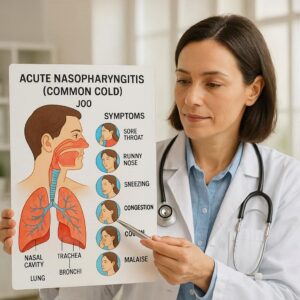
Acute nasopharyngitis is the medical term for what billions of people experience every year: the common cold. It’s a viral infection of the nose and throat (pharynx).
Typical Symptoms:
-
Runny or stuffy nose
-
Sneezing
-
Sore or scratchy throat
-
Mild cough
-
Low-grade fever (more common in children)
-
General sense of malaise or tiredness
-
Watery eyes
Causes: Over 200 viruses can cause a cold, with rhinoviruses being the most common. It spreads through airborne droplets, direct contact with an infected person, or contaminated surfaces.
Treatment: Primarily supportive. There is no cure for the common cold. Management includes:
-
Rest
-
Hydration
-
Over-the-counter pain relievers/fever reducers (e.g., acetaminophen)
-
Decongestants or saline nasal sprays
-
Throat lozenges
Why the Transition from ICD-9 to ICD-10 Matters
The move from ICD-9 code 460 to ICD-10 code J00 was part of a massive overhaul. Here’s why it was necessary:
-
Specificity: ICD-10 allows for detailed coding about laterality (left, right, bilateral), etiology, and severity, leading to better patient data.
-
Clinical Detail: It reflects modern medical practices and technological advancements.
-
Public Health Tracking: More precise data improves disease surveillance and outbreak tracking.
-
Billing Accuracy: Reduces ambiguities in insurance claims, leading to fewer denials and more precise reimbursement for the complexity of care provided.
Practical Coding Scenarios: Applying J00
Let’s look at how this code is used in real-world documentation.
Scenario 1: Standard Office Visit
-
Patient Presentation: A 25-year-old presents with a 2-day history of runny nose, sneezing, and a scratchy throat. No fever. On examination: mild pharyngeal erythema.
-
Documentation: “Acute viral nasopharyngitis” or “Common cold.”
-
Appropriate ICD-10-CM Code: J00
Scenario 2: Cold with Associated Otitis Media
-
Patient Presentation: A 4-year-old with cold symptoms for 4 days now complaining of ear pain. Diagnosis: Acute nasopharyngitis and acute suppurative otitis media.
-
Documentation: Must code both conditions.
-
Appropriate ICD-10-CM Codes: J00 (Acute nasopharyngitis) and H66.01 (Acute suppurative otitis media with spontaneous rupture of ear drum, right ear) or similar, based on specificity.
Important Reminder: Never code from a headline or lab report alone. Code strictly based on the provider’s final diagnostic statement in the medical record.
Legacy Data and Crosswalks: Working with Old ICD-9 Codes
For professionals dealing with historical data or retrospective studies, understanding the crosswalk between systems is vital.
General Equivalence Mappings (GEMs) are the official tools linking ICD-9 and ICD-10. The mapping for our topic is straightforward:
-
ICD-9 460 maps directly to ICD-10 J00.
However, caution is advised. Some ICD-9 codes may map to multiple ICD-10 codes depending on unspecified details. The one-to-one mapping for the common cold is a simple exception.
Frequently Asked Questions (FAQ)
Q1: Can I still use ICD-9 code 460?
A: No. For all healthcare services provided on or after October 1, 2015, in the U.S., ICD-10-CM is mandatory for diagnosis coding. ICD-9 is obsolete for current billing and clinical reporting.
Q2: Is there a difference between J00 and J06.9?
A: Yes. J00 is specifically for acute nasopharyngitis (the common cold). J06.9 is “Acute upper respiratory infection, unspecified.” This is a broader code used when the provider documents a generic “URI” without specifying the exact anatomical site (e.g., nasopharyngitis, pharyngitis, laryngitis). Always use the more specific code when the documentation supports it.
Q3: How do I code a “chest cold” or bronchitis?
A: A “chest cold” typically refers to acute bronchitis, which has a different code set in the J20-J22 range (e.g., J20.9 for Acute bronchitis, unspecified). This is distinct from an upper respiratory infection like a cold (J00).
Q4: What if the common cold is complicated by a confirmed bacterial infection?
A: You would code both the viral nasopharyngitis (J00) and the bacterial infection. For example, J00 for the cold and an additional code from B95-B97 to identify the bacterial agent (e.g., B95.0 for Streptococcus, group A), if known and documented.
Q5: Why is my search for “ICD-9 code for J00” so common?
A: It’s a very natural point of confusion. Many people remember or encounter old ICD-9 codes in legacy systems, forms, or older educational materials. Searching for the “ICD-9 of” a known ICD-10 code is a standard way to bridge that knowledge gap.
Additional Resources
For the most authoritative and up-to-date information, always refer to these official sources:
-
Centers for Medicare & Medicaid Services (CMS) ICD-10 Page: https://www.cms.gov/medicare/coding/icd10
-
CDC ICD-10-CM Browser/Tools: https://www.cdc.gov/nchs/icd/icd-10-cm.htm
-
World Health Organization (WHO) ICD-10 Online: https://icd.who.int/browse10/2019/en
Conclusion
Understanding that J00 is an ICD-10 code for the common cold, with an ICD-9 predecessor of 460, clarifies a common point of confusion in medical coding. The transition to ICD-10 brought necessary specificity, with J00 providing a precise classification for acute nasopharyngitis. Accurate use of this code, while mindful of its exclusions and clinical context, remains fundamental for clear documentation, correct billing, and effective public health data tracking.
Disclaimer: This article is for informational and educational purposes only. It is not a substitute for professional medical coding advice, official coding guidelines, or clinical guidance. Medical coders must always use the current, official ICD-10-CM code set and follow the most recent coding conventions and payer-specific instructions.
Author: The WebMD Medical Coding Reference Team
Date: FEBRUARY 04, 2026