If you’re researching medical codes for Juvenile Idiopathic Arthritis (JIA), you might have encountered the term “ICD-9 code.” This can be a source of confusion, especially when dealing with older medical records or certain insurance documents. While the healthcare world has moved on to a newer system, understanding this older code is still valuable for historical clarity and navigating past paperwork.
This comprehensive guide will demystify the ICD-9 code for Juvenile Idiopathic Arthritis. We’ll explain exactly what the code was, why it’s important contextually, and—critically—how it maps to the modern ICD-10 system used today. Our goal is to provide you with a clear, reliable resource that empowers you to better understand your child’s medical journey.
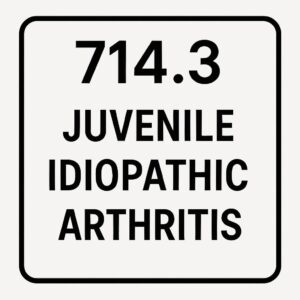
ICD-9 Code for Juvenile Idiopathic Arthritis
Understanding Medical Coding: ICD-9 vs. ICD-10
Before we dive into the specific code, let’s establish what we’re talking about. Medical coding is the language used by healthcare providers, insurance companies, and public health agencies to uniformly describe diagnoses, symptoms, and procedures.
ICD-9 (International Classification of Diseases, 9th Revision) was the standard diagnostic coding system in the United States from 1979 until October 1, 2015. On that date, the U.S. healthcare system underwent a massive transition to ICD-10, a much more detailed and specific system.
Think of it like this:
-
ICD-9 was an older, more basic dictionary with about 13,000 codes.
-
ICD-10 is a comprehensive, modern encyclopedia with over 68,000 codes, allowing for incredible detail about a patient’s condition.
“The transition from ICD-9 to ICD-10 was a necessary leap forward for precision in medicine. It allows us to capture the complexity of conditions like Juvenile Idiopathic Arthritis with far greater accuracy, which directly benefits patient care and research.” – A Certified Professional Coder (CPC) perspective.
Why You Might Still See the ICD-9 Code Today
Even though ICD-10 is now the standard, you may encounter the old ICD-9 code in several places:
-
Historical Medical Records: Any diagnosis or treatment note from before October 2015.
-
Older Insurance Claims or Appeals: When referencing past care.
-
Some Research Papers: Published prior to the transition.
-
Legacy Software or Older Educational Materials.
The Specific ICD-9 Code for Juvenile Idiopathic Arthritis
In the ICD-9-CM (Clinical Modification) system, the diagnosis of Juvenile Idiopathic Arthritis was classified under a broader category.
The primary ICD-9 code for Juvenile Idiopathic Arthritis was: 714.30
Let’s break down what this code meant:
-
714: This is the parent code for “Other rheumatoid arthritis and unspecified arthropathy.”
-
.3: This fourth digit specifies “Juvenile chronic polyarthritis.”
-
0: This fifth digit was often a placeholder. In ICD-9, the code 714.30 was typically listed as “Chronic or unspecified juvenile polyarthritis.”
Important Note: Unlike ICD-10, the ICD-9 system did not differentiate between the various subtypes of JIA (such as oligoarticular, polyarticular, or systemic). Code 714.30 was a catch-all for the condition, lacking the specificity modern medicine requires.
Limitations of the ICD-9 Code 714.30
The use of a single, non-specific code like 714.30 had several drawbacks:
-
Lacked Detail: It didn’t communicate which type of JIA a child had, which can significantly impact treatment plans.
-
Research Challenges: Made it harder to track epidemiology and outcomes for specific JIA subtypes.
-
Billing Imp precision: Could sometimes lead to issues with insurance coverage for very specific therapies.
The Modern Equivalent: ICD-10 Codes for JIA
This is where the modern system provides a crucial advantage. In ICD-10-CM, Juvenile Idiopathic Arthritis has its own dedicated category (M08) with specific codes for each major subtype. This specificity is vital for treatment, prognosis, and billing.
The following table shows how the old, single ICD-9 code translates into the precise ICD-10 codes used today.
ICD-9 to ICD-10 Code Comparison Table
| Juvenile Idiopathic Arthritis Type | Old ICD-9 Code (Pre-2015) | Modern ICD-10 Code (Current) | Code Description |
|---|---|---|---|
| General / Unspecified | 714.30 | M08.9 | Juvenile arthritis, unspecified |
| Oligoarticular JIA | 714.30 | M08.40 | Pauciarticular juvenile rheumatoid arthritis, unspecified site |
| Polyarticular JIA (RF Negative) | 714.30 | M08.30 | Juvenile rheumatoid polyarthritis (seronegative) |
| Polyarticular JIA (RF Positive) | 714.30 | M08.20 | Juvenile rheumatoid arthritis with rheumatoid factor |
| Systemic Onset JIA | 714.30 | M08.20 | Systemic onset juvenile rheumatoid arthritis |
| Psoriatic Juvenile Arthritis | 714.30 | M09.0* | Juvenile arthritis in psoriasis |
| Enthesitis Related Arthritis | 714.30 | M08.10 | Juvenile ankylosing spondylitis |
| Undifferentiated Arthritis | 714.30 | M08.80 | Other juvenile arthritis |
*Note: Psoriatic JIA falls under a sibling category (M09) to the main JIA category (M08).
As you can see, the single code 714.30 has been replaced by a family of codes that immediately tell the healthcare team much more about the patient’s condition.
Why Accurate Coding for JIA Matters
Beyond just bureaucracy, accurate medical coding has a direct impact on patient care. For a chronic condition like JIA, precise coding is essential.
-
Insurance Reimbursement: Insurance companies use diagnosis codes to determine if a prescribed treatment (like a specific biologic drug or physical therapy regimen) is medically necessary for that specific type of JIA. An incorrect or vague code can lead to claim denials.
-
Treatment Planning: The subtype of JIA guides the rheumatologist’s approach. Systemic JIA and oligoarticular JIA, for example, have very different treatment pathways. Accurate coding in the chart ensures all caregivers are aware of the precise diagnosis.
-
Research and Public Health: Detailed codes allow researchers to accurately identify cohorts of patients for clinical studies and track the prevalence of different JIA subtypes nationally. This drives better treatments and understanding.
-
Continuity of Care: As a child moves from pediatric to adult rheumatology care, a precise diagnostic history is invaluable.
Navigating Medical Records and Bills
If you are reviewing an old document that lists code 714.30, you now know it refers to a Juvenile Idiopathic Arthritis diagnosis given before October 2015. For any current or future care, you should see one of the specific ICD-10 codes (like M08.40, M08.30, etc.).
What to do if you see a discrepancy:
-
On a Current Bill: If you see the old ICD-9 code 714.30 on a bill for recent care (post-2015), it is likely an error. Contact the healthcare provider’s billing office and ask them to update the diagnosis code to the correct ICD-10 code.
-
In Medical Records: If you are consolidating historical records, note that 714.30 is the historical equivalent. For a current summary, ask your rheumatologist to provide a diagnosis statement that includes the specific JIA subtype and its ICD-10 code.
Helpful Checklist for Parents and Caregivers
Knowing the correct medical code is part of being an advocate. Keep this checklist:
-
Ask for the Specific Diagnosis: At appointments, confirm not just “JIA” but the specific subtype (e.g., “polyarticular, RF-negative”).
-
Know the ICD-10 Code: Note the corresponding ICD-10 code from the table above for your child’s type.
-
Verify on Paperwork: Glance at explanation of benefits (EOBs) from insurance or clinic summaries to ensure the correct code is used.
-
Keep a Health Binder: Maintain a section for diagnosis information, including the precise medical term and code.
-
Communicate During Transitions: When seeing a new specialist or changing insurance, provide the specific diagnosis and code.
Conclusion
The journey from the broad ICD-9 code 714.30 to the detailed ICD-10 codes for Juvenile Idiopathic Arthritis reflects medicine’s move toward personalized care. While 714.30 is a historical artifact, understanding it helps decipher past records. Today, the specificity of ICD-10 coding ensures clearer communication, more targeted treatment, and smoother insurance processes for managing your child’s health.
Frequently Asked Questions (FAQ)
Q: Is the ICD-9 code 714.30 still used anywhere?
A: No, for all official diagnostic and billing purposes in the U.S. after October 1, 2015, it is obsolete. You will only encounter it in historical contexts.
Q: My child’s recent insurance form still has 714.30 on it. What should I do?
A: Contact the healthcare provider who submitted the claim. Their billing department needs to resubmit it with the correct, current ICD-10 code. Using an outdated code will cause processing delays or denials.
Q: Are there different ICD-10 codes for different joints affected?
A: Yes, to an even finer degree. The codes in the table are the primary diagnosis codes. Providers often add additional “laterality” codes (e.g., right shoulder, left knee) to specify exactly which joints are involved, creating a complete clinical picture.
Q: How can I find out my child’s exact ICD-10 code?
A: The best source is your child’s rheumatologist or their official medical summary. You can also find it listed on detailed visit summaries from your patient portal or on accurate insurance Explanation of Benefits (EOB) forms.
Additional Resources
For the most authoritative and up-to-date information on medical coding, please visit the Centers for Disease Control and Prevention (CDC) ICD-10 page: https://www.cdc.gov/nchs/icd/icd10.htm. This is an essential tool for understanding the official coding structure.