If you’re dealing with an old medical bill, researching past health records, or trying to understand a historical diagnosis, you’ve likely encountered the term “ICD-9 code.” For conditions as common as joint pain and arthritis, knowing how this system worked is key to unlocking that information.
This guide is your essential resource. We’ll walk you through everything you need to know about ICD-9 codes for joint disorders. You’ll learn how the coding system was organized, where to find specific codes, and why this knowledge remains important today. Our goal is to turn a confusing jumble of numbers into clear, useful information for you.
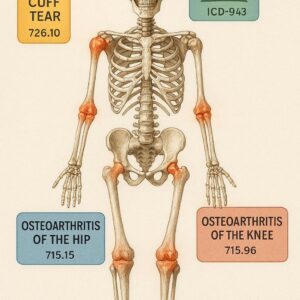
ICD-9 Codes for Joint Disorders
Understanding the ICD-9 Coding System
The International Classification of Diseases, 9th Revision (ICD-9) was the standard diagnostic tool for healthcare providers in the United States for decades. It served a critical purpose: translating medical diagnoses, symptoms, and procedures into universal alphanumeric codes. These codes were the backbone of medical billing, insurance claims, and population health statistics.
Think of ICD-9 as a massive, detailed filing system for human disease. Every conceivable health condition had a corresponding code. This allowed for consistent record-keeping across different doctors, hospitals, and insurance companies. When your doctor diagnosed you with osteoarthritis of the knee, they didn’t just write that down in plain English for your chart; they also assigned a specific ICD-9 code. That code told the insurance company exactly what condition was being treated, which was necessary for processing payment.
The system was retired on October 1, 2015, when the U.S. healthcare system transitioned to ICD-10, a much more modern and detailed classification. However, ICD-9 codes are far from irrelevant. They are vital for understanding any medical record or claim from before that date. If you are reviewing past treatment for a chronic joint condition, you are almost certainly looking at ICD-9 codes.
The Structure of an ICD-9 Code
An ICD-9 code is typically 3 to 5 digits long. The structure is hierarchical:
-
First three digits (Category): This is the core code representing a single disease or related group of diseases. For example, “715” is the category for Osteoarthrosis and allied disorders.
-
Fourth and fifth digits (Subclassification): These digits add specificity. They describe the etiology (cause), anatomical site, severity, or other important clinical details. For instance, “715.16” pinpoints the diagnosis to Primary generalized osteoarthrosis, lower leg.
This structure meant that a simple 3-digit code was often too vague for proper billing. The 4th and 5th digits provided the necessary detail for accurate claims processing and clinical tracking.
The ICD-9 Code Range for Joint Disorders
Joint disorders in ICD-9 were primarily found in one major chapter of the manual: Chapter 13: Diseases of the Musculoskeletal System and Connective Tissue (710-739). This chapter covered everything from arthritis and back pain to acquired deformities.
Within this chapter, joint conditions were scattered across several blocks of codes. There was no single “joint disorder” code; instead, codes were defined by the type of joint problem and its location.
Important Note: The following information is for historical and educational reference only. For all current coding, billing, and diagnostic purposes, the ICD-10-CM system must be used.
Major ICD-9 Categories for Common Joint Conditions
Here is a breakdown of the key code categories you would encounter for joint issues:
| ICD-9 Code Range | General Description | Common Examples & Specific Codes |
|---|---|---|
| 710-719 | Arthropathies (Joint Diseases) | This is the primary section for arthritis and inflammatory joint disease. |
| 711 | Arthropathy associated with infections | Septic arthritis (711.0x) |
| 712 | Crystal arthropathies | Gout (712.0x), Chondrocalcinosis (712.1x) |
| 713 | Arthropathy associated with other disorders | Joint disorder in diabetes (713.5) |
| 714 | Rheumatoid arthritis and related | Rheumatoid arthritis (714.0), Juvenile RA (714.3) |
| 715 | Osteoarthrosis and allied disorders | The most common category for degenerative “wear-and-tear” arthritis. |
| 716 | Other and unspecified arthropathies | Traumatic arthropathy (716.1x), Allergic arthritis (716.2) |
| 717 | Internal derangement of knee | Torn meniscus (717.x), chondromalacia (717.7) |
| 718 | Other derangement of joint | Joint contracture (718.4x), Loose body in joint (718.1x) |
| 719 | Other and unspecified disorders of joint | Joint effusion (swelling) (719.0x), Stiffness (719.5x) |
| 720-724 | Dorsopathies (Back & Spine Disorders) | Often involving the spinal joints (facet joints). |
| 721 | Spondylosis and allied disorders | Spinal osteoarthritis (721.x) |
| 724 | Other and unspecified disorders of back | Spinal stenosis (724.0x) |
| 726-729 | Peripheral Enthesopathies & Soft Tissue Disorders | Problems where tendons/ligaments attach to joints. |
| 726 | Peripheral enthesopathies | Rotator cuff syndrome (726.1), Epicondylitis (tennis elbow, 726.3) |
| 727 | Synovium, tendon, and bursa disorders | Bursitis (727.3x), Trigger finger (727.0) |
| 729 | Other disorders of soft tissues | Myalgia (muscle pain, 729.1) |
* Primary ICD-9 Code Categories for Joint-Related Diagnoses*
Spotlight on Common Specific ICD-9 Codes
Let’s dive deeper into some of the most frequently used codes for joint disorders. Remember, the 4th and 5th digits are crucial. The “x” in the examples below is a placeholder for the digit that specified the exact joint.
Osteoarthritis (Degenerative Joint Disease): Category 715
This was the workhorse code for age-related or injury-related joint wear.
-
715.0x: Osteoarthrosis, generalized. Used when multiple joints were affected.
-
715.1x: Osteoarthrosis, localized, primary. The most common code for osteoarthritis with no known specific cause.
-
715.16: Primary osteoarthrosis, lower leg. This often meant the knee.
-
715.15: Primary osteoarthrosis, pelvic region and thigh. This typically meant the hip.
-
-
715.2x: Osteoarthrosis, localized, secondary. Used when the arthritis was a direct result of a known cause like prior injury, infection, or congenital deformity.
-
715.3x: Osteoarthrosis, localized, not specified whether primary or secondary.
-
715.8x: Osteoarthrosis involving multiple sites, but not specified as generalized.
-
715.9x: Osteoarthrosis, unspecified.
How to read it: The 5th digit defined the location:
-
.0 – Shoulder region
-
.1 – Upper arm (elbow)
-
.2 – Forearm (wrist)
-
.3 – Hand
-
.4 – Pelvic region and thigh (hip)
-
.5 – Lower leg (knee)
-
.6 – Ankle and foot
-
.7 – Other specified sites (e.g., spine)
-
.8 – Multiple sites
-
.9 – Unspecified site
Rheumatoid Arthritis: Category 714
This category covered autoimmune forms of arthritis.
-
714.0: Rheumatoid arthritis. The standard code for adult RA.
-
714.1: Felty’s syndrome. RA with spleen and white blood cell complications.
-
714.2: Other rheumatoid arthritis with visceral or systemic involvement.
-
714.3: Juvenile rheumatoid arthritis. Arthritis beginning in childhood.
-
714.4: Chronic postrheumatic arthropathy.
-
714.8: Other specified inflammatory polyarthropathies.
-
714.9: Unspecified inflammatory polyarthropathy.
Internal Derangement of the Knee: Category 717
This category was specifically for knee injuries.
-
717.0: Old bucket handle tear of medial meniscus.
-
717.1: Derangement of anterior horn of medial meniscus.
-
717.3: Other and unspecified derangement of medial meniscus.
-
717.4: Derangement of lateral meniscus.
-
717.5: Derangement of meniscus, not elsewhere classified.
-
717.7: Chondromalacia of patella.
-
717.8: Other internal derangement of knee.
-
717.9: Unspecified internal derangement of knee.
Other Essential Joint Disorder Codes
-
719.4x: Pain in joint. A very common code for undiagnosed or unspecified joint pain.
-
718.4x: Contracture of joint. For joints that have lost range of motion.
-
718.0x: Loose body in joint. For cartilage or bone fragments within a joint.
-
726.1: Rotator cuff syndrome. Shoulder disorders of the tendons.
-
726.3: Enthesopathy of elbow region. Includes lateral epicondylitis (tennis elbow).
How to Find the Right ICD-9 Code
Since ICD-9 is no longer active for billing, you won’t find it on current medical forms. However, if you need to decipher an old record, here was the general process:
-
Identify the Main Diagnosis: Start with the physician’s written diagnosis (e.g., “primary osteoarthritis of the right knee”).
-
Locate the Chapter: Know that most joint issues fall in Chapter 13 (710-739).
-
Find the Category: Determine the type of disorder. Degenerative? Look at 715. Inflammatory? Look at 711-714. Knee-specific injury? Look at 717.
-
Apply the Specificity: Use the 4th and 5th digit tables (like the one for 715 above) to pinpoint the exact location and laterality (if applicable).
A key limitation of ICD-9: Unlike ICD-10, ICD-9 did not have a consistent way to indicate laterality (left vs. right). Sometimes it was implied in the 5th digit, but often the medical record itself was needed to clarify which side was affected. This was a major driver for the switch to the more precise ICD-10.
Why Knowing This History Matters
You might wonder why we bother with an outdated system. Here are practical reasons:
-
Understanding Your Medical History: Your long-term health record is a timeline. Diagnoses from 2014 or earlier are written in the “language” of ICD-9.
-
Reviewing Old Bills or Insurance Claims: Disputes or questions about past services require understanding the codes used.
-
Medical Research: Studies tracking disease trends over long periods must bridge data from the ICD-9 era to the ICD-10 era.
-
Personal Knowledge: It helps you be an informed participant in your own healthcare journey, seeing how diagnostic precision has evolved.
The Transition from ICD-9 to ICD-10 for Joint Disorders
The shift to ICD-10-CM on October 1, 2015, was a monumental change. For joint disorders, the difference is stark:
-
Dramatically Increased Detail: ICD-10 has nearly 5x the number of codes related to musculoskeletal disorders. Where ICD-9 had one code for “osteoarthritis of the knee,” ICD-10 has separate codes for the left knee, right knee, bilateral knees, and different types of osteoarthritis in each.
-
Consistent Laterality: Almost every code specifies left, right, or bilateral.
-
More Etiology and Severity: Codes can indicate the cause (primary, post-traumatic) and, in some cases, the encounter (initial, subsequent, sequela).
Example Comparison:
-
ICD-9:
715.16= Primary osteoarthrosis, lower leg (knee). Does not specify left or right. -
ICD-10:
M17.11= Primary osteoarthritis, right knee.M17.12= Primary osteoarthritis, left knee.
This level of specificity improves patient care, public health tracking, and the accuracy of reimbursement.
FAQ: ICD-9 Codes for Joint Disorders
Q: I have an old bill with code 719.46. What does it mean?
A: Code 719.46 falls under “Other and unspecified disorders of joint.” The “46” indicates the location is the “lower leg” (which typically means the knee). Therefore, it translates to “Pain in joint of lower leg,” or essentially, knee pain of unspecified cause. You would need the doctor’s notes to know more.
Q: Can I still use an ICD-9 code for a current doctor’s visit or insurance claim?
A: No. Since October 1, 2015, all healthcare providers covered by the HIPAA code set rule must use ICD-10-CM codes for diagnosis reporting. Using an ICD-9 code will result in a rejected claim.
Q: How do I convert an old ICD-9 code to the new ICD-10 code?
A: There is no simple one-to-one conversion. While general “crosswalks” or mapping tools exist (often used by medical coders and billing departments), the conversion requires clinical knowledge. The best approach is to take the original diagnosis description (e.g., “left knee osteoarthritis”) and look it up in the current ICD-10 code set. The Centers for Medicare & Medicaid Services (CMS) provides a general equivalency mapping tool, but it should be used with caution.
Q: Why was ICD-9 replaced?
A: ICD-9 was over 30 years old and could no longer support modern medical practice. It was running out of space for new codes, lacked clinical detail, and did not align well with current terminology and technology. ICD-10 provides the granularity needed for value-based care, advanced analytics, and precise treatment tracking.
Q: Where can I find an official, complete list of old ICD-9 codes?
A: The U.S. government maintains archives. The CDC’s National Center for Health Statistics (NCHS) website provides final, official code files for ICD-9-CM.
Conclusion
Understanding ICD-9 codes for joint disorders is like learning a historical language of medicine—it’s essential for interpreting the past. While the system has been replaced by the more precise ICD-10, its codes are the key to unlocking decades of medical records, bills, and health data. By grasping the structure of categories like 715 for osteoarthritis and knowing how to find specific codes, you empower yourself to navigate your own health history with clarity and confidence.
Disclaimer: This article is for informational and historical reference purposes only. It does not constitute medical or coding advice. For current diagnoses, treatment, and medical billing, always consult with a qualified healthcare provider or certified medical coder who uses the official, current ICD-10-CM code set.
Additional Resource:
For the official archive of ICD-9-CM codes, visit the CDC NCHS ICD-9-CM page: https://www.cdc.gov/nchs/icd/icd9cm.htm