If you work in mental health, you have probably stared at your billing sheet and asked yourself a simple question: Is this a 90834 or a 90837 day?
You are not alone. This is one of the most common sources of confusion—and anxiety—for therapists, psychologists, and clinical social workers. Choosing the wrong code can mean losing money or, worse, triggering an audit.
The difference between CPT code 90834 and CPT code 90837 is exactly 15 minutes. But in practice, that gap feels much larger.
This guide will walk you through everything you need to know. We will look at time requirements, insurance expectations, documentation tips, and when to use each code. No complex jargon. No unrealistic promises. Just honest, practical advice to help you bill with confidence.
What Are These Codes? A Quick Overview
Before we compare them, let us define each code clearly.
CPT Code 90834: The Standard Session
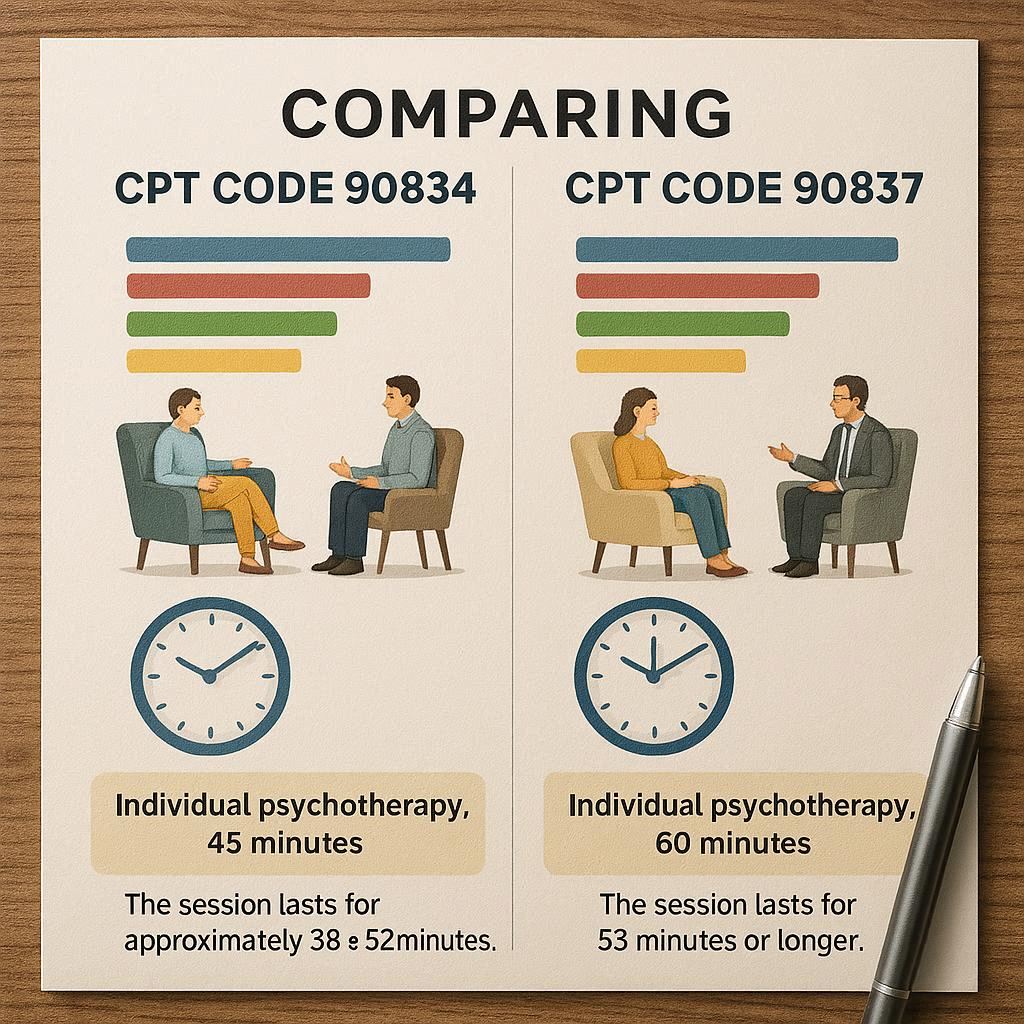
CPT 90834 represents psychotherapy for 45 minutes with a patient. This is often called the “standard therapy hour,” even though it is technically 45 minutes of face-to-face time.
- Typical time range: 38 to 52 minutes
- Common uses: Weekly individual therapy, follow-up sessions, moderate complexity cases
- Insurance view: The “default” code for most outpatient therapy
CPT Code 90837: The Extended Session
CPT 90837 represents psychotherapy for 60 minutes with a patient. This is the longer, more intensive session.
- Typical time range: 53 to 67 minutes
- Common uses: Trauma work, crisis intervention, complex cases, EMDR sessions
- Insurance view: A higher-value code that requires clear medical necessity
Important note: These codes are for individual psychotherapy. They do not include family therapy (90846, 90847) or group therapy (90853). Keep that distinction in mind.
The Core Differences: 90834 vs 90837 at a Glance
Let us put the two codes side by side. This table gives you the fast answer before we dive deeper.
| Feature | CPT 90834 | CPT 90837 |
|---|---|---|
| Typical session length | 45 minutes | 60 minutes |
| Time range (face-to-face) | 38–52 minutes | 53–67 minutes |
| Average reimbursement (Medicare, 2024) | ~90–100 | ~130–145 |
| Insurance reimbursement difference | Baseline | ~30-40% higher |
| Best for | Routine therapy, check-ins, mild to moderate issues | Complex trauma, skill building, crisis work |
| Audit risk | Lower | Higher (if not documented well) |
| Medical necessity requirement | Standard | Stronger justification needed |
The table shows a clear pattern. Longer session means more money, but also more scrutiny.
Now let us unpack each element in detail.
Time Rules: The 8-Minute Rule and Face-to-Face Reality
Here is something many therapists misunderstand. The time on these codes is not a suggestion. It is a strict guideline.
How to Count Time Correctly
Insurers follow something called the 8-minute rule (common in medical billing) or, more accurately for psychotherapy, the “mid-point rule.”
- For 90834: Your face-to-face time must be at least 38 minutes and no more than 52 minutes. If you go over 52 minutes, you should bill 90837.
- For 90837: Your face-to-face time must be at least 53 minutes and no more than 67 minutes. If you exceed 67 minutes, you may need an add-on code or a modifier.
What counts as face-to-face time?
Only the time you are actively providing therapy with the patient present. This includes:
- Talking and listening
- Teaching coping skills
- Processing emotions
- Crisis de-escalation
This does not include:
- Writing notes after the session
- Calling the patient’s psychiatrist
- Scheduling follow-ups
- No-shows or late cancellations
A Real-Life Example
You see a patient for 50 minutes. You talk about their week, practice grounding techniques, and explore a recent conflict at work. At minute 50, you wrap up.
Correct code: 90834 (because 50 minutes falls between 38 and 52).
You see a different patient for 55 minutes. You process a traumatic memory, do a safety check, and create a crisis plan.
Correct code: 90837 (because 55 minutes falls between 53 and 67).
The rule is simple: let the clock guide you, not your gut feeling.
Reimbursement: What You Actually Get Paid
Money is not the only reason to choose a code, but it matters. You deserve fair pay for your time.
Average Rates (2024-2025 Estimates)
These numbers vary by region, insurer, and your contract. But they give you a realistic baseline.
| Insurance Type | 90834 Reimbursement | 90837 Reimbursement |
|---|---|---|
| Medicare (national avg) | 92–98 | 135–142 |
| Blue Cross Blue Shield | 85–110 | 120–160 |
| UnitedHealthcare | 80–105 | 115–150 |
| Cigna | 85–100 | 125–145 |
| Aetna | 82–108 | 118–155 |
The difference is usually 30to30to50 per session. Over a full week of five sessions, that is 150to250 less if you only bill 90834.
But here is the catch. Some insurers actively review 90837 claims. They want to know: Why does this patient need 60 minutes instead of 45?
If you cannot answer that question clearly in your note, you risk a clawback (insurance asking for their money back).
Realistic advice: Do not bill 90837 for every patient just to earn more. Bill it for patients who genuinely need the extra time. Your documentation will thank you, and so will your audit risk.
Medical Necessity: The Heart of the Decision
Medical necessity is the single most important concept in therapy billing. It does not matter how long you sit with a patient. If the session length is not medically necessary, the code is wrong.
What Does “Medically Necessary” Mean?
For insurance purposes, a service is medically necessary when it is:
- Required to treat a diagnosed condition (like major depression, PTSD, or generalized anxiety)
- Evidence-based (the treatment has a reasonable chance of helping)
- Not just for convenience (the patient wants to talk longer, but does not clinically need to)
Applying This to 90834 vs 90837
| Clinical Situation | Appropriate Code | Why? |
|---|---|---|
| Mild anxiety, stable mood, weekly check-in | 90834 | 45 minutes allows time to review symptoms and practice skills. |
| Moderate depression with some functional impairment | 90834 | Sufficient for CBT or interpersonal therapy in most cases. |
| Recent trauma processing (EMDR or prolonged exposure) | 90837 | The extra time allows for activation, processing, and stabilization. |
| Bipolar disorder with manic symptoms | 90837 | Needs more time for safety planning and medication coordination. |
| Crisis intervention or suicidal ideation | 90837 | Requires thorough assessment and safety planning. |
| Personality disorder with emotional dysregulation | 90837 | Skills training and de-escalation take longer. |
The golden rule: Match the code to the clinical need, not the patient’s preference or your schedule.
When to Use 90834 (45-Minute Session)
Let us get practical. Here are clear scenarios where 90834 is the right choice.
Good Candidates for 90834
- Stable patients who are making consistent progress
- Follow-up sessions after an initial intake (which is usually a different code: 90791)
- Medication management plus brief therapy (when a psychiatrist or NP handles meds)
- Patients with mild to moderate symptoms (PHQ-9 score 5-14, GAD-7 score 5-12)
- Solution-focused therapy or brief interventions
- Later sessions in a long-term treatment plan where crisis has passed
Documentation Example for 90834
*”Patient presented with stable mood. Reviewed sleep log and identified two triggers for anxiety this week. Practiced diaphragmatic breathing for 5 minutes. Patient reported decreased anxiety from 7/10 to 4/10 after exercise. Continued CBT for generalized anxiety disorder. Plan to continue weekly sessions. Session length: 46 minutes face-to-face.”*
This note clearly shows:
- The diagnosis (generalized anxiety disorder)
- What you did (CBT, breathing exercise)
- The outcome (anxiety decreased)
- The time (46 minutes)
Red Flags for 90834 (When NOT to use it)
- The patient is actively suicidal
- You just started trauma processing
- The patient has multiple complex comorbidities
- You are constantly running over 52 minutes
If you see these red flags, lean toward 90837.
When to Use 90837 (60-Minute Session)
Now let us talk about the longer code. 90837 is not a “bonus.” It is a tool for deeper clinical work.
Good Candidates for 90837
- Trauma-focused therapy (EMDR, CPT, PE, or TF-CBT)
- Patients in crisis or with recent hospitalization
- Severe depression (PHQ-9 15+) or suicidality
- Eating disorders (requires medical monitoring plus therapy)
- Substance use disorders with relapse prevention and coping skills
- Borderline personality disorder (DBT skills take time)
- Complex grief or prolonged grief disorder
- Children with behavioral dysregulation (requires parent coaching plus child work)
Documentation Example for 90837
*”Patient diagnosed with PTSD (chronic) related to childhood abuse. Today we completed 45 minutes of EMDR processing targeting a memory of physical abuse. Patient experienced significant affect (crying, somatic tension). Spent remaining 15 minutes on grounding, containment, and safety planning. Patient stabilized before leaving. Session length: 60 minutes face-to-face.”*
This note justifies the longer session because:
- The treatment (EMDR) requires extended time
- The patient had a strong emotional response
- You needed extra time for stabilization
- The session could not be safely cut short
When 90837 Becomes Risky
Some insurance companies flag providers who use 90837 for more than 50% of their sessions. Others have no problem with it.
What matters is pattern plus documentation.
- Low risk: You use 90837 for 30% of your sessions, mainly for trauma or crisis cases
- Medium risk: You use 90837 for 60-70% of sessions, but your notes are excellent
- High risk: You use 90837 for 90%+ of sessions, and your notes are brief or copy-pasted
Be honest with yourself. Do you have a clinical reason for each 90837? Or did you get comfortable billing the higher code for everyone?
A word from compliance experts: Payers like Medicare have audited 90837 heavily in recent years. Some have even suggested that 90834 should be the “typical” code. This does not mean you cannot use 90837. It means you need to earn it with your documentation.
The Documentation Difference: How to Protect Yourself
Your therapy note is your only defense in an audit. A good note for 90834 is good. A good note for 90837 is essential.
Checklist for a Strong 90837 Note
- Explicit mention of session length: “Face-to-face time was 58 minutes”
- Why a longer session was needed: “Due to recent trauma trigger and emotional dysregulation”
- Specific interventions that require time: “Completed full EMDR protocol including resourcing, processing, and closure”
- Medical necessity statement: “A shorter session would not allow for adequate processing and safety planning”
- Patient response: “Patient reported feeling ‘lighter’ but tired. Returned to baseline affect by end of session.”
- Risk assessment if relevant: “Suicidal ideation denied. Contracted for safety.”
Weak Note (Audit Bait)
“Patient talked about work stress. Processed feelings. Did coping skills. Patient feels better. 60 minutes.”
This note could describe any session. It does not justify the extra 15 minutes. If audited, an insurer might downcode this to 90834 and ask for the difference back.
Strong Note (Audit-Proof)
*”Patient with MDD, recurrent, severe (F33.1). Session extended to 60 minutes due to suicidal ideation with plan (cutting) earlier in the week. Spent first 20 minutes on safety assessment and means restriction (removed sharps from home). Middle 25 minutes on CBT chain analysis of latest episode. Final 15 minutes on relapse prevention and scheduling psychiatry follow-up. By end of session, patient denied active SI and agreed to safety plan. A 45-minute session would not have allowed sufficient time for both acute risk assessment and skill building.”*
See the difference? The strong note tells a story that matches the time.
Insurance Company Policies: What You Need to Know
Not all insurers treat 90834 and 90837 the same way. Some are friendly to the longer code. Others are actively hostile.
Medicare
- Policy: Covers both codes but expects 90834 for most sessions
- Audit activity: High. Medicare has specifically targeted 90837 in recent years.
- Tip: Use 90837 only when clearly justified. Document medical necessity in every single note.
UnitedHealthcare (UHC)
- Policy: Publically stated that 90837 requires “medical necessity beyond the typical 45-minute session”
- Audit activity: Moderate to high
- Tip: Avoid using 90837 for stable, maintenance therapy. UHC has downcoded these in audits.
Blue Cross Blue Shield (varies by state)
- Policy: Highly variable. Some BCBS plans reimburse 90837 generously. Others cap it.
- Audit activity: Low to moderate
- Tip: Check your specific BCBS state plan’s policy manual.
Cigna
- Policy: Generally accepts 90837 but reviews high utilizers
- Audit activity: Moderate
- Tip: If you bill 90837 for >80% of sessions, expect a records request.
Aetna
- Policy: One of the more 90837-friendly plans
- Audit activity: Low
- Tip: Still document well, but less likely to be flagged.
Medicaid (state-dependent)
- Policy: Many states require prior authorization for 90837
- Audit activity: High for unauthorized claims
- Tip: Never bill 90837 for Medicaid without checking your state’s rules first.
Important note: Insurance policies change frequently. These guidelines reflect common practices as of 2024-2025, but always verify with your specific payer contracts.
Common Billing Mistakes and How to Avoid Them
Even experienced therapists make errors with these codes. Here are the most frequent ones.
Mistake 1: Billing 90837 for a 45-Minute Session
Some therapists think “the hour” is 50 minutes, so they bill 90837. This is incorrect. If your session is 45 minutes, use 90834.
Fix: Use a timer. Write down your start and end time in every note.
Mistake 2: Using the Same Code for Every Patient
If every session you bill is 90837, insurance algorithms will notice. Human reviewers will wonder why no one needs a shorter session.
Fix: Aim for a mix. Most outpatient therapists use 90834 40-60% of the time and 90837 40-60% of the time. Adjust based on your population.
Mistake 3: Forgetting the Add-On Codes
What if a session runs 80 minutes? You cannot bill two 90837s. Instead, use an add-on code like 99354 (prolonged service) or the psychotherapy with evaluation and management (E/M) codes.
Fix: Learn about prolonged service codes if you regularly run long sessions.
Mistake 4: Not Documenting Time Clearly
A note that says “session was about an hour” is not enough. Auditors want exact minutes.
Fix: Write “Face-to-face psychotherapy from 2:05 PM to 3:02 PM (57 minutes).”
Mistake 5: Billing 90837 for Non-Clinical Time
If you spent 10 minutes of the session checking insurance benefits or scheduling the next appointment, that does not count toward the 60 minutes.
Fix: Keep the session focused on clinical work. Do administrative tasks before or after.
How to Decide: A Step-by-Step Flowchart (In Words)
You do not need a fancy diagram. Use this mental checklist before you pick a code.
Step 1: Look at your clock.
- Under 53 minutes? Go to Step 2A.
- 53 to 67 minutes? Go to Step 2B.
Step 2A (Under 53 minutes): Bill 90834, provided medical necessity exists. If the session was too short to address clinical needs, schedule a longer next session.
Step 2B (53 to 67 minutes): Ask yourself four questions.
- Did the patient have a clinical crisis, trauma trigger, or severe symptom exacerbation?
- Did you perform a specific therapy (EMDR, CPT, DBT skills, prolonged exposure) that requires extended time?
- Would a 45-minute session have been clinically insufficient or unsafe?
- Is your documentation strong enough to justify the extra time?
If you answered YES to at least two of these, bill 90837.
If you answered NO to most, consider whether 90834 was actually the right code.
Step 3: Document your decision.
In your note, write one sentence explaining why the chosen code fits. Example: “90837 selected due to crisis intervention needs.”
Special Populations and Scenarios
Different clinical situations call for different codes. Here is specific guidance.
Children and Adolescents
- Young children (5-10): Often cannot sustain 60 minutes. Use 90834 for most sessions.
- Adolescents (11-17): 90837 can be appropriate for trauma, DBT, or family-involved sessions.
- Parent coaching: If you see the parent alone without the child, that may be a different code (90846 family therapy without patient present).
Tip: Children with ADHD or disruptive behavior disorders often need shorter, more focused sessions. Do not force 60 minutes just because insurance pays more.
Couples Therapy
- Important: 90834 and 90837 are for INDIVIDUAL therapy. Couples therapy is usually 90847 (family therapy with patient present).
- Exception: If you are seeing one partner individually, use the individual codes.
Intakes and Assessments
- The intake code is 90791 (diagnostic evaluation without medical services).
- Typical length: 60-90 minutes.
- Do NOT use 90834 or 90837 for an intake session unless you also delivered psychotherapy (which is rare).
Telehealth Sessions
- Telehealth uses the same CPT codes: 90834 and 90837.
- Add modifier 95 or place of service 02 to indicate telehealth.
- Time rules are identical. Face-to-face means video-to-video.
Crisis Sessions
If a patient calls in crisis and you see them the same day for an unscheduled extended session, 90837 is often appropriate. Document the crisis clearly.
- Example: “Patient presented with active suicidal ideation after learning of divorce. Session extended to 65 minutes to complete safety assessment, crisis plan, and contact emergency contact.”
Reimbursement Strategies: Maximizing Income Without Risk
You want to be paid fairly. You also want to stay compliant. Here is how to balance both.
Strategy 1: Know Your Payer Mix
Calculate what percentage of your income comes from each insurer. Focus your documentation effort on the payers who audit the most (Medicare, UHC, and some BCBS plans).
Strategy 2: Use 90837 Selectively, Not Exclusively
A good target for most outpatient therapists:
- 30-50% of sessions: 90837 (complex cases, trauma, crisis)
- 50-70% of sessions: 90834 (stable cases, brief therapy, maintenance)
Strategy 3: Improve Your Efficiency
If you are constantly running 60-minute sessions but only billing 90834 because you are afraid of audits, you are leaving money on the table. Either:
- Shorten sessions to 45 minutes (realistic for many patients), or
- Improve your documentation so you can confidently bill 90837.
Strategy 4: Negotiate Your Contracts
When you renew your insurance contracts, look at the reimbursement difference between 90834 and 90837. Some insurers pay very little extra for the longer code. If the difference is under $20, it may not be worth the documentation burden.
Strategy 5: Go Private Pay or Out-of-Network
If you accept insurance, you play by their rules. If you go private pay or out-of-network, you and your patient decide what is appropriate. Many private pay therapists bill 90837 as their standard 60-minute session and use 90834 for 45-minute follow-ups.
Audit Risks and Red Flags: What Insurers Look For
Understanding the auditor’s mindset helps you avoid problems.
Top Red Flags for 90837 Audits
- Excessive use (more than 80% of sessions)
- Short time but high code (billing 90837 for 54 minutes repeatedly)
- Poor documentation (notes shorter than two sentences)
- Identical notes (copy-paste across patients or sessions)
- No medical necessity justification (just “talked about feelings”)
- High volume for stable patients (no crisis, no trauma, no complexity)
What Happens in an Audit?
- Level 1 (Records request): Insurer asks for 5-10 patient records. They review notes for medical necessity.
- Level 2 (Downcoding): Insurer decides your 90837 notes should have been 90834. They recoup the difference.
- Level 3 (Clawback): Insurer asks for repayment of all 90837 claims over a period (e.g., 6 months or 1 year).
- Level 4 (Exclusion): In severe cases, the insurer may terminate your contract.
Do not panic. Most audits end at Level 1 or 2, especially if you fix the issues quickly.
How to Survive an Audit
- Respond promptly (within the deadline)
- Provide complete records (no missing pages)
- Do not alter notes after the fact (that is fraud)
- Hire a billing consultant if the amount is large
- Learn from the experience
Reassurance: A single audit does not mean you did something wrong. Many therapists are audited randomly. But repeated problems do indicate a pattern.
Frequently Asked Questions (FAQ)
1. Can I bill 90837 for a 50-minute session?
No. 50 minutes falls in the 90834 range (38-52 minutes). Billing 90837 for 50 minutes is incorrect and will be flagged in an audit.
2. What if my session is exactly 52 minutes and 30 seconds?
Round down to 52 minutes. That is still 90834. Only bill 90837 when you reach 53 minutes or more.
3. Does insurance pay more for 90837?
Yes, typically 30-40% more. But the exact amount depends on your contract and the patient’s plan.
4. Can I use both codes for the same patient on different days?
Absolutely. A patient might need 90837 during a crisis week and 90834 during a stable week. That is clinically appropriate.
5. Which code is audited more often?
90837 is audited significantly more often than 90834. Insurers assume the shorter code is usually correct. The longer code requires proof.
6. What if my patient only wants 30-minute sessions?
There is no CPT code for 30-minute individual therapy. Use 90834 but document that the session was shorter than typical due to patient preference or clinical appropriateness. Some therapists bill 90832 (30-minute therapy), but many insurers do not cover it well.
7. Does the 8-minute rule apply to therapy codes?
Yes and no. The 8-minute rule strictly applies to timed physical therapy and some E/M services. For psychotherapy, the simpler “mid-point rule” is standard: Bill the code that matches the closest time group. But many insurers reference the 8-minute rule in audits, so do not cut it too close.
8. How do I document for 90837 in electronic health records (EHRs)?
Most EHRs have a place to enter start and end times. Use it. Then add a sentence in your narrative note explaining the extended time. Do not rely on checkboxes alone.
9. Can I bill 90837 for two patients in the same hour?
No. Each patient must have their own face-to-face session. You cannot bill 90837 for concurrent sessions.
10. What if I run 5 minutes over into a 90837 but the patient cannot afford the higher copay?
This is an ethical dilemma. You cannot bill a lower code to save the patient money. That is fraud. Instead, end the session on time (at 52 minutes) or discuss the cost difference with the patient beforehand.
Additional Resources
For more official guidance, refer to these trusted sources:
- American Psychological Association (APA): Practice Guidelines for CPT Coding – www.apaservices.org/practice/reimbursement/billing/cpt-codes
- Centers for Medicare & Medicaid Services (CMS): Medicare Claims Processing Manual, Chapter 12 – www.cms.gov
- American Medical Association (AMA): CPT Professional Edition (the official codebook)
Disclaimer: This article is for educational purposes only. Billing and coding rules change frequently. Always verify current guidelines with your specific insurance contracts, your state licensing board, and a qualified billing professional. The author and publisher assume no liability for any billing errors, audits, or recoupments resulting from the use of this information.
Conclusion
CPT 90834 (45 min) works for routine therapy and stable patients, while 90837 (60 min) is reserved for complex trauma, crisis, and severe symptoms. The longer code pays better but requires stronger documentation and clinical justification to survive audits. Match the code to the patient’s medical necessity, track your time carefully, and write notes that explain why the session length fits the clinical need.