If you have ever searched for “icd 10 code x50,” you likely work in a clinic, a therapy center, or a billing department. You need a clear answer. Not medical jargon. Not confusing government speak.
You want to know: when do I use this code? What counts as overexertion? And how do I avoid a denied claim?
Let us walk through everything together. This guide covers the X50 family of codes step by step. We will look at real patient examples, official guidelines, and common mistakes.
By the end, you will feel confident assigning X50 codes for exercise, training, and strenuous activities.
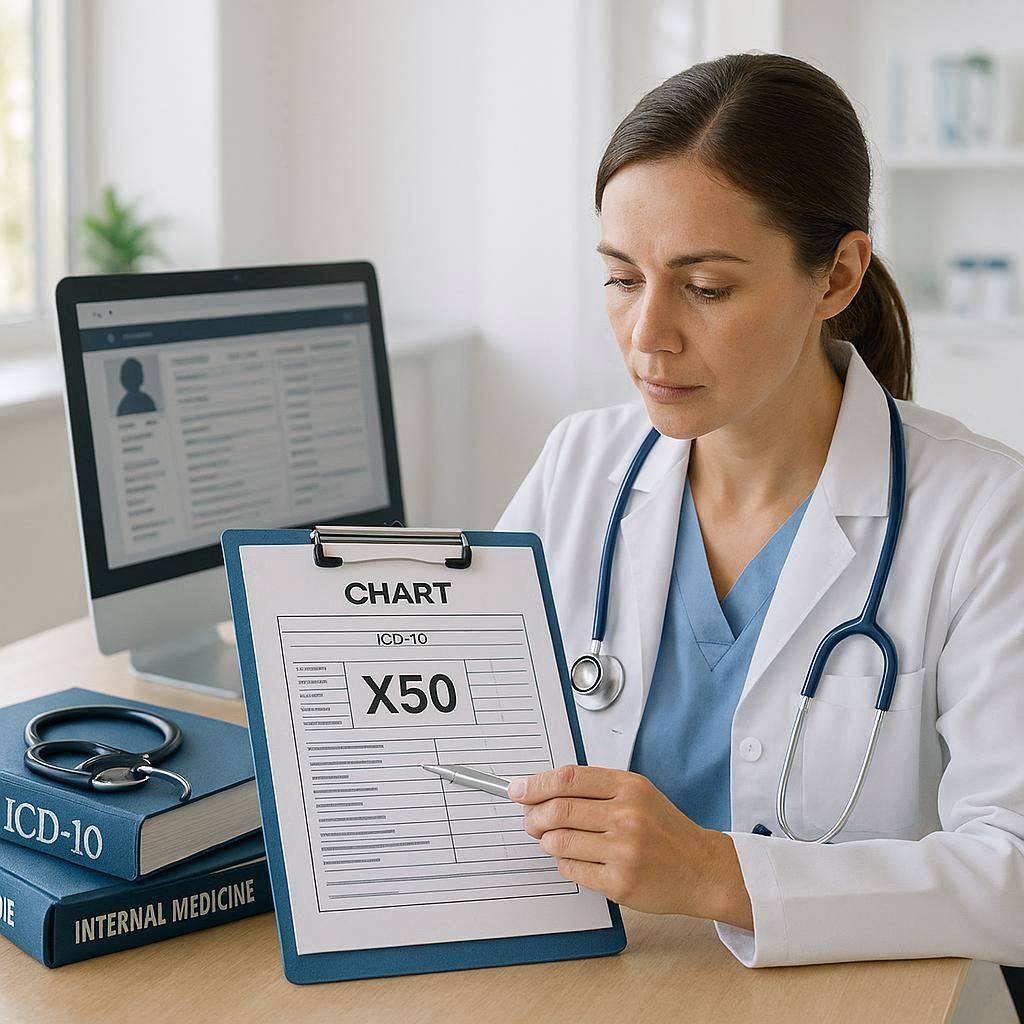
What Is ICD-10 Code X50? A Simple Breakdown
ICD-10 code X50 sits inside a specific chapter. It belongs to External causes of morbidity (V00-Y99). More precisely, it falls under Overexertion and strenuous or repetitive movements (X50).
Think of this code as the “too much effort” category. It describes injuries or health events caused by pushing the body past its comfortable limit.
But here is an important note: X50 is never a primary diagnosis. You always use it as a secondary code. The primary code describes the actual injury (like a sprain or strain). The X50 code explains how that injury happened.
Reader Note: Always check your payer guidelines. Some insurers have specific rules about external cause codes. When in doubt, document everything in the patient’s note.
Where Does X50 Fit in the ICD-10 System?
The full category reads: X50 Overexertion and strenuous or repetitive movements.
The structure looks like this:
- X50.0 – Overexertion from strenuous movement or load
- X50.1 – Overexertion from repetitive movements
- X50.3 – Overexertion from sudden forceful movement
- X50.9 – Overexertion, unspecified
We will break down each subcode in the next section.
The Complete X50 Code Family (With Subcodes)
Let me show you exactly how these codes differ. The differences matter for accurate billing.
| ICD-10 Code | Description | Typical Scenarios |
|---|---|---|
| X50.0 | Overexertion from strenuous movement or load | Lifting a heavy box, pushing a stalled car, intense weightlifting |
| X50.1 | Overexertion from repetitive movements | Thousands of tennis serves, assembly line work, long-distance running |
| X50.3 | Overexertion from sudden forceful movement | Jerking motion to catch a falling child, abrupt change in direction |
| X50.9 | Overexertion, unspecified | Documentation does not specify type of movement |
X50.0 – Strenuous Movement or Load
This code applies when the patient performed a single, demanding physical task. The key word is load. Think weight, resistance, or force.
Examples:
- A firefighter carries a victim down three flights of stairs.
- A patient throws out their back lifting a wet concrete bag.
- A runner collapses after sprinting uphill with a weighted vest.
The activity itself is not the problem. The problem is that the load exceeded the person’s current capacity.
X50.1 – Repetitive Movements
Here, the damage comes from doing the same motion over and over. No single movement is extreme. But the repetition adds up.
Examples:
- A warehouse worker scans items for 10 hours straight.
- A tennis player develops lateral epicondylitis (tennis elbow).
- A pianist experiences hand cramps after a three-hour rehearsal.
Repetitive stress injuries often develop slowly. The X50.1 code tells the story of how the wear-and-tear happened.
X50.3 – Sudden Forceful Movement
This is the “quick jerk” category. The patient was not lifting a heavy load. They were not repeating the same motion. Instead, they moved suddenly, and their body reacted badly.
Examples:
- Twisting to catch a falling vase.
- Jerking the steering wheel to avoid an accident.
- Lunging unexpectedly to grab a child’s hand.
These injuries often involve muscles, tendons, or ligaments that were not prepared for the sudden demand.
X50.9 – Unspecified
Use this sparingly. It means the medical record does not specify whether the overexertion was strenuous, repetitive, or sudden.
Realistically, this code leads to more denials. Insurers want specificity. If possible, ask the provider to add details.
When to Use an X50 Code (Clinical Scenarios)
Let me share realistic cases. These examples come from actual clinical practice (anonymized, of course).
Scenario 1: The Weekend Warrior
A 42-year-old accountant plays in a recreational soccer league. During a game, he sprints hard after a long pass. He feels a sharp pop in his right hamstring. He cannot continue. The ER notes a hamstring strain.
- Primary code: S76.311A (Strain of muscle of right posterior thigh)
- Secondary code: X50.0 (Overexertion from strenuous movement)
Why X50.0? Because a sprint is a strenuous, high-intensity movement. The load was the patient’s own body weight plus acceleration.
Scenario 2: The Factory Worker
A 55-year-old assembly line worker reports chronic shoulder pain. She performs the same reaching motion 2,000 times per shift. Over six months, she develops rotator cuff tendinopathy.
- Primary code: M75.101 (Unspecified rotator cuff tear or rupture, right shoulder)
- Secondary code: X50.1 (Overexertion from repetitive movements)
Notice the timeline. Repetitive codes work well for cumulative injuries.
Scenario 3: The Home Improver
A 60-year-old man lifts a 70-pound bag of concrete mix from his truck bed. He twists slightly to clear the tailgate. Immediate low back pain follows. Diagnosis: lumbar strain.
- Primary code: S39.012A (Strain of muscle of lower back)
- Secondary code: X50.0 (Overexertion from strenuous movement)
The load here is clear. The code fits perfectly.
Scenario 4: The Pickleball Injury
A 65-year-old woman pivots suddenly to return a shot. She feels a pop in her left knee. MRI shows a medial meniscus tear.
- Primary code: S83.212A (Bucket-handle tear of medial meniscus, left knee)
- Secondary code: X50.3 (Overexertion from sudden forceful movement)
The sudden pivot is the mechanism. X50.3 tells that story.
Common Mistakes When Using Code X50
Let me save you some claim denials. These are the top errors I see.
Mistake #1: Using X50 as the Primary Diagnosis
Remember: X50 is an external cause code. It never stands alone. You must pair it with an injury or condition code.
Wrong: X50.0 as the only diagnosis.
Right: S39.012A + X50.0
Mistake #2: Confusing “Overexertion” with “Exposure”
Some coders mix up X50 with X52 (Prolonged stay in weightless environment) or other environmental codes. Overexertion is about muscular effort. Not temperature, not gravity, not pressure.
Mistake #3: Using X50 for Normal Physical Activity Without Injury
If a patient runs a 5K and feels tired but has no injury, do not use X50. This code requires an actual diagnosis of harm. Fatigue alone is not enough.
Mistake #4: Choosing X50.9 Too Often
Unspecified codes create red flags for auditors. Take the extra minute to ask: was the movement strenuous, repetitive, or sudden? Document the answer. Use the correct subcode.
Official Guidelines for External Cause Codes
The ICD-10-CM Official Guidelines for Coding and Reporting say this about external cause codes (including X50):
- Use them after the primary diagnosis.
- They describe the cause, intent, and place of an injury.
- You do not need an external cause code for every visit. Only when the provider documents a specific external cause.
In plain English: if the doctor writes “injury due to overexertion while exercising,” you add the X50 code. If they write only “lumbar strain,” you do not assume the cause.
Reader Note: Some states and payers require external cause codes for trauma registries or workers’ compensation. Check local requirements.
How to Document for X50 Codes (Tips for Providers)
If you are a physician, physical therapist, or nurse practitioner, your documentation matters. Here is how to support accurate coding.
What to Include in Your Note
- The specific activity (e.g., “patient was deadlifting 225 pounds”)
- The type of movement (strenuous, repetitive, sudden)
- The timing (acute injury vs. cumulative)
- The body part involved
- Any relevant prior injuries
Sample Documentation
“Patient reports acute low back pain after lifting a 50-pound suitcase from the floor to an overhead bin. The movement was a single, strenuous lift. No twisting involved. No prior back injuries.”
That note clearly supports X50.0.
Another example:
“Patient has right elbow pain for three months. Works as a sushi chef, making 300 cutting motions per hour, 10 hours daily. The movement is highly repetitive. No single injury event.”
That note supports X50.1.
The Difference Between Overexertion and Other External Causes
Sometimes coders get confused. Is it overexertion? Or something else? Let me clarify.
| Code Range | Category | Key Difference |
|---|---|---|
| X50 | Overexertion | Body pushed beyond limit by effort |
| W00-W19 | Falls | Injury due to losing balance/gravity |
| W20-W49 | Striking against object | Hit by something external |
| W50-W64 | Contact with person/animal | Another living thing caused it |
| X10-X19 | Heat exposure | External temperature, not muscle effort |
Example: If a patient trips while running and sprains an ankle, that is a fall (W00). If they simply run too hard and strain a calf muscle, that is overexertion (X50.0).
The difference is the mechanism. Overexertion does not require an external event like tripping or being hit.
Billing and Reimbursement Considerations
Let us talk money. Because that is why you are reading this, right?
Does X50 Affect Reimbursement?
In most standard insurance plans (Medicare, commercial), external cause codes do not directly change payment. They are informational. However:
- Workers’ compensation often requires them.
- Some value-based contracts track injury causes for prevention programs.
- Denials happen if required fields are missing.
The safest approach: always include an external cause code when documented.
Place of Occurrence Codes
For complete documentation, also consider adding a place of occurrence code (Y92). This tells where the overexertion happened.
Examples:
- Y92.320 – Gym or fitness center
- Y92.0 – Home
- Y92.53 – Factory or warehouse
- Y92.8 – Other specified place
So a complete coding set might look like:
- Primary: S39.012A (Lumbar strain)
- Secondary: X50.0 (Overexertion, strenuous)
- Secondary: Y92.320 (Gym)
Activity Codes (Y93)
You can also add an activity code (Y93). This describes what the patient was doing.
- Y93.0 – Activities involving walking, running, jogging
- Y93.1 – Activities involving water and watercraft
- Y93.2 – Activities involving ice and snow
- Y93.3 – Activities involving sports (team, individual, rackets)
- Y93.A – Activities involving other cardiorespiratory exercise
Example with all three:
- S76.311A (Hamstring strain)
- X50.0 (Overexertion, strenuous)
- Y92.320 (Gym)
- Y93.3 (Sports activity)
That is a complete, audit-proof record.
X50 Codes for Different Medical Specialties
Different specialties use X50 codes differently. Here is a quick guide.
Physical Medicine & Rehab (Physiatry)
Physiatrists see many overexertion cases. Patients often return to activity too quickly after an injury. The X50 code helps document the cause of re-injury.
Common pairings:
- M62.838 (Muscle spasm) + X50.0
- M79.1 (Myalgia) + X50.1
Orthopedics
Orthopedic surgeons code surgical injuries. But they also see non-surgical overexertion cases in clinic.
Common pairings:
- S83.5 (Sprain of knee) + X50.3
- S86.1 (Strain of other muscle of lower leg) + X50.0
Emergency Medicine
ER docs see acute overexertion injuries. The X50 code helps distinguish from trauma (car accidents, falls).
Common pairings:
- S39.012A + X50.0 (Heavy lifting)
- S16.1 (Strain of neck) + X50.3 (Sudden head jerk)
Occupational Medicine
Workers’ comp claims live here. X50 codes are essential for job-related overexertion.
Common pairings:
- M65.0 (De Quervain’s disease) + X50.1 (Repetitive movement)
- S39.012A + X50.0 + Y92.53 (Warehouse)
Sports Medicine
Athletes push limits. That is literally the job. But when they get hurt, X50 codes explain the mechanism.
Common pairings:
- M77.1 (Lateral epicondylitis) + X50.1 (Tennis)
- S86.9 (Unspecified injury of lower leg) + X50.0 (Sprinting)
Real-World Examples of Denials and How to Fix Them
Let me share common denial scenarios. These come from real billing audits.
Denial 1: Missing Required External Cause Code
Denial reason: “This injury requires an external cause code per payer policy 2024-07.”
What happened: The coder submitted only S39.012A. The payer (a workers’ comp plan) requires X50 for overexertion claims.
Fix: Add the appropriate X50 code. Resubmit with documentation of the exertion mechanism.
Denial 2: Unspecified Code Used
Denial reason: “Code X50.9 is not specific for this injury mechanism.”
What happened: The provider documented “overexertion at work” but did not specify strenuous vs. repetitive vs. sudden. The coder used X50.9.
Fix: Query the provider. Ask: “Was this a single heavy lift (strenuous), a repeated motion (repetitive), or a sudden jerk (forceful movement)?” Update the note and code.
Denial 3: X50 as Primary Diagnosis
Denial reason: “X50.0 cannot be a primary diagnosis. Please add a valid injury code.”
What happened: A new coder submitted X50.0 alone.
Fix: Review the note. Find the actual injury (strain, sprain, tear). Add that as primary. Keep X50.0 as secondary.
The Relationship Between X50 and Injury Severity
Not all overexertion injuries are equal. The X50 code does not indicate severity. It only indicates cause.
Severity comes from the primary code:
- Minor: M79.1 (Myalgia)
- Moderate: S39.012A (Lumbar strain)
- Severe: S83.212A (Bucket-handle meniscus tear)
You can have a severe injury from a seemingly minor overexertion. And you can have a mild injury from extreme overexertion. The X50 code stays the same. Only the primary code changes.
Prevention and Patient Education Tie-In
As a medical writer, I believe codes should inform prevention. Here is what you can tell patients about avoiding overexertion injuries.
For Strenuous Movements (X50.0)
- Use proper lifting technique (legs, not back)
- Ask for help with heavy loads
- Warm up before intense activity
- Know your current strength limits
For Repetitive Movements (X50.1)
- Take micro-breaks every 20 minutes
- Rotate tasks when possible
- Use ergonomic tools
- Stretch opposing muscle groups
For Sudden Forceful Movements (X50.3)
- Improve reaction time with balance drills
- Strengthen core and stabilizer muscles
- Practice controlled movements in daily tasks
- Avoid rushing during physical work
You can use this information in after-visit summaries. It shows patients you care about prevention, not just billing.
X50 Codes in the Context of Long COVID and Deconditioning
Here is a modern consideration. Many patients lost fitness during the pandemic. Now they are returning to activity. Their bodies cannot handle previous exertion levels.
Example: A patient ran 5 miles easily before COVID. After a mild case and three months of inactivity, they try to run 5 miles again. They strain a calf muscle at mile 3.
- Primary: S86.9 (Unspecified injury of lower leg)
- Secondary: X50.0 (Overexertion, strenuous)
- Also consider: Z86.19 (Personal history of COVID-19)
The X50 code captures the mismatch between attempted exertion and current capacity. That is valuable data for public health tracking.
How to Query Providers for Better X50 Documentation
Sometimes the provider writes “overexertion” but does not specify type. You need to ask. Here is a template query.
Sample Physician Query
Re: Clarification of overexertion type for ICD-10 coding
Dear Dr. [Name],
For patient [Name, MRN], you documented “overexertion injury of the lumbar spine.” To assign the most specific external cause code, please clarify:
□ X50.0 – Strenuous movement/load (single heavy effort)
□ X50.1 – Repetitive movements (many small efforts over time)
□ X50.3 – Sudden forceful movement (quick jerk or twist)Thank you for your guidance.
[Coder Name]
Keep it short. Respect their time. You will get better answers.
Frequently Asked Questions (FAQ)
Q1: Can I use X50 for a heart attack during exercise?
Yes, if the heart attack was triggered by overexertion. Primary code would be I21.9 (Acute myocardial infarction). Secondary code: X50.0.
Q2: Do I need an X50 code for every physical therapy visit?
No. Only use it at the initial injury visit or if a new overexertion event occurs during treatment. Do not repeat the code at every follow-up.
Q3: What is the difference between X50 and W64 (exposure to animate forces)?
X50 is self-generated effort. W64 involves another person or animal (e.g., a patient strains a muscle while pushing a person away).
Q4: Can children use X50 codes?
Yes. Children can overexert themselves during sports, play, or chores. Use the same subcode guidelines.
Q5: Does Medicare accept X50 codes?
Yes, as secondary external cause codes. Medicare does not require them but accepts them when documented.
Q6: What if the patient overexerted but has no diagnosed injury?
Do not use X50. The code requires an injury or condition. Without a diagnosis, there is nothing to code.
Q7: Is dehydration related to overexertion coded with X50?
Not directly. Dehydration is E86.0. If dehydration led to weakness that caused overexertion, you would code both. But X50 describes the muscular effort, not the fluid status.
Q8: Can I use two X50 codes for one injury?
Generally no. Choose the single best match. If a movement was both strenuous and sudden, pick X50.3 (sudden) as it is more specific.
Additional Resources
For more official guidance, bookmark this link:
🔗 ICD-10-CM Official Guidelines for Coding and Reporting (CMS.gov)
*[Insert your website’s internal or external link here – example: /resources/icd10-guidelines]*
This document updates annually. Always reference the current year’s guidelines.
Conclusion
Let us wrap this up in three clear lines.
First: ICD-10 code X50 captures injuries from overexertion—strenuous, repetitive, or sudden forceful movements—but always as a secondary code paired with a specific injury diagnosis.
Second: Choose the correct subcode (X50.0, X50.1, X50.3, or rarely X50.9) based on the documented mechanism of injury to avoid denials and support accurate data.
Third: Strong documentation from providers and careful querying by coders make all the difference in getting these codes right for workers’ comp, sports medicine, orthopedics, and primary care.
Use this guide as your desk reference. Bookmark it. Share it with your coding team. And the next time you see “patient lifted, pulled, or pushed too hard,” you will know exactly which X50 code to choose.
Disclaimer: This article is for informational and educational purposes only. It does not constitute legal, medical, or billing advice. Coding guidelines and payer policies change frequently. Always verify with current official sources and your specific payer contracts.