If you are a biller, coder, or surgeon, you already know that combining procedures can create confusion. One of the most common grey areas in plastic surgery coding is the CPT code for abdominoplasty with diastasis recti repair.
You might think you can simply bill two separate codes. But that is rarely the case. Insurance companies and Medicare follow specific bundling rules. And if you choose the wrong code, you risk claim denials, audits, or lost revenue.
This guide walks you through everything you need to know. We will cover the correct codes, when you can bill separately, how to handle documentation, and real-world scenarios. Let us make this simple, clear, and practical.
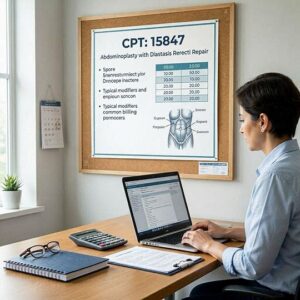
cpt code for abdominoplasty with diastasis recti repair
What Exactly Are We Coding?
Before we talk about codes, let us quickly define the two procedures.
Abdominoplasty (Tummy Tuck)
This is the surgical removal of excess skin and fat from the lower abdomen. The surgeon often tightens the remaining skin and repositions the belly button. This part of the procedure is cosmetic in many cases. But it can be reconstructive when patients have massive weight loss, hernias, or skin infections.
Diastasis Recti Repair
Diastasis recti is the separation of the left and right abdominal muscles. This happens often after pregnancy or significant weight gain. The repair involves suturing these muscles back together along the midline.
Here is the catch. During a standard tummy tuck, the surgeon must open the abdominal wall. So repairing diastasis recti is often part of the same surgical exposure. Therefore, coding guidelines treat these two as bundled in most situations.
The Primary CPT Code for Abdominoplasty with Diastasis Recti Repair
Let us give you the direct answer first.
The standard CPT code for abdominoplasty with diastasis recti repair is 15830.
Code 15830 is defined as: Excision, excessive skin and subcutaneous tissue (including lipectomy); abdomen, infraumbilical panniculectomy.
But wait – that definition does not mention muscle repair. And that is the root of the confusion.
What 15830 Actually Includes
According to the American Medical Association (AMA) and the National Correct Coding Initiative (NCCI), code 15830 includes repair of diastasis recti when performed through the same incision during an abdominoplasty.
Let me repeat that. You cannot bill a separate code for the muscle repair if you are already billing 15830.
The official language states that diastasis recti repair is considered an integral component of abdominal wall reconstruction during an abdominoplasty. So from a coding perspective, the muscle suture is part of the main surgery.
What If You Do Not Have Excess Skin?
Here is a critical nuance. Sometimes a patient needs diastasis recti repair for functional reasons – back pain, pelvic floor issues, or poor posture – but does not have significant excess skin. In that case, 15830 may not be appropriate.
For isolated diastasis recti repair without skin excision, you would use:
-
CPT 49999 – Unlisted procedure, abdomen (if no other code fits)
-
Or CPT 15730 (if you are adding flaps, but that is rare)
However, most surgeons combine muscle repair with skin and fat removal. So 15830 remains the go-to code.
When Can You Bill Two Codes Instead of One?
Now, let us talk about exceptions. Because there are a few legitimate scenarios where you can report an additional code alongside 15830.
Scenario 1: A Separate Hernia Repair
If the patient has a true ventral hernia or umbilical hernia – not just diastasis – you may bill a hernia repair code in addition to 15830.
Common hernia codes used with abdominoplasty:
| Hernia Type | CPT Code | Description |
|---|---|---|
| Umbilical hernia | 49580 | Repair, initial, reducible |
| Ventral hernia (primary) | 49560 | Repair of anterior abdominal hernia |
| Incisional hernia | 49561 | Repair of incisional hernia (separate from diastasis) |
Important note: You must use modifier 59 (Distinct Procedural Service) or XS (Separate structure) on the hernia code. This tells the payer that the hernia repair was distinct and not part of the routine abdominoplasty.
Scenario 2: Extensive Rectus Plication Beyond Standard
Some coders try to bill 15830 for the skin and fat plus 15847 for the muscle repair. Code 15847 is defined as: Excision, excessive skin and subcutaneous tissue (including lipectomy); abdomen (e.g., abdominoplasty), with rectus plication (i.e., diastasis recti repair).
But be careful. Code 15847 was created for revisional or complex abdominoplasty. It is not meant for routine cases. If you use it incorrectly, you risk an audit. Most payers expect 15830 for standard tummy tuck with muscle repair.
Scenario 3: Bilateral Flank Lipectomy
If you also remove fat from the flanks (love handles) during the same surgery, you can bill:
-
15830 – Abdominoplasty with diastasis recti repair
-
15832 (if medically necessary) – Excision, excessive skin and subcutaneous tissue, thigh, each thigh
But again, insurance often denies 15832 as cosmetic unless the patient has rashes or infections documented.
Why Insurance Usually Denies These Claims
Here is the honest truth that many coders do not want to admit. Most abdominoplasty procedures are cosmetic. And diastasis recti repair, by itself, is often considered cosmetic too.
For insurance to pay for cpt code for abdominoplasty with diastasis recti repair, you must prove medical necessity. That means submitting documented evidence of:
-
Chronic skin rashes or infections (intertrigo) under the pannus
-
Back pain or posture problems directly linked to muscle separation
-
Failed conservative treatment (physical therapy, binders, exercise)
-
Functional impairment (difficulty walking, breathing, or performing daily tasks)
Even then, many policies explicitly exclude abdominoplasty. Some Medicare Administrative Contractors (MACs) cover panniculectomy (15830) but not the cosmetic reshaping.
Reader note: Always check the patient’s specific insurance policy before surgery. A prior authorization is mandatory for any chance of coverage.
Complete Coding Table for Abdominoplasty with Muscle Repair
Here is a quick reference table to help you choose the right code combination.
| Procedure Performed | Correct CPT Code(s) | Modifier Needed | Notes |
|---|---|---|---|
| Tummy tuck + diastasis recti repair (standard) | 15830 | None | Muscle repair is included |
| Tummy tuck + diastasis recti + umbilical hernia repair | 15830 + 49580 | 59 or XS on 49580 | Separate documentation required |
| Tummy tuck + diastasis recti + ventral hernia repair | 15830 + 49560 | 59 or XS on 49560 | Must prove hernia is distinct |
| Isolated diastasis recti repair (no skin excision) | 49999 | None | Submit operative report with claim |
| Revisional abdominoplasty with complex plication | 15847 | None | Only for secondary or complex cases |
| Panniculectomy (skin only, no muscle repair) | 15830 | None | Do not report if no muscle work done |
Documentation Tips to Avoid Denials
You cannot fix a coding error after the claim is denied if your documentation is weak. Here is what your operative note must clearly state.
Required Elements in the Op Report
-
Preoperative diagnosis – Specify diastasis recti with width (e.g., 4 cm separation)
-
Medical necessity – Why is this surgery needed? Reference symptoms, failed PT, skin issues.
-
Intraoperative findings – Describe the muscle separation. Note any hernia defects.
-
Procedure details – State exactly how the rectus muscles were plicated (suture type, technique, from xiphoid to pubis).
-
Separate structure language – If billing a hernia repair, write: “The umbilical hernia was a distinct defect separate from the diastasis recti. It required separate dissection and closure with interrupted figure-of-eight sutures.”
Sample Operative Note Snippet
*“After marking the planned incision, we infiltrated with local anesthetic. A standard infraumbilical elliptical excision of skin and fat was performed. The anterior rectus sheath was exposed. A 5 cm diastasis recti was identified from the xiphoid to the pubis. This was repaired with interrupted 0 PDS sutures placating both rectus sheaths. Additionally, a small 1 cm umbilical hernia defect was found separate from the diastasis. This was repaired primarily with 2-0 PDS. The skin was closed in layers.”*
This note supports 15830 + 49580 with modifier 59.
Common Coding Mistakes to Avoid
Even experienced coders slip up here. Let us look at the most frequent errors.
Mistake 1: Billing 15830 and 15847 Together
You cannot bill both. Code 15847 includes the same work as 15830 plus plication. Using both is double dipping. Choose one based on complexity.
Mistake 2: Adding Modifier 50 for Bilateral
Abdominoplasty is not a bilateral procedure. Do not use modifier 50. The abdomen is one anatomic site.
Mistake 3: Forgetting Modifier 59 on Hernia Repair
Without modifier 59, the hernia repair will bundle into 15830. The claim will auto-deny. Always append modifier 59 or XS.
Mistake 4: Reporting Liposuction as a Separate Code
Most insurance plans consider liposuction (15877) cosmetic. And if performed during an abdominoplasty, it is bundled. Do not bill it separately unless you have a rare reconstructive indication like lipedema.
Medicare and CPT Code for Abdominoplasty with Diastasis Recti Repair
Medicare has specific rules. They do not cover cosmetic surgery. However, they may cover a panniculectomy (15830) if the pannus hangs below the pubic symphysis and causes chronic intertrigo.
Does Medicare cover diastasis recti repair?
Generally, no. Medicare considers diastasis recti repair part of the panniculectomy. They do not pay extra for it. And they will not cover isolated muscle repair without skin excision.
Some local coverage determinations (LCDs) exist. For example, Noridian Medicare (Jurisdiction E) explicitly states that diastasis recti repair is not separately reimbursed with 15830.
You should check your MAC’s LCD before submitting any Medicare claim.
Private Payer Variations
Private insurers vary widely. Here is a general snapshot based on common policies.
| Payer | Coverage for 15830 | Separate payment for hernia repair with modifier 59 | Prior authorization required |
|---|---|---|---|
| Aetna | Yes, with medical necessity | Yes, for true hernia | Yes |
| Cigna | Rarely (often cosmetic exclusion) | Yes, if documented separately | Yes |
| UnitedHealthcare | Yes, for panniculectomy criteria | Yes, with separate defect | Yes |
| Blue Cross (varies by state) | Case by case | Usually yes | Yes |
| Humana | Only for post-bariatric patients | Yes | Yes |
Key takeaway: Never assume coverage. Always obtain written prior authorization with the specific CPT codes you plan to bill.
Real-World Billing Examples
Let us walk through three patient cases. This will help you apply the rules in practice.
Example 1: Post-Pregnancy Patient
History: 34-year-old female, two pregnancies, 4 cm diastasis recti, moderate lower abdominal skin redundancy, no hernias. She has back pain and urinary urgency.
Procedure: Abdominoplasty with rectus plication.
Correct coding: 15830 only.
Explanation: The muscle repair is bundled. No hernia. Back pain and urgency support medical necessity but do not change the code.
Example 2: Massive Weight Loss Patient
History: 48-year-old male, lost 120 lbs after gastric bypass. Large pannus hanging to mid-thigh. Chronic rashes. On exam, a 6 cm diastasis recti and a small incisional hernia from previous surgery.
Procedure: Panniculectomy, diastasis repair, and incisional hernia repair.
Correct coding: 15830 + 49561 (with modifier 59).
Explanation: The incisional hernia is separate from diastasis. Modifier 59 is required. The rashes support medical necessity.
Example 3: Patient with Isolated Diastasis
History: 29-year-old male, athletic, no excess skin, but a 5 cm diastasis causing abdominal wall bulging and performance issues. He tries PT for 6 months without improvement.
Procedure: Open diastasis recti repair without skin excision.
Correct coding: 49999 (unlisted). Submit operative report and a cover letter explaining why no other code fits.
Explanation: 15830 requires skin/fat excision. Without that, you must use unlisted code. Reimbursement is unpredictable.
How to Handle Denials
You will get denials. That is the reality of coding this combination. Here is what to do.
Denial Code CO-50 (Not medically necessary)
-
Action: Appeal with records showing functional impairment. Include photos of skin rashes. Add a letter from physical therapy.
-
Tip: Some payers require a second-level appeal with peer-to-peer review.
Denial Code CO-97 (Bundled into another service)
-
Action: Check if you forgot modifier 59 on a hernia code. If no hernia, accept the denial – it is correct.
Denial Code PR-204 (Cosmetic exclusion)
-
Action: This is hard to overturn unless you have strong documentation of infection or functional loss. Consider patient self-pay.
Frequently Asked Questions (FAQ)
1. Can I bill 15830 and 15832 together?
Yes, if you perform a thigh lift at the same time. But most insurers consider thigh lift cosmetic. Medical necessity must be proven separately.
2. What is the difference between 15830 and 15847?
Code 15830 is for standard abdominoplasty (first-time or uncomplicated). Code 15847 is for revisional or complex abdominoplasty with extensive rectus plication. Do not use 15847 for routine cases.
3. Does diastasis recti repair require a separate incision?
No. In a standard abdominoplasty, the muscle repair is performed through the same incision. That is why it bundles.
4. Can a patient pay out-of-pocket for diastasis repair and use insurance for the hernia part?
Yes. This is called “unbundling for patient convenience.” But you cannot bill insurance for the diastasis portion if it is not covered. The patient signs a waiver for non-covered services.
5. What modifier do I use for bilateral flank lipectomy during abdominoplasty?
Use modifier 50 for bilateral flank lipectomy (15877-50) if it is medically necessary. But again, most payers deny liposuction as cosmetic.
6. Is there a specific code for robotic diastasis recti repair?
No. Robotic repair is reported with the same codes as open repair (e.g., 15830, 49999, or hernia codes). You can add modifier 62 if two surgeons perform the case.
7. How many sutures or plication width justifies separate coding?
There is no magic number. The NCCI manual states that any plication of the rectus sheath during an abdominoplasty is bundled – regardless of width or number of sutures.
8. What is the Medicare reimbursement for 15830 in 2025?
The national average allowed amount for 15830 is approximately $550–$700 for the professional component. Facility fees are separate. These amounts change annually.
Additional Resources for Coders and Surgeons
For the most up-to-date information, always refer to official sources. Here are trusted links.
-
AMA CPT® Professional Edition – The official codebook. [Link to AMA store]
-
NCCI Policy Manual – Chapter 4, Surgery: Integumentary System. [CMS.gov]
-
American Society of Plastic Surgeons (ASPS) – Coding Corner articles on abdominoplasty.
-
Noridian Medicare LCD for Panniculectomy – L35162 (if you are in Jurisdiction E).
Author’s Note: Coding guidelines change every year. The information in this article is accurate as of the publication date. Always verify with your local payer and the current CPT manual before billing.
Quick Summary Checklist Before You Bill
Use this checklist to ensure you are using the correct CPT code for abdominoplasty with diastasis recti repair.
-
Did you document the width of the diastasis recti? (e.g., 4 cm)
-
Did you prove medical necessity with symptoms, failed PT, or skin issues?
-
Is there a separate hernia defect? If yes, add hernia code + modifier 59.
-
Did you avoid billing 15847 unless the case is revisional/complex?
-
Did you obtain prior authorization?
-
Did you check the patient’s cosmetic exclusion clause?
If you answer yes to all, you are ready to submit your claim.
Final Thoughts on Mastering This Code
The cpt code for abdominoplasty with diastasis recti repair is not as complex as it first seems. The main rule is simple: use 15830 alone. Resist the urge to add extra codes for the muscle work. Only break out additional codes when a true hernia exists.
Documentation is your best defense. A clear operative note that describes the separation, the plication technique, and any distinct defects will survive audits and appeals.
And remember – medical necessity drives payment. Even with the perfect code, if the surgery is cosmetic in the eyes of the insurer, you will not get reimbursed. Know your payer. Know your patient. And code honestly.
Conclusion
In three lines: The correct CPT code for a standard abdominoplasty with diastasis recti repair is 15830, which bundles the muscle plication into the primary procedure. Separate hernia repairs require additional codes with modifier 59, but isolated diastasis repair without skin excision must use an unlisted code (49999). Always prioritize medical necessity documentation and prior authorization to avoid denials from both Medicare and private insurers.
Disclaimer: This article is for educational purposes only and does not constitute legal or medical coding advice. Coding rules vary by payer, region, and year. Always consult a certified professional coder and the current CPT manual before submitting claims. The author and publisher assume no liability for claim denials, audits, or financial losses resulting from the use of this information.