Navigating the landscape of medical billing for gynecological procedures requires constant vigilance. Even a well-established procedure like the Loop Electrosurgical Excision Procedure, universally known as LEEP, demands updated knowledge as coding rules evolve. For practices reviewing their revenue cycle heading into 2026, understanding the precise Current Procedural Terminology identifiers is not just an administrative task—it is the cornerstone of financial health. This guide serves as a definitive resource. You will discover the primary CPT code for LEEP conization, dissect its technical components, and examine the nuanced differences between conization and simple excision. Whether you are a seasoned coder, a new biller in an OB/GYN practice, or a provider checking documentation requirements, this article delivers actionable, realistic advice. We focus exclusively on verified coding conventions and real-world application, ensuring every section equips you to handle claims with confidence.
Understanding LEEP Conization: The Clinical Foundation
Precision in coding begins with a rock-solid grasp of the clinical service. Without this understanding, selecting an accurate code becomes guesswork. LEEP conization represents a specific therapeutic and diagnostic intervention targeting the uterine cervix.
What Defines a Conization Procedure
The term “conization” refers to the removal of a cone-shaped wedge of tissue from the cervix. Clinicians perform this procedure to excise the transformation zone, where most cervical abnormalities originate. The shape is not arbitrary. It allows the pathologist to evaluate the full spectrum of tissue layers, from the exocervix through the transformation zone into the endocervical canal. This architectural preservation is critical for ruling out invasive cancer.
A LEEP procedure uses a thin wire loop energized by an electrosurgical unit. The electric current simultaneously cuts and coagulates tissue, providing a specimen suitable for histological examination while minimizing bleeding. Physicians often perform this under local anesthesia in an office setting, a colposcopy clinic, or an outpatient surgical suite.
The key distinction defining conization lies in intent and depth. A conization aims to remove the entire lesion and the transformation zone in one intact or few large fragments. The physician intends to excise the disease completely with a curative margin. This contrasts sharply with a superficial biopsy, which samples tissue merely for diagnosis. Coders must recognize that the word “conization” in documentation triggers a specific code set.
Common Indications for the Procedure
Providers recommend LEEP conization when diagnostic colposcopy reveals high-grade cervical intraepithelial neoplasia, typically CIN 2 or CIN 3. Suspicion of microinvasive disease also warrants a diagnostic excisional procedure. Persistent low-grade lesions that remain unchanged over time may eventually require excision if surveillance becomes impractical.
Another indication arises when the squamocolumnar junction is not fully visible during colposcopy, described as an unsatisfactory examination. A diagnostic excisional procedure becomes necessary to rule out an occult higher-grade lesion hiding in the endocervical canal. Coders should look for terms like “inadequate colposcopy,” “positive endocervical curettage,” or “discordant cytology and histology” in the medical record.
Therapeutic intent also drives coding. If the provider states that they aim to treat a confirmed high-grade lesion, the service reflects therapeutic conization. Insurance carriers may process claims differently based on whether the primary intent is diagnostic or therapeutic, although the CPT code remains the same. Documenting medical necessity thoroughly protects against audits and denials.
The Evolution of Electrosurgical Excision
Medicine continuously refines its tools. The shift from cold-knife conization performed in an operating room under general anesthesia to LEEP performed under local anesthesia revolutionized gynecologic care. Cold-knife conization requires a scalpel and sutures, often with greater blood loss and operative time. LEEP replaced that with a rapid, office-based alternative.
This historical shift matters for coding because older operative reports sometimes use outdated terminology. A physician dictating “conization” without specifying the method forces the coder to query for clarification. Never assume the technique. Cold-knife conization (CPT 57520) and LEEP conization map to different codes with different relative value units (RVUs). The 2026 coding environment maintains this distinction clearly.
The Primary CPT Code for LEEP Conization in 2026
Now we arrive at the core of this guide: the specific code. For the 2026 calendar year, the official CPT code set identifies LEEP conization under a dedicated code that describes loop electrosurgical excisional procedure of the cervix.
CPT 57461: Definitive Identification and Full Description
The American Medical Association publishes the complete descriptor. For your reference, the full official description reads:
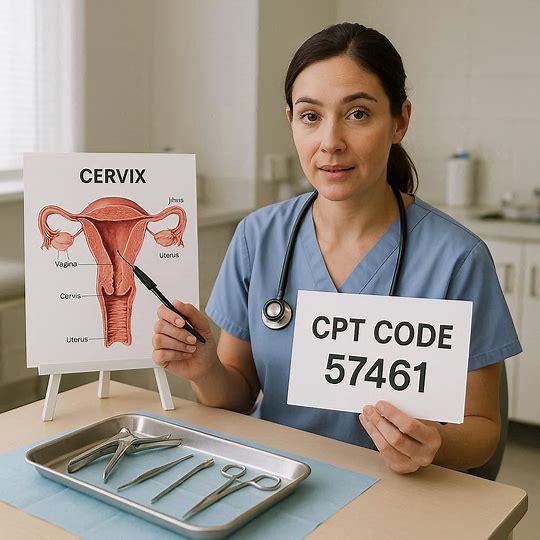
CPT 57461 – Colposcopy of the cervix including upper/adjacent vagina; with loop electrode conization of the cervix.
This descriptor includes several critical elements. First, the code bundles the colposcopic examination performed immediately before the excision. You do not report a separate colposcopy code on the same date of service. Second, the term “loop electrode” specifies the technique, distinguishing it from cold-knife or laser methods. Third, the phrase “conization of the cervix” confirms the excisional intent and cone-shaped specimen.
The global surgical package applies to this code. Office-based procedures include the visit on the day of surgery, local anesthesia, the excision, and typical post-operative care. Coders should check individual payer policies regarding evaluation and management (E/M) services on the same day if a separately identifiable problem is addressed.
Code Specificity and Lay Descriptions
The CPT codebook includes a lay description for clinical clarity. The physician first performs a colposcopy, thoroughly examining the cervix and upper vagina using a colposcope, a binocular microscope with a bright light. Acetic acid and sometimes Lugol solution highlight abnormal epithelial changes. Once the lesion borders are identified, the physician injects a local anesthetic, usually lidocaine with epinephrine, into the cervical stroma.
The physician then selects an appropriately sized wire loop. An electrosurgical generator delivers a blended cutting and coagulation current. The loop passes through the cervical tissue, removing a cone-shaped specimen encompassing the entire transformation zone and the lesion. The physician may use a smaller loop or a ball electrode to fulgurate the base for additional hemostasis. The specimen is oriented, placed in formalin, and sent for pathological examination. The lay description clarifies that this code covers the complete service as a unit.
Code 57461 Versus Other Excision Codes
Differentiation drives clean claims. You must separate CPT 57461 from similar but distinct codes. The table below maps these critical distinctions.
| CPT Code | Official Descriptor | Technique | Specimen Type | Setting |
|---|---|---|---|---|
| 57461 | Colposcopy with loop electrode conization | Wire loop electrosurgery | Cone-shaped, intact or few fragments | Office or outpatient |
| 57520 | Conization of cervix, cold knife or laser | Scalpel or laser | Single cone specimen | Hospital or ASC |
| 57460 | Colposcopy with loop electrode biopsy(s) | Wire loop biopsy | Small, non-cone fragments | Office or outpatient |
| 57500 | Biopsy of cervix, single or multiple | Punch or forceps | Small mucosal samples | Office |
Pay close attention to documentation indicating a “LEEP biopsy” versus a “LEEP conization.” A LEEP biopsy, coded as 57460, involves removing one or more discrete pieces of abnormal tissue without necessarily excising the entire transformation zone as a single cone. The distinction rests on physician intent and specimen description.
Important Note for Coders: When the pathology report describes the specimen as “multiple fragments of tan-white tissue, not reconstructed as a cone,” the procedure may represent a LEEP biopsy rather than a conization. Conversely, a report describing a “cone-shaped specimen measuring 2.0 x 1.5 x 1.0 cm with ink-painted margins” supports 57461. Let the operative note and pathology correlation guide final code selection.
Changes and Confirmed Updates for 2026
CPT codes undergo review and potential revision each year. The AMA releases the new code set in the fall preceding the implementation year. As of the latest finalized rulemaking and CPT Editorial Panel actions, CPT 57461 remains the valid code for LEEP conization for the 2026 calendar year.
Official AMA and CMS Guidance for Calendar Year 2026
The Centers for Medicare & Medicaid Services (CMS) updates the Medicare Physician Fee Schedule annually. For 2026, CMS has assigned work Relative Value Units (wRVUs) and practice expense inputs under the Final Rule. The total facility and non-facility RVUs determine your payment. Coders should download the latest fee schedule file from the CMS website to import current payment rates into practice management systems.
The National Correct Coding Initiative (NCCI) edits also update quarterly. For 2026, NCCI bundles continue to prohibit separate reporting of colposcopy codes (e.g., 57454, 57455) with 57461. The colposcopy is an inherent component of the conization. Additionally, NCCI edits pair 57461 with certain biopsy codes. You cannot unbundle a cervical biopsy performed on the same lesion that is subsequently completely excised via conization on the same day. A biopsy of a separate, distinct lesion (for example, a vaginal lesion) may be reported with modifier 59 or XS, but only if documentation clearly supports the separate site.
The AMA CPT Professional Edition remains the definitive source. Practices must obtain the current year’s edition and not rely solely on electronic health record prompts, which may lag in updates.
Reimbursement Insights and RVU Shifts
For 2026, CMS continues to refine valuation under the global surgical package. LEEP conization performed in the office (non-facility setting) attracts a higher practice expense RVU because the practice supplies the equipment, supplies, and clinical staff. The wRVU, reflecting physician work, remains constant regardless of place of service.
According to proposed and finalized indicators, the physician work for 57461 includes the intra-service time for the colposcopy, anesthesia injection, loop excision, and hemostasis. It also includes the immediate post-service work in the office. If a provider performs the procedure in a facility (hospital outpatient or ambulatory surgery center), the facility bills for the technical resources while the physician bills the professional component only, resulting in a lower total RVU for the physician claim.
Coders must verify payer-specific fee schedules. Commercial carriers may adopt Medicare RVUs with a negotiated conversion factor multiplier. Accurate payment posting requires running test claims after system updates each January.
Important Update to Modifier Usage
The NCCI Policy Manual for Medicare Services effective January 1, 2026, reiterates that modifier 25 applies only to a separately identifiable E/M service by the same physician on the same day as the procedure. If a patient presents for a scheduled LEEP conization, the preoperative history and physical are part of the procedure and not separately billable. However, if the patient presents with acute pelvic pain prompting an additional, distinct evaluation beyond the normal pre-procedural work, you may report an E/M code with modifier 25. Documentation must clearly reflect that the additional work exceeded the usual pre-operative service.
Modifier 59 or the X{EPSU} modifiers apply to distinct procedural services. For example, if a provider performs a LEEP conization and also excises a completely separate vulvar lesion in the same session, you may append modifier XS (Separate Structure) to the vulvar lesion code. Always structure the operative report with separate paragraphs describing each discrete procedure to withstand auditor scrutiny.
Comparative Billing: CPT 57461 vs. 57520 vs. 57460
Choosing incorrectly among these three codes causes frequent denials and compliance risk. Let us break down their application in realistic clinical vignettes.
When to Select Conization Over Simple Excision
Scenario one: A 34-year-old patient has biopsy-proven CIN 3 extending into the endocervical canal. The colposcopist visualizes the full lesion and the squamocolumnar junction. Using a 20 mm x 8 mm loop electrode, the physician passes the loop through the cervix from the lateral margin on the right, excising a cone specimen containing the transformation zone in one pass. The operative note documents “LEEP conization” and describes a cone-shaped specimen.
Correct code: CPT 57461.
Scenario two: The same patient has two discrete, raised white lesions on the exocervix at 3 o’clock and 9 o’clock, well away from the canal. The colposcopist uses a small loop electrode to shave off each lesion individually, taking the lesions down to the stroma but not attempting a full-thickness cone excision. The operative note states “LEEP biopsy of two exocervical lesions.” The pathology report describes two separate fragments of squamous mucosa.
Correct code: CPT 57460.
The distinction turns on whether the physician removes a contiguous transformation zone cone. Never code based on the instrument alone. The loop electrode can perform both a conization and a biopsy. The operative note intent determines the code.
Procedure Table: Conization, Cold-Knife, and Biopsy
The following table presents a side-by-side comparison of key attributes. Review this carefully when auditing operative reports.
| Attribute | CPT 57461 (LEEP Conization) | CPT 57520 (Cold-Knife Conization) | CPT 57460 (LEEP Biopsy) |
|---|---|---|---|
| Anesthesia Setting | Local in office or outpatient | General or regional in OR | Local in office |
| Instrument | Thin wire loop with electrosurgery | Scalpel | Small wire loop |
| Specimen | Cone-shaped, intact or few pieces | Single cone, intact | Multiple small fragments |
| Hemostasis Method | Ball electrode fulguration or Monsel solution | Sutures (Sturmdorf or figure-eight) | Monsel solution or light fulguration |
| Global Period | 000 (0-day) or 010 (10-day) depending on payer | 090 (90-day major surgery) | 000 (0-day) typically |
| Code Bundles | Includes colposcopy and E/M for the procedure | Includes hospital visit on day of surgery | Includes colposcopy |
Coders must note the global period variance. Medicare assigns a 0-day global period to 57461, meaning that routine post-operative care on subsequent days is separately billable if medically necessary and documented. However, private insurers may assign a 10-day global. Query your carrier contracts.
Coding Decision Tree for Excisional Cervical Procedures
To streamline your daily workflow, follow this logical sequence when assigning a code:
- Did the physician document “conization”?
- Yes: Proceed to step 2.
- No: Proceed to step 4.
- What instrument did the physician use?
- Loop electrode: Select CPT 57461.
- Cold knife or laser: Select CPT 57520.
- No instrument specified: Query the physician. Do not assume LEEP.
- Did the colposcopy occur as part of the same encounter?
- Yes: The colposcopy bundles into 57461 or 57460. Do not report separately.
- No: If colposcopy was on a prior date purely for diagnostic decision-making, do not report it again on the procedure date.
- If no conization, did the physician take an excisional biopsy with a loop?
- Yes: Select CPT 57460.
- No: If punch biopsy, select CPT 57455 (colposcopy with biopsy).
- Are there multiple procedures?
- Review NCCI edits. Append modifiers 59 or XS only for distinct anatomical sites or separate lesions clearly documented.
This simple decision tree, printed and posted in the coding department, reduces error rates dramatically.
Complete Coding Guidance for Accurate Reimbursement
Beyond the primary procedure code, comprehensive reimbursement depends on linking the correct diagnosis, applying the appropriate modifiers, and addressing global period rules.
Global Periods, Modifiers, and Bundling Rules
The global surgical package for 57461 includes the pre-operative evaluation, the local anesthesia, the procedure, and post-operative care for the defined period. As discussed, verify the global days with each payer. Medicare assigns 0 days, which means the day of surgery is the only global day. Therefore, an E/M service on postoperative day 5 for a complaint of increased discharge requires a separate E/M code, typically 99212-99214, with no modifier.
If a patient undergoes LEEP conization and the provider also performs a dilation and curettage (D&C) for endocervical curettage that extends into the endometrial cavity, review the operative note carefully. A diagnostic fractional D&C (CPT 58120) may be reported separately if the endocervical curettage performed during the LEEP addresses a different anatomical site (the endometrial cavity) and is not part of the typical LEEP procedure. Append modifier 59 or XU (Unusual Non-Overlapping Service) to 58120. Clear documentation of the distinct medical necessity for entering the uterine cavity is non-negotiable.
Pro Tip: Most commercial payers follow NCCI guidelines. Obtain and review your top five payers’ medical policies on multiple procedures and endoscopic bundling every quarter. Policy changes mid-year can catch revenue cycle teams off guard.
ICD-10-CM Diagnosis Linkage Requirements
Medical necessity is not proven by the procedure code alone. The ICD-10-CM diagnosis code justifies the intervention. Payers scrutinize the link between diagnosis and service. For LEEP conization in 2026, the highest specificity ICD-10-CM codes include:
- N87.1 – Moderate cervical dysplasia (CIN 2)
- D06.1 – Carcinoma in situ of exocervix (CIN 3, severe dysplasia, CIS)
- D06.7 – Carcinoma in situ of other parts of cervix (CIN 3 of endocervix)
- N87.2 – Severe cervical dysplasia, not elsewhere classified (when documentation specifies severe dysplasia but not CIS)
- R87.619 – Abnormal cytological findings in specimens from cervix uteri, unspecified
Always code to the highest degree of specificity supported by the pathology report. If the pre-procedure biopsy showed CIN 2, but the LEEP specimen reveals CIN 3, code the CIN 3 (D06.1 or D06.7) as the definitive diagnosis. The pre-procedure biopsy diagnosis becomes secondary or not reported on the procedure claim. The final pathological diagnosis provides the most accurate supporting code.
Screening codes like Z12.4 (Encounter for screening for malignant neoplasm of cervix) are never primary for a therapeutic LEEP conization. Use them only if the initial intent of a visit was purely screening, and the procedure was scheduled separately.
Payer-Specific Variations: Medicare, Medicaid, and Commercial Plans
Medicare covers LEEP conization when medically necessary for diagnosing and treating pre-malignant cervical conditions. Medicare Administrative Contractors (MACs) publish Local Coverage Determinations (LCDs). Your jurisdiction’s LCD may specify acceptable diagnosis codes and frequency limitations. For example, First Coast Service Options or Noridian may list a covered diagnosis array. Check your MAC’s website annually.
Medicaid programs often align with Medicare but may impose their own global periods or require prior authorization for facility-based procedures. A few state Medicaid programs have started requiring pre-authorization for certain high-volume gynecological procedures. Always verify state-specific provider manuals.
Commercial payers like UnitedHealthcare, Aetna, and Anthem issue medical policy bulletins. Many adopt InterQual or MCG guidelines. They may require a biopsy-proven high-grade lesion before authorizing a therapeutic conization. Aetna Clinical Policy Bulletin 0411, for example, discusses cervical excision criteria. Bookmark these policies and review them when establishing office protocols.
Documentation Best Practices for a Clean Claim
The operative report stands as the single most defensible document in an audit. Weak documentation invites denials, downcoding, or recoupment. Strive for narrative clarity and completeness in every procedure note.
Operative Report Elements Auditors Demand
Every LEEP conization operative report should include these elements:
- Pre-procedure Diagnosis and Indication: State the specific abnormality (e.g., “CIN 3 on colposcopic biopsy from the 6 o’clock position”).
- Colposcopic Findings: Describe the transformation zone visualization, lesion margins, vascular patterns, and Lugol staining results.
- Anesthesia: Document type, agent (e.g., 1% lidocaine with epinephrine), volume, and injection technique.
- Procedure Description: Use the exact term “LEEP conization” or “loop electrode conization.” Describe the loop size, power settings (cut and coagulation modes), and the number of passes.
- Specimen Details: Note whether the specimen was removed as an intact cone or in fragments. Document specimen orientation (e.g., “suture placed at 12 o’clock margin”).
- Hemostasis: Describe the method and effectiveness. “Base fulgurated with ball electrode at 40 watts. Good hemostasis achieved. No sutures required.”
- Estimated Blood Loss: Even a typical minimal blood loss of “less than 5 mL” should be recorded.
- Complications: Explicitly state “No complications” if none occurred. Silence implies missing information.
- Post-Operative Plan: Include instructions, follow-up timeline, and pathology expectations.
An operative report that simply states “LEEP done” is a denial waiting to happen. Train providers to dictate or enter structured notes with all required fields.
Quoting Auditors: What Coders Look For
Experienced coding auditors share consistent advice. We include a direct quote reflecting a standard auditor mindset:
“When I review a LEEP conization claim, I immediately scan for the word ‘conization’ and a description of a cone specimen. If the note says ‘loop excision of lesion’ without specifying ‘conization,’ and the path report shows multiple fragments, I hold the claim for a query. I also look for medical necessity. A LEEP for a low-grade Pap without a biopsy showing CIN 2+ will almost always trigger a medical necessity denial.”
This insight underscores two principles. First, the language must match the code. Second, the diagnostic pathway must justify the procedure’s invasiveness. Coders and providers should routinely audit each other’s work to close communication gaps.
Essential Checkboxes for EHR Templates
Electronic health record systems can enforce documentation discipline. Build a procedure template that includes required fields. The template should prompt the provider to:
- Select the procedure name from a picklist that maps directly to CPT terminology (e.g., “Colposcopy with LEEP conization” not “LEEP”).
- Choose the indication from a diagnosis picklist linked to ICD-10-CM codes.
- Enter the number of passes and specimen integrity.
- Document hemostasis technique.
- Attach a labeled diagram or photograph of the cervix with lesion location marked.
Hard stops in the template prevent the note from being signed until these fields contain data. This technical safeguard protects revenue and patient safety.
Testing and Pathology Coding After LEEP
The LEEP conization generates a tissue specimen. The pathology examination produces a separate professional service. Coding for this service correctly captures the complete episode of care.
Specimen Handling and Lab Code Selection
The LEEP specimen requires careful handling. The surgeon typically orients it on a flat surface or wax board with pins, marking the 12 o’clock margin with a suture or ink. The specimen is placed in a formalin container. This orientation allows the pathologist to assess margin status precisely and communicate which margins are involved, guiding further management.
The pathology CPT codes depend on the complexity. For a routine cervical conization specimen examined for squamous dysplasia, the pathologist typically codes CPT 88307 (Level V surgical pathology, cervix, conization). This code covers the gross and microscopic examination of the conization specimen. The descriptor specifically lists “Cervix, conization” as a Level V specimen.
If the pathologist performs immunohistochemical stains to evaluate for p16 or Ki-67 biomarkers, those stains are coded separately using CPT 88342 (immunohistochemistry, first single antibody stain) or 88341 for multiplex. Add-on codes may apply for additional stains. Each payer has unique policies regarding the medical necessity of biomarker testing in cervical dysplasia. Some require documentation that the histology is ambiguous between CIN 1 and CIN 2 before covering p16.
For the technical component performed in an office lab, append modifier TC. For the professional interpretation only, append modifier 26. Many practices bill globally without a modifier when they own the lab.
Linking the Excision Code with Surgical Pathology
The surgeon’s claim for 57461 and the pathologist’s claim for 88307 are independent services but must tell a coherent story. The diagnosis code on the surgeon’s claim should reflect the pre-procedure diagnosis (e.g., D06.1) until the final pathology results return. If the claim drops before the path report is final, use the pre-procedure biopsy result as the indication. Some practice management systems flag a mismatch later during a post-payment review. Coders should not go back and change a previously submitted claim solely to update the diagnosis unless the initial code was wrong based on the information known at the time of billing.
The pathology report itself serves as the source document for the pathologist’s claim. The final pathologic diagnosis ICD-10-CM code must appear on the pathologist’s claim form.
Practice Management and Revenue Cycle Integrity
Medical coding does not exist in a vacuum. It is integrated into the broader revenue cycle. Optimizing workflows around LEEP conization coding protects cash flow and reduces provider frustration.
Prior Authorization Navigation
High-value procedures often require prior authorization. While many LEEP procedures occur in the office without prior authorization, some commercial plans and Medicaid managed care organizations mandate pre-certification even for office-based excisions. Aetna and Cigna periodically update their precert lists. LEEP conization may not always appear, but if performed in a facility, the hospital or ASC will usually initiate the authorization for the facility fee. However, the surgeon’s office must confirm whether the professional service also requires authorization.
Develop a matrix for your top ten payers listing whether office LEEP requires authorization. Assign a staff member to verify this matrix quarterly and update it. When an authorization is required, submit the following:
- The planned CPT code (57461)
- The supporting ICD-10-CM code with a copy of the colposcopy report and biopsy pathology
- A brief statement of medical necessity explaining the need for diagnostic/therapeutic excision
Obtain the authorization number and log it in the practice management system before the date of service.
Correct Modifier Application for Multiple Procedures
We touched on modifier 59 and X{EPSU} earlier. Let us formalize the process with a practical example.
A provider performs the following during the same encounter:
- LEEP conization of the cervix (CPT 57461)
- Excision of a vaginal condyloma (CPT 57061, destruction of vaginal lesion)
These procedures target anatomically separate organs (cervix versus vagina). Modifier XS (Separate Structure) is the most precise modifier. Bill as:
- 57461 (no modifier)
- 57061-XS
The operative report must describe the vaginal lesion location, size, and destruction method in a distinct paragraph. Without this, the payer bundles 57061 into 57461.
Also, consider the case of a LEEP conization and an endometrial biopsy performed for abnormal uterine bleeding. The endometrial biopsy (CPT 58100) samples the uterine corpus, a separate organ from the cervix. You may report 58100 with modifier XS if documentation supports distinct medical necessity for evaluating the endometrium concurrently. Routine practice of “doing an EMB with every LEEP” may not meet medical necessity criteria unless the patient has separate indications like postmenopausal bleeding or irregular menses.
Strategies to Prevent Denials and Reduce Lag Time
Denials erode margins. Build a proactive denial prevention program with these steps:
- Eligibility and Benefits Verification: Confirm coverage for diagnostic surgical procedures under the patient’s plan two days before the service.
- Coding Scrubbing Software: Use an encoder or claim scrubber with up-to-date NCCI edits to flag bundling issues pre-submission.
- Documentation Review Workflow: Have a certified coder review a random sample of LEEP operative reports monthly. Provide feedback to clinicians on missing elements like specimen description or hemostasis documentation.
- Denial Root Cause Analysis: Track every LEEP-related denial by reason code. Categorize them: medical necessity, bundling, modifier missing, or credentialing. Address the top reason with a targeted intervention.
- Timely Filing: Know each payer’s timely filing limit. File claims within seven days of service. Late claims lose revenue permanently.
A streamlined, monitored revenue cycle makes the technical details of coding translate into reliable cash flow.
Compliance and Audit Preparedness
Healthcare faces intense regulatory scrutiny. Audits from Medicare Recovery Audit Contractors (RACs), Unified Program Integrity Contractors (UPICs), and commercial Special Investigation Units (SIUs) target procedure coding. LEEP conization, a high-volume gynecological procedure, appears on audit radars.
Medicare LCDs and NCDs Impacting LEEP Claims
There is no National Coverage Determination (NCD) specifically for LEEP conization. Therefore, Local Coverage Determinations govern. MACs in different jurisdictions set their own policies. For instance, Palmetto GBA and Novitas Solutions may have LCDs addressing “Outpatient Cervical Excision Procedures.” These LCDs typically list covered diagnosis codes and may include limitations such as frequency of repeat conizations.
A common audit target is the performance of a LEEP conization less than six months after a previous conization. Unless the documentation clearly shows recurrent high-grade disease or suspicion of invasive cancer not previously identified, payers may deem a repeat conization unnecessary. Coders should flag any repeat procedure within a year for a compliance review before billing.
Documentation supporting repeat conization must include:
- The previous pathology results
- The current cytology and colposcopy findings
- A statement from the physician explaining why a second excisional procedure is clinically necessary (e.g., “Recurrent CIN 3 at the margin of prior cone site with positive endocervical curettage”).
Common OIG Findings and How to Avoid Them
The Office of Inspector General (OIG) publishes an annual Work Plan. While not always listing LEEP specifically, themes emerge. Upcoding, unbundling, and medically unnecessary services recur.
A realistic danger zone: Billing 57461 when only a LEEP biopsy (57460) was performed. The OIG can review operative reports and compare them with pathology reports. If the pathology report describes three unoriented mucosal fragments totaling 0.5 cm, the service likely matches a biopsy, not a conization. The practice then faces overpayment refund demands and potential False Claims Act liability. Consistent documentation and honest coding are the only shields.
Another risk: Billing for an E/M service with modifier 25 on the same day as a scheduled LEEP for routine clearance. A patient coming in solely for the pre-scheduled procedure does not support a separate E/M. Only a distinct, problem-focused evaluation outside the pre-procedural work warrants the modifier. Internal audits should flag all instances of 99213-25 or 99214-25 billed with 57461 for review.
Self-Audit Process for Gynecological Coding
Implement a quarterly self-audit process. Pull every claim for CPT 57461 over the past quarter. If volume allows, audit all; if high volume, use a statistically valid random sample. For each claim, obtain the operative report and the final pathology report. Verify:
- The operative report contains the term “conization” or clearly describes a cone specimen.
- The colposcopy is documented and bundled correctly.
- No unbundled colposcopy or biopsy appears.
- The diagnosis code matches the pathology report.
- Any modifier 25 or 59/XS claims have robust documentation in the record supporting separate service.
Document the audit findings. If errors exceed a 5% threshold, conduct provider education and re-audit the targeted area after 60 days. This internal vigilance corrects drift before an external auditor arrives.
The Patient Encounter and Financial Experience
A patient undergoing LEEP conization experiences anxiety about the procedure itself, the potential for cancer, and the financial implications. Coding and billing practices directly affect the patient experience. A denied claim or an unexpected bill compounds stress and harms the practice’s reputation.
Transparent Cost Estimates and Coding Communication
Before the procedure, provide a clear, written estimate. The estimate should list the planned CPT code (57461), the expected charges, the anticipated insurance adjustment, and the patient’s estimated responsibility based on their deductible and coinsurance status. This transparency aligns with the No Surprises Act for uninsured or self-pay patients but represents best practice for all patients.
Train front desk and financial counselors to explain what the code covers. A sample script: “Your physician will perform a LEEP procedure, which is coded as 57461. This covers the colposcopy, the local anesthesia, and the removal of the tissue. The pathology lab will bill separately for examining the tissue. We are estimating your out-of-pocket cost today based on your insurance plan.”
When patients understand the code and the process, they feel respected. They are less likely to challenge the bill later and more likely to comply with follow-up care.
Addressing EOB Confusion with LEEP Codes
Patients often receive an Explanation of Benefits (EOB) listing the code 57461 with a description like “Colposcopy with loop electrode conization.” This medical jargon can alarm or confuse. Some patients may search the code online and find misleading cost estimates or clinical information. Proactively offer to explain EOBs during a post-procedure phone call or patient portal message.
Create a simple patient-facing handout (written at a sixth-grade reading level) titled “Understanding Your LEEP Procedure Billing.” Include a section that reads:
“The code 57461 on your insurance statement is the standard medical billing number for the LEEP (Loop Electrosurgical Excision Procedure) conization you had. This code includes the examination with the colposcope and the removal of the abnormal cells. It is normal to see this code. If your insurance did not pay the full amount, you may receive a bill. Please call our billing office if you have questions about your statement.”
This small effort reduces billing-related phone calls and builds trust.
Education and Continuous Learning Resources
The coding landscape evolves. Maintaining competency requires ongoing education. Multiple authoritative sources offer deep dives into CPT, ICD-10-CM, and payer policy.
Credentialed Organizations and Authoritative Guidance
- American Medical Association (AMA): Publishes the CPT Professional Edition, CPT Assistant, and hosts the CPT Symposium. CPT Assistant often clarifies code intent and real-world scenarios.
- American College of Obstetricians and Gynecologists (ACOG): The ACOG Committee on Health Economics and Coding produces coding guides, FAQs, and the annual “Coding Manual for OB/GYN.” This manual translates CPT rules into gynecologic clinical contexts.
- AAPC: Offers the Certified Professional Coder (CPC) credential. AAPC monthly magazine “Healthcare Business Monthly” frequently publishes specialty-specific coding articles. Local chapter meetings provide peer learning.
- AHIMA: The American Health Information Management Association offers the Certified Coding Specialist (CCS) credential and publishes educational materials focused on compliance.
- Centers for Medicare & Medicaid Services (CMS): The CMS website hosts the Physician Fee Schedule, NCCI Policy Manual, and MLN Matters articles. MLN Matters SE documents and MM articles explain national policy changes directly to billers.
Bookmark these resources and designate a lead coder to receive and digest email alerts, summarizing relevant changes for the team in a brief monthly meeting.
Internal Staff Training for Procedure Code Updates
Do not outsource all learning. Build an internal training rhythm. Every November, when the upcoming year’s CPT changes become public, hold an in-service for coders, billers, and interested providers. Focus on the codes relevant to the practice. For a gynecology practice, LEEP conization updates will always be on the agenda.
Create a one-page “quick card” for each major procedure code. Laminate it. The card for 57461 should list:
- Full CPT descriptor
- Relative weight and global period
- ICD-10-CM codes that support medical necessity
- Common NCCI edits (e.g., colposcopy bundles)
- Required documentation elements for audit defense
This job aid reduces the distance between learning and practice. When a coder faces a difficult chart, the quick card provides immediate, correct reinforcement.
Additional Valuable Resources for Your Practice
Beyond core coding, your practice efficiency benefits from access to reference tools and communities that understand the nuance of procedure coding. This section highlights resources that add practical value.
Recommended Authoritative External Link
For real-time Medicare fee schedule lookups and NCCI edit checks, we recommend the official CMS Medicare Physician Fee Schedule Lookup Tool. This free, government-maintained website allows you to enter a CPT code (such as 57461) and retrieve the national payment amount, RVU breakdown, and global period indicator. It also links to the specific MAC pricing for your locality. Using this tool keeps your fee schedule calculations anchored to the primary source rather than third-party aggregators that may introduce errors. While we do not endorse any commercial product, the CMS website stands as an indispensable, authoritative link for every coding professional.
Resource Link: CMS Physician Fee Schedule Search
Coding Roundtable Participation
Join your local AAPC chapter’s OB/GYN roundtable, or start one virtually. These informal peer groups offer a safe space to discuss difficult cases without judgment. A coder might ask, “How is everyone coding a LEEP with top-hat endocervical excision in addition to the main cone?” The group discussion reveals consensus and alternative payer interpretations. Collective intelligence sharpens individual competency.
Maintaining an Internal Knowledge Base
Use a shared drive or intranet wiki to build a practice-specific knowledge base. When a payer sends a denial with a unique rationale, document the resolution steps. Include the claim number (de-identified), the payer, the denial reason, the steps taken, and the outcome. Over time, this repository becomes a searchable memory of hard-won wisdom. New hires can onboard faster, and repeat denials can be solved by reference to past success.
Conclusion
Coding for LEEP conization in 2026 centers on the precise application of CPT 57461, which bundles colposcopy and loop electrosurgical cone excision. Mastery of documentation, diagnosis linkage, and modifier use protects against denials and ensures correct reimbursement for this high-volume gynecologic procedure. Ongoing education, payer policy review, and internal audit cycles are not optional extras but essential pillars of a resilient revenue cycle.
Frequently Asked Questions
Q1: Can I bill an office visit with CPT 57461 if the LEEP was scheduled?
No. The preoperative evaluation is part of the global package. Report a separate E/M service with modifier 25 only if a distinct, separately identifiable problem beyond the pre-procedure assessment is documented.
Q2: My provider used a loop but documented “cone biopsy.” Is that 57461 or 57460?
If the documentation describes a cone-shaped specimen and the intent was to excise the entire transformation zone, report 57461. The term “biopsy” in the note should not mislead you; base coding on the procedure description and specimen architecture.
Q3: What if pathology shows CIN 1, but the indication was CIN 3? Should I change the diagnosis on the claim?
Code the definitive diagnosis from the final pathology report if available at the time of billing. CIN 1 may be coded as N87.0. Medical necessity is not retroactively negated; the pre-procedure indication justified the decision. Ensure documentation supports that the pre-procedure suspicion was reasonable.
Q4: Is CPT 57461 assigned a 0-day global period by all payers?
Medicare assigns 0 days. Commercial payers vary. Verify each payer’s global surgery days policy. Some assign a 10-day global. This affects whether post-operative follow-up visits are separately billable.
Q5: Can I report 57461 and 57500 together for a separate biopsy of a vaginal lesion?
Yes, but you must append modifier XS (Separate Structure) to 57500. The operative report must clearly describe the vaginal lesion and its distinct anatomical location from the cervical excision.
Q6: Does a LEEP conization always require prior authorization?
Not always. Many office-based LEEP procedures do not. However, an increasing number of managed care plans require prior authorization. Check your payer’s specific policy before the scheduled date. Facility-based LEEP typically requires authorization by the facility.
Disclaimer: This article provides general coding information based on CPT 2026 guidelines and Medicare national policies as of the date of writing. Payer-specific policies and state Medicaid rules supersede general guidance. Codes and reimbursement rates change. Always verify coverage with the specific payer and consult the official AMA CPT codebook and payer fee schedules. Clinical scenarios are fictional examples for educational purposes and do not constitute medical or legal advice. Consult with a qualified coding professional or attorney for specific billing questions.