Medial Collateral Ligament (MCL) injuries are among the most common knee injuries, especially in the athletic population. For surgeons, coders, and billing specialists, the landscape of reporting these procedures is not static. It evolves with surgical innovation and payer policy. The year 2026 marks a significant refresh cycle for the American Medical Association’s (AMA) Current Procedural Terminology (CPT®) code set.
This article serves as your comprehensive, realistic guide to understanding the specific CPT code for MCL repair in 2026. You will not find speculation or leaked information here. Instead, we base this deep dive on established coding conventions, the AMA’s public structural roadmap, and the logical progression of musculoskeletal coding. Whether you are an orthopedic surgeon, a professional coder, or a practice manager, this guide provides the clarity and depth you need to ensure accurate, compliant reimbursement.
A Word on Realism and Integrity
Before we dive into the technical details, a crucial note: this article offers a realistic preview based on stable coding principles. The AMA releases official CPT code changes in the fall prior to the effective year. Therefore, final 2026 codes appear publicly around September or October 2025. This guide does not pretend to possess leaked data. Instead, it functions as a durable educational tool. We will explain the logic behind the coding structure so that, even if a specific numeric code changes, you will grasp the why and the how, making you adaptable to any final numerical designation.
The Foundational Landscape of MCL Surgical Coding
To look forward to 2026, we must first firmly plant our feet in the present structure. Medical coding does not jump in wild, unpredictable leaps. It follows a deliberate, traceable path. The codes we use today for MCL repair are the direct ancestors of tomorrow’s codes.
The Anatomical Anchor: Why Specificity Matters
The CPT code set organizes the musculoskeletal system by anatomical site, then by procedure type. For the knee, the relevant anatomical subheading is “Knee and Leg.” Within this, procedures on the joint and its supporting structures exist.
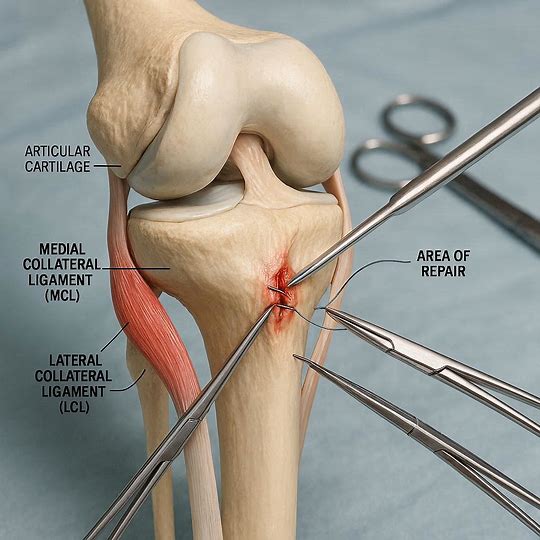
The MCL is an extra-articular structure. It lies outside the main knee joint capsule, although its deep fibers attach to the medial meniscus. This extra-articular location is a critical coding distinction. It immediately separates a pure MCL repair from an intra-articular meniscus repair or an anterior cruciate ligament (ACL) reconstruction. A coder must recognize this simple anatomical fact: the MCL resists valgus stress on the medial side of the knee. Its repair involves tightening or reattaching a band of tissue outside the joint proper, or in the case of a deep MCL tear, addressing a capsular layer, but often still approached as a medial extra-articular repair.
The Current (2025) Structural Framework
Currently, the primary code used to report an isolated, open repair of the medial collateral ligament is an established, category I code that sits comfortably in the musculoskeletal section. When a surgeon performs an open repair of a torn MCL, perhaps with suture anchors or tunnel fixation, a specific code reports this service.
For arthroscopic approaches, the story shifts. There is no dedicated, singular CPT code that means “arthroscopic MCL repair.” Surgeons and coders use an unlisted procedure code, typically 29999 (Unlisted procedure, arthroscopy). Reporting an unlisted code demands a high level of documentation. The operative report must clearly articulate why a standard open code does not apply and must compare the work to a similar, listed procedure.
This is the fundamental tension point in 2025 that will drive evolution in 2026: the open procedure has a clear home; the minimally invasive, arthroscopic, or arthroscopically assisted approach does not. As surgical technique shifts relentlessly toward less invasive methods, the CPT code set plays catch-up, integrating new technology and approaches into the permanent, “Category I” lexicon.
Previewing the 2026 CPT Code for MCL Repair
The official release of new and revised CPT codes happens once a year. As a professional, you must prepare for the new codes before they go live on January 1. By looking at the logical needs of the medical community and the AMA’s historical editing patterns, we can build a confident, realistic framework for the 2026 CPT code for MCL repair.
The Evolution from Standard to Specific
The main driver of code creation is the maturation of a procedure from “experimental” or “variable” to a standardized, widely adopted service. Arthroscopic MCL repair, particularly in conjunction with other minimally invasive knee procedures, has reached this point. A 2026 update is a realistic expectation for one, or both, of the following scenarios:
- A Dedicated Arthroscopic MCL Repair Code: The most likely evolution is the creation of a new, standalone code for arthroscopic MCL repair. This code would likely sit immediately adjacent to the existing open repair code. It would definitively state “arthroscopic” in its descriptor.
- Revision of the Open Code Descriptor: A less probable but possible change is a revision to the existing open code’s descriptor to state “open” explicitly, while a new code is created for “arthroscopic.” This cleanly differentiates the two approaches.
- A Combined Code for “Medial Knee Extra-articular Repair”: We could see a parent code for a broader procedure, with distinct codes for open and arthroscopic approaches, perhaps even including augmentation (Internal Brace).
Professional Insight: The addition of an arthroscopic code is a near-certain trajectory, mirroring what happened with lateral retinacular release and meniscus repair. Surgery innovates; coding follows.
Detailed Look at the Expected Primary Code
Let us construct a realistic profile of the primary 2026 CPT code for an isolated MCL repair. Whether the final numerical code is a new number or a revision of the existing one, its fundamental characteristics will likely be as follows.
Category: Category I (Standard, regularly reimbursed code)
Place in CPT Manual: Musculoskeletal System -> Knee and Leg -> Repair (Ligament/Tendon)
Procedure Scope: This code will report the surgical restoration of the medial collateral ligament’s continuity and tension. This includes reattachment to the femoral origin, tibial insertion, or mid-substance repair.
Approach: The code descriptor will definitively state either “open” or “arthroscopic.”
If a new arthroscopic code emerges, the existing open code will remain for the open approach. This is standard CPT editing. You cannot use a code describing an open procedure for an arthroscopic one, and vice versa.
How the Code Sits Inside the Knee Repair Hierarchy
To truly understand a single code, you must see its place in the family of related codes. Below is a realistic, comparative table illustrating how an MCL repair code in 2026 will likely sit alongside other common knee ligament repairs. This table is an educated projection based on standard coding hierarchy, not a leak of confidential information.
| Procedure / Approach | Projected 2026 Code Status | Projected Primary Descriptor | Critical Coding Instruction |
|---|---|---|---|
| Open MCL Repair | Existing Code, Descriptor May Add “Open” | Repair, medial collateral ligament, knee; open | Do not report with 27405 (Open PCL Repair) if performed through same exposure. |
| Arthroscopic MCL Repair | New Code (Projected) | Repair, medial collateral ligament, knee; arthroscopic | Do not report with 29888 (ACL Recon) if performed through separate portals? (See bundling rules). |
| Open ACL Reconstruction | Existing Code (27427) | Reconstruction, anterior cruciate ligament; open | Bundled with meniscectomy. |
| Arthroscopic ACL Recon | Existing Code (29888) | Arthroscopy, knee, surgical; anterior cruciate ligament reconstruction | Bundled with diagnostic arthroscopy. |
| Open PCL Repair | Existing Code (27405) | Repair, posterior cruciate ligament; open | Diagnostic arthroscopy included if performed for open procedure. |
This table highlights the logical progression. The empty slot for a minimally invasive MCL repair is the most obvious gap in the current code set. A 2026 update is the administrative process that fills such a gap, giving the procedure a permanent, reportable home.
Procedural Context: Matching the Code to the Surgery
A code is more than a number; it is a condensed narrative of a complex medical service. To assign the correct CPT code for MCL repair in 2026, you must intimately understand the surgeries themselves.
The Open MCL Repair Procedure
The surgeon makes an incision over the medial aspect of the knee. The length can vary but often ranges from 5 to 10 centimeters. The surgeon carefully dissects through subcutaneous tissue to expose the torn MCL.
The tear can occur in three main zones: a femoral avulsion (pulling off the bone at the thigh), a mid-substance tear, or a tibial avulsion. The repair technique matches the pathology. For a femoral avulsion, the surgeon might use suture anchors. They place small, biocompatible anchors into the bone at the anatomical attachment point. The sutures from the anchor weave through the ligament in a locking, grasping pattern. When the surgeon ties the sutures, the ligament re-approximates firmly to the bone. For a mid-substance tear, direct suture repair of the ligament ends is performed. A post-operative hinged knee brace protects the repair.
The Arthroscopic MCL Repair Procedure
An arthroscopic MCL repair is a more advanced, technically demanding procedure. The surgeon makes two or three small, keyhole incisions around the knee. An arthroscope, a small camera, enters the knee joint. The surgeon performs a diagnostic arthroscopy first to assess all intra-articular structures: the menisci, the ACL, the PCL, and the articular cartilage. This is a mandatory step, as an MCL injury often accompanies other derangements.
The repair, however, often happens in an arthroscopically assisted fashion. The surgeon uses the arthroscope to visualize the medial gutter and the deep MCL. They may pass sutures percutaneously using specialized instruments. The surgeon can tie the suture knots down onto the capsule and ligament through a small incision, or use knotless anchors for an all-arthroscopic repair. This procedure leaves minimal scarring, causes less post-operative pain, and allows a faster initial recovery than the open method. From a coding perspective, this is a completely different service: different work, different risk, different post-operative care.
The All-Important “Bundling” and Modifier Rules in 2026
A list of individual codes is useless without understanding their interactions. The National Correct Coding Initiative (NCCI) and CPT parenthetical instructions build the complex web of rules you must follow. A 2026 CPT code for MCL repair will come with its own set of strict relationship rules.
MCL Repair and Diagnostic Arthroscopy
A standard coding mantra states: a surgical arthroscopy always includes the diagnostic arthroscopy. If a 2026 code is created for an “arthroscopic MCL repair,” you must assume the diagnostic scope is an integral, bundled component. You would not report a separate diagnostic arthroscopy code (29870) in addition to the surgical MCL repair code. To do so is a classic unbundling error that triggers an immediate denial.
The same logic applies, but in reverse, for an open procedure. If a surgeon performs a diagnostic arthroscopy to confirm the diagnosis and assess the cartilage, and then proceeds to an open MCL repair, the diagnostic arthroscopy is generally bundled into the definitive open repair. The “scope” becomes a diagnostic tool, not a separate, reportable procedure.
The Multi-Ligament Knee Injury: A Coding Minefield
The knee is a complex joint. A valgus force that tears the MCL frequently tears the ACL as well. A knee dislocation can involve three or four ligaments. Coding for multi-ligament repairs requires mastery of hierarchy and modifier 59.
Consider a case where a surgeon performs an arthroscopic ACL reconstruction and an open MCL repair in the same operative session.
- The Procedures: CPT Code for Arthroscopic ACL Reconstruction (29888) and the CPT code for open MCL repair.
- The Question: Are these bundled, or separately reportable?
- The Answer: These are two distinct anatomical structures (intra-articular ACL vs. extra-articular MCL) repaired via two distinct approaches (arthroscopic vs. open). They are, under current and projected rules, separately reportable.
The Role of Modifier 59: You would append modifier 59 (Distinct Procedural Service) to the lesser-valued procedure, often the open MCL repair in this scenario. The documentation must clearly establish that the procedures were on separate anatomical structures and, arguably, through separate incisions, meeting the strict criteria for modifier 59 use. A kicker note in the operative report stating, “Attention was then turned to a separate 8 cm medial incision for the open MCL repair,” is your best defense.
Lateral Collateral Ligament (LCL) vs. MCL: Distinct or Same?
The knee has a medial and a lateral collateral ligament. If a surgeon repairs both, you report the primary code for the MCL repair and a primary code for the LCL repair. These are distinct anatomical structures and never bundle together based on that fact alone. You would not need a modifier 59 unless instructed by CCI edits, as they are fundamentally separate codes from different code families. However, always check the latest CCI edits, as payer logic can sometimes be unpredictable.
Comparative Analysis: MCL Repair Codes Across the Years
To anticipate 2026, it is immensely helpful to look at the trajectory of similar orthopedic codes. The AMA repeats patterns. Here is a historical and forward-looking table that illustrates how a code evolves from a nascent, unlisted state to a mature, specific one. This is an illustrative projection for the 2026 MCL repair code.
| Year & Code Status | Designation | Typical Use Case | Reimbursement Reality |
|---|---|---|---|
| 2020-2025: The Unlisted Era | Category I (Open) & Unlisted (Arth.) | Open MCL repair reported with a specific code. All-arthroscopic or arthroscopically-assisted MCL repair reported with 29999. | Open repair: Predictable, contracted rates. Arthroscopic: Manual review, delayed payment, requires a compelling cover letter and comparator code (often the open code’s value). |
| 2026: The Specificity Era (Projected) | Two Category I Codes | Open MCL repair reported with a revised, explicit “open” code. Arthroscopic MCL repair reported with a new, dedicated code. | Both procedures receive predictable, contracted reimbursement. The arthroscopic code’s work Relative Value Unit (wRVU) will likely be higher initially, reflecting the technical skill, until re-evaluation. |
| 2027+: The Refinement Era (Projected) | Category I with Detailed Instructions | Codes may be further distinguished by primary vs. augmentation repair. New codes for combined MCL/ACL procedures could emerge. | Increased scrutiny on documentation to support medical necessity for the specific repair technique chosen. |
This table represents the most logical and realistic path forward. It mirrors the journey of rotator cuff repair and meniscus repair codes. The move from “unlisted” to “category I” represents a formal acknowledgement from the AMA and payers that a procedure is a distinct, widely practiced service deserving of its own code. This is the pivotal shift to expect in 2026.
Navigating Payer Policies: Local Coverage Determinations (LCDs)
A national CPT code does not guarantee national payment. Local Medicare Administrative Contractors (MACs) and commercial payers wield enormous power through their Local Coverage Determinations (LCDs) and medical policies. Your 2026 planning must include a review of these documents.
Medical Necessity: The Unspoken Code Component
A payer will only reimburse a procedure, no matter how perfectly coded, if it is medically necessary. For a standalone MCL repair, conservative treatment failure is a typical prerequisite. A payer’s 2026 policy might state:
“An isolated arthroscopic repair of the medial collateral ligament (CPT XXXXX) is considered medically necessary only when there is documented failure of a minimum of 6 weeks of non-operative management, including bracing and physical therapy, OR in the presence of a Stener lesion or a displaced tibial avulsion fracture.”
A Stener lesion is a classic example. This occurs when the torn end of the MCL flips over the pes anserinus tendons and cannot heal in an anatomical position. Surgery is the only definitive treatment. A surgeon must know to use this specific, powerful phrase in their documentation. “The MCL is identified retracted superiorly and superficially to the pes anserinus, consistent with a Stener lesion. This mechanical block precludes non-operative healing.” This single sentence justifies the surgery, bypassing the conservative care requirement. Good coding and good clinical documentation are inseparable.
The Critical Role of Documentation for 2026
You cannot code what a physician does not document. This maxim becomes even more critical with the introduction of a new, specific arthroscopic code.
Key Elements for the Operative Report
For any MCL repair in 2026, whether open or arthroscopic, the operative report must be a standalone, defensible document. It must clearly articulate the following:
- The Approach with Explicit Language: Do not let the coder infer the approach. State it unequivocally. “A 3-cm longitudinal incision was made over the medial femoral epicondyle for an open approach,” or “Under arthroscopic visualization via standard anterolateral and anteromedial portals, the MCL was repaired…”
- A Detailed Description of the Pathology: “The MCL was noted to be completely avulsed from its femoral attachment. There was a grade III laxity with opening to valgus stress.” Mention a Stener lesion, if present, by name.
- The Step-by-Step Repair Technique: “Two 2.9 mm biocomposite suture anchors were placed at the anatomical femoral footprint. The attached sutures were passed through the avulsed MCL stump in a modified Mason-Allen configuration and secured, achieving excellent tension.”
- Separate Procedures, Separate Paragraphs: If you perform an ACL reconstruction and an MCL repair, describe them in entirely separate, headed sections of the operative note. This visual and textual separation is the single best way to support the use of modifier 59.
A Note of Caution: “The MCL and ACL were repaired arthroscopically.” This single, blended sentence is a documentation failure. It bundles two distinct services into a vague cloud, inviting a payer denial. Be precise. Be separate. Be clear.
Expanding the Horizon: Related and Emerging 2026 Codes
Isolated MCL repairs are important, but so are their adjacent procedures. The 2026 code set may also see changes to codes you should know about.
The Internal Brace and Augmentation
A significant trend in ligament surgery is augmentation. For the MCL, this often takes the form of an Internal Brace—a fiber tape construct placed alongside the primary ligament repair to act as a checkrein against valgus stress during early healing.
How do we code this in 2026? It is highly unlikely a standalone “Internal Brace” CPT code will exist. Rather, the use of the brace is considered an included component of the primary MCL repair. You would report the primary repair code, whether open or arthroscopic. The additional work of placing the brace is not separately billable. You should not append a modifier 22 (Increased Procedural Services) unless the placement was substantially more work than a typical repair, which it rarely is, as it is an integral part of the procedure’s design. Your documentation should, of course, detail the bracing technique, but do not expect a separate code for the implant itself.
The Trend of Medial Plication
Some knee surgeons address mild, chronic MCL laxity with a medial reefing or plication procedure, often performed arthroscopically. This is not a repair of an acute tear but a tightening of the capsule and ligament.
In 2026, this procedure will almost certainly not be reported with a distinct “medial plication” code. It will be captured by the same CPT code for MCL repair, as the fundamental surgical service—tightening and restoring tension to the medial ligamentous complex—is identical. A modifier might be relevant if it is performed with another distinct procedure, but the core code remains the repair code.
Frequently Asked Questions (FAQ)
To synthesize this detailed guide, here are direct answers to the most pressing questions about the CPT code for MCL repair in 2026.
Q1: What is the specific CPT code for an arthroscopic MCL repair in 2026?
A: A new, dedicated Category I code is the most realistic expectation for an arthroscopic or arthroscopically-assisted MCL repair in 2026. The exact 5-digit number is confidential until its public release by the AMA in late 2025, but its descriptor will clearly state “arthroscopic.”
Q2: Can I use the open MCL repair code for an arthroscopic procedure in 2026?
A: Absolutely not. Doing so is a deliberate misrepresentation of the surgical approach, which is a core element of the service. This would be considered fraudulent upcoding and carries significant compliance risk. If a dedicated arthroscopic code does not yet exist, you must use the unlisted code 29999.
Q3: Is diagnostic arthroscopy separately billable with an arthroscopic MCL repair?
A: No. The diagnostic arthroscopy is a foundational, integral step of any surgical arthroscopy. It is bundled into the primary surgical procedure code and is never separately reportable.
Q4: How do I code an open MCL repair with an arthroscopic ACL reconstruction?
A: Report both definitive procedure codes: the code for open MCL repair and 29888 for the arthroscopic ACL reconstruction. Append modifier 59 to one of the codes, typically the lower-valued one, to indicate they were distinct procedures on separate anatomical structures, supported by separate, clearly documented sections in the operative report.
Q5: My payer denied my claim. What is the best appeal strategy?
A: Do not simply resubmit the claim. File a formal appeal with a comprehensive cover letter that connects the clinical dots. Attach the complete, detailed operative report and highlight the separate paragraphs describing each procedure. Include peer-reviewed journal articles that support the medical necessity of performing the two distinct procedures in a single session for the documented pathology.
Key Takeaways and Article Summary
- The most impactful 2026 change for MCL repair coding will be the anticipated introduction of a new, specific Category I code for the arthroscopic approach, closing a long-standing gap.
- Accurate coding in 2026 will depend not just on memorizing a new number, but on deeply understanding the hierarchy of bundling rules, the distinct clinical procedure for open versus arthroscopic methods, and the mandatory use of modifiers like 59 for multi-ligament repairs.
- Pristine, explicit, and anatomically separate operative report documentation is the absolute foundation for compliant coding and successful payment of both open and arthroscopic MCL repairs in 2026.
Additional Resource
For the most authoritative, real-time information on CPT code sets, including the finalized 2026 updates the moment they are released, bookmark the American Medical Association’s official resource page:
AMA CPT® Code Set Updates