Navigating surgical coding often feels like solving a puzzle where the pieces change shape every year. For surgeons, coders, and billing specialists working in urogynecology and pelvic reconstructive surgery, few procedures require as much precision in documentation as sacrocolpopexy. The correct CPT code unlocks timely reimbursement, minimizes audit risks, and accurately reflects the complexity of the work performed. In this guide, we examine everything you need to know about the CPT code for sacrocolpopexy in 2026. We move beyond simple code numbers and dive into proper usage, payer policies, documentation essentials, and common pitfalls that derail claims. This information remains grounded in official coding guidance and real-world application, giving you a reliable resource whether you are preparing for a case, auditing charts, or educating your revenue cycle team.
Understanding Sacrocolpopexy and Why Precise Coding Matters
Sacrocolpopexy stands as the gold standard surgical treatment for apical pelvic organ prolapse. The procedure suspends the vaginal vault or cervix to the anterior longitudinal ligament of the sacrum using a graft material, most commonly a synthetic mesh. Surgeons perform this operation through an open abdominal incision, laparoscopically, or with robotic assistance. Each approach carries its own documentation requirements, but the core surgical objective remains the same: restore normal pelvic anatomy, alleviate symptoms, and preserve vaginal function.
Incorrect coding does more than delay a payment. It can trigger audits, recoupment demands, and damage a practice’s reputation with payers. The stakes in 2026 are particularly high because coding edits have evolved, payer scrutiny on mesh procedures continues, and the shift toward value-based care means that accurate procedure identification feeds directly into quality metrics. A thorough grasp of the correct CPT code for sacrocolpopexy helps everyone sleep better at night—surgeons, coders, administrators, and most importantly, the patients whose outcomes depend on uninterrupted access to care.
A Brief Historical Context of Sacrocolpopexy Coding
To understand the 2026 landscape, it helps to glance at where we came from. For many years, surgeons reported sacrocolpopexy using an unlisted code or a generic colpopexy code that did not fully capture the work. The American Medical Association (AMA) responded to the growing volume of these procedures and introduced a dedicated Category I CPT code in the mid-2010s. That code, 57425 for laparoscopic sacrocolpopexy, represented a major victory for the specialty. It gave surgeons a specific, trackable code that reflected the technical demands of suspending the vaginal apex laparoscopically.
Over subsequent years, coding guidance clarified bundling rules, add-on codes for concomitant procedures, and the correct way to report open versus minimally invasive approaches. The 2026 code set preserves these foundations while refining the nuances. No radical overhaul occurred this year, but subtle shifts in National Correct Coding Initiative (NCCI) edits, Medicare Physician Fee Schedule (MPFS) valuations, and private payer medical policies mean that 2024 or 2025 practices cannot simply be copy-pasted into 2026 without review.
The Primary CPT Code for Sacrocolpopexy in 2026
For the vast majority of sacrocolpopexy cases performed in 2026, you will look to a single, primary code: 57425. Let us state that clearly at the outset so there is no confusion. CPT code 57425 describes a laparoscopic sacrocolpopexy. The full official descriptor reads: “Laparoscopy, surgical, colpopexy (sacrocolpopexy).” Despite the word “laparoscopy” in the definition, this code also applies to robot-assisted laparoscopic procedures. The AMA and the Centers for Medicare and Medicaid Services (CMS) consider robotic assistance a technique, not a distinct procedure warranting its own code. When your surgeon performs a sacrocolpopexy using the da Vinci system or another robotic platform, you still report 57425.
Key Attributes of CPT Code 57425
- Global period: 90 days (major surgery).
- Site of service: Inpatient hospital, hospital outpatient department, or ambulatory surgery center, depending on medical necessity and payer rules.
- Bilateral surgery indicator: Code 57425 is a unilateral procedure code as it addresses the midline compartment; the bilateral surgery concept does not apply.
- Assistant surgeon: Allowed; modifier 80 or AS may be appended when a qualified assistant surgeon participates.
- Co-surgeon: Permitted with modifier 62 when two surgeons of different specialties perform distinct parts of the procedure.
- Multiple procedure indicator: 57425 appears on the MPFS as a multiple procedure indicator 2, meaning standard multiple procedure reduction rules apply. You append modifier 51 only when required by specific payers; Medicare prefers no modifier 51 and instead applies the reduction algorithm automatically.
What About Open Sacrocolpopexy?
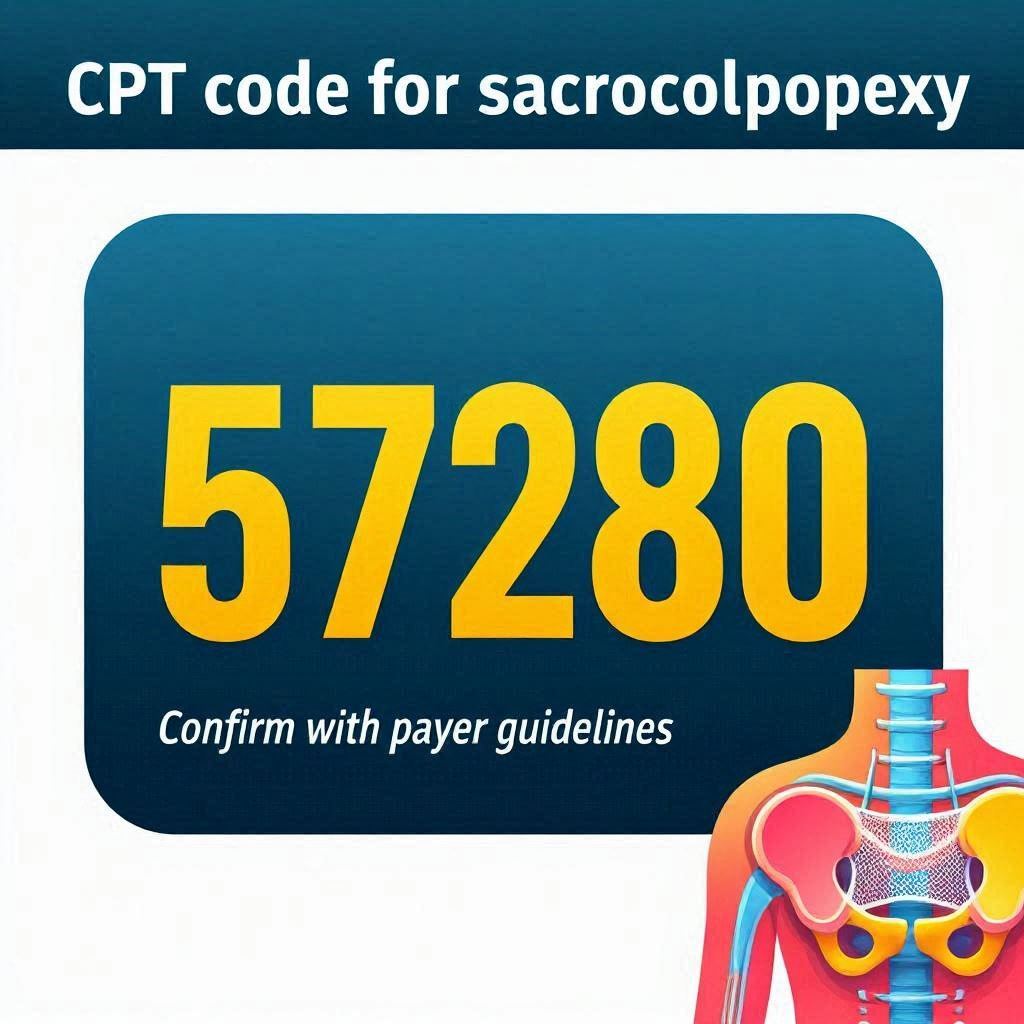
This question arises at least once a week in coding departments. In 2026, no specific Category I CPT code exists for an open abdominal sacrocolpopexy. The AMA has not created a direct equivalent to 57425 for the open approach. When a surgeon performs an open sacrocolpopexy, you must report code 57280 (Colpopexy, abdominal approach). Code 57280 is a longstanding code that predates the laparoscopic version. However, RVU and valuation experts generally consider 57280 less accurately valued for a formal open sacrocolpopexy with graft fixation to the sacrum compared to 57425. The work involved in an open sacrocolpopexy often exceeds a basic abdominal colpopexy, but without a dedicated code, 57280 remains the closest available option. Some surgeons and coders have historically debated using an unlisted code (58999) for open sacrocolpopexy to better capture the complexity. In 2026, payer guidance remains mixed. Most Medicare Administrative Contractors (MACs) and commercial payers instruct providers to use 57280 and allow the documentation to speak for itself during medical review. Before reporting an unlisted code for an open sacrocolpopexy, you should contact the payer’s provider relations team, obtain written guidance, and weigh the high probability of a manual review and initial denial.
Robotic Sacrocolpopexy Coding in 2026: Separating Fact from Confusion
Every year, whispers circulate that the AMA or CMS will finally issue a unique code for robot-assisted sacrocolpopexy. In 2026, no such code exists. You code a robotic sacrocolpopexy with 57425. You do not append modifier 22 for robotic assistance alone. You do not add S2900 (a HCPCS code that some payers used historically for robotic surgical systems) unless a specific payer contract stipulates it for tracking purposes. S2900 is not recognized by Medicare, and most commercial payers have retired it. Appending modifier 22 requires documented additional work that goes substantially beyond the typical 57425, such as extensive lysis of adhesions that adds 90 minutes to the case or a body mass index of 60 that significantly complicates access and closure. The robotic approach itself does not qualify as a “substantially greater” service because over 80 percent of sacrocolpopexies in the United States now use robotic assistance; it has become the typical approach.
A helpful way to remember the 2026 guidance: approach does not equal a different CPT code; it equals a different surgical technique documented within the same code.
Sacrocolpopexy at the Time of Hysterectomy: Bundling and Unbundling
One of the most important coding challenges involves sacrocolpopexy performed at the same operative session as a hysterectomy. The NCCI bundles many abdominal and laparoscopic procedures to prevent unbundling of integral components. However, sacrocolpopexy and hysterectomy are not inherently bundled. They represent distinct surgical objectives with separate diagnoses: hysterectomy treats uterine pathology (leiomyomas, abnormal bleeding, cancer risk reduction), while sacrocolpopexy treats apical prolapse. In 2026, you may report both 57425 and the appropriate hysterectomy code when the surgeon performs both procedures and documentation supports each one independently.
Common Hysterectomy Code Combinations with 57425
| Hysterectomy Type | CPT Code | Documentation Must Show |
|---|---|---|
| Laparoscopic supracervical hysterectomy | 58541 or 58542 (with or without tubes/ovaries) | Indication for hysterectomy separate from prolapse; description of uterine pathology |
| Laparoscopic total hysterectomy | 58570, 58571, 58572, 58573 (based on weight and adnexal work) | Cervix removed intentionally; uterus and adnexal decision noted |
| Robot-assisted laparoscopic hysterectomy | Same as above; robotic technique documented | Use of robotic system, docking time, console time |
| Vaginal hysterectomy at time of laparoscopic sacrocolpopexy | 58260, 58262, 58263, 58267, 58270, 58275, 58280, 58290, 58291, 58292, 58294 (depending on approach and extent) | Vaginal approach separately listed; distinct incision, distinct surgical field |
When reporting 57425 with a hysterectomy code, append modifier 51 if required by the payer. Many coders place 57425 as the primary procedure because it carries the higher RVU total. The NCCI edit checker should be your final reference point. Run every combination through an updated 2026 version before claim submission.
Concomitant Procedures: Anterior and Posterior Repairs, Sling Procedures, and More
Pelvic organ prolapse rarely occurs in isolation. The apical defect that sacrocolpopexy addresses often presents alongside anterior compartment prolapse (cystocele) and posterior compartment prolapse (rectocele). Stress urinary incontinence frequently accompanies prolapse, leading surgeons to perform a mid-urethral sling at the same time. Understanding how these combinations affect 57425 coding keeps your claims clean.
Anterior Colporrhaphy (Anterior Repair)
Code 57240 for anterior colporrhaphy (or 57260 for combined anteroposterior colporrhaphy) may be reported with 57425 when the surgeon performs a separate, medically necessary anterior repair. NCCI edits do not bundle anterior repair with sacrocolpopexy. You should ensure the operative report describes the anterior repair as a distinct step: a midline anterior vaginal incision, dissection of the bladder from the vaginal epithelium, plication of the pubocervical fascia, and excision of redundant vaginal mucosa. Simply plicating the peritoneum or performing a Halban culdoplasty as part of the sacrocolpopexy does not meet the definition of a separate anterior colporrhaphy.
Posterior Colporrhaphy and Perineorrhaphy
Posterior repair (57250) also escapes the 57425 bundle. If the surgeon performs a posterior colporrhaphy to correct a rectocele or to narrow the genital hiatus, that work is separately reportable. Perineorrhaphy (56810) performed for cosmetic or functional perineal body reconstruction is likewise distinct. Document the indication for each procedure. A typical operative note sentence that helps a coder reads: “Attention was then turned to a rectocele measuring 4 cm beyond the hymen on preoperative POP-Q. A separate posterior vaginal incision was made, the rectovaginal fascia dissected and plicated, and redundant mucosa excised.”
Mid-Urethral Sling and Other Anti-Incontinence Procedures
Mid-urethral sling (57288) is the most common companion code to 57425. NCCI bundles do not apply between 57425 and 57288. You should report both when the surgeon places a sling for stress urinary incontinence confirmed on preoperative urodynamics or demonstrated on prolapse-reduced stress testing. Document the sling passage, trocar path, cystoscopy confirmation, and tensioning technique. If the surgeon performs a Burch colposuspension (51990) instead of a sling, that code is separately reportable. Again, no NCCI edits bundle Burch with sacrocolpopexy.
Lysis of Adhesions
Lysis of adhesions becomes separately reportable only when it requires significant additional time and effort beyond the routine exposure necessary for the sacrocolpopexy. If the surgeon spends 15 minutes lysing a few omental adhesions to the anterior abdominal wall to place trocars, that work is integral to 57425. If dense, vascular adhesions from multiple prior surgeries consume 90 minutes of meticulous dissection and threaten bowel or ureteral injury, modifier 22 on 57425 or a separate lysis code (44005 for enterolysis, 58660 for laparoscopic lysis) may be justified. In 2026, payer scrutiny on adhesion lysis remains high. Never code lysis as a separate procedure without a separately dictated paragraph in the operative note detailing the time, location, density, and risks involved.
Sacrocolpopexy Coding Table: Quick Reference for 2026
The table below summarizes the core coding options and common scenarios. Print it, save it to your desktop, or pin it to the bulletin board in your coding office.
| Clinical Scenario | Primary CPT Code(s) | Modifier(s) | Notes |
|---|---|---|---|
| Laparoscopic sacrocolpopexy, no other procedures | 57425 | None | Robotic approach does not change code |
| Laparoscopic sacrocolpopexy with supracervical hysterectomy | 57425, 58541 | Modifier 51 if required by payer | Report 57425 first due to higher RVU |
| Robotic sacrocolpopexy with total laparoscopic hysterectomy | 57425, 58571 | Modifier 51 if required | Ensure separate indications documented |
| Laparoscopic sacrocolpopexy with anterior repair | 57425, 57240 | Modifier 51 if required | Describe distinct anterior compartment dissection |
| Laparoscopic sacrocolpopexy with posterior repair and perineorrhaphy | 57425, 57250, 56810 | Modifier 51 if required | List each layer of posterior repair |
| Laparoscopic sacrocolpopexy with mid-urethral sling | 57425, 57288 | Modifier 51 if required | Cystoscopy included in 57288 |
| Open abdominal sacrocolpopexy | 57280 | None | No specific open sacrocolpopexy code exists; 57280 is best fit |
| Laparoscopic sacrocolpopexy converted to open | 57425, 57280 | Modifier 22 may apply | Document reason for conversion, added work |
| Laparoscopic sacrocolpopexy with extensive lysis of adhesions | 57425 | Modifier 22 | Detailed separate paragraph required |
| Bilateral salpingo-oophorectomy at time of sacrocolpopexy (no hysterectomy) | 57425, 58661 | Modifier 51 if required | Confirm medical necessity for adnexal removal |
2026 Medicare Physician Fee Schedule and Relative Value Units
The financial side of coding keeps the lights on. For 2026, the MPFS final rule sets the following values for the key sacrocolpopexy codes. These figures reflect national payment amounts; geographic adjustments based on your locality will alter the final allowed amount.
| CPT Code | Work RVU | Total Facility RVU | National Medicare Payment (Approximate) |
|---|---|---|---|
| 57425 | 21.45 | 28.90 | $965 |
| 57280 | 11.78 | 16.12 | $540 |
| 57425 + 58541 | Combined with multiple procedure reduction | – | ~$1,375 |
| 57425 + 57240 | Combined with multiple procedure reduction | – | ~$1,220 |
*Note: Payment amounts are rounded estimates based on the 2026 conversion factor of approximately $33.90. Actual payments vary by locality, sequestration, and patient deductible status. Always verify final amounts through your MAC’s fee schedule look-up tool.*
The payment differential between 57425 and 57280 highlights the reimbursement challenge for open cases. A surgeon performing an open sacrocolpopexy that takes three hours and involves complex retroperitoneal dissection receives substantially less payment than a laparoscopic case under the current coding structure. This disparity fuels ongoing advocacy efforts within the American Urogynecologic Society (AUGS) and the American College of Obstetricians and Gynecologists (ACOG) to create a specific open sacrocolpopexy code. Until that happens, providers who perform open sacrocolpopexy for valid clinical reasons (multiple prior laparotomies, inability to tolerate pneumoperitoneum, extensive adhesive disease) must rely on 57280 and trust that their documentation will support medical necessity during any audit.
Private Payer Policies: The Hidden Coding Landscape
Medicare sets the tone, but private payers write their own medical policies that can deviate significantly. In 2026, many commercial insurers maintain specific coverage criteria for sacrocolpopexy. Common requirements include:
- Prior conservative therapy: Documentation of failed pessary trial, pelvic floor physical therapy, or both.
- Prolapse quantification: POP-Q scores demonstrating apical prolapse at or beyond the hymen.
- Graft type specification: Some payers prefer biologic grafts over synthetic mesh in certain populations and may deny coverage for mesh in sexually active women under 65 without prior failed native tissue repair.
- Site of service restrictions: Certain plans mandate that sacrocolpopexy be performed only in the inpatient setting for patients with BMI over 40, cardiac comorbidities, or anticipated operative time exceeding four hours.
The CPT code itself does not change with these policies, but your pre-authorization process must align with each payer’s rules. A robust prior authorization team that tracks these policies saves thousands of dollars in denied claims. Coders should flag sacrocolpopexy cases during scheduling, verify benefits, obtain authorization for the exact CPT codes planned, and document the authorization number prominently in the patient’s record.
Top Five National Payers and Their 2026 Sacrocolpopexy Stance
| Payer | Prior Authorization Required? | Site of Service Rule | Special Notes |
|---|---|---|---|
| UnitedHealthcare | Yes, for all settings | Inpatient or outpatient; reviews medical necessity for inpatient | Requires POP-Q and trial of conservative therapy |
| Anthem Blue Cross Blue Shield | Yes, varies by state plan | Outpatient preferred; inpatient requires justification | Some plans exclude mesh; check specific plan |
| Aetna | Yes | Ambulatory surgery center or hospital | Covers robotic; no separate prior auth for robotic approach |
| Cigna | Yes | Outpatient unless comorbidities | May require urodynamics if concurrent sling planned |
| Humana | Yes, Medicare Advantage plans follow Medicare LCDs | Inpatient for complex cases | Follows NCD for mesh; monitors for frequency |
Documentation Essentials That Support Clean Claims
Great coding begins with great documentation. The operative note represents the single most important piece of evidence for your CPT code selection. In 2026, auditors increasingly rely on artificial intelligence tools to scan documentation for keywords and structured data. You can future-proof your claims by ensuring your operative notes contain these elements:
Structured Operative Note Elements for 57425
- Preoperative diagnosis: Clearly state “apical pelvic organ prolapse” with POP-Q stage. Example: “Stage III apical prolapse, point C at +3 cm relative to the hymen.”
- Indications for surgery: Mention prior conservative therapy, patient symptoms (vaginal bulge, pressure, splinting to void), and desire for definitive repair.
- Approach description: State “laparoscopic” or “robot-assisted laparoscopic.” Describe trocar placement, pneumoperitoneum establishment, and docking of the robotic system if used.
- Graft material: Name the specific graft (e.g., “Restorelle Y-mesh,” “DynaMesh,” “autologous fascia lata”). Note dimensions and whether it was trimmed intraoperatively.
- Dissection sequence: Describe the presacral dissection with identification of the middle sacral vessels and anterior longitudinal ligament. Describe the vesicovaginal and rectovaginal dissection to create peritoneal tunnels.
- Graft fixation: Document the number and type of sutures or tacks used on the sacral side and the vaginal side. Example: “Two permanent 2-0 Gore-Tex sutures placed through the anterior longitudinal ligament at the S1 level; graft secured to the anterior and posterior vaginal walls with six interrupted 2-0 PDS sutures.”
- Peritoneal closure: Note whether the graft was retroperitonealized and how (running barbed suture, interrupted sutures).
- Estimated blood loss, complications, specimens removed.
- Distinct procedures listed separately: If concurrent hysterectomy, repairs, or sling were performed, dictate each in a separate labeled section.
A well-written operative note transforms coding from guesswork into a straightforward matching exercise. When an auditor reviews a note and finds every element described precisely, the likelihood of an adverse determination drops dramatically.
CCI Edits and Modifier 59: Navigating the NCCI Maze
The National Correct Coding Initiative (NCCI) publishes quarterly updates that every coder must review. For sacrocolpopexy, the most impactful edits involve the relationship between 57425 and other laparoscopic pelvic procedures. In 2026, the following edit pairs demand attention:
| Column 1 Code | Column 2 Code | Modifier Allowed? | Rationale |
|---|---|---|---|
| 57425 | 49320 (Diagnostic laparoscopy) | No | Diagnostic laparoscopy is integral to surgical laparoscopy |
| 57425 | 58660 (Laparoscopic lysis of adhesions) | Yes, with modifier 59 and strong documentation | Only when adhesions are extensive and unrelated to access |
| 58571 | 57425 | Yes, modifier allowed | Distinct procedures; no inherent bundle |
| 57425 | 57240 | No edit exists | These are not bundled; report together |
When you use modifier 59 to override an NCCI edit, your documentation must rise to the challenge. The operative note must describe a separate anatomic site, separate session, or separate patient encounter. Coding professionals often use the phrase “separate and distinct” as a mantra. For lysis of adhesions paired with 57425, that means describing adhesions in the upper abdomen completely unrelated to the pelvic access required for the sacrocolpopexy. If the lysis occurs in the pelvis to reach the sacrum, it is not separate; it is part of 57425.
Global Period Management: What to Report in the 90 Days After Surgery
CPT code 57425 carries a 90-day global period. All routine postoperative care related to the surgery is bundled into the global fee. However, certain services during the global period warrant separate reporting. Understanding these exceptions prevents lost revenue.
Separately Reportable Services During the Global Period
- Treatment for complications: If the patient returns to the operating room for a graft erosion, bowel obstruction, or port-site hernia, you report the appropriate procedure code with modifier 78 (unplanned return to the operating room) or modifier 58 (staged or related procedure) depending on the scenario.
- Unrelated evaluation and management (E/M) services: If the patient presents for diabetes management or an upper respiratory infection during the global period, you may report an E/M code with modifier 24, provided the documentation clearly separates the problem from the surgical follow-up.
- New problems: A new diagnosis that requires workup and treatment beyond typical surgical aftercare qualifies for separate billing. For example, new-onset stress incontinence that was not present before surgery and requires urodynamics and a sling would fall outside the global package.
Many practices under-report global period services out of an abundance of caution. While conservative billing avoids audits, it also leaves legitimate revenue uncollected. Train your providers to document clearly when a visit addresses something outside routine post-surgical care, and empower your coders to query when the documentation suggests a separately reportable service.
Outpatient vs. Inpatient Coding: Site-of-Service Considerations
In 2026, the majority of sacrocolpopexies occur in the outpatient hospital setting or ambulatory surgery centers. The “Two-Midnight Rule” governs Medicare inpatient admissions: a patient qualifies for inpatient status when the admitting physician expects the stay to span at least two midnights. Most sacrocolpopexy patients discharge on postoperative day one, making them appropriate for outpatient observation or inpatient-only if a complication arises. Hospitals lose significant revenue when they misclassify an inpatient case that should be outpatient observation. A strong utilization review team reviews every sacrocolpopexy admission and communicates with the surgeon about expected length of stay.
The CPT code 57425 does not change with site of service. The same code applies whether the patient is in an inpatient bed, observation status, or ambulatory surgery center. The difference lies in the facility coding. Hospital coders assign an ICD-10-PCS code for the inpatient claim; CPT codes are not used on the institutional inpatient claim (UB-04). However, the surgeon’s professional claim (CMS-1500) always uses 57425 regardless of site of service.
ICD-10-CM Diagnosis Coding to Support Medical Necessity
Accurate diagnosis coding makes the difference between a paid claim and a denial for lack of medical necessity. For sacrocolpopexy, the primary diagnosis reflects apical prolapse. In ICD-10-CM, you will most commonly use:
| Diagnosis | ICD-10-CM Code | Notes |
|---|---|---|
| Vaginal vault prolapse, post-hysterectomy | N99.3 | Use for patients with prior hysterectomy |
| Uterovaginal prolapse, incomplete | N81.2 | Use for patients with a uterus; describes descent to or through introitus |
| Uterovaginal prolapse, complete | N81.3 | Procidentia |
| Vaginal enterocele | N81.5 | May be present with apical prolapse |
| Cystocele | N81.1 | Secondary diagnosis if anterior repair performed |
| Rectocele | N81.6 | Secondary diagnosis if posterior repair performed |
| Stress urinary incontinence, female | N39.3 | Secondary diagnosis if sling performed |
Sequence the most resource-intensive diagnosis first. If the patient has stage III uterovaginal prolapse and stress incontinence, list N81.2 as the primary diagnosis for 57425 and N39.3 as a secondary diagnosis for 57288. This sequencing tells the payer’s automated logic exactly why each procedure was medically necessary.
Modifier Deep Dive: Which Ones Apply and When
Modifiers tell the story that the CPT code alone cannot. In sacrocolpopexy coding, several modifiers appear frequently. Using the wrong modifier, or omitting a required one, leads to claim rejection or underpayment.
Modifier 51 – Multiple Procedures
Medicare and most commercial payers no longer require modifier 51. The claims processing system applies multiple procedure reduction logic automatically. However, some smaller payers and workers’ compensation plans still expect modifier 51 on secondary and subsequent procedures. Know your payer contracts. When in doubt, check the payer’s provider manual.
Modifier 59 – Distinct Procedural Service
This modifier signals that two procedures normally bundled are distinct and separately reportable. Use it sparingly and only when documentation explicitly describes a different anatomic site, different encounter, or different session. The Office of Inspector General (OIG) has repeatedly identified modifier 59 overuse as a target for fraud investigations. In the sacrocolpopexy context, the most common legitimate use is lysis of adhesions (58660 or 44005) that is truly separate from the access required for 57425.
Modifier 22 – Increased Procedural Services
When the work performed substantially exceeds the typical work for 57425, append modifier 22. The operative note must describe the reasons in explicit detail. Acceptable reasons include morbid obesity requiring extra-long instruments and hand-assist ports, extensive adhesive disease that adds two hours of dissection, or a concomitant procedure that falls outside the normal sacrocolpopexy workflow. The claim will likely suspend for manual review, and your documentation will determine the outcome. Do not use modifier 22 casually; the additional reimbursement rarely justifies the audit risk unless the extra work is undeniable.
Modifier 78 – Unplanned Return to the Operating Room
If a patient returns to the OR within the global period for a complication related to the sacrocolpopexy, modifier 78 appended to the new procedure code tells the payer that the return was unplanned and related. The payer processes the claim with reduced reimbursement (intraoperative portion only), but you receive payment rather than a global period denial.
Modifier 62 – Co-Surgeons
When a gynecologic surgeon and a urologist or colorectal surgeon share operative responsibility for distinct parts of the procedure, each reports 57425 with modifier 62. The documentation must describe each surgeon’s role. Both surgeons receive 62.5 percent of the fee schedule amount. This arrangement commonly occurs when sacrocolpopexy is performed alongside a complex colorectal resection or continent urinary diversion.
Case Studies: Applying the 2026 Coding Rules to Real Scenarios
The best way to cement coding knowledge is through case studies. Let us walk through several fictional but realistic patient scenarios. These examples incorporate the principles discussed so far and show how they apply in practice.
Case Study 1: Straightforward Robotic Sacrocolpopexy
A 62-year-old woman with stage III vaginal vault prolapse after hysterectomy 20 years ago presents for robotic sacrocolpopexy. She has no stress incontinence and no anterior or posterior defects. The surgeon performs the case robotically, places a polypropylene Y-mesh, and retroperitonealizes the graft. The patient tolerates the procedure well and discharges the next morning.
Coding: 57425.
Rationale: The robotic approach does not change the CPT code. No additional procedures were performed, and the documentation supports the medical necessity of sacrocolpopexy for post-hysterectomy vault prolapse (N99.3). The claim is clean and will process without edits.
Case Study 2: Sacrocolpopexy with Supracervical Hysterectomy and Sling
A 48-year-old woman with stage II uterovaginal prolapse and stress urinary incontinence confirmed on urodynamics desires definitive repair. She has no interest in future fertility and opts for supracervical hysterectomy at the time of sacrocolpopexy. The surgeon performs a robotic supracervical hysterectomy with bilateral salpingectomy, then proceeds with sacrocolpopexy using mesh. Finally, the surgeon places a retropubic mid-urethral sling. Cystoscopy confirms ureteral efflux and bladder integrity.
Coding: 57425, 58541, 58700 (if salpingectomy performed for sterilization; 58661 if oophorectomy done), 57288, 52000 (cystoscopy bundled with 57288; do not report separately).
Rationale: 57425 addresses the prolapse. 58541 addresses the uterine indication (menorrhagia, fibroids, or simply risk reduction with hysterectomy at time of prolapse repair). 57288 addresses the incontinence. Cystoscopy is inherent to 57288 and is not separately billable. The operative note should describe each procedure under a separate heading. The claim will apply multiple procedure reduction to the second and third procedures.
Case Study 3: Open Sacrocolpopexy Due to Hostile Abdomen
A 55-year-old woman with a history of four prior laparotomies for bowel obstructions, extensive abdominal wall mesh from hernia repairs, and a frozen pelvis on imaging requires sacrocolpopexy. The surgeon determines that laparoscopic access is unsafe and plans an open approach. The open sacrocolpopexy takes four hours due to dense adhesions. The graft is successfully placed.
Coding: 57280 with modifier 22.
Rationale: No specific open sacrocolpopexy code exists. 57280 is the closest available code. Modifier 22 captures the substantially increased work (four hours vs. typical two hours for a straightforward open colpopexy). The operative note must document in detail why the laparoscopic approach was abandoned, the extent of adhesions, the additional time required, and the techniques used to safely enter the abdomen. The claim will likely suspend for manual review; a cover letter summarizing the modifier 22 justification helps.
Case Study 4: Sacrocolpopexy with Concurrent Anterior and Posterior Repair
A 70-year-old woman with stage III uterovaginal prolapse, a large cystocele, and a rectocele undergoes robotic sacrocolpopexy with a supracervical hysterectomy, anterior colporrhaphy, and posterior colporrhaphy with perineorrhaphy. The operative note describes a 35-minute anterior repair with midline plication of the pubocervical fascia and a 40-minute posterior repair with levator plication and perineal body reconstruction.
Coding: 57425, 58541, 57240, 57250, 56810.
Rationale: Each compartment repair represents a distinct surgical objective. The operative note devotes separate paragraphs to each procedure. The diagnoses support medical necessity for all five codes. Modifier 51 applies to all but the primary code if the payer requires it. The multiple procedure reduction will significantly reduce payment for the secondary codes, but under-coding is not the solution. Report what the surgeon did, and let the payer apply the reduction.
Coding for Sacrocolpopexy Complications: Erosion, Infection, and Reoperation
Sacrocolpopexy is a highly successful procedure, but complications occur. When they do, accurate coding becomes both a medical and a legal necessity. The global period rules intersect with complication coding in ways that confuse even experienced coders.
Mesh Erosion
Synthetic mesh erosion into the vagina occurs in approximately 3 to 5 percent of cases. When a patient returns one year after 57425 with a mesh exposure, the global period has expired, and you code the revision procedure without any global period modifiers. The CPT code for excision of exposed mesh transvaginally is 57295 (Revision of prosthetic vaginal graft, vaginal approach). If the mesh has eroded into the bladder or bowel, the procedure becomes more complex and may require 57296 (Revision of prosthetic vaginal graft, open abdominal approach) or other urologic or colorectal codes. Each scenario demands careful code selection based on the approach and extent of the revision.
Graft Infection
Infection of the sacrocolpopexy graft is rare but devastating. The patient typically returns to the operating room for graft explantation. This return usually occurs within the 90-day global period. You report the explantation code with modifier 78 because the return is unplanned and related to the original surgery. The specific code depends on the approach. A laparoscopic explantation may be reported with an unlisted code (49329, Unlisted laparoscopy procedure, pelvis) because no specific CPT code describes laparoscopic removal of a sacrocolpopexy graft. An open graft removal would be reported with 57296. Always inform the patient that their insurance may be audited for a procedure that falls within a global period, and ensure the documentation explicitly describes the infection diagnosis and the medical necessity of graft removal.
Recurrent Prolapse Requiring Repeat Sacrocolpopexy
If the sacrocolpopexy fails due to graft detachment, suture pull-through, or tissue attenuation, and the patient requires a repeat procedure more than 90 days after the original, you report 57425 again. The diagnosis code changes to reflect the failure: N99.3 (for vault prolapse) plus a secondary code for mechanical complication of the graft, if applicable. Document what caused the failure if it is known. Payers may scrutinize repeat procedures closely, so solid documentation of recurrent symptoms, POP-Q findings, and failed conservative measures post-primary surgery is essential.
Pediatric and Young Adult Sacrocolpopexy: Rare but Real
While most sacrocolpopexy patients are postmenopausal, the procedure occasionally becomes necessary for younger patients with congenital anomalies, connective tissue disorders, or traumatic prolapse after childbirth. Coding does not change based on patient age; 57425 applies regardless of whether the patient is 22 or 82. However, medical necessity documentation requires extra care in younger patients. Payers may question why a 25-year-old with prolapse needs a mesh-augmented sacrocolpopexy rather than a native tissue repair. The surgeon should document a clear rationale: severe connective tissue laxity (Ehlers-Danlos syndrome), failed prior native tissue repair, or traumatic obstetric injury that destroyed native support structures. Genetic counseling notes and preoperative imaging strengthen the case.
ICD-10-PCS Coding for Hospital Inpatient Cases
This guide focuses primarily on CPT coding for physician services, but a brief note on inpatient hospital coding adds value for coders who work across both sides. When a patient is admitted as an inpatient for sacrocolpopexy, the hospital coder assigns ICD-10-PCS codes rather than CPT codes. The relevant ICD-10-PCS code depends on the approach and the specific procedure.
- Laparoscopic sacrocolpopexy: 0UQG0ZZ (Repair vagina, open approach) may not accurately capture the laparoscopic nature. The most representative ICD-10-PCS code for laparoscopic sacrocolpopexy is 0UQG4ZZ (Repair vagina, percutaneous endoscopic approach).
- Robotic sacrocolpopexy: The same code applies; ICD-10-PCS does not distinguish robotic from standard laparoscopic.
- Open sacrocolpopexy: 0UQG0ZZ.
Hospital coders should confirm with their facility’s coding compliance team that the chosen ICD-10-PCS code aligns with the documentation and payer expectations. The DRG assignment for sacrocolpopexy typically falls under DRG 742 (Uterine and Adnexa Procedures for Non-Malignancy) with CC or MCC, or DRG 743 without CC/MCC.
Telemedicine and Remote Postoperative Care in the Global Period
The 2026 landscape includes expanded telemedicine flexibility that began during the COVID-19 public health emergency and has persisted. For sacrocolpopexy patients, many surgeons conduct routine postoperative visits via synchronous video or telephone. These visits are bundled into the global surgical package and are not separately billable. The global period covers all routine follow-up regardless of modality. If a patient requires a problem-focused visit for a new issue such as a wound infection or new-onset pain, and the visit occurs via telemedicine, you may report an E/M code with modifier 24 if the service meets the criteria for an unrelated, separately identifiable service. The fact that the visit occurred via telemedicine does not change the coding rules; the global period rules remain paramount.
The Role of Artificial Intelligence in Sacrocolpopexy Coding Audits
As this guide is written in early 2026, artificial intelligence (AI) tools have begun to penetrate the claims auditing space. Payers and recovery audit contractors (RACs) deploy AI algorithms that scan thousands of claims for patterns suggestive of over-coding or unbundling. For sacrocolpopexy, AI systems flag claims where 57425 appears alongside multiple other procedure codes without supporting diagnoses. These systems also identify providers whose coding patterns deviate significantly from their peers. The best defense against AI-driven audits is airtight documentation and conservative, by-the-book coding. Do not unbundle unless you can defend the decision with a detailed operative note. Do not report a higher-level E/M service during the global period unless the documentation clearly describes a separate problem. Think like an auditor: if you can imagine a question, answer it preemptively in your documentation.
Quality Reporting and Sacrocolpopexy: MIPS and Beyond
CPT code 57425 feeds into multiple quality measures under the Merit-based Incentive Payment System (MIPS) and alternative payment models. The surgical approach, complication rate, readmission rate, and patient-reported outcomes all tie back to this code in the data warehouses. In 2026, the urogynecology specialty measure set includes metrics specifically relevant to sacrocolpopexy:
- Patient-Reported Outcome-Based Performance Measure for Pelvic Organ Prolapse: This measure requires pre- and post-operative completion of validated questionnaires (PFDI-20, PGI-I). The CPT code 57425 flags the measure denominator.
- Unplanned Reoperation within 30 Days: CMS tracks unplanned returns to the OR after sacrocolpopexy. Accurate complication coding directly affects this measure.
- Antibiotic Prophylaxis: The Surgical Care Improvement Project (SCIP) measures track appropriate antibiotic timing for sacrocolpopexy cases.
When your coders report 57425 accurately, you contribute clean data to these quality programs, which in turn affects your MIPS composite score and potentially your payment adjustments. Inaccurate coding distorts quality data and can lead to unfair penalty assessments.
Practical Billing Tips from the Front Lines
The following tips come from conversations with experienced coders, auditors, and practice managers who handle sacrocolpopexy claims daily. Apply these to your workflow in 2026.
- Verify benefits for the exact CPT codes before surgery. Avoid surprises when the patient finds out their plan excludes mesh procedures or requires a higher cost share.
- Batch your sacrocolpopexy prior authorizations. If you perform 20 sacrocolpopexies per month, designate one team member to master each payer’s requirements and build a repeatable submission template.
- Query surgeons early when operative notes are vague. A query that catches missing detail within 48 hours of surgery results in a corrected note. A query six months later often results in frustration and an incomplete addendum.
- Track your denial patterns. If a particular payer consistently denies 57425 with a sling as “not medically necessary,” appeal in bulk with evidence-based literature. Build a relationship with the payer’s medical director.
- Educate your surgeons annually. Spend 15 minutes at a department meeting reviewing the coding changes for the new year. Surgeons appreciate the brevity and the direct impact on their practice.
- Use a coding audit tool. Run your sacrocolpopexy claims through an encoder with NCCI edits enabled before submission. Catch the unbundling error before the payer does.
Looking Ahead: Potential Future Changes
The 2026 CPT code set is stable, but the specialty anticipates future changes. The Relative Value Scale Update Committee (RUC) continues to survey sacrocolpopexy and may propose refinements to the RVU valuation for 57425 or the creation of a dedicated open sacrocolpopexy code. The shift toward bundled payments and episode-of-care reimbursement models could eventually wrap sacrocolpopexy, hysterectomy, and repairs into a single payment for prolapse surgery. Coders and surgeons who stay engaged with AUGS and ACOG coding committees will hear about these changes early and can prepare their practices.
Common Myths and Misunderstandings About Sacrocolpopexy Coding
Let us dispel some persistent myths that circulate in coding forums and social media groups.
Myth: “Robotic sacrocolpopexy gets a different code or a special modifier.”
Fact: 57425 covers all laparoscopic approaches including robotic. No distinct code or routine modifier exists.
Myth: “When sacrocolpopexy is performed with hysterectomy, you should only bill the hysterectomy code because sacrocolpopexy is bundled into it.”
Fact: Sacrocolpopexy and hysterectomy are not bundled. Both are separately reportable with appropriate diagnoses.
Myth: “Modifier 22 always adds 25 percent more payment to the claim.”
Fact: Modifier 22 triggers manual review. The payer determines if additional payment is warranted and how much. It often yields less than 25 percent, and sometimes nothing if the documentation is insufficient.
Myth: “You can bill an E/M visit for the preoperative history and physical even though the patient is having surgery the next day.”
Fact: The decision for surgery E/M visit on the day before or day of surgery is bundled into the global package unless the documentation supports a separately identifiable significant, separately identifiable service. Routine preoperative clearance does not qualify.
Myth: “Open sacrocolpopexy code 57280 pays the same as 57425.”
Fact: 57280 pays significantly less. This reimbursement disparity is a known issue that the specialty societies are working to address.
A Note on Ethical Coding
This guide provides the technical roadmap to correct sacrocolpopexy coding, but it is worth pausing to emphasize ethics. The CPT code set exists to accurately represent the services provided, not to maximize reimbursement through creative interpretation. When you unlist procedures that have specific codes, you distort national data. When you unbundle integral services, you expose your practice to audits and recoupments. When you add modifier 22 without justification, you erode trust with payers. Accurate coding benefits everyone: patients whose data feeds into safety research, surgeons whose outcomes are tracked, and practices whose revenue cycle remains clean and predictable.
Conclusion
The CPT code for sacrocolpopexy in 2026 remains 57425 for laparoscopic and robotic approaches, while open cases continue to rely on 57280 with the option of modifier 22 for increased complexity. Accurate documentation, careful attention to NCCI edits, and proactive prior authorization form the three pillars of successful sacrocolpopexy billing this year. By mastering the nuances discussed in this guide—from concurrent hysterectomy and repair coding to global period management—you position your practice for clean claims, appropriate reimbursement, and a strong defense against audits.
Frequently Asked Questions
Q: Is there a specific CPT code for robotic sacrocolpopexy in 2026?
A: No. CPT code 57425 covers all laparoscopic sacrocolpopexies, including those performed with robotic assistance. Robotic technique does not change the code.
Q: What code do I use for an open sacrocolpopexy?
A: Use CPT code 57280 (Colpopexy, abdominal approach). No specific code for open sacrocolpopexy exists in 2026. Consider modifier 22 if the work substantially exceeds a typical open colpopexy.
Q: Can I bill sacrocolpopexy and hysterectomy together?
A: Yes. These procedures address different conditions and are not bundled under NCCI. Report both with modifier 51 if the payer requires it and ensure separate diagnoses support each code.
Q: Is the mid-urethral sling code (57288) bundled with 57425?
A: No. You may report both codes together. Cystoscopy performed to confirm sling placement is included in 57288 and should not be separately billed.
Q: What diagnosis code supports medical necessity for sacrocolpopexy?
A: For post-hysterectomy vault prolapse, use N99.3. For uterovaginal prolapse, use N81.2 (incomplete) or N81.3 (complete). Always include POP-Q staging in your documentation.
Q: How should I code lysis of adhesions during sacrocolpopexy?
A: Extensive lysis of adhesions that is separate from routine access may warrant modifier 22 appended to 57425. Separate lysis of adhesions codes (58660, 44005) require documentation of a distinct, unrelated site of lysis. Routine lysis for exposure is integral to 57425 and is not separately billable.
Additional Resource
For the most current National Correct Coding Initiative edits and Medicare coverage policies affecting sacrocolpopexy, visit the CMS NCCI Edits page at https://www.cms.gov/medicare/coding-billing/national-correct-coding-initiative-edits. This resource provides the definitive quarterly edit files that determine bundling relationships and modifier allowances for all procedure code pairs.
Disclaimer: The information in this article serves as a general coding resource and does not constitute legal or professional billing advice. Coding requirements vary by payer, state, and individual patient circumstances. Always verify coding decisions with your organization’s compliance team and consult official AMA CPT guidelines, CMS regulations, and specific payer policies before submitting claims.