Navigating the world of medical coding often feels like solving a complex puzzle. You want to ensure accurate reimbursement, maintain compliance, and avoid the headache of claim denials. One of the most common procedures in gastroenterology is the esophagogastroduodenoscopy, commonly known as an EGD. When a physician performs a biopsy using cold forceps during this examination, the coding landscape shifts in a very specific way.
This guide serves as your comprehensive resource. We will explore not just the primary code you need, but the nuanced rules that govern its use. We will dissect documentation requirements, contrast it with other biopsy methods, and clarify the modifier maze. Think of this as a direct conversation, crafted to make you an expert on the correct CPT code for EGD with cold forceps biopsy.
cpt code for egd with cold forceps biopsy
Understanding the Foundation: What is an EGD?
Before we dive into the alphanumeric codes, we need a clear clinical picture. An EGD is a diagnostic procedure that allows a physician to visualize the upper gastrointestinal tract. This includes the esophagus, stomach, and the first part of the small intestine, the duodenum.
The physician uses a flexible endoscope with a tiny camera and light at its tip. The images transmit to a high-definition monitor, allowing for a meticulous examination of the mucosal lining. The primary goal is often to identify the source of symptoms like persistent heartburn, difficulty swallowing, abdominal pain, or bleeding. However, seeing an abnormality is only half the story. To make a definitive diagnosis, the physician almost always needs a tissue sample.
That is where the biopsy comes in. A biopsy involves removing a small piece of tissue for pathological analysis. The pathologist examines this tissue under a microscope to determine if it is benign, inflamed, or malignant. The method of obtaining this tissue is the critical detail that dictates code selection. The cold forceps biopsy technique stands as the most prevalent method for this task.
The Core of the Matter: The Primary CPT Code
Let us get directly to the heart of your search. When a gastroenterologist performs a diagnostic EGD and obtains a tissue sample via a cold forceps biopsy, you must look beyond the base diagnostic EGD code. The procedure has moved from a simple “look” to a “look and sample.” This changes the coding structure.
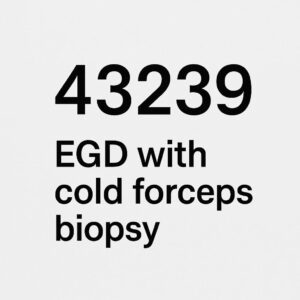
The correct and singular CPT code to report for an upper gastrointestinal endoscopy, inclusive of biopsy when performed with cold forceps, is 43239.
This code’s official descriptor is clear: Esophagogastroduodenoscopy, flexible, transoral; with biopsy, single or multiple. You will notice it does not explicitly state “cold forceps.” This is intentional in CPT coding. The code 43239 is a functional code. It describes the outcome—the act of taking a biopsy—not the specific tool used to achieve it, provided the method is standard and non-excisional. Cold forceps biopsy falls squarely within this standard definition. Payers consider cold forceps biopsy the archetypal biopsy method represented by 43239.
A Critical Distinction: Cold Forceps Biopsy vs. Hot Biopsy
One of the greatest sources of confusion in GI coding arises from the difference between cold and hot biopsy techniques. Both yield tissue, but their intent and the corresponding coding differ dramatically. Making an error here can mean the difference between clean reimbursement and an audit flag.
The Cold Forceps Biopsy Technique
This is a straightforward, mechanical process. The physician advances a pair of tiny, cup-shaped forceps through the working channel of the endoscope. The jaws of the forceps are “cold,” carrying no electrical current. The physician opens the cups, presses them against the target mucosa, closes them to grasp a tissue sample, and gently pulls back to avulse the tissue. A small, superficial mucosal defect remains, which typically requires no intervention to stop bleeding. This technique is ideal for sampling abnormal-appearing mucosa, such as in suspected Barrett’s esophagus, gastritis, or duodenitis. It prioritizes tissue architecture, as the absence of thermal energy prevents cautery artifact in the sample.
The Hot Biopsy Technique and Its Trap
A hot biopsy forceps looks similar but functions differently. It connects to an electrosurgical generator. The physician grasps the tissue identically, but then activates a controlled electrical current. The goal is not just to sample tissue but also to coagulate or destroy the remaining abnormal tissue at the base. Think of it as a combined biopsy and mini-ablation.
The moment electrical current for tissue destruction enters the equation, the procedure’s coding intent shifts from pure diagnostics toward therapy. You no longer report a simple biopsy code like 43239. The “hot” method, when used for ablation of lesions like small polyps or arteriovenous malformations, falls under a different family of codes that often include the term “with control of bleeding” or “with ablation.” A common pitfall is using a hot forceps to obtain tissue from a visible vessel or to treat a bleeding lesion and mistakenly coding it as a routine biopsy. You must always link the tool’s thermal capability to the therapeutic intent documented in the operative report.
Navigating the EGD Code Family: A Comparative Look
To truly master code 43239, you must see where it lives in the hierarchy of upper GI endoscopy codes. The CPT manual organizes EGD codes in a logical progression, from the simplest diagnostic procedure to more complex therapeutic interventions. Understanding this family tree prevents downcoding and ensures you capture the full extent of the work performed.
CPT Code Comparison: EGD Procedures
| CPT Code | Procedure Descriptor | When to Use It | Key Differentiator |
|---|---|---|---|
| 43235 | EGD, diagnostic, including collection of specimen(s) by brushing or washing | A normal exam, or when only cytology samples are taken. | No biopsy forceps are used. Only brushes or washes. |
| 43239 | EGD, with biopsy, single or multiple | The physician takes any number of tissue bites with cold forceps. | Cold forceps biopsy is the core procedure. |
| 43244 | EGD, with band ligation of esophageal varices | The physician places rubber bands to treat actively bleeding or high-risk varices. | A therapeutic procedure for varices, not just a biopsy. |
| 43250 | EGD, with removal of tumor(s), polyp(s), or other lesion(s) by hot biopsy forceps | A distinct lesion is removed using a hot forceps for its ablative effect. | The intent is complete removal and cautery, not just sampling. |
| 43251 | EGD, with removal of tumor(s), polyp(s), or other lesion(s) by snare technique | A polyp or lesion is lassoed with a wire loop and removed, often with electrocautery. | Uses a snare device for polypectomy. |
| 43255 | EGD, with control of bleeding, any method | The primary intent is to stop active bleeding using injections, thermal probes, or clips. | Hemostasis is the principal goal. |
Selecting 43239 is correct when the physician’s primary purpose is to gather tissue from a suspicious area for pathological diagnosis, and the tool is a cold instrument. If the exam is completely normal and only a gastric fluid wash is collected, you step back to 43235. If a polyp is lassoed and severed with a cautery snare, you leap forward to 43251. The code must mirror the most complex and clinically significant action performed.
Adding Precision with Modifiers: The Final Layer
Submitting the correct CPT code for EGD with cold forceps biopsy forms the foundation. However, payer-specific rules often demand modifiers to tell the complete financial story of the encounter. Modifiers are two-character suffixes that provide critical context without changing the procedure’s definition. Their appropriate use can prevent a significant percentage of front-end denials.
The Professional and Technical Component Split: Modifiers 26 and TC
In many settings, a physician performs the EGD at a hospital-owned facility. The hospital bills for the use of the scope, the procedure room, and support staff. The physician bills for their professional skill and interpretation. Modifiers ensure the payer does not issue a duplicate payment.
-
Modifier 26 (Professional Component): The physician appends this to 43239 on their claim. It tells the payer, “I am billing only for my cognitive and intraoperative work.”
-
Modifier TC (Technical Component): The facility appends this to its claim to capture the resources used to enable the procedure.
The Global Billing Scenario
When a physician performs the EGD in their privately owned office or an ambulatory surgery center where they have a direct equipment contract, they often bill globally. In this instance, no modifier is needed. The single code 43239 signals that the professional and technical components are billed together. You must verify your place of service and contract to choose correctly.
The Distinct Procedural Service: Modifier 59 and Its Successors
Modifier 59, the X-modifiers (XE, XP, XS, XU), is the most scrutinized modifier in an auditor’s arsenal. It communicates that a procedure is distinct or separate from another service performed on the same day. The classic GI example involves a colonoscopy performed in the same session as an EGD. Both procedures pass through a scope. Payers bundle them under National Correct Coding Initiative edits.
To bypass this edit legitimately, you must demonstrate that the EGD with biopsy (43239) was a distinct service. The key is documentation of a separate distinct site. For example, an EGD for a gastric ulcer biopsy is a different anatomical site from a screening colonoscopy. Appending the XS modifier (Separate Structure) to 43239 on the claim clarifies this distinction to the payer’s automated system. Never apply this modifier casually. An auditor will first check if a different anatomical organ or lesion site truly justified the separate procedure. Misusing this modifier on a bundled pair where only one continuous scope pass occurred is a compliance violation.
A Quick Reference Guide for Key Modifiers
-
26: Physician’s professional service only.
-
TC: Facility’s technical service only.
-
XS: Separate Structure, a distinct organ or lesion site.
-
53: Discontinued Procedure, when a patient’s instability stops the EGD after induction but before biopsy.
-
52: Reduced Services, if, for example, a patient’s altered anatomy prevents a full duodenal exam but a biopsy is taken in the stomach. Documentation must justify why the full service was not completed.
Documentation: The Physician’s Narrative Is Your Shield
A claim for 43239 without a robust operative note is like a house built on sand. The physician’s documentation is the sole legal proof that the coded service occurred. Coders and auditors rely entirely on the narrative text. If a detail is not explicitly written, legally, it did not happen.
A bulletproof EGD note should contain specific, irrefutable elements that align perfectly with the code 43239 descriptor.
-
Extent of the Examination: The note must confirm the scope advanced beyond the stomach and into the duodenum. A phrase like “The endoscope was passed into the second portion of the duodenum” is essential. An exam that halts in the stomach is not a full EGD.
-
Description of Findings: The physician must detail the appearance of the esophagus, stomach, and duodenum. This includes specific descriptors for any abnormal mucosa: nodularity, friability, erythema, erosions, or visible lesions.
-
The Biopsy Details – The Smoking Gun: This is the most critical section. The note must state, at a minimum, “Cold forceps biopsies were obtained.” The best documentation goes further, specifying “from the gastric antrum” or “from suspected Barrett’s esophagus in the distal esophagus.” It must specify the tool was cold. If the word “cold” is missing but “biopsy” is present, the code 43239 is still technically correct, but explicitly stating “cold” provides the highest level of audit defense. The number of biopsies taken is also a quality metric.
-
Indication and Outcome: The pre-procedure diagnosis must support the medical necessity of a biopsy. A simple heartburn diagnosis rarely supports a biopsy without findings. The note should list a suspected condition, such as “r/o H. pylori gastritis” or “r/o eosinophilic esophagitis.”
When you see the words “cold forceps biopsy of gastric ulcer,” you have everything required for 43239. The tool is clear, the location is specific, and the procedure matches the code’s intent.
The Cold, Hard Facts About Reimbursement and Denials
Understanding the RVU (Relative Value Unit) weight of 43239 provides insight into its reimbursement profile. The code carries a total RVU that combines physician work, practice expense, and malpractice expense. The physician work RVU for 43239 is higher than the diagnostic EGD (43235) by a significant margin, acknowledging the additional skill, time, and risk involved in obtaining biopsy specimens.
The Medicare Physician Fee Schedule assigns a specific conversion factor to translate RVUs into a dollar amount, which varies by locality. It is prudent to consult your specific Medicare Administrative Contractor’s (MAC) fee schedule for exact allowable amounts. Private payers often negotiate rates based on a percentage of the Medicare rate, making the RVU structure a foundational concept.
Denial patterns for 43239 often follow a predictable script. The most common reason is a failure of medical necessity. A payer sees a submitted diagnosis of K21.9 (Gastro-esophageal reflux disease without esophagitis) paired with a biopsy code. Without a supporting finding in the note, like a description of irregular Z-line or mucosal nodularity, the claim fails. The treatment for a normal-appearing GERD exam is usually medical therapy, not a biopsy. Linking the biopsy to a more specific finding code, such as K22.70 (Barrett’s esophagus without dysplasia), creates an unassailable medical necessity link.
Another common trigger is a CCI edit bundling issue, particularly with same-day therapeutic procedures. If a physician performs an EGD with cold forceps biopsy of the stomach and then performs an EGD with dilation of an esophageal stricture, only the dilation code typically pays. The biopsy is considered part of the access route. Only if the biopsy is on a truly separate and distinct lesion, clearly documented, can you override the edit. The benchmark for a clean claim is a congruous triad of indication, documented finding, and coded procedure.
Specialized Clinical Scenarios and Their Coding Solutions
Real-world medicine rarely reads the textbook. Patients present with overlapping conditions, and physicians perform complex interventions in a single session. How 43239 navigates these situations reveals its true place in the coding workflow.
Let us consider a patient with iron deficiency anemia and a positive fecal occult blood test. The physician performs a colonoscopy, which is normal. An EGD follows, revealing a large, clean-based gastric ulcer with no stigmata of bleeding. The physician takes multiple cold forceps biopsies from the ulcer margins to rule out malignancy. This is a same-day, dual-procedure scenario. The colonoscopy is coded with its appropriate code. For the EGD, you report 43239-XS. The XS modifier is critical here. It declares that the gastric ulcer biopsy is a separate organ site from the colon, justifying a distinct procedural service for the bundled scoping family. The documentation must clearly delineate the two exams.
Consider another scenario involving eosinophilic esophagitis (EoE). The standard EoE protocol requires multiple biopsies from the proximal, mid, and distal esophagus, even when the mucosa appears visually normal. The physician documents obtaining six cold forceps biopsies from designated sites. The code remains a single unit of 43239. The descriptor “single or multiple” captures the entire diagnostic sampling process, regardless of whether one or ten bites are taken.
What if, during a planned diagnostic EGD, the physician encounters a small sessile polyp in the gastric fundus? They decide to remove it entirely with a cold snare, a technique that uses a loop wire without electrocautery to transect the polyp. After removal, they also take cold forceps biopsies of surrounding gastritis. For this procedure, you code 43251 for the polypectomy. The cold forceps biopsies of the gastritis are not separately coded. The instructional notes in the CPT codebook direct you to the code for the most clinically resource-intensive therapeutic procedure. The polypectomy is a more complex service than a biopsy and fully captures the session’s work. Attempting to add 43239 with a modifier would be a coding error.
Establishing Medical Necessity: A Deep Dive into Diagnosis Codes
Connecting a medically appropriate ICD-10-CM code to CPT 43239 is the ultimate determinant of a paid claim. The diagnosis code tells the payer, “This is why we had to look, and this is why we had to take tissue.” A vague or non-specific code can trigger a swift denial, even if the procedure was impeccably performed.
The most defensible diagnosis codes for a cold forceps biopsy are those that directly justify tissue sampling.
-
For Suspected Barrett’s Esophagus: K22.70 (Barrett’s esophagus without dysplasia) or K22.710 (with low-grade dysplasia). A note documenting a “salmon-colored, velvety tongue of mucosa extending above the gastroesophageal junction” perfectly supports these codes.
-
For Gastric Pathology: K29.40 (Chronic atrophic gastritis without bleeding) is a strong choice when biopsies are taken to confirm atrophy and intestinal metaplasia. For a discrete finding like an ulcer, the code should specify its location and complication status, such as K25.3 (Gastric ulcer, acute without hemorrhage or perforation). Do not default to K29.00 (Acute gastritis without bleeding) if a more specific structural lesion like an ulcer exists.
-
For Celiac Disease Surveillance: A clinical indication of “r/o celiac disease” and biopsies from the duodenal bulb and distal duodenum warrant K90.0 (Celiac disease), even if the diagnosis is ultimately ruled out. The sign or symptom prompting the rule-out must be documented, such as R10.9 (Unspecified abdominal pain) in conjunction with a positive antibody test.
-
For Eosinophilic Esophagitis (EoE): K20.0 (Eosinophilic esophagitis) directly describes the condition. The physician’s indication should connect the biopsies to a surveillance protocol or a high clinical suspicion based on dysphagia and a history of impaction.
Avoid using “screening” Z-codes for a procedure with a biopsy. A screening test, by definition, occurs in an asymptomatic patient and is a preventive service. Once a physician sees something concerning and performs a biopsy, the service has transitioned to a diagnostic evaluation. The primary diagnosis must reflect the finding that prompted the biopsy, converting the encounter from a screening to a diagnostic service. This distinction can have profound implications for patient cost-sharing, so getting it right is paramount.
A Step-by-Step Guide for the Working Medical Coder
Let us transform theory into a practical, repeatable workflow. When a gastroenterology operative report for an EGD lands on your desk, a systematic approach ensures you never miss a critical detail.
Step 1: Read the Entire Note.
Do not scan for keywords. Begin with the indication. Why is the patient here? Next, read the procedure details. Finally, study the findings and impression. This linear approach builds a mental model of the case.
Step 2: Identify the Most Advanced Action.
Was this a look-only exam? Was tissue simply pinched? Or was a lesion cut out, burned, or injected? Your job is to rank the actions by complexity. Biopsy (cold forceps) is the first step above diagnostic. Snare removal, ablation, and hemorrhage control all outrank a cold biopsy.
Step 3: Verify the Tool and Tissue Method.
Find the verbatim text on how the tissue was obtained. Key phrases:
-
“Cold forceps biopsies were obtained.” -> Points to 43239.
-
“Biopsies were taken with a hot forceps for ablation.” -> This is not 43239; investigate removal/ablation codes.
-
“Multiple specimens were collected via cold snare polypectomy.” -> This is not 43239; it is a polypectomy code.
Step 4: Check the Anatomical Extent.
Locate the line confirming the scope passed into the duodenum. If the note states, “The procedure was terminated in the gastric antrum due to food residue,” you cannot code a complete EGD. Depending on the extent, you may need to code a limited esophagoscopy or esophagogastroscopy or append a reduced services modifier (52) with a clear rationale.
Step 5: Link a Bulletproof Diagnosis.
Match the pathology found (or the high-risk indication) to the most specific ICD-10-CM code. Link this code directly to the 43239 line item on your superbill or charge capture screen. Do not link the biopsy to a non-specific symptom code if a definitive structural or pathological condition was suspected and supported by the findings.
Step 6: Add Modifiers as a Final, Conscious Act.
Will your claim reject without a 26/TC split? Did the provider document a separate and distinct site for another procedure performed the same day? Only apply modifiers that answer a specific payment rule or contract requirement. If in doubt, leave them off. A silent code is often better than a code with a mismatched modifier.
Expanding the Horizon: EGD Biopsy in Context
While our focus remains the cold forceps biopsy, coding does not exist in a vacuum. Understanding when not to use 43239 is a sign of true mastery.
Banding and Biopsy
A physician treating esophageal varices with band ligation may also biopsy the stomach for portal hypertensive gastropathy. This is a distinct service. Code 43244 (banding) and 43239-XS (biopsy) for the separate location. The note must clearly document the distinct gastric finding.
Guidewire-Assisted and Balloon-Assisted EGD
Sometimes, an endoscopist uses a guidewire or an overtube to facilitate a complex EGD. The biopsy code 43239 does not change. No separate CPT code adds a modifier for the use of a wire-guided technique for a standard EGD. The complexity is intrinsic to the base code.
Foreign Body Removal and Biopsy
If a physician removes a food impaction from the esophagus and then biopsies the underlying stricture, both services may be billable. Code 43247 (foreign body removal) and 43239-XS (for the stricture biopsy). The XS modifier clarifies the biopsy was on a separate lesion (the stricture), distinct from the impaction removal site.
Endoscopic Ultrasound (EUS) and Biopsy
An EUS with Fine Needle Aspiration (FNA) uses an ultrasound scope and a needle to sample a submucosal lesion. This is not an EGD with biopsy. An EGD exam performed before an EUS to provide a mucosal view and take mucosal cold forceps biopsies is a separate procedure. The documentation must support the medical necessity for both the mucosal and submucosal sampling. You would report 43239-XS for the EGD biopsies and the appropriate EUS/FNA code for the submucosal sampling.
The Audit Shield: Internal Compliance Strategies
Even the most skilled coder can fall into patterns of assumption. Building an internal audit framework protects your practice from reputational and financial harm. Regular, proactive reviews are far less costly than an external payer audit.
Start with a focused probe audit. Pull ten claims for 43239. Obtain the complete operative notes. Review them for the following red flags:
-
The Missing Modifier: A claim for a colonoscopy and EGD biopsy billed by a facility, and the 43239 claim has no modifier. This claim likely auto-denied or was overpaid in error.
-
The Mismatched Tool: The note says “hot biopsy forceps,” but the claim is for 43239. This is a direct coding error. The procedure must be re-coded.
-
The Incomplete Exam: The note says the EGD was terminated early due to poor prep, and only the esophagus was examined. 43239 is incorrect without a modifier 52 or a change to an esophagoscopy code.
-
The Flimsy Diagnosis Link: The primary diagnosis code is K21.9 (GERD) with no other supporting codes, and the note describes “normal-appearing mucosa throughout.” Why was the biopsy taken? This claim has a high medical necessity denial risk.
Create a simple feedback loop. When you find an error, discuss it in a confidential, educational meeting with the provider or coding team. Focus on the pattern, not the individual. A brief, visually clear tip sheet for the GI suite, highlighting the differences between a cold and hot biopsy and the corresponding codes, can dramatically reduce future errors at the point of care.
Looking Forward: Technology and Regulatory Trends
The ground beneath medical coding is never completely still. Payer policies evolve, technology advances, and regulations like the No Surprises Act introduce new compliance layers. Staying proactive is essential.
One key regulatory trend is the ongoing refinement of Evaluation and Management (E/M) coding on the same day as a procedure. If a gastroenterologist sees a new patient in the clinic and, due to alarm symptoms, performs a same-day EGD with biopsy, appending a modifier 25 to the E/M visit code is necessary. The documentation must clearly show that the E/M service was a “significant, separately identifiable service” above and beyond the usual pre-procedure work for the EGD. The medical decision making to proceed to an immediate procedure is the key component. A simple note that says “patient scheduled for EGD” does not suffice.
Telehealth has also created a new pre-procedure pathway. A thorough telehealth visit where the decision for the urgent EGD is made may support the modifier 25, even if the in-person evaluation is brief on the day of the procedure. The total picture of the patient’s management over time is the new focus.
Artificial intelligence is also entering the procedural field. Computer-aided detection (CADe) systems highlight subtle mucosal abnormalities during an EGD. While the physician still visually identifies and biopsies the lesion, the documentation of CADe use is a separate, non-billable detail. It does not change the CPT code from 43239, but its presence in the report strengthens the clinical story of a thorough, high-suspicion examination.
Your Most Pressing Questions, Answered
We will now address the most common, nuanced questions that arise when applying this code in daily practice. These scenarios often trip up even experienced coders.
What is the exact CPT code for an EGD with cold forceps biopsy?
The code is 43239. Its official descriptor is “Esophagogastroduodenoscopy, flexible, transoral; with biopsy, single or multiple.” This code covers the standard tissue sampling technique using cold forceps. You do not need a separate code specifically naming “cold forceps,” as the code is defined by the biopsy action itself.
Can I bill for an EGD with biopsy if the final pathology report is normal?
Absolutely. Medical coding is based on the intent, findings, and services rendered during the patient encounter, not on the pathological outcome. If the physician visually identifies a suspicious lesion and performs a clinically indicated biopsy, you should report 43239, even if the pathologist later determines the tissue was normal.
How do I code a same-day EGD and colonoscopy when the EGD includes a cold forceps biopsy?
You should report the colonoscopy code and 43239. Because the two procedures are often bundled by payer edits, you will need to append an appropriate modifier to 43239 to show it was a distinct service. The XS modifier (Separate Structure) is correct here, as the upper and lower GI tracts are different anatomical sites. Your documentation must clearly support a medical necessity for both exams.
If a physician takes ten cold biopsies from different areas, should I bill 43239 multiple times?
No. The code descriptor clearly states “single or multiple.” You should report 43239 only once per session, regardless of the number of individual cold forceps biopsy bites performed. The number of biopsies does not change the service’s complexity for coding purposes.
What is the key difference between coding a cold biopsy and a hot biopsy?
The coding intent is the difference. A cold biopsy, coded as 43239, is primarily a tissue sampling procedure. A hot biopsy, which uses electrical current for a simultaneous ablative effect to destroy or remove the remaining tissue, is considered a therapeutic procedure and is reported with a code like 43250. The operative note must clearly state the use of a “hot biopsy forceps” to use the therapeutic code.
Does Medicare (CMS) have any special rules for CPT code 43239?
Medicare follows standard CPT rules for 43239, but you must pay strict attention to National Correct Coding Initiative (NCCI) edits. The most common edit pairs 43239 with other EGD services. Never override an edit unless documentation clearly establishes separate and distinct lesions or sites. Medicare also requires a robust medical necessity link between the biopsy and a covered diagnosis.
What should I do if the physician performs a biopsy but the scope cannot reach the duodenum?
You cannot report a complete EGD code. If the procedure is terminated after examining the esophagus and stomach, you must code what was performed. Use an esophagogastroscopy code with a biopsy if one exists, or use the appropriate reduced service code for the limited procedure. Append modifier 52 (Reduced Services) to 43239 as a last resort, and only with a detailed rationale in the documentation explaining why the full service could not be completed.
Is a cold snare polypectomy the same as a cold forceps biopsy for coding?
No, they are entirely different. A cold snare polypectomy uses a wire loop to fully transect and remove a distinct polypoid lesion, and it is coded as 43251. A cold forceps biopsy uses a pinch tool to sample tissue from a flat or non-polypoid area and is coded as 43239. The tool and the intent differ, driving the code selection.
Final Summary: The Path to Confident Coding
Mastering the CPT code for EGD with cold forceps biopsy comes down to a trinity of accuracy: selecting the correct base code 43239, applying a meaningful modifier only when required by a distinct service, and anchoring everything to a medically necessary diagnosis code. It is a process of constant learning and meticulous attention to the physician’s narrative.
Disclaimer: This article is an informational guide for medical coding and billing professionals. CPT codes are copyright of the American Medical Association. The information provided does not constitute legal or compliance advice. Coding and reimbursement rules vary by payer and locality and change frequently. Always verify medical policies with your specific payers, follow your organization’s compliance plan, and consult with a qualified auditor for complex cases.