
The decision to restore your smile with dental implants is a significant one. It touches on your health, your confidence, and your finances. You have probably heard stories of people traveling south of the border, returning with a new smile and a much lighter financial burden. The central question in your mind is simple and urgent: How much do dental implants cost in Mexico?
This article serves as your definitive guide. We will move beyond vague promises and marketing slogans. We will explore the exact numbers, the regional price variations, and the critical factors that influence the final bill. More importantly, we will equip you with the knowledge to distinguish a world-class clinic from a risky bargain. This is a realistic, comprehensive, and honest walkthrough of everything you need to know about financing your dental restoration in Mexico.
A Realistic Look at the Price Tag
Let’s start with the hard numbers you came for. In the United States and Canada, a single dental implant, including the post, abutment, and crown, can range from $3,000 to $6,000. A full-mouth restoration can easily climb to a staggering $45,000 or more per arch. These figures place a healthy smile out of reach for many families.
In Mexico, the cost structure operates on a fundamentally different economic basis. Lower operating expenses, from lab fees to staff salaries and real estate, translate directly into lower prices for you, the patient.
For a single tooth implant in Mexico, you can expect to pay between $750 and $1,500. This price typically includes the titanium post and a standard porcelain-fused-to-metal crown. An all-ceramic or zirconia crown will command a higher fee, often bringing the total to $1,200 to $2,000. These are not “cheap” prices in a local context; they are fair market prices for high-quality care. For you, they represent a savings of 50% to 70% off North American rates.
The real transformation, however, is seen in full-arch restorations. The “All-on-4” or “All-on-6” procedure, which replaces an entire arch of teeth with a fixed bridge supported by four to six implants, is the most sought-after treatment. In Mexico, a single arch often ranges from $7,000 to $12,000. A full-mouth restoration (both upper and lower arches) generally costs between $14,000 and $22,000. This is a life-changing sum, but one that is often comparable to the cost of a used car, not a house down payment.
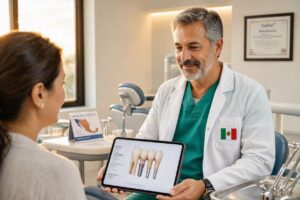
How Much Do Dental Implants Cost In Mexico?
A Note on Quoted Prices: When a clinic quotes a price for a full arch, ask a direct question: “What does this price exclude?” A transparent quote will be an “all-inclusive” package for your medical journey, covering the surgery, a temporary fixed prosthesis, the final permanent prosthesis, all pre-operative scans (like a 3D CBCT), and medications.
Price Map: Cost Variations by Mexican City
Mexico is a large and diverse country. The cost of dental implants is not uniform. It shifts based on the local economy of a city, its proximity to the U.S. border, and the clinic’s target clientele. Choosing a city is a balance of cost, convenience, and clinical specialization.
We have compiled a detailed comparison of the most popular dental tourism destinations. Use this table as a strategic map for your planning.
| City | Single Implant (with Crown) | All-on-4 (per arch) | Full Mouth (All-on-4/6) | Key Characteristic |
|---|---|---|---|---|
| Los Algodones | $750 – $1,100 | $7,000 – $9,500 | $14,000 – $18,000 | Highest clinic density; fast, competitive “Molar City.” |
| Tijuana | $800 – $1,300 | $8,000 – $11,000 | $16,000 – $21,000 | Largest labs, modern tech, easy San Diego fly-in. |
| Cancun | $900 – $1,500 | $9,000 – $12,000 | $18,000 – $22,000 | Vacation-style recovery, bilingual, premium labs. |
| Mexico City | $850 – $1,400 | $8,500 – $11,500 | $17,000 – $20,000 | Academic specialists, capital quality, cultural hub. |
| Guadalajara | $800 – $1,200 | $7,500 – $10,500 | $15,000 – $19,000 | Strong medical community, lower accommodation costs. |
| Monterrey | $900 – $1,400 | $8,500 – $11,500 | $17,000 – $21,000 | Industrial wealth, high-end tech, specialist surgeons. |
Los Algodones: The Efficiency of “Molar City”
This small border town near Yuma, Arizona, has more dentists per square block than almost anywhere else in the world. The competition here is fierce, which drives prices down to the absolute lowest in Mexico for single implants. The entire town’s infrastructure is built for walk-in dental tourists. The experience is clinical and efficient, not luxurious. If your primary goal is the lowest possible price for a single tooth and you do not mind a no-frills, quick trip, Los Algodones is the practical choice.
Tijuana: The Modern Powerhouse
Just south of San Diego, Tijuana has evolved from a border option into a center of dental innovation. Many clinics here rival or surpass what you would find in an American city. They invest heavily in in-house 3D CBCT scanners, CAD/CAM milling machines for same-day crowns, and top-tier on-site dental laboratories. For complex, full-arch cases requiring a high degree of prosthetic customization, Tijuana’s technological infrastructure is a major draw. You fly into San Diego and a clinic driver escorts you across the border in minutes.
Cancun: The Concierge Experience
Cancun targets a different demographic—one that wants to combine a major dental procedure with a resort-style recovery. The clinics here are often bilingual, spa-like, and accustomed to managing every detail of a patient’s stay, from airport pickup to hotel bookings. The implants cost more here because the overheads are higher, but the experience is designed to feel like a medical vacation. Your recovery view might be the Caribbean Sea. This can have a genuine, positive psychological impact on your healing process.
Decoding the Material: What Your Implant Is Made Of
Your final cost is not just about the surgery. It is heavily influenced by the physical components placed in your jaw. You are not buying a single product; you are investing in a system of three parts: the post, the abutment, and the crown. Each part has a material choice with a distinct cost and benefit profile.
The Implant Post: The Foundation
This is the screw placed in your jawbone. The material choice here is a non-negotiable matter of patient safety. The global gold standard, mandated by international regulatory bodies and used by every credible Mexican clinic, is medical-grade titanium alloy, specifically Ti-6Al-4V ELI. This material is biocompatible, meaning your body accepts it and bone cells will fuse directly to its surface in a process called osseointegration.
You may see a higher fee for a “premium” implant brand, such as Straumann (Swiss) or Nobel Biocare (Swedish). This is not a meaningless upsell. These companies have decades of documented clinical research, guaranteeing their surface technology, connection design, and long-term survival rates. A generic or cloned implant might cost half as much for the dentist, but it carries the silent risk of a weaker internal connection, which can lead to screw fracture or bone loss years later. A respected Mexican specialist will offer you a choice but will strongly recommend a known, traceable brand.
The Zirconia Question: You might have read about metal-free, ceramic zirconia posts. They exist and are a fantastic option for patients with a proven titanium allergy or a strong aesthetic demand for a truly white, metal-free foundation. They are, however, 20-30% more expensive and not every surgeon is experienced in their use. A titanium post with a ceramic crown is the standard combination for a reason: it provides a proven metal foundation hidden completely by a tooth-colored top.
The Abutment: The Critical Link
The abutment is a small connector that screws into the implant post and supports the final crown. It is the most overlooked but structurally vital component.
-
Stock Prefabricated Abutments: These are pre-manufactured, one-size-fits-most pieces, usually made of titanium. They cost the lab around $50-$100. For a back molar where forces are highest and aesthetics are a low priority, a custom-healed titanium stock abutment is a strong, cost-effective choice.
-
Custom CAD/CAM Abutments: For any tooth visible in your smile line, a custom abutment is essential. A digital scan of your implant’s exact position is sent to a lab. A technician designs an abutment that emerges from your gums at the perfect angle and profile to support a tooth that looks like it grew there. This adds $200 to $400 to your overall cost but is the primary defense against a visible gray line at the gum or a bulky, unnatural-looking crown.
The Crown: The Art of the Visible Tooth
This is the part you see. The price difference between a $200 crown and an $800 crown is the mastery of the ceramist.
| Feature | PFM (Porcelain-Fused-to-Metal) | Full Zirconia (Monolithic) | E.max (Lithium Disilicate) |
|---|---|---|---|
| Aesthetics | Fair. Can show a dark metal margin at the gum line over time. | Good. Very white and opaque; lacks natural translucency. | Excellent. Chameleon-like; mimics natural enamel light play. |
| Strength | Very Good. Porcelain can chip off the metal. | Maximum. Virtually unchippable. | Very Good. Strong when bonded, ideal for front and premolars. |
| Best Use | Back molars in non-aesthetic zone. | Heavy grinders, bruxers, or patients preferring maximum durability. | Any single tooth in the smile zone. The ultimate aesthetic choice. |
| Cost Factor | Included in base price. | +$150 to +$300 over base. | +$300 to +$500 over base. |
A master Mexican ceramist, often working in a lab that exclusively serves demanding American dentists, will layer porcelain on a zirconia framework to create a “layered zirconia” crown. This marries ultimate strength with breathtaking beauty. It is the most expensive option and a justified one for a front tooth implant.
The All-on-X Journey: A Detailed Fee Breakdown
The All-on-4 or All-on-6 treatment is a complex, staged process. Understanding each stage’s cost component will help you compare quotes intelligently and avoid a financially dangerous “bait and switch” tactic.
Stage 1: Diagnosis, Extraction, and Immediate Load
You arrive for surgery. The fee for this first, dramatic day usually includes:
-
Pre-operative 3D CBCT scan and surgical guide fabrication.
-
Any necessary extractions of remaining failing teeth.
-
Bone grafting or socket preservation if immediate implant placement requires it.
-
Placement of 4, 5, or 6 implants per arch.
-
A fixed, all-acrylic temporary bridge screwed onto the implants on the same day.
This temporary bridge is not your final smile. It is a healing prosthesis. It is made of a high-impact acrylic reinforced with a metal bar or fiber. It is functional and aesthetically acceptable, but it will stain and wear down. It buys your jaw time to heal and integrate with the implants for 4-6 months. This stage alone might represent 50-60% of your total quoted fee, $4,500 to $7,000 per arch.
Stage 2: The Definitive Restoration
After osseointegration is confirmed, you return for your final, permanent set of teeth. This is where price diverges dramatically based on material. A $12,000 full-arch quote will get you a final bridge that is still high-quality acrylic. It’s durable, but it is a maintenance item that will need replacement in 5-7 years.
A $16,000 to $20,000 full-arch quote reflects a final bridge milled from a solid block of zirconia. This is a monolithic structure, beautiful, dense, and incredibly strong. It mimics the wear of natural teeth and resists fracture. It is often guaranteed against breakage for a period by the lab. The fee here covers:
-
Taking a master impression with a custom tray.
-
A try-in appointment where you approve the shape and color of your new teeth in wax before they are finalized.
-
The CAD/CAM design and precision milling of the final zirconia bridge.
-
The titanium framework that reinforces the zirconia and screws into the implants.
-
Final delivery, bite adjustment, and polishing.
Always Ask About the Final Prosthesis Warranty: A top-tier Mexican clinic and its lab will provide a written warranty, often 3 to 5 years or more, on a final zirconia bridge against fractures. This warranty is a powerful signal of their confidence in the material and craftsmanship.
The Hidden Economies: Travel and Stay Logistics
Your total cost of getting dental implants in Mexico is the clinic’s bill plus the travel logistics. These are not hidden costs if you plan for them.
A single implant requires at least two trips. The first is for the implant placement surgery. You return home for 4-6 months to heal. The second trip is shorter, just to uncover the implant and take the impression for the crown. Some clinics with in-house milling can make and deliver the final crown in just a few days during this second trip, while others will require a third visit to cement it. Factor in:
-
Flights: $300 to $700 USD round trip, depending on your home city and the season.
-
Accommodation: Border town hotels can be $50-$70 per night. A recovery-friendly Cancun resort may be $100-$200 per night. You will need 2-3 nights for a surgical trip and 1-2 nights for a restorative trip.
-
Local transport: Many clinics include a driver for dental appointments. If not, budget $20-$40 a day for taxis.
For a full-arch case, the logistics are more intense but often bundled. The first trip is longer, typically 7 to 10 days. This allows for surgery, a day of rest, a follow-up, and an adjustment of your temporary bridge before you fly home. The second trip, 4-6 months later, lasts 5-7 days to place the final zirconia bridge. A well-organized clinic will offer a “concierge package” that transparently itemizes all non-medical costs for your partner or companion, covering hotel, transport, and even a post-recovery excursion to soften the medical anxiety.
The Quality Scale: A Candid Look at Risk
Is a $750 implant in Mexico the same as a $4,500 implant in Los Angeles? The honest answer is: it can be, from the same lab, using the same brand. But you carry a greater responsibility as the patient to verify this. The Mexican dental industry contains a spectrum. On one end, there are board-certified specialists with international fellowships and in-house labs producing work that is indistinguishable from the world’s best. On the other, there are high-volume, minimally supervised clinics using a one-size-fits-all surgical approach with generic implant copies.
Your safety lies in your method of questioning. A red flag is a clinic that quotes a price without seeing a panoramic X-ray. No ethical dentist can make a precise diagnosis from a holiday photo. A green flag is a specialist who asks for your medical history, prescribes a 3D scan before you travel, and provides a biological, not just a financial, reason for their treatment plan. The implant itself is not the risk. The risk is the skill of the surgeon placing it and the lab crafting the tooth on top. Two dentists can use the same premium implant brand and produce two drastically different final results: one a masterpiece of biological integration and one a future case of peri-implantitis.
The True Cost of a Failed Implant: A failure is not just about losing the $1,500 you paid. It is the emotional devastation, the cost of a local specialist to remove the implant and do a bone graft, the months of additional healing, and the price of a new implant back home at full North American rates. The real loss could be $10,000 and two years of your life.
Navigating Insurance and Financial Vehicles
Mexico is a cash-and-carrier market for dentistry. Your U.S. or Canadian dental insurance plan will not have a direct billing relationship with a Mexican clinic. You will pay the full cost out-of-pocket and then seek reimbursement from your insurer, if your plan allows.
Before you go, call your insurance provider and ask one specific question: “What is the out-of-network benefit for a major restorative service performed internationally?” The response will fall into one of three categories:
-
No Coverage: Most HMO and many PPO plans will not cover any services outside the country.
-
In-Network Equivalent: Some premium plans will cover a procedure at an “in-network” percentage if performed out-of-country, up to a usual and customary fee. You submit the paid invoice and a full narrative from the Mexican dentist.
-
Purely Reimbursive: You can use your Health Savings Account (HSA) or Flexible Spending Account (FSA) to pay for the implants directly. This is the most common and powerful option. Dental implants are an IRS-qualified medical expense. You can use your HSA debit card at the clinic or reimburse yourself from the account. Always obtain a detailed, paid-in-full invoice coded with the proper dental treatment codes.
A Step-by-Step Plan for Your Journey
Clarity comes from a proven sequence of actions. Here is a realistic path from initial research to final smile.
-
The Virtual Consultation: Do not settle for an email quote. Request a 15-minute live video call with the dentist who will perform your surgery, not a patient coordinator. Use this call to judge their communication style. Do they listen? Do they explain things simply? Send them a recent panoramic X-ray from your local dentist before the call.
-
The Credential Check: After the call, ask for the dentist’s full name and professional ID number (Cédula Profesional). Use the Mexican government’s official website for the National Registry of Professionals to verify their license and specialty. Look for board certification in Oral Implantology or Periodontology, not just a general dentistry degree with weekend implant courses.
-
The Lab Inquiry: Ask the clinic: “Who is your dental lab, and where are they located?” A clinic that proudly names a specific, reputable local lab or has an in-house technician is a sign of quality control. A clinic that says “we use different labs” is a sign of price-shopping that can compromise your case.
-
The All-Inclusive Agreement: Before sending any money, demand a written, line-item treatment plan in English. This document must list every component by brand name: Straumann or Nobel implant, custom or stock abutment, type of crown material, and brand of bone graft. It must state the warranty on the implant fixture and the crown. It must also outline the clinic’s policy in the rare event of a surgical complication or immediate implant failure. Who covers what?
-
The Tactical Booking: Schedule surgery for a Tuesday or Wednesday. This ensures the full senior clinical and lab team is on-site. Avoid Mondays (national holidays can create scheduling chaos) and Fridays (you do not want to have a post-operative question during the weekend with no immediate support).
The Recovery Equation: Aftercare and Maintenance
Your financial and biological investment requires a maintenance plan. Implants do not get cavities, but the gum and bone around them can get infected, a condition called peri-implantitis. Your contract with a quality Mexican clinic should include a post-operative care package. This means a specific protocol for you to follow and a clear point of contact for emergencies.
Your at-home kit must include a water flosser with a non-metal tip, soft interproximal brushes, and a non-abrasive gel. Annually, you need a visit to either your local dentist or a return trip to Mexico for a professional debridement using special plastic or titanium scalers that won’t scratch the implant’s abutment surface. A scratched abutment is a magnet for plaque. The cost of this maintenance, roughly $100-$200 per year, is the insurance policy on your $15,000 smile.
Conclusion
The real cost of dental implants in Mexico is not a single number but a calculation of value. It is the sum of a specialist’s skill, a traceable brand of implant, a master ceramist’s art, and your own diligent research. You can find a life-changing restoration for 50-70% less than in the U.S., with a final result that is clinically and aesthetically world-class. The path to this success is paved not with blind trust, but with informed, specific questions. Choose the clinic that answers them transparently and in writing.
Frequently Asked Questions
Is it safe to travel to Mexico for dental implants right now?
Yes, dental tourism to established hubs like Tijuana, Cancun, and Los Algodones remains safe and robust. These clinics are experts in managing international patients. We recommend using a clinic driver for local transport and following standard travel advisories for the region, just as you would in any unfamiliar city. The medical corridor zones are highly protected and cater exclusively to medical visitors.
How long do I have to stay in Mexico for a full set of All-on-4 implants?
You will make two separate trips. The first trip requires a stay of about 7 to 10 days. This allows for your initial surgery, a follow-up check, and any necessary adjustments to your temporary fixed bridge. You then heal at home for 4 to 6 months. Your second trip is shorter, typically 5 to 7 days, to place your final, permanent set of zirconia teeth.
Will my warranty be valid if I go back home?
This is a critical question to verify with your clinic. Most high-quality Mexican clinics that serve an international clientele fully intend for their warranty to be valid regardless of your location. They have a system for handling this, often asking you to see a local dentist for a simple X-ray and then shipping a replacement part directly to you or via your local dentist if needed. Confirm this written process before treatment.
What’s the difference between a $9,000 and a $16,000 full arch in Mexico?
The difference almost always lies in the final set of teeth, not the surgery. The $9,000 arch will typically conclude with a durable but less aesthetic acrylic hybrid bridge that will eventually need replacement. The $16,000 arch is finished with a precision-milled, monolithic zirconia bridge that is virtually unbreakable, highly aesthetic, and designed to be a final, lifelong restoration. The surgical implant placement is often identical in both cases.
Additional Resource:
For the official U.S. government resource on traveling abroad for medical care, including planning your trip, insurance considerations, and understanding the risks, visit the CDC page on Medical Tourism: https://wwwnc.cdc.gov/travel/page/medical-tourism


