The day your braces come off is a day of celebration. The metal or ceramic brackets are gone, and in the mirror, you see the straight smile you invested so much time and money to achieve. Then the orthodontist hands you a small, clear plastic case. Inside is your retainer. They explain, with a gravity that can feel surprising on such a happy day, that this device is for life. A question lingers in the back of your mind, perhaps for years: after everything I paid for braces, do retainers cost more than braces?
The question is deceptively simple. The answer is not a direct price comparison. It is a story of two fundamentally different financial models. Braces are a one-time, capital investment. Retainers are a lifelong, recurring operational expense. This article will dissect the economics of both, revealing the long-term cost of retention and why the small, clear piece of plastic in your hand is one of the most financially significant objects in your dental health journey.
Do Retainers Cost More Than Braces?
The Initial Investment: Braces as a Capital Expense
To answer the question, we must first establish the benchmark. What did the braces themselves actually cost? The comprehensive orthodontic treatment you completed was a bundled service. The fee covered a sequence of clinical actions, proprietary materials, and professional oversight over a period of 18 to 36 months.
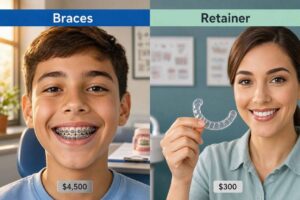
The average cost of comprehensive orthodontic treatment in the United States for a full case of traditional metal braces is between $3,000 and $7,000. For ceramic braces, the range is $4,000 to $8,000. For Invisalign, the fee is typically $4,000 to $7,500 for a moderate to comprehensive case. This is a significant, one-time financial outlay. Payment plans are structured over the duration of treatment, and once the final payment is made, the active treatment phase is financially closed.
This fee covers a vast amount of professional time: the initial diagnostic records, the case planning, the bonding appointment, every monthly adjustment visit, any emergency bracket repairs, and the debonding appointment. It is a fee for a project with a defined end date. When the braces come off, the large payments stop. This is the critical financial pivot. You have just finished paying for the project of straightening. You are now entering the project of retention.
The Cost of Retention: The First Retainer
The first set of retainers is typically included in your comprehensive orthodontic contract. You do not pay a separate line item on the day of debonding. You have already paid for them as part of the bundled treatment fee. This is a fact that creates a false sense of financial finality.
An orthodontist does not view this first retainer as free. It is a cost they have internally budgeted into the total case fee. The laboratory cost for a set of clear plastic retainers is typically $100 to $200 per arch. The orthodontist absorbs this lab bill as part of their overhead. So, while you do not hand over a credit card on the day of delivery, you did pay for that first retainer. It was simply pre-paid over the previous two years.
If your orthodontic contract specifies a single set of clear retainers, you receive two pieces of thermoformed plastic, one for your upper teeth and one for your lower teeth. Some contracts include a combination: a clear upper retainer and a bonded lower wire. Regardless of the configuration, this initial set is your entry point into the retention phase. Its lifespan is finite, and your financial responsibility for what comes next is entirely yours.
The Recurring Expense: The Lifelong Cost of Retainers
Here lies the core truth of the retainer-braces cost question. Braces are paid for once. Retainers are paid for, and replaced, for the rest of your life. The initial retainer you receive on debonding day will not last forever. Plastic fatigues. It micro-cracks from the constant stress of your bite and the thermal cycling of your mouth. You will lose it. Your dog will chew it. You will accidentally throw it away wrapped in a napkin at a restaurant. These are not hypotheticals; they are the lived experience of millions of former orthodontic patients.
When you need a replacement, you are no longer under the financial umbrella of the original treatment contract. You are now a cash-paying customer for a single product: a new retainer. The cost of a replacement removable retainer is a direct, out-of-pocket expense.
-
Clear Essix Retainer (single arch): $150 to $300. This is the most common replacement. It is a clear plastic shell that snaps over your teeth. Its primary disadvantage is its fragility and tendency to crack along the occlusal surface over time.
-
Hawley Retainer (single arch): $250 to $500. This is the classic design with an acrylic body that sits in the palate or floor of the mouth and a wire that wraps across the front teeth. It is significantly more durable than an Essix retainer but is more visible.
-
Vivera Retainers (Invisalign brand, set of 4 arches): $500 to $1,000. These are proprietary, high-strength clear retainers manufactured by Align Technology. You receive four sets in a box, which is designed to last you several years of rotation.
A single replacement event is not financially catastrophic. A $300 new upper retainer is an annoyance. The real cost of retention becomes clear when you compound this expense over a lifetime. Imagine an orthodontic patient who finishes treatment at age 15. They are told to wear their retainer every night for life. A set of clear retainers lasts, with perfect care, between two and five years before becoming cloudy, loose, or cracked. A more realistic average lifespan for a single set of clear retainers is three years.
If this patient lives to age 85, they have 70 years of retention ahead of them. Replacing a clear retainer set every three years over 70 years means approximately 23 replacement sets. At a conservative average cost of $400 for an upper and lower set, the lifetime cost of retention reaches $9,200. This is more than the original cost of many comprehensive braces cases. The math is stark and undeniable. Retainers, silently and slowly over a lifetime, can indeed cost more than the braces that started the journey.
The Fixed Retainer Economy: A Different Calculation
A bonded lingual retainer, a wire glued to the back of the lower front teeth, has a different financial profile. Its initial cost is higher, often $300 to $500 for placement. But it is not subject to loss or dog-chewing in the same way. It simply sits, passively, performing its duty for years.
The cost of a fixed retainer is not zero after placement, however. It is a deferred maintenance cost. The composite bonding material that holds the wire to the teeth can chip, wear down, or detach from one tooth. You will need a repair visit to rebond it. A simple rebond of one site costs $50 to $100. More significantly, a fixed retainer creates a hygiene challenge. Plaque and calculus accumulate around the wire and between the teeth. You must use floss threaders or a water flosser to clean around it meticulously. Failure to do so leads to gum inflammation, cavities, and bone loss on the lower incisors. The hidden cost of a fixed retainer is the potential restorative bill for fillings or gum treatment if hygiene is neglected. It is a cost of ownership, not a purchase cost.
The Catastrophic Cost of Not Wearing Your Retainer
There is a third financial path that is the most expensive of all. You lose your retainer. You do not replace it. Your teeth shift. The crowding and spacing that took two years and $6,000 to fix slowly recurs. Five or ten years later, you look in the mirror and realize your smile is no longer straight. You are now back at the orthodontist’s office, not for a $300 retainer, but for a full, second round of braces or Invisalign, costing another $4,000 to $7,000.
This is the most brutal and avoidable financial outcome. A neglected retainer converts a lifelong maintenance cost into a second, massive capital expenditure. The $300 replacement retainer you should have bought is now a $5,000 re-treatment case. The cost ratio of the retainer to the re-treatment is nearly 1:17. The retainer is not the expensive choice. The re-treatment is the expensive choice. The retainer is the insurance policy that prevents financial disaster.
The Role of Dental Insurance in Retention
Dental insurance is designed around the braces-and-retainer financial model in a specific and limited way. Orthodontic benefits typically have a lifetime maximum, as we discussed, often $1,500 or $2,000. This benefit is applied to the active braces phase and is exhausted.
Once active treatment is complete, the orthodontic benefit is gone. It does not reset annually. It does not cover replacement retainers. Retainer replacement falls under the general dental plan, and most general plans do not have a specific, generous benefit for a “retainer replacement.” A plan might cover it under a general “prosthetic appliance” category, but it will be subject to your deductible and your annual maximum, which is likely already consumed by cleanings, fillings, and other care. For most patients, replacement retainers are a purely out-of-pocket, elective expense. Financially planning for this reality, perhaps by setting aside a small amount each month into a “future retainer fund,” is a wise and pragmatic habit.
Conclusion
The question “do retainers cost more than braces?” has a dual answer. In a single, upfront payment sense, no. A retainer is a fraction of the cost of braces. But in a lifetime, compounded sense, yes. The recurring, cumulative cost of replacing retainers every few years over a lifetime can silently surpass the one-time capital cost of the original braces. The retainer is not a souvenir of your orthodontic treatment. It is a permanent, recurring line item in your personal health budget. That small piece of plastic is the most valuable thing you own for protecting the tens of thousands of dollars you have invested in your smile.
Frequently Asked Questions
How long do clear plastic retainers really last?
Under normal, nightly wear, a set of clear Essix-style retainers lasts approximately two to five years. The plastic fatigues and micro-cracks. If you grind your teeth at night, the lifespan can be significantly shorter, sometimes less than a year, as the material is worn thin by the abrasive forces. A Hawley retainer, with its acrylic and wire design, can last a decade or more if not damaged.
Is it cheaper to get a replacement retainer from my original orthodontist or a general dentist?
Your original orthodontist often maintains your digital scan on file and can order a replacement from their lab without a new impression appointment. This can be the most convenient and sometimes competitively priced path. A general dentist can also scan your teeth and provide a retainer. The cost is similar. The value is in the convenience and the retention of your records.
Can I just use a mail-order retainer service?
Mail-order clear retainers, where you take your own impression at home, have a lower upfront cost, often under $100 per arch. The risk is the quality of the impression and the lack of a professional assessing the fit on your teeth. An ill-fitting retainer can place uneven pressure on teeth and cause orthodontic relapse or discomfort. For a simple replacement of a previously stable retainer, they can be a low-cost option, but for any shift in tooth position, they are a false economy.
Additional Resource:
For a detailed, patient-focused explanation of orthodontic retention and why lifelong retainer wear is necessary, visit the British Orthodontic Society’s patient information page: https://www.bos.org.uk/Patients/Retainers