Becoming a dental hygienist offers a rewarding career with competitive pay, flexible scheduling, and strong job security. The profession consistently ranks among the best healthcare support careers. However, aspiring hygienists must first navigate the educational requirements and associated costs. Understanding the total investment required helps you plan financially and choose the right educational pathway.
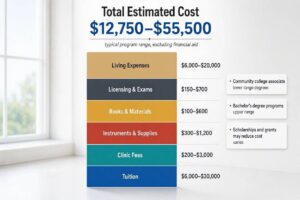
The total cost of dental hygienist education ranges from $7,000 to $60,000 depending on the degree pathway, institution type, and geographic location. An associate degree from a community college costs $7,000 to $25,000 for in-district students. A bachelor’s degree from a university costs $30,000 to $60,000 or more. Additional expenses for instruments, supplies, licensing exams, and living costs add $5,000 to $15,000 beyond tuition.
Educational Pathways to Becoming a Dental Hygienist
Aspiring dental hygienists choose between two primary educational routes. Each offers distinct advantages and carries different costs.
Associate Degree in Dental Hygiene
The associate degree represents the most common entry point into the profession. Community colleges and technical schools offer these two-year programs combining classroom instruction with hands-on clinical training. Graduates earn an Associate of Applied Science (AAS) or Associate of Science (AS) in Dental Hygiene.
Typical Duration: 2 years (after completing prerequisites)
Average Total Tuition: $7,000 – $25,000 (in-state/district)
Program Format: Full-time, cohort-based, limited part-time options
Associate degree programs prepare students for clinical practice. Graduates qualify for licensure in all states and can begin working immediately. This pathway offers the fastest, most affordable route to entering the profession.
Bachelor’s Degree in Dental Hygiene
Universities offer Bachelor of Science (BS) programs in dental hygiene. These four-year programs include the same clinical training as associate programs plus additional coursework in research, education, public health, and leadership.
Typical Duration: 4 years (including prerequisites)
Average Total Tuition: $30,000 – $60,000+ (in-state)
Program Format: Full-time, traditional semester schedule
Bachelor’s degrees open doors to career advancement opportunities including teaching, public health administration, research, and corporate roles. Some employers, particularly hospitals and academic institutions, prefer or require bachelor’s preparation.
Degree Completion Programs
Registered dental hygienists holding associate degrees can pursue bachelor’s degree completion programs. These programs build on existing education and clinical experience, typically requiring one to two additional years of study.
Typical Duration: 1-2 years (part-time options available)
Average Total Tuition: $10,000 – $25,000
Program Format: Often online with minimal on-campus requirements
Degree completion offers working hygienists a cost-effective path to career advancement without sacrificing employment income.
Detailed Cost Breakdown of Dental Hygiene Education
Tuition represents the largest expense, but many additional costs contribute to the total educational investment.
Tuition and Fees
Tuition varies dramatically by institution type and residency status. Public community colleges charge the lowest rates for in-district students. Private institutions and out-of-state tuition carry significant premiums.
| Institution Type | Associate Degree Tuition | Bachelor’s Degree Tuition |
|---|---|---|
| Public Community College (in-district) | $7,000 – $15,000 | N/A |
| Public Community College (out-of-district) | $12,000 – $25,000 | N/A |
| Public University (in-state) | $15,000 – $25,000 | $30,000 – $45,000 |
| Public University (out-of-state) | $25,000 – $40,000 | $50,000 – $75,000+ |
| Private Institution | $25,000 – $45,000 | $50,000 – $80,000+ |
These figures represent program totals, not annual costs. Dental hygiene programs typically charge per-credit-hour rates, with associate programs requiring 80-90 credits and bachelor’s programs requiring 120-130 credits.
Prerequisite Coursework
Most dental hygiene programs require prerequisite courses in biology, chemistry, anatomy, and other sciences before admission to the professional program. These prerequisites typically require one to two semesters of full-time study.
Prerequisite Tuition Cost: $2,000 – $8,000 (at community college rates)
Prerequisites completed at community colleges cost less than those taken at universities. Transfer credits from accredited institutions typically satisfy prerequisite requirements regardless of where you complete the dental hygiene program.
Instruments, Supplies, and Equipment
Dental hygiene students purchase professional instruments and supplies for clinical training. These one-time purchases represent a significant upfront cost beyond tuition.
Typical Instrument Kit Cost: $3,000 – $7,000
A complete kit typically includes:
Scaling instruments (curettes, scalers) in various sizes. Periodontal probes and explorers. Mouth mirrors and handles. Instrument cassettes and sharpening supplies. Loupes (magnification eyewear): $800 – $2,500. Typodont (practice model) and teeth: $200 – $500. Safety glasses and clinic attire: $200 – $500. Portable light source: $200 – $500
Loupes represent the most significant individual instrument expense. These custom-fitted magnification glasses reduce eye strain and improve clinical precision. Many programs require specific loupe specifications, limiting shopping options.
Textbooks and Learning Materials
Dental hygiene textbooks are specialized, hardcover, and expensive. Digital access codes for online learning platforms add additional costs.
Textbook Cost: $1,500 – $3,500 (for the entire program)
Board review materials for the National Board Dental Hygiene Examination (NBDHE) add $300-$800 in the final semester.
Uniforms and Professional Attire
Clinical training requires professional scrubs, clinic shoes, and sometimes program-specific uniforms. These costs are modest compared to other expenses but add to the total.
Uniform Cost: $300 – $800
Licensure Examination Fees
Graduates must pass national and state/regional clinical examinations to obtain licensure. These examination fees fall to the student.
| Examination | Cost |
|---|---|
| National Board Dental Hygiene Examination (NBDHE) | $490 |
| Regional Clinical Examination (CDCA, WREB, etc.) | $1,000 – $1,500 |
| State Licensure Application Fee | $100 – $400 |
| Jurisprudence Exam (some states) | $50 – $150 |
| CPR Certification | $50 – $100 |
| Total Examination Costs | $1,690 – $2,640 |
Some states require additional examinations or background checks. Research your intended state’s specific requirements to budget accurately.
Background Checks, Drug Screening, and Immunizations
Healthcare education programs require criminal background checks, drug screening, and documentation of immunizations. These requirements apply at program entry and sometimes again before clinical rotations.
Background Check and Drug Screen: $100 – $250
Immunization Titers and Vaccinations: $200 – $600
Students who completed childhood vaccinations may need titer tests to prove immunity. Students lacking required immunizations face additional costs for vaccination series.
Living Expenses During Education
Dental hygiene programs demand significant time commitments, limiting employment opportunities. Many students reduce work hours or stop working entirely during the intensive clinical phases.
Estimated Living Costs (2-year program): $20,000 – $50,000
Living costs vary dramatically by location, housing arrangements, and personal spending. Students living with family during school significantly reduce this expense.
Total Cost Summary: What You Will Actually Pay
Combining all expense categories provides a realistic picture of the total educational investment.
| Expense Category | Associate Degree (Community College) | Bachelor’s Degree (Public University) |
|---|---|---|
| Tuition and Fees | $7,000 – $15,000 | $30,000 – $45,000 |
| Prerequisites | $2,000 – $5,000 | $3,000 – $8,000 |
| Instruments and Supplies | $5,000 – $8,000 | $5,000 – $8,000 |
| Textbooks | $1,500 – $3,000 | $2,000 – $3,500 |
| Uniforms | $300 – $500 | $300 – $500 |
| Licensure Exams | $1,700 – $2,600 | $1,700 – $2,600 |
| Background/Medical Clearance | $300 – $800 | $300 – $800 |
| Living Expenses (est.) | $20,000 – $40,000 | $30,000 – $50,000 |
| Total Estimated Range | $37,800 – $74,900 | $72,300 – $118,400 |
These totals include living expenses, which you would incur regardless of educational pursuit. Excluding living costs, the direct educational expenses total $17,800 to $34,900 for an associate degree and $42,300 to $68,400 for a bachelor’s degree.
Financial Aid and Funding Options
Multiple funding sources help make dental hygiene education affordable. Understanding your options maximizes financial support and minimizes debt.
Federal Financial Aid
Accredited dental hygiene programs qualify for federal student aid. Complete the Free Application for Federal Student Aid (FAFSA) to determine eligibility for grants, loans, and work-study programs.
Federal Pell Grants:
Need-based grants that do not require repayment. Maximum award for 2024-2025 academic year: $7,395. Eligibility depends on Expected Family Contribution (EFC) and enrollment status.
Federal Direct Loans:
Subsidized loans: Government pays interest while enrolled at least half-time. Unsubsidized loans: Interest accrues during enrollment. Annual limits vary by dependency status and academic level.
Federal Work-Study:
Part-time employment opportunities, often on campus or at community service organizations. Earnings supplement other financial aid.
Scholarships for Dental Hygiene Students
Professional organizations, community foundations, and educational institutions offer scholarships specifically for dental hygiene students.
American Dental Hygienists’ Association (ADHA) Scholarships:
The ADHA Institute for Oral Health awards scholarships ranging from $1,000 to $5,000 to student members. Eligibility criteria include academic achievement, financial need, and professional involvement.
State and Local Dental Hygiene Associations:
Many state associations offer scholarships for residents or students attending in-state programs. Awards typically range from $500 to $2,500.
College and University Scholarships:
Institutional scholarships based on academic merit, financial need, or specific donor criteria. Contact your program’s financial aid office for available opportunities.
Employer Tuition Assistance:
Some dental practices offer tuition assistance or loan repayment as recruitment incentives. These arrangements typically require post-graduation employment commitments.
Loan Repayment and Forgiveness Programs
Federal and state programs offer loan repayment assistance for dental hygienists working in underserved areas.
National Health Service Corps (NHSC):
Loan repayment of up to $50,000 for two years of full-time service at an approved site in a Health Professional Shortage Area. Dental hygienists qualify when providing services in designated settings.
State Loan Repayment Programs:
Many states operate loan repayment programs for healthcare professionals serving underserved populations. Eligibility, award amounts, and service requirements vary by state.
Public Service Loan Forgiveness (PSLF):
Federal Direct Loan borrowers employed by qualifying government or non-profit organizations may receive forgiveness after 120 qualifying monthly payments. Dental hygienists working in public health clinics, community health centers, or academic institutions may qualify.
Return on Investment: Earnings Potential
Dental hygiene education costs must be evaluated against career earnings potential. The profession offers strong returns on educational investment.
National Salary Data
According to the U.S. Bureau of Labor Statistics, dental hygienists earned the following in 2023:
Median Annual Wage: $84,860
**Top 10% Annual Wage:** $107,640+
Bottom 10% Annual Wage: $64,200
Salaries vary by geographic location, practice setting, experience, and hours worked. Metropolitan areas typically offer higher wages but also higher living costs.
Salary by Practice Setting
| Practice Setting | Average Annual Salary |
|---|---|
| Dental Offices | $83,000 – $95,000 |
| Outpatient Care Centers | $85,000 – $100,000 |
| Physician Offices | $80,000 – $90,000 |
| Government Facilities | $75,000 – $85,000 |
| Employment Services (temporary) | $90,000 – $110,000+ |
Temporary or “temp” hygienists often command higher hourly rates but forgo benefits like health insurance, retirement contributions, and paid time off.
Debt-to-Income Analysis
A graduate with an associate degree and $25,000 in student loan debt earning $75,000 annually maintains a manageable 33% debt-to-income ratio. Federal income-driven repayment plans limit monthly payments to a percentage of discretionary income.
The strong return on investment makes dental hygiene an attractive career despite rising educational costs. Most graduates repay educational debt within 5-10 years while maintaining comfortable living standards.
Choosing the Right Program for Your Budget
Selecting a dental hygiene program requires balancing cost, quality, and career goals.
Accreditation Status
Only graduates of programs accredited by the Commission on Dental Accreditation (CODA) qualify for licensure in all states. Verify CODA accreditation before committing to any program. Unaccredited programs may cost less but leave graduates unable to obtain licensure.
The CODA website maintains a searchable database of accredited dental hygiene programs. This should be your starting point for program research.
Community College vs. University
Community college associate programs offer the most affordable path to licensure. Graduates earn similar starting salaries to bachelor’s-prepared hygienists. The cost savings are substantial.
Bachelor’s programs cost more but provide advancement opportunities that may increase lifetime earnings. Hygienists interested in teaching, public health, or corporate roles benefit from bachelor’s preparation.
Many hygienists pursue the associate-to-bachelor’s pathway: earn an affordable associate degree, begin working, then complete a bachelor’s through a degree completion program while earning income.
In-State vs. Out-of-State Programs
Public institutions charge dramatically higher tuition for out-of-state students. Establishing residency before enrollment saves tens of thousands of dollars. Most states require 12 months of continuous residence for in-state tuition eligibility.
Attending an out-of-state private institution avoids the residency premium but often costs as much as out-of-state public tuition. Evaluate total program cost rather than annual tuition when comparing options.
Program Length and Intensity
Accelerated programs compress coursework into shorter timeframes, reducing living expenses but increasing intensity. Traditional two-year associate programs allow more time for part-time employment.
Some programs offer evening or weekend cohorts that accommodate working students. These options may extend program duration but allow continued income during education.
Frequently Asked Questions
How much does dental hygienist school cost in total?
Total educational expenses range from $18,000 to $68,000 depending on degree type and institution, excluding living expenses. Including living costs, the total investment ranges from $38,000 to $118,000.
Can I work while attending dental hygiene school?
Part-time employment is possible during prerequisite coursework. Clinical phases demand significant time commitments, limiting work opportunities. Many students reduce work hours or stop working entirely during clinical training.
Are there online dental hygiene programs?
Didactic coursework can be completed online through some programs. Clinical training requires in-person attendance at approved facilities. No fully online entry-level dental hygiene programs exist due to clinical requirements.
How long does it take to become a dental hygienist?
An associate degree requires approximately two years of professional coursework after completing prerequisites (one semester to one year). Total time from start to licensure typically ranges from 2.5 to 3.5 years.
Is dental hygiene a good return on investment?
Yes. Median salaries exceeding $84,000 per year provide strong returns on educational investments of $18,000 to $68,000. Most graduates repay educational debt within 5-10 years.
What is the cheapest way to become a dental hygienist?
In-district community college associate programs offer the most affordable pathway. Completing prerequisites at the same community college, applying for scholarships, and working during non-clinical periods further reduces costs.
Do dental hygienists need a bachelor’s degree?
An associate degree qualifies graduates for licensure and clinical practice in all states. Bachelor’s degrees are required for some non-clinical roles and preferred for certain employers but are not necessary for entry-level clinical practice.
Additional Resources
For more information about dental hygiene education and careers:
-
American Dental Hygienists’ Association: www.adha.org
-
Commission on Dental Accreditation: www.ada.org/en/coda
-
American Dental Education Association: www.adea.org
-
U.S. Bureau of Labor Statistics Occupational Outlook: www.bls.gov/ooh