Navigating the world of dental insurance and procedural coding can often feel like learning a new language. For dental professionals and office administrators, accuracy in coding is not just about paperwork; it is the linchpin of practice revenue, legal compliance, and clear communication with insurance providers. When it comes to complex, high-value restorations like hybrid dentures (often referred to as All-on-4 or implant-supported overdentures), getting the code right is paramount.
The terminology “hybrid denture” itself is a bit of a chameleon in the dental world. It describes a prosthesis that replaces a full arch of teeth, but unlike a traditional denture, it is screwed or snapped into place onto dental implants. Because it blends characteristics of a removable denture and a fixed bridge, it occupies a gray area in coding manuals.
This guide is designed to demystify the process. We will explore the most commonly used ADA (American Dental Association) codes for hybrid dentures, explain the clinical scenarios that dictate which code to use, and provide practical advice for ensuring your claims are processed smoothly and profitably.
Whether you are a seasoned treatment coordinator, a dentist looking to expand your restorative services, or a student eager to learn, this resource will provide the clarity you need to code with confidence.
ADA Code for Hybrid Dentures
At a Glance: Common Codes for Hybrid Dentures
To start, here is a quick reference table of the primary codes you will encounter when billing for hybrid denture procedures. We will dive deeper into each one throughout the article.
| ADA Code | Procedure Description | Typical Application for Hybrids |
|---|---|---|
| D6110 | Implant/abutment supported removable denture – for an edentulous arch – maxillary | Overdenture retained by implants (patient can remove for cleaning). |
| D6111 | Implant/abutment supported removable denture – for an edentulous arch – mandibular | Same as above, for the lower jaw. |
| D6112 | Implant/abutment supported fixed denture – for an edentulous arch – maxillary | Fixed hybrid bridge (only dentist can remove). |
| D6113 | Implant/abutment supported fixed denture – for an edentulous arch – mandibular | Same as above, for the lower jaw. |
| D6066 | Abutment supported porcelain fused to metal crown (implant) | Sometimes used for segmental hybrid constructions. |
| D6080 | Implant maintenance procedures (removal and replacement of prosthesis) | Charged when removing the hybrid for cleaning or repair. |
Understanding the “Hybrid Denture” and Its Coding Challenges
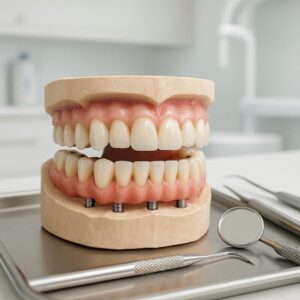
Before we assign a code, we must understand the unique nature of the restoration. A hybrid denture is neither fish nor fowl. It has a pink, gum-colored acrylic base that mimics soft tissue, into which acrylic or composite teeth are set. Inside this acrylic base lies a metal or milled bar that connects the entire structure to the implants.
The fundamental question that dictates your code choice is: Is the prosthesis removable by the patient, or is it fixed?
-
Removable Hybrid (Overdenture): The patient can snap the prosthesis on and off for daily oral hygiene. It relies on attachments (like locators or bars and clips) for retention.
-
Fixed Hybrid (Fixed-Detachable): The prosthesis is screwed directly into the implants or a milled bar. It is considered “fixed” because only a dentist can remove it using a special tool to unscrew the retaining screws.
This distinction leads us directly to the two main families of codes: the D6100 series for implant-supported prostheses.
Diving Deep: The D6100 Series for Implant-Supported Prostheses
The American Dental Association created the D6100 codes specifically to address the rise of implant dentistry. These are the most accurate codes for reporting hybrid dentures, provided you choose the correct sub-code based on fixation and arch.
D6110 and D6111: The Removable Path (Overdentures)
These codes are used when you are delivering a removable implant-supported or implant-retained denture.
-
D6110: Maxillary (upper) arch.
-
D6111: Mandibular (lower) arch.
When to use them:
You should use these codes when the final prosthesis is designed to be taken in and out of the mouth by the patient. This is a common treatment modality for patients who want the stability of implants but prefer the ability to clean their prosthesis thoroughly outside the mouth. The prosthesis often uses a metal bar with clips or individual abutments with O-ring or locator attachments.
Important Note for Billing:
Insurance companies will look for a few key elements when processing D6110/D6111 claims:
-
The abutments: You will also need to bill for the implant abutments (e.g., D6056 or D6057) placed at a separate appointment.
-
The attachments: The retentive mechanisms (clips, O-rings) are often billed separately or are included in the laboratory fee. Know your payer contract.
A Note for Patients: Think of a D6110/D6111 prosthesis like a high-tech, secure snap-in retainer. It offers incredible stability for eating and speaking, but you have the freedom to remove it for a deep clean.
D6112 and D6113: The Fixed Path (Fixed-Detachable Bridges)
These are the codes most associated with the popular “All-on-4” or “Teeth-in-a-Day” concept. These procedures result in a fixed prosthesis.
-
D6112: Maxillary (upper) arch.
-
D6113: Mandibular (lower) arch.
When to use them:
You will use these codes when the final prosthesis is screwed into place and is not intended to be removed by the patient. This is the “hybrid” in its most common form—a full arch of teeth that feels and functions like natural teeth, with the only access to the screws being through small holes in the biting surface (which are then sealed with composite).
Why “Fixed-Detachable”?
You may hear this term in the dental lab world. It signifies that while the patient cannot remove it, the dentist can detach it for servicing, repair, or professional cleaning of the underlying implants and bar. This is a critical distinction from a traditional cemented bridge.
D6100 Series vs. Traditional Crown & Bridge Codes
A common point of confusion is whether to use the implant prosthesis codes (D6100 series) or the traditional crown and bridge codes (D6200-D6999). The answer is almost always the implant-specific codes.
Billing for a multi-unit implant hybrid using a series of individual crown codes (e.g., D6066 for each crown) is generally incorrect for a full-arch, one-piece prosthesis.
-
The D6100 series is intended for a single, monolithic prosthesis that replaces all teeth in an arch.
-
Individual crown codes are intended for multiple, separate crowns or a bridge with individual retainers and pontics.
Using the wrong code can lead to automatic denial of the claim, as it misrepresents the clinical procedure performed.
Step-by-Step: The Clinical Journey and Billing Timeline
Coding a hybrid denture isn’t a single event; it’s a process that unfolds over months. Here is a realistic timeline of appointments and the corresponding codes you would submit.
Phase 1: Diagnosis and Treatment Planning
-
Procedure: Comprehensive oral evaluation, cone beam CT scan, diagnostic wax-up.
-
Codes to Bill:
-
D0150: Comprehensive oral evaluation.
-
D0367: Cone beam CT capture and interpretation for implant placement.
-
D9995 & D9996: Digital wax-up and surgical guide fabrication (if applicable).
-
Surgical Guide: D6190 (Radiographic/surgical implant index).
-
Phase 2: Imple Surgery and Abutment Placement
-
Procedure: Placement of implants, possibly immediate placement of healing abutments or custom abutments.
-
Codes to Bill:
-
D6010: Surgical placement of implant body (per implant).
-
D6056: Prefabricated abutment (per implant).
-
D6057: Custom abutment (per implant).
-
D6100: Implant removal (only if an implant fails and must be removed).
-
Phase 3: Delivery of the Final Prosthesis
-
Procedure: Insertion of the final hybrid denture.
-
Codes to Bill (Choose one per arch):
-
D6110 or D6111 (for removable hybrid/overdenture).
-
D6112 or D6113 (for fixed hybrid bridge).
-
Phase 4: Post-Operative Care and Maintenance
-
Procedure: Routine recall exams and hygiene appointments involving the prosthesis.
-
Codes to Bill:
-
D6080: Implant maintenance procedure. This is the code for removing the prosthesis (unscrewing or un-snapping it), cleaning the implants and the tissue side of the prosthesis, and re-attaching it. This is not a simple prophy.
-
Key Insight: The largest portion of the fee for a hybrid denture is typically captured under the final prosthesis code (D6112/D6113). This single code represents the laboratory fabrication and the clinical delivery of the entire arch of teeth.
Common Denials and How to Appeal Them
Even with perfect coding, insurance claims for hybrid dentures are frequently denied on the first submission. Here is how to handle the most common scenarios.
The “Missing Tooth Clause” and Medical Necessity
Many traditional dental insurance plans have a “missing tooth clause,” meaning they will not provide benefits for a tooth that was missing before the policy started. Since most patients getting hybrids have been missing teeth for years, this can trigger a denial.
Appeal Strategy:
Frame the procedure as medically necessary. Write a compelling narrative in your appeal letter. Do not just say “replace missing teeth.” Say:
“The patient’s edentulism results in an inability to masticate a normal diet, leading to nutritional deficiencies. The current traditional denture provides insufficient retention and stability, causing chronic pain and mucosal ulceration. The proposed implant-supported fixed prosthesis (D6112) is medically necessary to restore oral function, nutritional intake, and overall health.”
Plan Limitations and Alternate Benefits
Insurance plans have annual maximums (often $1,500 – $2,000) that are a fraction of the cost of a hybrid denture. They may also have clauses that limit benefits for implant procedures.
Appeal Strategy:
Focus on the patient’s contractual benefits. If the plan covers implant prostheses, they owe the benefit. You can also check for a “major services” rider.
-
If the plan denies D6112 as “not covered,” but covers D6110 (removable), they may apply “alternate benefits,” paying for the removable option as a concession. This is a partial victory for the patient.
Frequency Limitations
Insurance companies know that a quality hybrid denture should last many years. They will often impose a frequency limitation, such as “once every 5 or 7 years.” If a patient’s prior record shows a full denture was provided two years ago, the new hybrid will be denied as a replacement that is too soon.
Appeal Strategy:
You must justify the early replacement. This is where clinical documentation is key.
-
Provide photos showing the ill-fitting old denture.
-
Provide photos of tissue irritation or sores.
-
Explain in the narrative that the old prosthesis is irreparable and causing harm, making the new hybrid a therapeutic necessity, not a convenience upgrade.
Essential Tips for Flawless Claim Submission
Submitting a claim for a D6112 or D6113 code is not like submitting for a simple filling. It requires a higher level of detail.
The Power of the Narrative
The procedure code is the “what.” The narrative is the “why.” A strong narrative can make the difference between a denial and a paid claim. Always include:
-
Medical History Context: Does the patient have diabetes, GERD, or a condition that is exacerbated by poor nutrition?
-
Functional Limitations: Describe the patient’s inability to chew. Use strong descriptors: “Patient is unable to chew solid foods, existing denture is grossly unstable, causing gagging and social withdrawal.”
-
The Existing Prosthesis’s Failure: Clearly state why the current situation is unacceptable. “Current complete denture lacks adequate retention and support due to severe residual ridge resorption.”
-
Link to the New Treatment: Explicitly state that the proposed hybrid denture will resolve these specific medical and functional issues.
Supporting Documentation Checklist
Before you hit “send” on that electronic claim, ensure you have the following attached or noted in the patient’s file:
-
Pre-operative photos (showing the edentulous ridge or failing denture).
-
Post-operative photos (if sending a delayed final claim).
-
Radiographs (panoramic or CBCT showing implants in place).
-
Laboratory prescription or work authorization form.
-
Narrative explaining medical necessity (as described above).
The Laboratory Prescription: A Legal and Clinical Document
Your communication with the dental lab is not just a conversation; it’s a part of the patient’s permanent record. A poorly written lab prescription can lead to a malformed prosthesis and a malpractice lawsuit. It also serves as evidence for what you intended to deliver, which can be useful in insurance audits.
Your lab prescription for a hybrid denture (e.g., D6112) should include:
-
Clear Designation: “Full-arch maxillary/mandibular implant-supported fixed-detachable hybrid prosthesis.”
-
Material Specifications: “Framework: Milled titanium. Denture Base: High-impact pink acrylic. Teeth: IPN acrylic, shade A2.”
-
Implant Information: Type of implant system, platform size, and torque specifications for the prosthetic screws.
-
Occlusal Scheme: “Bilateral balanced occlusion” or “canine guidance.”
-
Authorized Representative: The dentist’s signature and date.
The Future of Hybrid Coding: Digital Dentistry
The world of dental coding is slowly evolving to keep pace with technology. We are seeing an increase in codes related to digital workflows. While the final prosthesis codes (D6112) remain the same, the supporting codes are changing.
-
Digital Impressions: You can now bill D0470 for digital impressions, but check with your carrier if this is included in the global fee for the prosthesis.
-
CAD/CAM Services: Codes like D6057 (custom abutment) often imply a CAD/CAM fabrication process if it is milled.
-
3D-Printed Prostheses: As 3D printing of final hybrid dentures becomes more common, we may see code revisions. Currently, the code describes the procedure (a fixed denture), not the method of fabrication (printed vs. pressed), so the existing codes still apply.
Staying updated on these nuances ensures you are not leaving money on the table.
Frequently Asked Questions (FAQ)
Q1: Can I use D6112 for an arch that has natural teeth and implants?
No. The D6112 code is specifically for an “edentulous arch,” meaning an arch with no natural teeth. If the patient retains some natural teeth, you are likely looking at a different type of partial denture design and a different code.
Q2: What is the difference between D6112 and D6066?
D6112 is a single code for a full-arch, fixed prosthesis (replacing 10-14 teeth). D6066 is a code for a single implant crown. You would not use multiple D6066 codes to build a hybrid; you use D6112 for the entire arch.
Q3: Is the temporary hybrid denture billed the same way as the final?
No. The temporary prosthesis provided at the time of surgery or during healing is billed using a different code, such as D6191 (semi-precision abutment – provisional prosthesis) or a standard temporary denture code like D5820 or D5821.
Q4: My patient’s insurance denied D6112, saying it’s “investigational.” Is that true?
No, implant-supported fixed dentures are a well-established, standard-of-care treatment. This is a common insurance tactic. You must appeal with literature and a strong narrative showing that this is a proven, predictable therapy with decades of research behind it.
Q5: How do I bill for a repair to a hybrid denture?
If a tooth fractures or the acrylic breaks, you would use the appropriate repair code, such as D6090 (repair implant supported prosthesis, by report). You will likely need to submit a narrative and photos explaining the repair.
Additional Resource
For the most up-to-date information on coding rules and fee schedules, we highly recommend consulting the current year’s ADA Code on Dental Procedures and Nomenclature (CDT) manual. Additionally, your local dental society often provides coding workshops and helplines for members facing complex billing scenarios.
You can also refer to the American College of Prosthodontists for clinical guidelines that support the medical necessity of these procedures:
Visit the American College of Prosthodontists Website
Conclusion
Mastering the ADA codes for hybrid dentures is an essential skill for any modern dental practice offering implant services. By understanding the critical distinction between fixed (D6112/D6113) and removable (D6110/D6111) prostheses, and by supporting your claims with strong clinical narratives and documentation, you can navigate the complexities of insurance billing with confidence. This ensures that your practice is fairly compensated for the high-level care you provide, and that your patients receive the maximum benefits they are entitled to.
Disclaimer: This article is intended for informational purposes only and does not constitute legal or billing advice. Coding rules, insurance policies, and fee schedules vary by payer and region. Always verify requirements with the specific insurance carrier and consult with a professional coding specialist for your practice.
Author: Dental Coding Specialist
Date: March 16, 2026