
If you have recently invested in a dental laser, or you are simply looking to expand your soft tissue procedures, you know that laser gingivectomy is a game-changer. It offers patients reduced bleeding, less post-operative discomfort, and faster healing times compared to traditional scalpel surgery.
However, there is one thing that often causes confusion among dental professionals and their billing teams: the insurance code.
You might find yourself asking: Is there a specific “laser code”? Do I use the same code as I would for a scalpel procedure? Will insurance reimburse me at a higher rate for using a laser?
This guide is designed to answer all those questions. We will explore the specific ADA (American Dental Association) CDT (Current Dental Terminology) codes used for laser gingivectomy, the clinical scenarios that justify them, and how to navigate the insurance landscape to ensure your practice is both compliant and profitable.
Let’s clear up the confusion.
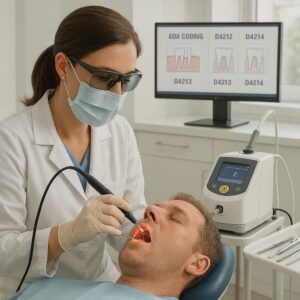
ADA Codes for Laser Gingivectomy
What is a Laser Gingivectomy?
Before we dive into the codes, it is important to understand the procedure itself. A gingivectomy is the surgical removal of gum tissue. In the past, this was almost exclusively done with a scalpel. Today, dentists often use diode lasers or CO2 lasers.
The laser offers distinct advantages:
-
Precision: It can remove tissue with incredible accuracy.
-
Hemostasis: It cauterizes as it cuts, meaning less bleeding.
-
Patient Comfort: There is often less need for sutures and a reduction in post-operative pain.
You might perform a gingivectomy to remove excess tissue caused by drug-induced gingival hyperplasia, to reshape a “gummy smile,” or to gain access to a tooth for a restoration.
The Truth About the “ADA Code for Laser Gingivectomy”
This is the most important part of the article, so please read carefully.
There is no specific ADA code for a “laser” gingivectomy.
I want to repeat that for clarity: The American Dental Association does not have a unique CDT code that designates a procedure as having been performed with a laser versus a scalpel.
The coding is based on the procedure performed, not the instrument used to perform it.
Therefore, when you perform a laser gingivectomy, you will use the same standard surgical codes that a dentist using a scalpel would use. The trick lies in understanding which of these codes applies to your specific patient situation and, crucially, how to document it.
Primary ADA Codes for Gingivectomy Procedures
When performing a gingivectomy (laser or otherwise), you will generally choose between two main codes, depending on the complexity of the case. A third code is used for a related, but distinct, procedure.
D4210: Gingivectomy – Per Quadrant
This is your go-to code for a routine gingivectomy.
-
What it covers: Surgical removal of gum tissue. The descriptor in the CDT manual specifies that it is “by procedure” and is often used in cases of gingival hyperplasia or fibrotic enlargement of the tissue.
-
When to use it: You have a patient with overgrown tissue due to medications (like Phenytoin, Cyclosporine, or Nifedipine). The tissue is generally healthy, but there is simply too much of it. You use the laser to trim it back to a normal, healthy contour.
-
Quadrant Specific: This code is billed “per quadrant.” This means if you are treating the upper front six teeth (which is often considered one quadrant in the anterior), you would bill one unit of D4210.
D4240: Gingivoplasty – Per Quadrant
This code is very similar to D4210 but has a different clinical intent.
-
What it covers: Reshaping the gingiva to achieve normal anatomical form and contour. It is less about removing excessive bulk and more about sculpting the existing tissue.
-
When to use it: A patient has a “gummy smile” due to altered passive eruption. The tissue is not necessarily diseased or hyperplastic, but it covers too much of the clinical crown. You use the laser to perform a gingivoplasty, sculpting the tissue to expose more of the tooth structure and create a harmonious smile line.
-
The difference: Think of D4210 as removing excess tissue and D4240 as sculpting for aesthetics or function.
D4245: Apically Positioned Flap
While not a gingivectomy in the strictest sense, this code is often confused with it.
-
What it covers: This is a surgical flap procedure where the gum tissue is cut, reflected, and then repositioned lower (apically) on the root or bone. This exposes more tooth structure.
-
When to use it: This is the correct code for surgical crown lengthening. If you need to expose tooth structure not just by removing gum tissue, but by actually moving the gum line down and potentially removing some bone, you need D4245. A laser alone cannot perform the bone recontouring required here; this usually involves a scalpel and a bur.
Important Note: Using a laser does not change the code for a surgical crown lengthening. If the procedure requires a flap and bone modification, it is still D4245.
Gingivectomy vs. Crown Lengthening: A Coding Comparison
To make the distinction crystal clear, here is a comparative table that highlights the difference between the codes we just discussed.
| Feature | D4210 / D4240 (Gingivectomy/Gingivoplasty) | D4245 (Apically Positioned Flap) |
|---|---|---|
| Common Name | Laser Gum Contouring / Gingivectomy | Surgical Crown Lengthening |
| Tissue Removed | Soft tissue only (gingiva). | Soft tissue and often bone. |
| Goal | Remove excess tissue or reshape gums for health or aesthetics. | Expose more tooth structure for a crown or to fix a “gummy smile” caused by the jaw bone. |
| Procedure | Tissue is simply excised or ablated with a laser or scalpel. | A flap is cut, bone is reshaped, and the flap is sutured in a new position. |
| Healing | Faster, usually no sutures with laser. | Slower, requires sutures and a longer healing period. |
| Key Code | D4210 (Hyperplasia) or D4240 (Reshaping) | D4245 |
How to Properly Document a Laser Gingivectomy
Since there is no specific laser code, your documentation becomes the key to getting your claim paid. You must justify why the procedure was necessary and, optionally, why the laser was the best instrument for the job.
Here is what your clinical notes should include:
-
The Diagnosis (The “Why”): This is the most critical part.
-
For D4210: Note the diagnosis (e.g., K06.1 – Gingival enlargement). Document the medication list. Include photos showing the extent of the overgrowth. Mention that the overgrowth is preventing proper home care, leading to inflammation.
-
For D4240: Note the diagnosis (e.g., M26.6 – Altered passive eruption). Include photos of the “gummy smile” and document the patient’s aesthetic concerns. Measure the biologic width if necessary.
-
For D4245: Note the diagnosis (e.g., K08. – Fractured tooth). Include radiographs showing decay or a fracture extending below the gum line. State that crown lengthening is necessary to expose a sound tooth structure for restorative margins.
-
-
The Procedure (The “What”):
-
State that a laser was used (e.g., “A diode laser was used to perform the procedure.”).
-
Describe the specifics: “The tissue was ablated to the desired height, creating a physiologic contour. Hemostasis was excellent.”
-
-
The Outcome (The “Result”):
-
Note the patient’s tolerance.
-
Describe the final appearance.
-
Provide post-operative instructions.
-
Example Documentation for D4210:
Diagnosis: Patient presents with significant gingival enlargement in the mandibular anterior region, secondary to long-term use of Nifedipine. The overgrowth is creating pseudo-pockets, making oral hygiene difficult and resulting in localized inflammation (Gingivitis). Clinical photos attached.
Procedure: After local anesthesia was administered, a diode laser was used to perform a gingivectomy on teeth #22-27 (Quadrant 3). The hyperplastic tissue was excised to the level of the CEJ, restoring a normal gingival contour and eliminating pseudo-pockets. Hemostasis was achieved intra-operatively. The patient tolerated the procedure well.
Outcome: Excellent hemostasis. Post-operative instructions given. Patient advised to use a soft diet and prescribed 0.12% Chlorhexidine rinse BID for 10 days.
Will Insurance Pay More for Laser?
This is a common question. The short answer is: Usually, no.
Insurance companies base their usual, customary, and reasonable (UCR) fees on the procedure code (D4210), not the method. If their UCR fee for D4210 is $300, that is likely what they will pay, regardless of whether you used a scalpel or a $10,000 laser.
However, there is a silver lining. Because laser procedures are often faster and have less post-operative morbidity, you can justify a fee that is higher than the insurance UCR fee. The patient may be responsible for the difference (your fee minus the insurance payment), but you are providing a premium service.
What about a “Laser Modifier”?
You may have heard of modifiers like -22 (Increased Procedural Service). While it is theoretically possible to append a -22 modifier to indicate that the laser procedure required substantially more work than a standard gingivectomy, this is very difficult to prove. Insurance companies rarely reimburse for this, and it requires extensive documentation.
Laser Gingivectomy in Restorative Cases
One of the most common uses for a laser is preparing the gingiva for restorative dentistry. For example, a patient comes in with a decayed tooth. The decay goes just below the gum line.
-
Scenario A: You simply need to remove a small amount of gum tissue to access the decay and place the restoration. This is often called gingival curettage or troughing. This is not a gingivectomy. The ADA code for this is D4212 – Gingivectomy to allow access for restorative procedure, per tooth.
-
Scenario B: The decay is deep, and after removing it, you find there is not enough tooth structure above the bone for a crown. You need to perform a true crown lengthening (D4245), which may involve bone.
It is vital not to confuse D4212 with D4210. D4212 is a limited procedure to gain access to a margin, often done during the same visit as the crown preparation.
FAQ: Common Questions About Gingivectomy Coding
Q: Can I use D4210 for every laser gum procedure?
A: No. You must match the code to the diagnosis. Use D4210 for hyperplasia, D4240 for aesthetic reshaping, and D4245 for crown lengthening involving bone.
Q: My laser can cut tissue and coagulate. Is there a code for laser coagulation?
A: Coagulation is considered part of the surgical procedure. If you are performing a gingivectomy, the laser’s ability to coagulate is simply a benefit of the instrument. It is not a separate, billable service.
Q: If I do a gingivectomy on six teeth, is that six units of service?
A: No. Gingivectomy codes (D4210, D4240) are billed per quadrant. If those six teeth are all in the same quadrant (e.g., the upper anterior), you bill for one unit.
Q: Will my claim be denied if I don’t write “laser” on it?
A: No. The payer processes the code (D4210). Mentioning the laser is for your clinical record and to justify your fee to the patient, not necessarily for the insurance company’s benefit.
Q: What is the diagnosis code for a “gummy smile”?
A: This can be tricky. For aesthetic concerns, you might use a code for a dentofacial anomaly. For altered passive eruption (where the gum tissue hasn’t receded as it should), M26.6 is often appropriate. Always check for medical necessity based on function or pathology first.
Conclusion
Mastering the coding for laser gingivectomy is about understanding that the laser is a tool, not a code. By focusing on the clinical diagnosis and the specific procedure performed—whether it is D4210 for hyperplasia, D4240 for gingivoplasty, or D4245 for surgical crown lengthening—you can ensure accurate billing and fair reimbursement. Document thoroughly, communicate the value of the laser technology to your patients, and you will turn this advanced procedure into a valuable asset for your practice.
Additional Resource
For the most up-to-date and official information, you should always refer to the current year’s ADA CDT Manual. It is the definitive guide for all dental procedure codes.
[Link to: ADA.org CDT (Current Dental Terminology)]
Disclaimer: This article is intended for informational purposes only and does not constitute legal or billing advice. Coding and reimbursement rules are complex and subject to change. You should always consult with your professional coding association, your payer contracts, and legal counsel to ensure compliance with all applicable laws and regulations.


