The thoracic spine presents a unique and demanding challenge in the landscape of anesthesia care. It is a region protected by the rib cage, housing the spinal cord segments that innervate the trunk and vital autonomic functions. When a surgeon operates on the thoracic vertebrae, discs, or the spinal cord itself, the anesthesia provider steps into a high-stakes environment where precise physiological management is paramount. For medical coders, anesthesiologists, and Certified Registered Nurse Anesthetists (CRNAs), understanding CPT Code 00620 is essential. This code specifically describes anesthesia for procedures on the thoracic spine and spinal cord, and its correct application hinges on a solid grasp of the anatomy, the surgical procedures involved, and the stringent documentation standards required to support the claim.
Thoracic spine surgery is not a single entity. It encompasses a spectrum from minimally invasive kyphoplasty for osteoporotic fractures to extensive multi-level scoliosis reconstructions that can last ten hours or more. Each procedure demands a tailored anesthetic approach. The patient’s positioning, often prone, creates a cascade of physiological changes including reduced cardiac output and altered respiratory mechanics. The risk of significant blood loss is ever-present, especially in procedures involving corpectomies or osteotomies. Furthermore, the proximity of the great vessels within the chest means that surgical misadventure can quickly become a life-threatening emergency. CPT 00620 is designed to capture the anesthetic intensity of these procedures, but the code itself is just the starting point. The real work of accurate billing lies in the documentation of time, the application of appropriate modifiers, and the clear differentiation from other spinal anesthesia codes.
In this exhaustive guide, we will dissect everything you need to know about CPT 00620. We will clarify its anatomical scope, list the common surgeries it accompanies, and detail the nuances of base unit valuation and time tracking. We will also address the common pitfalls that lead to claim denials, such as confusing the thoracic spine with the cervical or lumbar regions. By the end of this deep dive, you will possess the knowledge to code thoracic spine anesthesia with complete confidence, ensuring that every unit of service is accurately captured and defended.
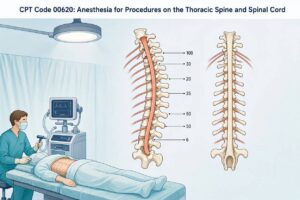
CPT Code 00620
The Anatomical Domain of CPT 00620
To master CPT 00620, you must first define its territory. The code covers anesthesia for procedures on the thoracic spine and spinal cord. The thoracic spine consists of the twelve vertebrae labeled T1 through T12. These vertebrae are distinct from the cervical vertebrae because they articulate with the ribs. This articulation provides significant structural stability but also creates a rigid kyphotic curve. The spinal canal in the thoracic region is narrower than in the cervical or lumbar regions, making the spinal cord more susceptible to compression from tumors, fractures, or disc herniations.
The spinal cord runs through the thoracic canal, giving off nerve roots that form the intercostal nerves. These nerves control the intercostal muscles essential for respiration. High thoracic injuries or surgeries can compromise respiratory function. The sympathetic chain also runs alongside the thoracic spine, and injury or manipulation can cause hemodynamic fluctuations. Anesthesia for procedures here often requires advanced monitoring, including arterial lines for beat-to-beat blood pressure monitoring and central venous access for volume resuscitation and vasopressor administration.
The descriptor for 00620 is very clear: it is for the thoracic spine and spinal cord. It does not include the ribs themselves (which might fall under chest wall codes if the surgery is purely on the ribs). It does not include the thoracic aorta or the heart, which are intrathoracic structures with their own codes. The anesthesia provider must maintain a clear distinction between the bony spinal column and the visceral contents of the chest. If a thoracic surgeon performs a thoracotomy to access an anterior thoracic disc herniation, the surgical approach goes through the chest wall. However, the primary surgical target remains the thoracic spine. In this case, CPT 00620 is still correct, even though the lung is deflated with a double-lumen endotracheal tube. The one-lung ventilation is an anesthetic technique to facilitate the spinal surgery, not a change in the primary surgical target. The coder must verify the surgeon’s postoperative diagnosis and procedure description to ensure the spine was the target.
Common Surgical Procedures Mapped to 00620
Many different surgical procedures map to CPT 00620. They range from short, relatively simple procedures to marathon cases involving multiple surgical teams. The anesthesia coder must be familiar with these operations to anticipate the typical time units and to spot any discrepancies in the anesthesia record.
-
Thoracic Laminectomy: The surgeon removes the lamina to decompress the spinal cord or nerve roots. This is often done for thoracic disc herniations or ligament ossification. The patient is prone, and the surgery can be delicate.
-
Thoracic Fusion: Using screws and rods, the surgeon stabilizes the thoracic spine. This is common for scoliosis, fractures, or tumors. Bone graft is placed to achieve a solid fusion. This procedure often carries a high blood loss risk.
-
Kyphoplasty/Vertebroplasty: A minimally invasive procedure where cement is injected into a fractured vertebral body to stabilize it and relieve pain. While often done percutaneously under MAC or general anesthesia, it still falls under the 00620 code umbrella if the target is a thoracic vertebra.
-
Thoracic Corpectomy: The removal of a thoracic vertebral body. This is a major procedure usually done for tumor, infection, or severe trauma. It involves anterior or lateral approaches, often requiring a thoracic surgeon for the exposure, and mandates large-bore IV access for potential massive transfusion.
-
Scoliosis Correction: Idiopathic or neuromuscular scoliosis curves often involve the thoracic spine. Posterior spinal fusion with segmental instrumentation can span from T2 to L4. For the thoracic portion, 00620 is the appropriate code if the surgery is limited to that area, or it may be part of a larger claim for extensive spine surgery (00670).
-
Intradural Tumor Resection: Tumors inside the dura, such as meningiomas or schwannomas of the thoracic cord, require a laminectomy and microsurgical dissection. The anesthesia provider must manage the mean arterial pressure to ensure cord perfusion while the surgeon works under the microscope.
Each of these procedures requires the continuous presence of the anesthesia provider. The record must reflect the specific physiological challenges of each. For a prone thoracic fusion, documentation of the eye padding, the chest rolls, and the abdominal decompression is essential. For a thoracotomy for an anterior corpectomy, documentation of one-lung ventilation, the double-lumen tube position, and the fluid management is critical.
CPT Code 00620: Base Units and Valuation
The value of an anesthesia service is built on its base units. These units represent the inherent complexity and risk of the procedure before the clock even starts ticking. For CPT 00620, the American Society of Anesthesiologists (ASA) Relative Value Guide typically assigns a base unit value of 5 units. This is the same base value as the cervical spine code (00600). The risk of spinal cord injury, the physiological trespass of prone positioning, and the potential for major hemorrhage all justify this level.
You must confirm this base unit with your specific payer’s fee schedule. Medicare Administrative Contractors (MACs) generally follow the ASA guide closely for this code, but private insurers might have a different value. Workers’ compensation fee schedules are completely independent and may have fixed dollar amounts per unit or per minute. The base unit of 5 means that even a perfectly simple, short procedure generates a certain level of reimbursement to cover the cost of having a highly trained provider present and ready to manage a crisis.
Let us look at the reimbursement formula again: (Base Units + Time Units) x Conversion Factor. With a base of 5, a 90-minute procedure yields 6 time units (90/15). That is 11 total units. If the conversion factor is $22.00, the claim is worth $242.00. A 5-hour scoliosis case yields 20 time units, plus 5 base, for 25 total units. At the same conversion factor, the claim is worth $550.00. This linear relationship between time and payment is why accurate time recording is the most crucial aspect of anesthesia billing.
| Procedure | Base Units | Typical Time | Total Units (approx) |
|---|---|---|---|
| Thoracic Kyphoplasty (T8) | 5 | 60 min | 9 (5 + 4) |
| Thoracic Laminectomy (T6-T7) | 5 | 120 min | 13 (5 + 8) |
| Posterior Scoliosis Fusion (T2-T12) | 5 | 360 min | 29 (5 + 24) |
| Anterior Corpectomy (T10) | 5 | 240 min | 21 (5 + 16) |
This table illustrates how the same base unit applies across a wide range of complexities. The extra work of the corpectomy and scoliosis fusion is captured entirely in the time units. This places a tremendous burden on documentation. If the provider fails to document the start and stop times correctly, or if there are gaps in the record, the payer will cut the time units, and the practice loses the very revenue that reflects the actual work performed.
Physical Status Modifiers for Thoracic Patients
Patients undergoing thoracic spine surgery often suffer from severe systemic diseases. The P3 modifier (severe systemic disease) is the default for many adults with comorbidities like diabetes, COPD, or controlled heart disease. The P4 modifier (life-threatening systemic disease) is frequently warranted for patients with metastatic cancer to the spine, acute spinal cord injury with hemodynamic instability, or severe scoliosis causing restrictive lung disease.
The physical status modifier does not change the base unit value in the Medicare formula, but it is a required informational modifier. More importantly, it is a powerful tool to justify extended time units. A claim for a P4 patient with a 4-hour anesthesia time will look more reasonable to an auditor than a P1 patient with the same time. The P4 modifier tells the story of a brittle, fragile patient whose every physiologic parameter needed constant titration. The pre-operative evaluation must explicitly state the conditions that support the P4 status. A note saying “ASA 4 due to metastatic lung cancer with spinal cord compression and respiratory failure” is clear and irrefutable.
Some commercial payers and many workers’ compensation programs do pay an additional base unit for P3, P4, or P5 patients. This extra unit, sometimes called the “qualifying circumstances” unit, can be a significant revenue stream for practices that handle complex spine patients. The coder must be intimately familiar with the payer’s policy. If the policy allows an extra unit for P4, the claim for the 5-hour scoliosis case becomes 5 (base) + 1 (physical status) + 20 (time) = 26 units. That single extra unit, multiplied by the conversion factor, adds real value. But you only earn it if you bill it with the correct modifier and the supporting documentation.
Medical Direction and the Role of the Anesthesia Team
Major thoracic spine surgery is often a team effort. The anesthesiologist may medically direct a CRNA or an Anesthesiologist Assistant (AA). The rules for medical direction are universal, but their application in these long, prone cases requires special attention.
The anesthesiologist’s documentation of their presence during the critical portions is the foundation of the QK modifier. Induction and positioning are the most demanding parts. Turning a patient prone with an unstable thoracic fracture is a high-risk maneuver. The anesthesiologist must coordinate the turn with the surgical team, maintain the airway, and ensure the patient is safely positioned. The record must state: “Personally supervised and assisted with prone positioning on Jackson table. Airway checked, eyes padded, pulses confirmed.” This single sentence justifies the medical direction for that segment.
During the maintenance phase of a 6-hour scoliosis case, the anesthesiologist does not have to be in the room every minute. They must be immediately available. This means they cannot leave the surgical floor to do a case in the endoscopy center across the hospital. They must be monitoring the course at frequent intervals. The record should show periodic co-signatures or notes from the anesthesiologist, such as “check-in 11:00, hemodynamically stable, EBL 400cc, ABG sent.” These check-ins prove the frequent intervals of monitoring.
The emergence and extubation are again critical. The patient must be turned supine. The anesthesiologist should be present. “Personally present for emergence and extubation. Patient moving all four extremities.” This documentation supports the QK billing. Both the anesthesiologist’s claim and the CRNA’s claim must show identical total times. A mismatch of even one unit is a red flag for the MAC’s adjudication system. The system is programmed to detect discrepancies and issue a denial pending development of the record.
Documentation of Intraoperative Neuromonitoring
Intraoperative Neuromonitoring (IONM) is the standard of care for most thoracic spine procedures that involve the spinal cord. Somatosensory evoked potentials (SSEPs), motor evoked potentials (MEPs), and electromyography (EMG) are used. The anesthesiologist must tailor the anesthetic to allow for these signals. This usually means a Total Intravenous Anesthesia (TIVA) technique, avoiding potent inhalational agents and muscle relaxants after intubation.
The anesthesia record must document the communication with the neuromonitoring team. If the IONM team reports a significant decrease in MEP signals from the lower extremities, the anesthesia record must reflect the clinical response. “MEP signals decreased in right leg at 12:15. Surgeon notified. Mean arterial pressure raised from 70 to 85 mmHg with phenylephrine drip. Signals returned to baseline at 12:22.” This note is pure gold for billing. It demonstrates the anesthesiologist’s active, critical care role in the surgery. It justifies the total intravenous anesthesia technique and the time spent managing the event.
The anesthesiologist does not bill for the IONM interpretation. That is a separate professional service billed by the neurologist or neurophysiologist. However, the anesthesia record must document that the IONM was in use because it affects the anesthetic plan. If the payer questions the medical necessity of a 7-hour TIVA case, the note showing signal changes and interventions will shut down the audit immediately.
Distinguishing CPT 00620 from Other Spine Codes
The spine anesthesia codes are a sequential family. Confusing one for another is a common coding error that results in underpayment or outright denial. Let us clearly define the neighbors of 00620.
CPT 00600 is for the cervical spine. The cervical spine starts at C1 and ends at C7. The key distinction is the airway involvement and the head positioning. Cervical cases often require fiberoptic intubation or manual in-line stabilization. Thoracic cases at T1 are below the level of the direct airway concern, but T1 is still technically the thoracic spine. A surgery at the cervicothoracic junction (C7-T1) requires careful analysis of the operative note. If the surgeon calls it a “cervicothoracic fusion” and the majority of the work is in the cervical spine, 00600 is correct. If the work is primarily in the thoracic spine, 00620 is correct.
CPT 00630 is for the lumbar spine. This is the region from L1 to L5. Lumbar surgeries are common for degenerative conditions. The spinal cord has ended by L1, so the concern shifts to the cauda equina. The airway is not a concern, but prone positioning and blood loss from large fusions still are. CPT 00670 is for extensive spine procedures. This code is used when the surgery crosses multiple regions, such as a T4-to-Pelvis scoliosis fusion. The base unit for 00670 is higher, often 6 or 7 units. You would not bill 00620 for a T4-to-Pelvis fusion. You would bill 00670.
A common error occurs with kyphoplasty. The surgeon might do a kyphoplasty at T12 and L2. Is this 00620 or 00630? T12 is thoracic, L2 is lumbar. You must read the operative note. If the primary diagnosis is a T12 fracture, and the L2 is a secondary prophylactic level, the code could be 00620. If it is a balanced procedure, some coders would use 00620 for the thoracic portion and 00630 for the lumbar, but usually the higher base unit code is used for the entire anesthetic. In this case, the base units for 00620 and 00630 are often the same (5 units). The coder would likely just choose one and stick with it, ensuring the diagnosis codes match the treated levels.
| CPT Code | Region | Vertebral Levels | Base Units (typical) |
|---|---|---|---|
| 00600 | Cervical | C1-C7 | 5 |
| 00620 | Thoracic | T1-T12 | 5 |
| 00630 | Lumbar | L1-L5 | 4-5 |
| 00670 | Extensive | Multi-region | 6-7 |
This table is a critical reference. Post it at your coding workstation. The distinction between T and L is the most common source of error. Always check the operative report’s dictated title, the surgical findings, and the procedure details. Never rely on the surgical scheduler’s shorthand, which is often incorrect.
Real-World Coding Scenarios for CPT 00620
Let us bring this code to life with three distinct clinical scenarios. These examples will help you internalize the correct coding logic.
Scenario 1: Minimally Invasive Kyphoplasty
An 80-year-old woman with severe osteoporosis and a T10 compression fracture is scheduled for a balloon kyphoplasty. She is classified as P3 due to her COPD. The anesthesiologist performs MAC. The patient is placed prone. The start time is 08:00. The stop time is 09:15. Total time: 75 minutes.
-
Code: 00620-AA-P3.
-
Time units: 75/15 = 5.0 units.
-
Total units: 5 (base) + 5 (time) = 10 units.
-
Claim is simple, but the documentation of the prone positioning and the COPD management supports the P3 modifier.
Scenario 2: Major Scoliosis Reconstruction
A 15-year-old with idiopathic scoliosis undergoes a T3-L3 posterior spinal fusion. The procedure takes 8 hours of surgical time. Dr. Roberts medically directs CRNA Jenkins. The patient is a P1. Total anesthesia time: 520 minutes (from 07:00 to 15:40).
-
Anesthesiologist claim: Because the surgery crosses thoracic and lumbar regions, the correct code is 00670 (Extensive spine), not 00620. This is a key teaching point. Do not code 00620 just because it involves thoracic vertebrae. The extensive code captures the multi-regional nature.
-
If the surgery was only T3-T12, the code would be 00620-QK-P1.
-
Time units: 520/15 = 34.66, rounded to 34.7.
-
Total units (if 00670 base is 7): 7 + 34.7 = 41.7 units.
Scenario 3: Thoracic Disc Herniation
A 50-year-old man with a T8-T9 herniated disc compressing the spinal cord is scheduled for a thoracotomy for anterior discectomy. The anesthesiologist places a double-lumen tube, an arterial line, and a central line. The patient is placed in the lateral decubitus position. Surgery time is 3 hours. Total anesthesia time: 240 minutes.
-
Code: 00620-AA-P2.
-
Time units: 240/15 = 16.0 units.
-
Total units: 5 (base) + 16 (time) = 21 units.
-
Documentation must describe the one-lung ventilation, the double-lumen tube placement, and the lung isolation.
These scenarios demonstrate how the same base code covers vastly different surgical realities. The time units are the great differentiator. The P modifier adds clinical context. The coder’s skill lies in reading the clinical story and translating it into accurate numbers.
The Critical Role of Time Documentation
For CPT 00620, time is the most valuable commodity. A long scoliosis case can easily generate more than 30 time units. Each unit is worth real dollars. The exact moment the clock starts and stops is therefore subject to intense scrutiny.
The anesthesia start time is defined by Medicare as the moment the anesthesia provider begins to prepare the patient for the induction of anesthesia in the operating room or an equivalent area. This includes the application of monitors, the placement of IV access, and the pre-oxygenation. For a complex thoracic case, the preparation can be extensive. Placing an arterial line and a central line before induction can take 30 to 45 minutes. This time is absolutely billable as long as it is part of the continuous preparation for the surgical procedure. The clock should not start when the patient is in the holding area merely being interviewed. That is part of the standard pre-anesthetic assessment. The clock starts when the physical hands-on preparation begins.
The stop time is the moment the anesthesia provider is no longer in continuous attendance. This is typically when the patient is safely transferred to the post-anesthesia care unit (PACU) and the report has been given. For a prone thoracic case, the transfer involves turning the patient from the operating table to a bed, which can be a complex and time-consuming maneuver involving multiple staff members. The anesthesiologist is in charge of the airway and the cervical spine during this transfer. The stop time must include this transfer period. The time from “surgery finished” to “patient in PACU bed” can be 15 to 20 minutes. This time belongs to the anesthesia provider and must be billed.
Any delays during the case, if the patient remains anesthetized, are billable. If the X-ray machine breaks down and the surgeon waits 30 minutes for a new one, the anesthesia time continues. The note must state: “Delay in surgery from 10:00 to 10:30 due to C-arm malfunction. Patient remained intubated, anesthetized, and monitored continuously.” Without this note, the auditor will see a 30-minute gap in surgical progress and assume the anesthesia provider was not providing a necessary service. The documentation of the delay proves the continuous care.
Anesthesia Modifiers and Their Application
We have built a solid understanding of the standard modifiers. Let us now create a specific reference for their use with CPT 00620.
| Modifier | Application to 00620 | Example |
|---|---|---|
| AA | Anesthesiologist personally performs entire case | Solo MD does a T10 kyphoplasty. |
| QK | MD directs 2-4 concurrent CRNA cases | MD directs CRNA for a T4-T10 fusion, also directing two other general surgery cases. |
| QY | MD directs one CRNA case | MD directs single CRNA for a complex thoracic corpectomy. No other concurrent cases. |
| QX | CRNA service with MD direction | CRNA submits claim with matching time for the QY case above. |
| QZ | CRNA service without medical direction | CRNA practices independently at a rural hospital for a T11 laminectomy. |
| P3 | Severe systemic disease | Patient with COPD, diabetes, and hypertension for thoracic fracture surgery. |
| P4 | Constant threat to life | Patient with acute spinal cord compression from metastatic cancer, in respiratory distress. |
Using the correct modifier is non-negotiable. A claim for 00620-AA from a CRNA will be denied because CRNAs cannot use the AA modifier. The claim must reflect the provider’s exact credentials and role. The system cross-references the NPI number on the claim with the provider’s taxonomy. An anesthesiologist’s NPI cannot bill with a QZ modifier. This level of detail prevents fraud and ensures clean claims.
Postoperative Pain Management for Thoracic Spine
Pain after thoracic spine surgery can be excruciating. The anesthesiologist often employs advanced regional techniques for postoperative pain control. The question arises: can you bill separately for a nerve block or an epidural placed for post-op pain in a 00620 case?
If the primary anesthetic for the surgery was a general anesthetic, and the anesthesiologist places a thoracic epidural or an erector spinae plane block at the end of the surgery for postoperative analgesia, you may be able to bill the block separately. This requires appending the 59 modifier to the block code. The National Correct Coding Initiative (NCCI) edits often bundle these blocks with the general anesthesia service. You must check the specific PTP edit for the block code and 00620. If the modifier indicator is “1,” a modifier is allowed. The documentation must clearly state the block was for “postoperative pain management” and not for the surgical anesthesia itself.
However, if a thoracic epidural is the primary anesthetic for the surgery (as it might be for some abdominal procedures, but rarely for major thoracic spine), you cannot bill it separately. In the case of a thoracotomy for an anterior discectomy, the surgeon might request a thoracic epidural for both intraoperative and postoperative pain. If the epidural is the primary anesthetic, you bill only 00620, and the placement time is included. If the patient has a general anesthetic and the epidural is placed for post-op pain, separate billing with a 59 modifier is possible but risky. Many auditors consider the placement of post-op pain blocks to be a standard part of the global anesthesia service. A safer approach for many practices is to bundle the service into the anesthesia time and not submit a separate charge, unless the payer contract explicitly allows it and the documentation is ironclad.
Cautionary Note: Unbundling a post-op pain block without clear, separate documentation is a frequent target of RAC audits. If you bill the block separately, you must have a separate procedure note for the block that details the indication, the technique, and the time. The time for the block placement must not be subtracted from the 00620 time; the patient remains under general anesthesia, and the continuous care time is unaffected.
Compliance and Audit Risks for CPT 00620
The high time units associated with major thoracic spine surgery make 00620 a frequent audit target. The Recovery Audit Contractors (RACs) have algorithms designed to find outliers. The primary audit trigger is the total billable time. If the MAC’s data shows that the average anesthesia time for a thoracic laminectomy is 150 minutes, and your group averages 300 minutes, you are going to be asked to provide records.
When the records are requested, the auditor will look for a few specific things. First, they will check the start and stop times against the hospital’s operating room log. Any discrepancy greater than a few minutes will be questioned. Second, they will look for the continuous presence of the provider. The vital signs log must be complete. A missing 20-minute block of vital signs is a gap in the record that could lead to a denial of that entire time block. Third, they will look for the medical direction attestations. If the claim is billed with QK, the record must contain the anesthesiologist’s notes showing their presence at induction, critical events, and emergence.
Another major audit risk is the use of the teaching physician rules in academic medical centers. If a resident performs the case under the supervision of an attending anesthesiologist, the attending can bill the claim as if they personally performed it, provided they are present for the entire case or the critical portions. For a thoracic spine case, the attending cannot simply check in at induction and leave the building. They must document their physical presence for the key parts and their immediate availability for the rest. The phrase “immediately available” has been legally tested and means able to return to the operating room within minutes, not driving home for the night. Document “Dr. Attending present continuously during induction, positioning, intraoperative wake-up test, and emergence.”
The Intraoperative Wake-Up Test and Billing
One unique aspect of scoliosis and major thoracic deformity surgery is the intraoperative wake-up test. Although increasingly replaced by MEP monitoring, some surgeons still request a Stagnara wake-up test, where the patient is awakened from anesthesia just enough to move their feet on command. This proves the spinal cord is intact.
From a billing perspective, this is a complex and time-consuming event. The anesthesia provider must lighten the anesthetic, often using specific agents, manage the patient’s airway while they are semi-conscious, and then re-induce anesthesia. The time spent on the wake-up test is continuous anesthesia time and is fully billable. The anesthesia record must meticulously document the process. “Wake-up test at 13:00. Isoflurane turned off. TIVA with Remifentanil maintained. Patient opened eyes, moved toes bilaterally on command at 13:05. Test complete. Anesthetic deepened. Patient re-paralyzed with Rocuronium.” This documentation proves the anesthesiologist’s active management during this high-risk period. It justifies the time units that accrue during a period where the surgical progress note might simply say “wake-up test, patient moved toes.”
Workers’ Compensation and CPT 00620
Thoracic spine injuries are common in certain industries. A construction worker who falls from scaffolding may suffer a burst fracture of T12. This is a surgical emergency that maps to 00620. Workers’ compensation billing is different from standard health insurance billing. Every state has its own Official Medical Fee Schedule (OMFS) for anesthesia.
You must use the state-specific fee schedule to determine the allowable amount. Some states, like California, have a specific formula for converting the base and time units into a dollar amount using a fixed conversion factor. Others use a flat rate per unit. You must obtain pre-authorization for the surgery, and the authorization number must be on the claim. The diagnosis code must be specific to the work injury. For a T12 burst fracture, the diagnosis could be S22.08 (Fracture of T11-T12 vertebra). You should not use the code for age-related osteoporosis (M80.08) unless the injury was just a minor fall that broke an osteoporotic bone, which might be contested as not work-related.
The workers’ comp carrier will also scrutinize the time units. They may have a policy that caps the number of billable units for certain procedures. If your anesthesia time exceeds the cap, you will need to submit a written appeal with the full anesthesia record. The documentation of the reason for the extended time must be exceptionally clear. “Case prolonged by 90 minutes due to intraoperative bleeding from epidural veins requiring extensive hemostasis and transfusion of 4 units of packed red blood cells.” This is a clear, irrefutable justification.
Conclusion
CPT Code 00620 provides the billing framework for anesthesia services during thoracic spine and spinal cord procedures, a category defined by its high anatomical risk and often extensive surgical times. Accurate claims depend on correctly identifying the thoracic target, applying the 5 base units, and meticulously documenting every minute of care from the start of preparation to the safe transfer to recovery. By mastering the distinct boundaries between thoracic, cervical, and lumbar codes, and by ensuring flawless documentation of positioning, monitoring, and medical direction, you secure the fair reimbursement that such demanding care deserves.
FAQ
What is the base unit value for CPT 00620?
The standard base unit for CPT 00620 is typically 5 units, reflecting the high risk of thoracic spinal surgery, but always verify with your specific payer contract.
Can I use CPT 00620 for a cervicothoracic fusion?
You must read the operative report. If the primary pathology is in the thoracic spine (T1 and below), 00620 is correct. If the majority of the work is in the cervical spine, use 00600.
Does CPT 00620 cover surgery on the ribs?
No, CPT 00620 is for the thoracic spine and spinal cord. Surgeries purely on the ribs fall under different anesthesia codes for the musculoskeletal system or thorax.
How do I bill a post-operative thoracic epidural with a 00620 case?
If the epidural is placed solely for post-operative pain after a general anesthetic, you can attempt to bill it separately with a 59 modifier, but it must be well-documented and the NCCI edits must allow it.
What is the correct modifier for an anesthesiologist medically directing a CRNA for a 00620 case?
The anesthesiologist must use the QK modifier (directing 2-4 cases) or QY modifier (directing 1 case), and the CRNA must use the QX modifier with the exact same total time units.
Additional Resources
For the official Relative Value Guide and comprehensive anesthesia billing guidance, refer to the American Society of Anesthesiologists: https://www.asahq.org/