If you work in gastroenterology, oncology, or pathology, you have probably faced a common question. What is the right CPT code for an endoscopic ultrasound with fine needle aspiration?
The short answer is CPT 43242. But the full answer is much more interesting. This code comes with specific rules, clinical scenarios, and billing nuances.
In this guide, we will walk through everything you need to know. You will learn when to use the code, when not to use it, and how to avoid costly claim denials.
Let us get started.
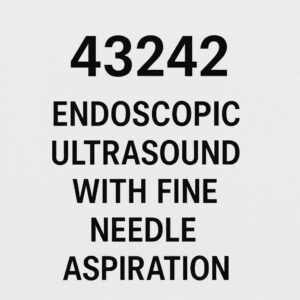
Table of Contents
ToggleWhat Is Endoscopic Ultrasound with Fine Needle Aspiration?
Before we talk about codes, let us quickly explain the procedure. An endoscopic ultrasound (EUS) combines two technologies. You have an endoscope, which is a flexible tube with a camera. And you have an ultrasound probe at the tip of that scope.
The doctor guides the scope through the mouth or rectum. The ultrasound creates images of the walls of the digestive tract. It also shows nearby organs like the pancreas, liver, and lymph nodes.
Sometimes, the doctor sees a suspicious area. A lump, a mass, or an enlarged lymph node. To find out what it is, the doctor needs a tissue sample.
That is where fine needle aspiration (FNA) comes in. The doctor passes a thin, hollow needle through the scope. The needle goes into the suspicious area. Then the doctor pulls back on a syringe to collect cells.
The entire procedure is minimally invasive. Patients usually receive sedation. They go home the same day.
Now, why do we need a specific CPT code? Because coding this procedure is not as simple as adding two separate codes together.
The Main CPT Code: 43242
The primary CPT code for endoscopic ultrasound with fine needle aspiration is 43242.
Here is the official descriptor from the American Medical Association (CPT® 2026):
43242 – Esophagoscopy, flexible, transoral; with endoscopic ultrasound examination and transendoscopic fine needle aspiration(s)
Let us break that down.
-
Esophagoscopy means looking at the esophagus. But in practice, this code often covers more than the esophagus. It can include the stomach and duodenum, depending on the approach.
-
Flexible, transoral means the scope goes through the mouth.
-
Endoscopic ultrasound examination means the ultrasound part is performed.
-
Transendoscopic fine needle aspiration(s) means the needle passes through the scope, and one or more aspirations are done.
Important note: The code includes one or more FNA passes. You do not report additional units for multiple needle passes. One code covers all aspirations during the same session.
What About Transrectal or Transanal Approaches?
Good question. If the EUS with FNA is done through the rectum or anus, you use a different code. That code is CPT 45341 (for flexible sigmoidoscopy with EUS and FNA) or CPT 45342 for more complex cases. But for most upper GI work, 43242 is your go-to code.
When to Use CPT 43242
You should use 43242 when the doctor performs both an endoscopic ultrasound examination and a fine needle aspiration during the same session.
Here are common clinical examples.
Example 1: Pancreatic Mass
A 65-year-old patient has a mass in the head of the pancreas seen on a CT scan. The gastroenterologist performs an EUS to visualize the mass. Then the doctor uses a 22-gauge needle to take three samples for cytology.
Code: 43242
Example 2: Mediastinal Lymph Node
A patient with suspected lung cancer has an enlarged lymph node near the esophagus. The doctor does an EUS and passes the needle into the lymph node.
Code: 43242
Example 3: Submucosal Tumor in the Stomach
A gastric submucosal lesion is found. The doctor uses EUS to see its layers. Then an FNA is done to rule out gastrointestinal stromal tumor (GIST).
Code: 43242
In all these cases, the key is that ultrasound and aspiration happen together.
When NOT to Use 43242
You should not use 43242 in the following situations.
EUS Without FNA
If the doctor only performs an endoscopic ultrasound and does not take any needle samples, do not use 43242. Instead, use CPT 43238 (EUS without FNA).
FNA Without EUS Guidance
If the doctor uses endoscopic guidance but not ultrasound to perform an aspiration, that is a different procedure. For example, a fine needle aspiration of a visible mass during a standard endoscopy. That would typically be reported with an unlisted code or a different endoscopic code.
Separate Sessions
If the doctor performs an EUS on Monday and an FNA on Wednesday, you report two separate codes. But this is rare. Most doctors complete both steps in one visit.
No Needle Aspiration – Only Biopsy Forceps
If the doctor uses a biopsy forceps instead of a needle, that is not an FNA. For endoscopic ultrasound-guided fine needle biopsy (core biopsy), some coders use 43242 as well. But check payer policies. Some payers prefer an unlisted code or a specific biopsy code.
CPT 43242 vs. Other Similar Codes
To avoid confusion, let us compare 43242 with other related codes.
| CPT Code | Procedure | When to Use |
|---|---|---|
| 43238 | EUS alone (no FNA) | Diagnostic EUS only |
| 43242 | EUS with FNA | Ultrasound + needle aspiration |
| 43244 | EUS with injection | Injecting medication (e.g., celiac plexus block) |
| 43245 | EUS with dilation | Dilating a narrowed area |
| 43246 | EUS with drainage | Draining a pseudocyst |
| 45341 | Sigmoidoscopy with EUS and FNA | Lower GI approach |
As you can see, 43242 is not for injections, dilations, or drainage. It is strictly for aspiration of cells using a fine needle.
What Does CPT 43242 Include?
Understanding what the code includes helps you avoid unbundling. Unbundling means billing separately for steps that are part of the same global procedure. Payers deny unbundled claims.
Here is what is included in 43242:
-
Placement of the endoscope
-
Ultrasound examination of the targeted area
-
Ultrasound guidance for needle placement
-
One or more fine needle aspirations
-
Preparation of slides or specimen handling (but not separate pathology interpretation)
-
Moderate sedation (if performed by the same physician – but check payer rules)
What is not included:
-
Pathology examination of the specimen (bill separately with codes like 88172, 88173 for cytology)
-
Rapid on-site evaluation (ROSE) – some payers allow separate coding, others do not
-
Fluoroscopy guidance (rarely needed for EUS)
-
Hospital facility fees (billed by the facility)
Modifiers for CPT 43242
Modifiers tell the payer that something changed. They do not change the procedure itself, but they add context.
Here are the most common modifiers used with 43242.
Modifier 26 – Professional Component
Hospitals own the equipment. Physicians provide the interpretation. If you are a physician billing for your professional services only, append modifier 26.
Example:
43242-26 – Professional fee for EUS with FNA.
Modifier TC – Technical Component
If you are a facility or an ASC billing for the use of equipment, staff, and supplies, use modifier TC. But most facilities bill with separate HCPCS codes. Check with your payer.
Modifier 59 – Distinct Procedural Service
Sometimes the doctor performs an EUS with FNA on two separate and distinct lesions in different organs. For example, a pancreatic mass and a separate liver lesion. Some payers want a modifier. Append modifier 59 or the more specific XU (unusual non-overlapping service).
But be careful. Do not use modifier 59 for multiple passes into the same lesion. One lesion = one code.
Modifier 51 – Multiple Procedures
If you perform 43242 with another major procedure (e.g., a polypectomy), you may need modifier 51. However, many payers now rank codes by relative value units (RVUs) and apply multiple procedure reductions automatically. Check your specific payer manual.
Modifier 76 – Repeat Procedure by Same Physician
If the doctor repeats the EUS with FNA on the same day for the same patient, you use modifier 76. But this is very rare. Most repeat procedures happen on a different day.
Billing and Reimbursement Tips
Now let us talk about money. Reimbursement for 43242 varies by payer, region, and setting.
Facility vs. Non-Facility Pricing
Medicare and private payers have two different fee schedules.
-
Facility setting (hospital outpatient, ASC): The physician gets a lower global payment because the facility provides equipment and staff.
-
Non-facility setting (office, ambulatory surgical center under certain agreements): The physician gets a higher payment to cover overhead.
For 2026, the Medicare Physician Fee Schedule national average non-facility payment is roughly $450–$550. The facility payment is around $250–$350. These numbers change every year. Always check the current fee schedule.
Common Denial Reasons
Claims for 43242 get denied for several reasons. Here are the most frequent ones.
1. Missing documentation
You need to prove that both ultrasound and aspiration were performed. The operative report must state “EUS with FNA” and describe the needle passes.
2. Unbundling
Some billers try to add 43238 (EUS) plus a separate FNA code. There is no separate FNA code for transoral EUS. You must use 43242.
3. Wrong approach
Using 43242 for a transrectal FNA. That requires a lower GI code (45341 or 45342).
4. No medical necessity
The payer may ask why an FNA was needed. The documentation should show a lesion or suspicious finding.
5. Missing modifier 26 or TC
If you bill globally (without modifier) in a facility, the payer may deny because the hospital already billed the technical component.
How to Avoid Denials
Follow this simple checklist before submitting your claim.
-
Confirm the procedure was an EUS with at least one FNA pass.
-
Use CPT 43242 as the primary code.
-
Append modifier 26 for physician professional fee in a facility.
-
Attach the operative report or a clear dictation.
-
Bill pathology codes separately for specimen interpretation.
-
Do not bill for “ultrasound guidance” separately – it is included.
Documentation Requirements
Payers do not pay for 43242 without proper documentation. Here is what your operative note should include.
-
Indication – Why was the EUS done? Example: “Evaluation of pancreatic head mass seen on CT.”
-
Findings – Describe the lesion: size, location, echogenicity, borders.
-
Procedure details – Type of echoendoscope, needle gauge, number of passes, suction used or not.
-
Specimen handling – “Three passes were made. Specimen was expelled onto a glass slide and fixed in alcohol.”
-
No complications – Or list any complications if they occurred.
A strong note is your best defense against an audit.
Frequently Asked Questions (FAQ)
Can I bill 43242 if the doctor does not find a lesion?
No. Medical necessity requires a suspicious lesion. If the EUS shows nothing abnormal and the doctor does not perform FNA, use 43238 instead. If the doctor performs FNA on normal tissue without a lesion, the claim will likely be denied.
How many FNA passes does 43242 cover?
Unlimited. The code says “aspiration(s)”. One pass or ten passes, you still bill one unit of 43242.
Is there a separate code for EUS-guided core biopsy?
Not specifically. Many coders use 43242 for both FNA and core biopsy (fine needle biopsy). However, some private payers ask for an unlisted code (43249 or 43999). Check your local coverage determination (LCD).
Can I bill 43242 with an EGD (43235) on the same day?
Generally no. The EUS with FNA includes a diagnostic endoscopy. Billing a separate EGD is considered unbundling. However, if the doctor performs a truly separate and distinct procedure (e.g., a polypectomy in a different part of the GI tract), you may bill with modifier 59. Document carefully.
What is the difference between 43242 and 43238?
43238 is EUS without FNA. 43242 is EUS with FNA. Simple as that.
Does 43242 include moderate sedation?
Yes, if the same physician provides the sedation. But many payers, including Medicare, now reimburse sedation separately under the anesthesia codes. For a standard EUS with FNA, the facility usually handles sedation. For the professional claim (modifier 26), sedation is not separately billed.
How do I bill for rapid on-site evaluation (ROSE) of the FNA specimen?
Pathologists or cytotechnologists may bill 88172 (cytopathology, evaluation of fine needle aspirate; immediate interpretation) for ROSE. But payer policies vary. Some consider ROSE bundled into 43242. Always verify.
What is the RVU for CPT 43242?
For 2026, the total facility RVU for 43242 is approximately 6.50 (work RVU ~4.50, practice expense ~1.80, malpractice ~0.20). These change annually. Check the CMS website for the exact current values.
Additional Resources
For official guidance, always refer to:
-
American Medical Association (AMA) CPT® Professional Edition – The definitive source for code descriptors and guidelines.
-
CMS Medicare Physician Fee Schedule Look-Up Tool – Search for current payment rates by region.
-
American Society for Gastrointestinal Endoscopy (ASGE) Coding and Reimbursement Resources – Great for specialty-specific advice.
👉 Recommended link:
ASGE Coding Corner – EUS with FNA (external – opens in new tab)
Important Notes for Readers
-
CPT codes are updated every year. Always use the most current edition. The information in this article reflects CPT 2026 guidelines at the time of writing.
-
Payer policies differ. Medicare, Medicaid, and private insurers may have different rules. Never assume one payer follows another’s guidelines.
-
Local Coverage Determinations (LCDs) can override national policies. Search for your state’s LCD for EUS with FNA.
-
This article is educational. It does not replace professional coding advice. When in doubt, consult a certified professional coder (CPC) or a coding consultant.
Final Thoughts
CPT 43242 is the correct code for endoscopic ultrasound with fine needle aspiration when performed through the mouth for upper GI lesions. It includes the ultrasound examination and all needle aspirations in one session. It does not include pathology interpretation, which you bill separately.
Remember these key takeaways:
-
Use 43242 for EUS + FNA together.
-
Do not unbundle into separate EUS and FNA codes.
-
Append modifier 26 for professional claims in facilities.
-
Document the lesion and the number of passes clearly.
-
Always check payer-specific rules before submitting.
Coding does not have to be a headache. When you understand the logic behind each code, you make fewer mistakes and get paid faster.
If you found this guide helpful, share it with a colleague. And if you have a specific case not covered here, leave a comment or contact a certified coder.
Conclusion (Three Lines)
CPT 43242 is the specific code for endoscopic ultrasound with fine needle aspiration for upper GI procedures. It bundles the ultrasound and all needle aspirations into one billable service. Use it correctly, document well, and always check payer modifiers to avoid denials.
Disclaimer:
This article is for informational and educational purposes only. It does not constitute legal, medical, or billing advice. CPT codes and payer policies change frequently. Always consult current official sources and a certified coding professional before submitting claims. The author and publisher assume no responsibility for errors, omissions, or adverse outcomes resulting from the use of this information.
Author:
Professional Medical Coding Writer – Content Team
Date:
APRIL 03, 2026