If you work in medical coding, billing, or transplant surgery administration, you already know that few procedures carry the weight—or the complexity—of an orthotopic liver transplant. Getting the code right is not just about reimbursement. It is about patient safety, hospital compliance, and the integrity of the medical record.
So, what is the correct cpt code for orthotopic liver transplant? The answer is not always a single number. It depends on the donor source, the recipient’s age, and whether any additional procedures happen during the same operation.
In this guide, we will walk through every relevant code, discuss real-world billing scenarios, and help you avoid the most common claim denials. Whether you are a new coder or a seasoned revenue cycle manager, you will walk away with a much clearer understanding of liver transplant coding.
Let us start with the basics.
CPT Code for Orthotopic Liver Transplant
Understanding Orthotopic Liver Transplant Surgery
Before we open the CPT manual, we need to understand what “orthotopic” actually means. An orthotopic transplant is one where the new organ is placed in the same anatomical location as the old one. In the case of the liver, the diseased organ is removed completely, and the donor liver is implanted in the same space.
This is different from a heterotopic transplant, where the new liver is placed in a different location without removing the original. Heterotopic transplants are extremely rare today, so almost all liver transplants you will code are orthotopic.
The surgery itself is a massive undertaking. It can last anywhere from six to twelve hours. The surgical team must manage the hepatic artery, portal vein, bile ducts, and vena cava. From a coding perspective, this complexity means we cannot simply pick one code and move on. We have to look at the specifics of the donor organ.
The Primary CPT Code for Orthotopic Liver Transplant
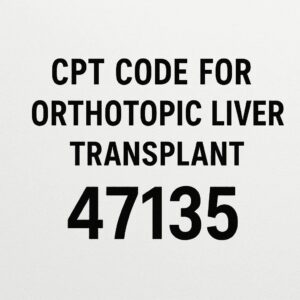
The main code you will use most often is CPT 47135. This code is officially described as “Transplantation of liver, orthotopic; cadaver or split-liver donor.”
Let us break that down.
CPT 47135 covers the complete transplant procedure when the liver comes from a deceased donor. This includes the recipient hepatectomy (removing the diseased liver) and the implantation of the new organ. It also includes the reconstruction of the hepatic artery, portal vein, and biliary tree.
When should you use 47135?
-
The donor is a deceased (cadaveric) donor.
-
The donor liver is a whole organ.
-
The donor liver is a “split” liver (one donor liver divided into two grafts for two recipients).
-
The recipient is an adult or a child (though children have a separate code we will discuss soon).
This is, by far, the most common code reported for adult liver transplants in the United States.
When to Use CPT 47136
Now, what about living donors? A living donor liver transplant is a completely different surgical and coding scenario. For that, you use CPT 47136.
CPT 47136 is described as “Transplantation of liver, orthotopic; living donor.”
This code is used exclusively when the liver segment comes from a living person. Typically, the donor gives a portion of their liver (often the left lateral segment for a child or the right lobe for an adult). The recipient then receives that partial graft.
It is very important to note: CPT 47135 and CPT 47136 are never reported together for the same recipient. You choose one or the other based solely on the donor source.
A Quick Comparative Table
To help you see the difference instantly, here is a simple reference table.
| Donor Source | CPT Code | Typical Recipient | Key Consideration |
|---|---|---|---|
| Deceased (cadaveric) or split-liver | 47135 | Adult or pediatric | Most common code in use |
| Living donor (partial graft) | 47136 | Adult or pediatric | Requires separate living donor evaluation codes |
| Pediatric recipient (under 18) | See note below | Child | May still use 47135 or 47136, but check payer rules |
Important Note for Pediatric Coders: There is no separate pediatric liver transplant code in the CPT manual. Children receiving a cadaveric graft get 47135. Children receiving a living donor graft get 47136. However, some payers have specific modifiers or documentation requirements for pediatric cases. Always verify.
Breaking Down the Components of the Codes
One reason these codes confuse new coders is that they include multiple surgical steps. You do not code the hepatectomy separately. You do not code the biliary anastomosis separately. Everything is bundled.
Let us list what is included in both 47135 and 47136.
Included in the transplant codes:
-
Recipient hepatectomy (removal of the native liver)
-
Dissection and preparation of the recipient’s blood vessels and bile duct
-
Implantation of the donor liver
-
Hepatic artery anastomosis
-
Portal vein anastomosis
-
Hepatic vein or vena cava anastomosis
-
Biliary reconstruction (duct-to-duct or Roux-en-Y)
-
Intraoperative management of the graft
What is not included (separately reportable):
-
Procurement of the donor liver (this is a separate code reported by the harvesting team)
-
Backbench work on the donor liver (preparing the graft on the back table)
-
Any additional procedures not directly related to the transplant itself (e.g., splenectomy, bowel resection)
We will talk about backbench work in the next section because it creates frequent billing confusion.
The Role of Backbench Work Codes
When a donor liver is procured, it does not arrive ready to implant. The surgical team must perform “backbench” preparation. This includes inspecting the vessels, flushing the organ, and reconstructing any venous or arterial anomalies.
For cadaveric donor livers, you report CPT 47140 for backbench work. The official descriptor is “Backbench standard preparation of cadaver donor liver prior to transplantation.”
For living donor livers, you report CPT 47141 for backbench work. That code is described as “Backbench standard preparation of living donor right lobe or left lateral segment prior to transplantation.”
Here is a crucial rule: The backbench code is reported by the recipient’s surgeon or the facility where the transplant takes place, but it is billed separately from the transplant code. You will report 47135 and 47140 together on the same claim, using appropriate modifiers.
Example of a Complete Claim (Cadaveric Transplant)
Let us imagine a 55-year-old patient with cirrhosis receives a whole liver from a deceased donor. The surgeon performs a standard recipient hepatectomy and implants the liver. The backbench preparation takes 90 minutes.
What codes do you report?
-
47135 (Orthotopic liver transplant, cadaver donor)
-
47140 (Backbench preparation of cadaver donor liver)
You do not need a modifier for 47140 in most cases, but check your payer’s policy. Some require modifier 51 (multiple procedures) or 59 (distinct procedural service). When in doubt, append modifier 59 to 47140 to show the backbench work is a separate and distinct service from the transplant itself.
What About Living Donor Hepatectomy?
If you code for the transplant center, you will not code the living donor’s surgery. That is a separate patient, a separate medical record, and a separate set of codes.
The living donor hepatectomy (removal of a liver segment from a healthy person) is reported using:
-
CPT 47142 (Donor hepatectomy for living donor liver transplantation)
This code is reported by the surgeon who removes the liver segment from the donor. It is never reported on the recipient’s claim. Keep these two patient records entirely separate. Mixing them up is one of the fastest ways to trigger an audit.
Modifiers You Will Use Frequently
Modifiers are not optional in transplant coding. They are essential for telling the payer that multiple procedures happened, or that the case was unusually complex.
Here are the modifiers you need to know for orthotopic liver transplant coding.
Modifier 51 (Multiple Procedures)
When you report 47135 and 47140 together, the backbench code is considered a secondary procedure. Many payers expect modifier 51 on the secondary code. However, Medicare and many commercial payers now prefer modifier 59 for backbench work. Check your local MAC policy.
Modifier 59 (Distinct Procedural Service)
This is your best friend for backbench coding. Modifier 59 tells the payer that 47140 (backbench preparation) is a distinct service from 47135 (the transplant). It did not occur in the same anatomic site or during the same exact operative session, even though it was on the same day.
Modifier 22 (Increased Procedural Services)
Occasionally, a liver transplant is extraordinarily complex. Maybe the patient has had multiple previous abdominal surgeries. Maybe there is severe portal vein thrombosis requiring a jump graft. In these cases, you can append modifier 22 to 47135 or 47136.
However, be careful. Modifier 22 requires exceptional documentation. You must send an operative report that clearly shows why this case required significantly more work than a standard transplant. Without that documentation, the modifier will be ignored or denied.
Common Billing Errors and How to Avoid Them
Even experienced coders make mistakes with liver transplant codes. Let us look at the most frequent errors so you can avoid them.
Error 1: Reporting the Hepatectomy Separately
This is the most common error. A coder sees the surgeon perform a “total hepatectomy” and thinks, “That is a separate procedure.” It is not. The hepatectomy is included in 47135 and 47136. Reporting it separately will result in a denial for bundled services.
Error 2: Using the Wrong Backbench Code
Using 47140 (cadaver) for a living donor case is a frequent mistake. Always double-check the donor source before assigning the backbench code. If the donor is alive, you need 47141.
Error 3: Forgetting the Backbench Code Entirely
Some coders think the backbench work is included in the transplant code. It is not. The transplant code (47135 or 47136) covers only the recipient’s surgery. The backbench preparation (47140 or 47141) is a separate service performed on the graft itself. Bill both.
Error 4: Coding for the Donor and Recipient on the Same Claim
The donor is a different patient. Their hepatectomy (47142) goes on a separate claim with the donor’s name, medical record number, and insurance information. Never combine donor and recipient services on one claim.
Documentation Requirements for Successful Claims
Payers do not trust liver transplant codes easily. These are high-dollar procedures. You will need strong documentation to get paid.
Here is what your operative report must include for the recipient.
Essential elements:
-
Indication for transplant (e.g., cirrhosis, acute liver failure, malignancy)
-
Donor source (deceased, split-liver, or living donor)
-
Confirmation that the transplant is orthotopic (native liver removed)
-
Description of the recipient hepatectomy
-
Description of all vascular anastomoses
-
Description of biliary reconstruction
-
Any complications or unexpected findings
-
Total operative time (though not a payment factor, it supports medical necessity)
-
Signature of the primary surgeon
For backbench work (47140 or 47141), the operative report or a separate backbench note must include:
-
Time the graft was received
-
Description of the preparation (flushing, vessel dissection, reconstruction)
-
Any anomalies encountered
-
Signature of the surgeon performing the backbench work
Without these details, your claim will likely be suspended for medical review. That means delayed payment and extra administrative work.
Payer-Specific Policies You Cannot Ignore
Medicare and private insurers do not always agree on liver transplant coding. You must know the rules for each payer in your practice.
Medicare (CMS)
Medicare covers orthotopic liver transplants for specific indications, including end-stage liver disease (ESLD), certain metabolic diseases, and some malignancies. Medicare does not cover transplants for alcohol-related liver disease unless the patient meets strict sobriety requirements.
For coding, Medicare follows the CPT manual closely. They expect 47135 for cadaveric transplants and 47136 for living donor transplants. Backbench codes (47140, 47141) are separately payable with modifier 59.
However, Medicare also requires the use of specific ICD-10-CM diagnosis codes to support medical necessity. For example:
-
K74.6 (Other and unspecified cirrhosis of liver)
-
K72.90 (Acute liver failure, unspecified)
-
C22.0 (Liver cell carcinoma)
Always check your local Medicare Administrative Contractor’s (MAC) Local Coverage Determination (LCD) for liver transplantation. Some MACs have additional documentation requirements.
Commercial Payers
Most commercial payers follow the same CPT coding rules, but their coverage policies vary widely. Some require prior authorization for liver transplant. Some do not pay for backbench work at all (they consider it part of the global transplant package). Others pay for backbench work but only with specific modifiers.
Before you submit a claim for a liver transplant, call the payer or review their provider manual. Ask two questions:
-
Do you separately reimburse for backbench preparation codes 47140 or 47141?
-
Which modifier do you require for the backbench code?
Write down the answers, including the name of the representative you spoke with. That documentation can save you during an appeal.
ICD-10-CM Coding for Orthotopic Liver Transplant
CPT codes tell the payer what you did. ICD-10-CM codes tell the payer why you did it. For a liver transplant to be covered, the diagnosis must justify the procedure.
Here are the most common ICD-10-CM codes used with liver transplant CPT codes.
| Diagnosis | ICD-10-CM Code | Notes |
|---|---|---|
| Alcoholic cirrhosis of liver | K70.30 | Requires documentation of sobriety for most payers |
| Other cirrhosis of liver | K74.69 | Includes cryptogenic cirrhosis |
| Primary biliary cholangitis | K74.3 | Autoimmune condition |
| Primary sclerosing cholangitis | K83.01 | Often requires exclusion of malignancy |
| Acute hepatic failure | K72.00 | Without coma |
| Acute hepatic failure with coma | K72.01 | High acuity, often status 1 |
| Hepatocellular carcinoma | C22.0 | Must meet Milan criteria for some payers |
| Metabolic disorders (e.g., Wilson’s disease) | E83.01 | Specific to the metabolic condition |
You will also use Z-codes to describe the patient’s status after transplant. For example:
-
Z94.4 (Liver transplant status) – used for encounters after the transplant
Do not use Z94.4 for the transplant admission itself. Use the underlying liver disease code as the primary diagnosis.
The Difference Between Orthotopic and Heterotopic Coding
We mentioned heterotopic transplants earlier. While they are rare, you might encounter one in an older patient or in a research protocol.
A heterotopic transplant leaves the native liver in place. The donor liver is implanted in a different location, often in the right paracolic gutter or below the native liver.
There is no specific CPT code for heterotopic liver transplant. In practice, most coders use the orthotopic codes (47135 or 47136) with modifier 22 to indicate the unusual technique. However, this is a gray area. Some payers will deny the claim because the code descriptor says “orthotopic.”
If you are coding a heterotopic transplant, contact the payer before surgery. Ask for written guidance on which code to use. If they insist on an unlisted code, you will use CPT 47999 (Unlisted procedure, liver). That comes with its own challenges, which we will discuss next.
When to Use an Unlisted Code (CPT 47999)
Sometimes, a liver transplant does not fit neatly into 47135 or 47136. Maybe it is a combined liver-kidney transplant. Maybe it is a re-transplant with extraordinary complexity. Maybe it is a heterotopic case.
In these situations, you might consider CPT 47999 (Unlisted procedure, liver).
However, unlisted codes are a last resort. Payers hate them because they trigger manual review for every single claim. You will need to submit a cover letter explaining exactly what was done, why no specific code exists, and a suggested reimbursement amount (often based on a comparable code’s relative value units).
Before using 47999, ask yourself:
-
Is there a specific code for this procedure? (For combined liver-kidney, you use the liver transplant code plus the kidney transplant code with modifiers).
-
Can I use modifier 22 instead? (Often a better choice for complex cases).
-
Have I called the payer to ask for guidance?
Only use 47999 when no other code or modifier combination accurately describes the service.
Global Period and Follow-Up Care
Both 47135 and 47136 include a 90-day global period. That means the transplant code covers all routine post-operative care for 90 days after surgery. This includes hospital visits, routine lab work, and management of standard immunosuppression.
Do not separately bill for:
-
Routine post-op visits on the transplant unit
-
Management of mild to moderate rejection (unless it requires hospitalization or a separate procedure)
-
Routine adjustments to immunosuppressive medications
You can separately bill for:
-
Return to the operating room for a complication (e.g., bile leak repair, hepatic artery thrombosis)
-
Treatment of a new, unrelated condition (e.g., a urinary tract infection)
-
Hospital readmission for a severe complication (though the E/M services may be bundled, procedures are not)
Understanding the global period prevents you from submitting denied claims for routine post-transplant care.
A Real-World Coding Scenario
Let us walk through a complete case together.
The patient: A 62-year-old male with NASH-related cirrhosis (K75.81). He has been on the transplant list for 14 months.
The surgery: A deceased donor whole liver becomes available. The recipient undergoes a standard orthotopic liver transplant. The backbench team prepares the graft, which requires reconstruction of an anomalous right hepatic artery. The recipient hepatectomy is uncomplicated. The implantation takes seven hours.
The codes:
-
47135 (Orthotopic liver transplant, cadaver donor)
-
47140 (Backbench preparation of cadaver donor liver)
-
Modifier 59 appended to 47140
The diagnosis: K75.81 (NASH cirrhosis)
The modifiers: 47140-59
The result: Clean claim, assuming the payer covers backbench work. If the payer does not cover 47140, the hospital may need to absorb the cost or appeal with documentation of the arterial reconstruction.
Frequently Asked Questions (FAQ)
Q1: Can I report 47135 and 47136 on the same patient?
No. A patient receives only one liver transplant at a time. You choose one code based on the donor source. You never use both.
Q2: Is the backbench code always separately reimbursed?
No. Some payers consider backbench preparation part of the global transplant package. Always verify with each payer before billing.
Q3: What if the patient receives a split-liver graft from a deceased donor?
You still use 47135. The split-liver donor is included in the code descriptor. Use the same backbench code (47140) as well.
Q4: How do I code a combined liver-kidney transplant?
You report the liver transplant code (47135 or 47136) and the kidney transplant code (50360 for living donor, 50365 for cadaveric donor) on the same claim. Use modifier 51 or 59 as required by the payer.
Q5: What is the difference between 47135 and 47140?
47135 is the transplant itself (the recipient’s surgery). 47140 is the preparation of the donor liver before implantation. They are separate services.
Q6: Does Medicare cover liver transplant for alcohol-related liver disease?
Yes, but only if the patient meets strict sobriety requirements (usually six months of abstinence and completion of a substance abuse treatment program). Documentation must be clear.
Q7: What modifier do I use for a re-transplant?
Use the same transplant code (47135 or 47136) without a special modifier. The diagnosis should indicate graft failure (T86.41 for liver graft rejection). If the re-transplant is extraordinarily complex, consider modifier 22.
Q8: Can I bill for the donor’s surgery on the recipient’s claim?
Absolutely not. The donor is a separate patient with a separate medical record and insurance. Billing donor services on the recipient’s claim is fraud.
Q9: Is there a specific CPT code for pediatric orthotopic liver transplant?
No. Children use the same codes as adults: 47135 for deceased donor, 47136 for living donor.
Q10: What should I do if a claim for 47135 is denied?
First, check the denial reason. Common denials include missing modifier on the backbench code, incorrect diagnosis code, or lack of prior authorization. Correct the claim and resubmit. If the denial stands, escalate to a formal appeal with supporting documentation.
Additional Resources
For the most current information on liver transplant coding and reimbursement, refer to these trusted sources:
-
American Association of Professional Coders (AAPC): www.aapc.com – Search their knowledge base for “liver transplant coding.”
-
CMS Local Coverage Determinations (LCDs): Search for “Liver Transplant” on the CMS Medicare Coverage Database.
-
UNOS (United Network for Organ Sharing): www.unos.org – For transplant data and policy updates.
These resources provide official, up-to-date guidance that can help you defend your coding choices during an audit.
Conclusion
In summary, the correct CPT code for orthotopic liver transplant depends entirely on the donor source: use 47135 for deceased or split-liver donors and 47136 for living donors. Always report the appropriate backbench code (47140 or 47141) separately, and never bill the recipient hepatectomy on its own. Master the modifiers, verify payer policies, and maintain airtight documentation to ensure clean claims and proper reimbursement.