If you have ever looked at a surgical schedule or a hospital billing sheet, you know that finding the right CPT code for Port-a-Cath placement can feel a little confusing at first. You are not alone.
Many medical coders, billing specialists, and even new clinicians ask the same question: Which code do I use for a totally implantable venous access port?
The short answer is that the most common CPT code for placing a new Port-a-Cath is 36561. But that is not the only code you need to know.
In this guide, we will walk through every relevant code. We will cover insertion, removal, repair, and even common troubleshooting scenarios. Our goal is to make this practical and easy to follow.
Let us get started.
CPT Code for Port-a-Cath Placement
What Exactly Is a Port-a-Cath?
Before we talk about codes, let us quickly clarify what a Port-a-Cath is. This helps you understand why specific codes exist.
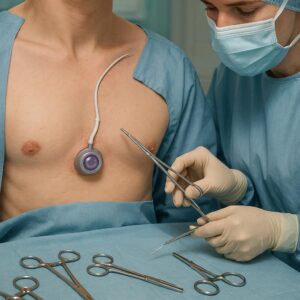
A Port-a-Cath is a small medical device. Surgeons place it completely under the skin, usually on the upper chest. It connects to a catheter that runs into a large vein near the heart.
Doctors use these ports for patients who need long-term intravenous therapy. This includes chemotherapy, antibiotics, nutrition, or frequent blood draws.
Because the device is totally implanted, it lowers infection risks. It also protects small veins from damage.
Now, because this procedure involves both a subcutaneous port and a central vein catheter, the coding rules are very specific.
The Primary CPT Code for Port-a-Cath Placement
Let us answer the main question right away.
For a new Port-a-Cath placement (insertion of a totally implantable venous access port), the correct CPT code is:
36561
This code is defined as: Insertion of a totally implantable venous access port device, with subcutaneous port, under imaging guidance.
Here is what you need to remember about 36561:
-
It includes the subcutaneous pocket creation.
-
It includes tunneling the catheter.
-
It includes connecting the port to the catheter.
-
It includes imaging guidance (like fluoroscopy or ultrasound).
Important note: Code 36561 is for patients age 5 years or older. For children under 5 years old, you would use 36560.
So if you see a chart for an adult or a child over five, reach for 36561 first.
When to Use the Other Insertion Codes (36560, 36563, 36565)
The 36561 code is the most common, but it is not the only insertion code. Let us look at the full family.
| CPT Code | Description | Typical Use |
|---|---|---|
| 36560 | Insertion of totally implantable venous access port, under imaging guidance, younger than 5 years | Pediatric patients |
| 36561 | Insertion of totally implantable venous access port, under imaging guidance, age 5 years or older | Most adults and older children |
| 36563 | Insertion of totally implantable venous access port, with subcutaneous port, under imaging guidance, with subcutaneously anchored device | When a special anchoring device is used |
| 36565 | Insertion of totally implantable venous access port, with subcutaneous port, under imaging guidance, with replacement of catheter only | Old catheter is removed and replaced through the same port |
Breaking Down Each Code
36560 is for the smallest patients. The anatomy and risks are different in young children, so payers want this specific code.
36561 is your workhorse. Use this for a brand-new port in a patient aged five and up.
36563 is less common. Use it only if the documentation specifically mentions a subcutaneously anchored device. This is a special device that locks into the tissue. Most standard ports do not need this code.
36565 is important. This code is for when the port (the small disc under the skin) is working fine, but the catheter (the long tube inside the vein) needs replacement. The doctor keeps the same port body but swaps out the line.
CPT Code for Port-a-Cath Removal
Removing a port is not the same as placing one. The code depends on how complex the removal is.
Here are the most common codes for taking a port out.
Simple Removal: 36590
36590 is the code for removal of totally implantable venous access port, with subcutaneous port, without imaging guidance.
Use this when:
-
The port is easy to access.
-
The doctor makes a small incision over the old port site.
-
They pull the port out and remove the catheter.
-
No imaging is needed during the removal.
This is the standard code for a routine port removal in a clinic or minor procedure room.
Complex Removal: 36591 or Unlisted Code
If the port is stuck, buried, or surrounded by scar tissue, you might need a different code. Sometimes the catheter breaks, and the tip remains in the vein.
In these cases:
-
36591 is for collection of blood specimen from a completely implantable venous access device. That is not for removal.
-
For complex surgical removal requiring vein cutdown or extensive dissection, you may need to use an unlisted code like 37799 or 35907, depending on the work.
Realistic advice: Always check the operative report. If the doctor documents “difficult removal with lysis of adhesions” or “catheter fragment retrieval from central vein,” do not use 36590. Report an unlisted code and send the report.
CPT Codes for Port-a-Cath Repair
Ports can break or malfunction. Sometimes only one part fails.
If the port body is damaged, you usually need a whole new port. That means a new insertion (36561 or 36560).
But if only the catheter is leaking or fractured, you have a specific code:
36575
36575 is repair of totally implantable venous access port, with subcutaneous port, under imaging guidance.
This code covers:
-
Locating the damaged catheter segment.
-
Cutting out the bad section.
-
Reconnecting the catheter to the port.
-
Testing the repair with imaging.
You cannot use this code if the port body itself is cracked. That is not a repairable situation.
Imaging Guidance and Why It Matters
You will notice that most of these codes include the phrase “under imaging guidance.” That is not just extra words. It is a key part of the code.
Imaging guidance usually means:
-
Fluoroscopy to watch the catheter tip move into place.
-
Ultrasound to guide the vein puncture.
-
Venography to confirm blood flow.
If a doctor places a port blindly (without imaging), you would technically use a different code. But in modern practice, that is extremely rare. Imaging is the standard of care.
So when you see a note saying “fluoroscopic confirmation of catheter tip in the superior vena cava,” you know you are on the right track with 36561.
Modifiers You Need to Know
Modifiers are two-digit add-ons to CPT codes. They tell a more complete story.
Here are the most common modifiers for Port-a-Cath procedures.
Modifier -50 (Bilateral Procedure)
You almost never use this for ports. Ports are placed on one side of the chest. There is no bilateral port placement.
Modifier -76 (Repeat Procedure by Same Physician)
Use this if a port fails soon after placement and the same doctor replaces it within the global period.
Modifier -78 (Return to the Operating Room)
Use this if a patient has a complication (like a catheter fracture) and needs to go back to the OR within the global period.
Modifier -79 (Unrelated Procedure)
Use this if the patient has a port placed, then later (within the global period) needs a completely different surgery that is not related to the port.
Important note: Do not add modifiers just to add them. Only use modifiers when the documentation clearly supports them.
What About Port Access and Deaccess?
This is a very common point of confusion.
Accessing a port means a nurse or doctor sticks a special needle through the skin into the port to give medicine or draw blood.
Deaccessing means removing that needle.
These are not surgical procedures. They are routine nursing or medical services.
The CPT code for accessing a port is 36592. But in many settings, this is included in the administration of chemotherapy or IV fluids. You often do not bill it separately.
Similarly, 36593 is for deaccessing a port. Again, this is usually bundled into other services.
Do not confuse these with the placement or removal codes.
How to Avoid Common Billing Mistakes
Even experienced coders make errors with port codes. Here are the most frequent problems and how to avoid them.
Mistake 1: Using 36561 for a PICC Line
A PICC line is not a Port-a-Cath. PICC lines are external catheters that stick out of the arm. Ports are totally under the skin.
PICC codes are in the 36568–36569 range. Do not mix them up.
Mistake 2: Billing Removal and Insertion Together on the Same Day
If a port fails and the doctor takes it out and puts a new one in the same session, you do not bill both 36590 and 36561.
Instead, you bill only the insertion (36561 or 36560). The removal is considered part of the replacement.
Mistake 3: Forgetting the Global Period
Port placement has a 90-day global period. That means for 90 days after surgery, most follow-up care related to the port is included in the original payment. Do not bill separately for minor port checks or simple complications.
Mistake 4: Using an Insertion Code for a Port Repair
If the doctor only fixes the catheter and keeps the same port body, use 36575, not a new insertion code.
Mistake 5: Not Checking Payer Policies
Medicare and private insurers sometimes have different rules. For example, some payers want modifier -RT (right side) or -LT (left side) for ports. Others do not. Always check local coverage determinations (LCDs).
Step-by-Step Coding Decision Tree
Let us make this very practical. Use this simple flow chart in your mind.
-
What is the procedure?
-
New port placement → Go to step 2.
-
Port removal → Go to step 4.
-
Port repair → Use 36575.
-
Port access/deaccess → Use 36592 or 36593 (if billable).
-
-
For new port placement: Is the patient under 5 years old?
-
Yes → 36560.
-
No (age 5+) → 36561.
-
-
For new port placement: Is it a replacement of the catheter only?
-
Yes, old catheter removed, same port body kept → 36565.
-
-
For port removal: Is it a simple removal without imaging?
-
Yes → 36590.
-
No (complex, requires vein cutdown or imaging) → Unlisted code (e.g., 37799) with report.
-
Real-World Examples
Examples help more than definitions. Let us walk through three common scenarios.
Example 1: Routine New Port in an Adult
The op note: “A 58-year-old female with breast cancer requires long-term chemotherapy. Under ultrasound guidance, the right internal jugular vein was accessed. A subcutaneous pocket was created in the right upper chest. A 7 French port catheter was advanced to the cavoatrial junction under fluoroscopy. The port was connected and secured. Good blood return was confirmed.”
Correct code: 36561
Why: Patient is over 5. New port. Imaging guidance used.
Example 2: Port Removal in Clinic
The op note: “A 72-year-old male completed chemotherapy. The old port site was anesthetized. An incision was made over the port. The port and catheter were easily removed intact. No imaging needed. Skin closed with a single suture.”
Correct code: 36590
Why: Simple removal. No imaging. No complications.
Example 3: Catheter Repair
The op note: “A 45-year-old female presented with a non-functioning port. Contrast injection showed a leak in the catheter near the clavicle. Under fluoroscopy, the damaged segment was resected. The catheter was reattached to the port. Repeat contrast showed no leak.”
Correct code: 36575
Why: Repair of the catheter. The port body itself was fine.
Documentation Requirements for Clean Claims
Insurance companies deny claims when documentation is weak. Protect your revenue by ensuring these elements are in every note.
For Insertion (36561 or 36560):
-
Patient age.
-
Indication (chemotherapy, long-term antibiotics, TPN, etc.).
-
Vein accessed (e.g., internal jugular, subclavian, femoral).
-
Use of imaging (ultrasound, fluoroscopy, or both).
-
Confirmation of catheter tip location (e.g., “tip in lower SVC”).
-
Description of pocket creation.
-
No complications or list of complications.
For Removal (36590):
-
Reason for removal (therapy completed, infection, malfunction).
-
Whether imaging was used (if yes, do not use 36590).
-
Description of incision and extraction.
-
Any adhesions or difficulties.
For Repair (36575):
-
Which part failed (catheter only, not port body).
-
How the leak or blockage was identified.
-
Imaging used to guide repair.
-
Post-repair testing (e.g., “good blood return”).
What About Emergency or Bedside Placement?
Sometimes a port is placed at the bedside in an ICU or in an emergency situation. Does that change the code?
No. The code is based on the procedure, not the location. 36561 is still the correct code for a new port placed at the bedside, as long as imaging is used.
But be honest about the setting. If the doctor documents “bedside placement using portable ultrasound and fluoroscopy,” that is fine. If no imaging is used, you have a different situation, but that is almost never done today.
Medicare and Private Payer Differences
Medicare uses the same CPT codes as private insurers. However, payment rates and coverage rules vary.
-
Medicare generally covers Port-a-Cath placement for reasonable and necessary indications like chemotherapy or long-term IV antibiotics.
-
Some private insurers require prior authorization. Always check before the procedure.
-
Workers’ compensation may have its own fee schedule.
The CPT code itself does not change. But the approval process and allowed amounts can differ significantly.
A Note on Global Periods and Post-Op Care
As mentioned, port placement has a 90-day global period. That means the surgical fee covers:
-
The day of surgery.
-
All routine follow-up visits for 90 days.
-
Management of minor complications (like a small hematoma).
If a patient comes back on day 45 with a suspected infection, you cannot bill an evaluation and management (E/M) code for that visit unless it is for a completely separate problem.
If the patient needs a second surgery for a complication within 90 days, you use modifier -78.
Frequently Asked Questions (FAQ)
Let us answer the questions readers ask most often.
Q1: Can I use 36561 for a port placed in the arm?
Yes, but with caution. The code does not specify chest only. However, most arm ports are placed using a different technique. If the port is in the arm and totally implantable, 36561 is still appropriate. Just confirm that the documentation supports it.
Q2: What is the difference between 36561 and 36563?
36561 is for a standard port. 36563 is for a port with a subcutaneously anchored device (a special system that hooks into the tissue). Unless the device packaging specifically says “anchored,” use 36561.
Q3: How do I code for removing a port and placing a new one in the same surgery?
You do not code both. You code only the new insertion (36561 or 36560). The removal is included.
Q4: Is there a separate code for port flushing?
No. Flushing a port is part of routine maintenance. It is not separately billable.
Q5: What if the doctor places the port but cannot complete the procedure?
If the doctor starts the procedure but stops due to an issue (e.g., unable to access the vein), you may report the discontinued procedure with modifier -53. Use the code for the procedure attempted (e.g., 36561) with modifier -53. Payment will be reduced.
Q6: Can a nurse bill for port access?
In most settings, no. The facility may include port access in its room fee. For independent billing, a physician or advanced practice provider must typically order and supervise. Check your local rules.
Additional Resources
For the most current and official information, always refer directly to the American Medical Association (AMA) CPT® codebook. You can also review the National Correct Coding Initiative (NCCI) edits from CMS.
Link to official AMA CPT resource: AMA CPT Code Information
(Always verify codes annually, as updates occur every year.)
Final Summary and Key Takeaways
We have covered a lot of ground. Let us bring it all together.
-
The primary CPT code for Port-a-Cath placement in patients age 5 and older is 36561.
-
For children under 5, use 36560.
-
Routine removal without imaging is 36590.
-
Repair of a damaged catheter (not the port body) is 36575.
-
Do not confuse access codes (36592/36593) with surgical placement or removal.
-
Always check documentation for imaging guidance. It is required for most insertion codes.
-
Use modifiers only when the operative report clearly supports them.
Coding for Port-a-Cath placement does not have to be stressful. Once you know the main codes and the few exceptions, most cases become straightforward.
Keep this guide handy. Bookmark it. Share it with your team. And when in doubt, go back to the operative note. The answer is almost always there.
Disclaimer: This article is for educational purposes only. CPT codes and payer policies change regularly. Always verify codes with the current AMA CPT manual and your specific payer guidelines. This content does not constitute legal or medical advice.