If you work in a cardiology clinic, an endocrinology practice, or a general medicine office, you have likely prescribed or administered Repatha. This medication is a game-changer for patients with high cholesterol. But knowing the right CPT code for Repatha injection is just the starting point.
You need to understand the difference between the patient’s own prefilled pen and an in-office injection. You also need to know how to bill for the drug itself and the administration service.
This guide walks you through everything. We will keep the language simple and practical. No confusing medical jargon. Just the facts you need to get paid correctly and avoid claim denials.
Let us begin with the most important piece of information.
What Is Repatha and Why Does the CPT Code Matter?
Repatha (evolocumab) is a PCSK9 inhibitor. It lowers LDL cholesterol dramatically. Patients usually inject it once every two weeks or once a month. Many patients use a prefilled autoinjector or a SureClick pen at home. But sometimes, a patient must receive the injection in a clinical setting.
When that happens, you need two things:
- A code for the drug product (the medication itself).
- A code for the administration (the act of injecting the patient).
The Centers for Medicare & Medicaid Services (CMS) and private payers watch these codes closely. Why? Because Repatha is expensive. A single injection can cost hundreds or even thousands of dollars. If you use the wrong code, the payer will reject the claim immediately.
So let’s get the codes right from the start.
The Exact CPT Code for Repatha Injection (Drug Product)
Here is the direct answer you came for.
The HCPCS Level II code (often called a “CPT code” in billing shorthand) for Repatha is:
J3490 – Unclassified drugs
Wait. That seems vague. Why “unclassified”?
Because Repatha does not have its own dedicated J-code in many commercial payer systems yet. However, there is an important update to note.
As of recent years, some payers now accept C9139 (Injection, evolocumab, 1 mg) for Repatha. But this code is not universally recognized. The safest, most widely accepted code across Medicare and most private insurers remains J3490 with specific documentation.
For Repatha, you must bill per milligram (mg).
- Repatha single-dose prefilled syringe or SureClick pen: 140 mg/mL
- Repatha single-dose prefilled Pushtronex system (monthly): 420 mg
So if a patient gets a standard 140 mg dose, you bill 140 units under J3490.
But here is the critical part. When you use J3490, you must attach the following information on the claim:
- The drug name: Evolocumab (Repatha)
- The NDC number (National Drug Code)
- The dosage: 140 mg
- The invoice cost
Without this information, the payer will deny the claim as “unidentified drug.”
Quick Reference Table: Repatha Drug Codes
| Drug Name | Common Dosage | HCPCS/CPT Code | Units to Bill | Notes |
|---|---|---|---|---|
| Repatha 140 mg/mL | 140 mg (biweekly) | J3490 (or C9139) | 140 | Use J3490 for broadest acceptance |
| Repatha Pushtronex | 420 mg (monthly) | J3490 (or C9139) | 420 | Same code, different units |
| Evolocumab (generic reference) | N/A | C9139 (some payers) | 1 mg per unit | Check payer-specific policy |
Important Note: Always verify with each payer. Some commercial plans have transitioned to C9139. Medicare Part B may have local coverage determinations (LCDs) that specify which code to use. When in doubt, call the payer’s provider line.
The Correct Administration Code for Repatha Injection
The drug code is only half the story. You also need to bill for the injection itself.
Repatha is given subcutaneously (under the skin). It is not an intramuscular or intravenous injection. This matters because the CPT code changes based on the route of administration.
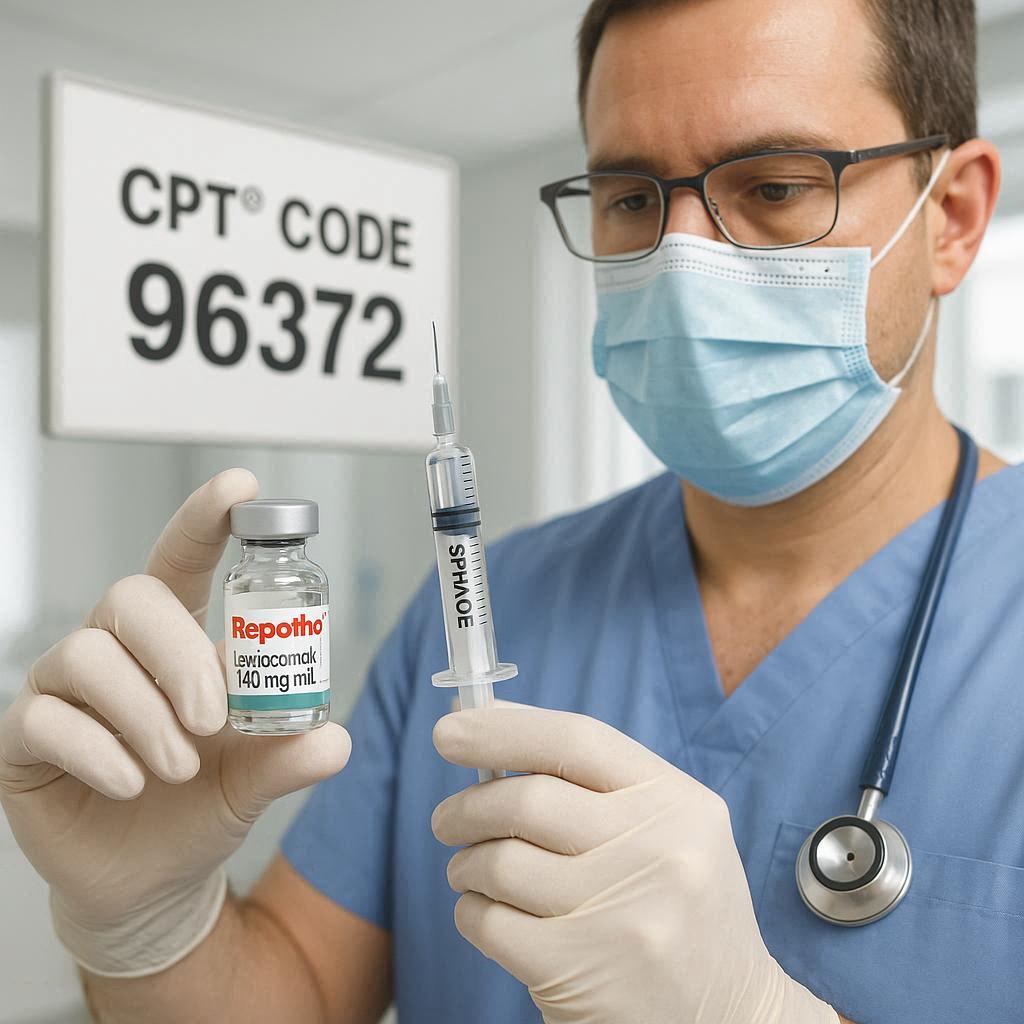
For a subcutaneous injection of a non-immunologic drug like Repatha, the correct administration code is:
CPT 96372 – Therapeutic, prophylactic, or diagnostic injection (specify substance or drug); subcutaneous or intramuscular
This code covers the work of preparing the syringe, drawing up the medication (if applicable), cleaning the site, injecting the patient, and disposing of sharps.
When to Use 96372
You use 96372 when:
- The patient comes to the clinic specifically for the injection.
- A nurse or medical assistant administers the drug under a provider’s supervision.
- The visit is separate from an evaluation and management (E/M) service.
When NOT to Use 96372
You do not use 96372 if:
- The patient injects themselves at home with a prefilled pen (no billing at all).
- The injection is part of a longer infusion service.
- The drug is given in an emergency room or observation setting (different rules apply).
Billing Repatha Injection in a Physician’s Office: Step-by-Step
Let us walk through a realistic example.
Scenario: Mr. Jones comes to your cardiology office. His LDL remains high despite statins. His insurance covers Repatha. The doctor orders a 140 mg injection today. A medical assistant administers the drug.
Step 1: Bill the Drug Product
On the CMS-1500 form or your electronic claim:
- Box 24D (CPT/HCPCS): J3490
- Units: 140
- NDC: 55513-890-01 (for SureClick pen – verify current NDC)
- Charges: Your acquisition cost plus a markup (often ASP+6% for Medicare)
Step 2: Bill the Administration
- Box 24D (CPT/HCPCS): 96372
- Units: 1
- Modifier: Usually none. But if you are also billing an E/M visit on the same day, append modifier 25 to the E/M code.
Step 3: Attach a Diagnosis Code
Repatha is indicated for:
- Heterozygous familial hypercholesterolemia (HeFH)
- Homozygous familial hypercholesterolemia (HoFH)
- Clinical atherosclerotic cardiovascular disease (ASCVD)
Common ICD-10 codes:
- E78.00 – Pure hypercholesterolemia
- E78.01 – Familial hypercholesterolemia
- I25.10 – Atherosclerotic heart disease of native coronary artery without angina pectoris
Do not just use a generic high cholesterol code. Payers will deny without a specific indication.
Repatha Prefilled Pen vs. In-Office Injection: Billing Differences
Many patients use Repatha at home. You cannot bill for that. The CPT codes are for face-to-face medical services only.
But there is a common point of confusion. What if the patient brings their own Repatha pen to the clinic?
You can still bill 96372 for the administration. However, you cannot bill J3490 for the drug because you did not supply it. The patient’s own medication is their personal property.
In that case, you should:
- Document that the patient provided their own medication.
- Bill only 96372.
- Add modifier JW (if applicable) – but rarely used in this scenario.
Some practices refuse to inject patient-supplied medications due to liability and storage concerns. That is a valid risk management decision.
Medicare and Repatha: Special Rules You Must Know
Medicare Part B covers Repatha, but only under specific conditions. The patient must have:
- A diagnosis of HoFH, HeFH, or clinical ASCVD, and
- Documented intolerance or contraindication to statins, or
- LDL cholesterol levels that remain above goal despite maximum statin therapy.
Medicare also requires prior authorization for almost every Repatha claim. Do not skip this step.
Medicare Billing Summary
| Payer | Drug CPT/HCPCS | Administration CPT | Prior Authorization Required? |
|---|---|---|---|
| Medicare Part B | J3490 (with NDC) | 96372 | Yes |
| Medicare Advantage | Varies (often J3490) | 96372 | Yes |
| Commercial Payer | J3490 or C9139 | 96372 | Usually yes |
Common Coding Mistakes to Avoid
Even experienced billers make errors with Repatha. Here are the most frequent ones:
- Using J3490 without supporting documentation. Payers will not guess the drug name. You must include the NDC and drug name in the 2400 loop or in box 19 of the CMS-1500.
- Billing 96372 when the patient did not come for a separate injection. If you give the injection during an E/M visit and do not document a separate service, Medicare may bundle the administration into the visit.
- Incorrect units. A 140 mg dose is 140 units. Do not bill “1” unit. That would imply 1 mg.
- Missing the prior authorization. Without it, the claim is an automatic denial. You will spend hours on appeal.
- Using an expired or incorrect NDC. NDCs change occasionally. Always check the actual package.
Private Payer Variations: UnitedHealthcare, Cigna, Aetina, BCBS
Commercial payers do not always follow Medicare rules. Here is a general guide, but always verify.
- UnitedHealthcare: Accepts J3490 for Repatha but requires the NDC. Some plans prefer C9139. Call the UHC provider line for your state.
- Cigna: Generally accepts J3490. They have a specific prior authorization form for PCSK9 inhibitors. Fill it out completely.
- Aetna: More likely to accept C9139. Aetna’s medical policy for Repatha is strict. Document statin intolerance clearly.
- Blue Cross Blue Shield (BCBS): Varies by state. Some BCBS plans have dedicated J-codes for Repatha. Others use J3490. Check your local BCBS fee schedule.
Pro tip: Create a payer cheat sheet. List the code each major payer wants. Update it every six months. Payer policies change without much notice.
Documenting Repatha Injection in the Medical Record
Good documentation is your best defense against denials and audits. For every Repatha injection, your note should include:
- Patient’s diagnosis (ICD-10) and why statins are not sufficient.
- Prior authorization number (if obtained).
- Drug name, dose, lot number, expiration date.
- Route (subcutaneous).
- Site of injection (e.g., left abdomen, right thigh).
- Name and credentials of the person administering.
- Patient education (if given).
- Any adverse reactions (even none – document “no complications”).
A sample nursing note might read:
“Repatha 140 mg subcutaneous injection administered to left abdomen using prefilled syringe. Patient tolerated well. No swelling or bleeding at site. Prior authorization on file (PA# 123456). Next dose scheduled in 14 days.”
Reimbursement Rates: How Much Will You Get Paid?
I cannot give you exact dollar amounts because rates vary by region, payer, and contract. But here is a realistic range based on 2025-2026 data.
- Medicare (J3490 drug reimbursement): Typically 106% of the Average Sales Price (ASP). For Repatha 140 mg, ASP is around 570–620 per dose. Medicare pays approximately 600–660.
- Medicare (96372 administration): Roughly 25–35.
- Commercial payers: Often higher. Some pay 1,000+forthedrugplus50–$80 for administration.
Cost warning for patients without coverage: The cash price for a single Repatha injection can exceed $1,500. Many patients rely on manufacturer copay cards or patient assistance programs.
What About Repatha Pushtronex (Monthly 420 mg)?
The Pushtronex system is a single-dose, body-worn infuser. It delivers 420 mg over several minutes. Some billers ask: “Is this an infusion or an injection?”
Clinically, it is still a subcutaneous administration. The difference is the device.
For Pushtronex:
- Drug code: Same as above – J3490 or C9139 with 420 units.
- Administration code: Still 96372 in most cases. However, some payers may consider it a prolonged subcutaneous infusion and request 96377 (Therapeutic, prophylactic, or diagnostic injection; subcutaneous infusion). Verify with the payer.
Do not assume. Call the payer to avoid a denial.
Handling Denials: A Simple Appeal Strategy
Denials for Repatha are common. Do not panic. Most denials fall into three categories:
1. Missing prior authorization.
Fix: Submit the PA approval number retroactively. Some payers require a new PA.
2. Incorrect J-code (payer wanted C9139).
Fix: Resubmit with the correct code. Do not change the units.
3. Diagnosis not covered.
Fix: Ask the provider if a more specific ICD-10 exists. Add a letter of medical necessity.
Keep a denial log. Track why each claim was denied. Over time, you will see patterns and prevent future errors.
Future Changes: Will Repatha Get a Dedicated J-Code?
As of this writing, there is growing pressure on CMS to assign a unique J-code for evolocumab. Several other biologics have received dedicated codes. It is possible that in the next HCPCS update cycle, Repatha will move from J3490 to a specific code.
When that happens, you will see something like J3590 (unclassified biologic) or a completely new number. Stay subscribed to your local MAC (Medicare Administrative Contractor) email updates.
Quick Reference Checklist for Billing Repatha Injection
Before you submit a claim, run through this list:
- Prior authorization obtained and number recorded.
- J3490 (or payer-specific code) with correct units (140 or 420).
- NDC number attached to the drug line.
- 96372 for administration.
- Correct ICD-10 diagnosis (E78.0x, I25.10, etc.).
- Modifier 25 on E/M code if same day.
- Documentation in the chart supports medical necessity.
Conclusion (Summary in Three Lines)
First: The primary CPT code for the Repatha drug product is J3490 (or C9139 for some payers) billed per milligram, while the administration code is 96372 for subcutaneous injection.
Second: Always secure prior authorization, attach the NDC number, and document statin intolerance or ASCVD to support medical necessity.
Third: Private payers vary widely, so verify local coverage rules and be prepared to appeal denials with proper documentation.
Frequently Asked Questions (FAQ)
1. Can I bill for Repatha if the patient injects at home?
No. You only bill for injections performed by clinical staff in your office. Home self-injection is not a billable service.
2. What is the difference between J3490 and C9139?
J3490 is the general “unclassified drugs” code accepted by most payers. C9139 is a more specific temporary code for evolocumab, but not all payers recognize it.
3. Does Medicare cover Repatha without prior authorization?
No. Medicare requires prior authorization for all PCSK9 inhibitors, including Repatha. The approval process can take 7–14 days.
4. How many units do I bill for a 140 mg Repatha injection?
Bill 140 units. Each unit represents 1 mg.
5. Can I bill 96372 and an office visit (99213) on the same day?
Yes, but you must append modifier 25 to the office visit code. The injection must be a separate, identifiable service.
6. What diagnosis code should I avoid?
Avoid E78.5 (Hyperlipidemia, unspecified). It is too vague. Payers want E78.00, E78.01, or a specific ASCVD code.
7. What if the patient has a reaction to the injection?
Document the reaction. Bill as normal. If you need to treat the reaction separately, use the appropriate E/M and treatment codes with modifier -59 (Distinct procedural service).
8. Is there a difference between billing for the SureClick pen and the prefilled syringe?
No. Both contain 140 mg of evolocumab. The administration code (96372) is the same.
Additional Resource
For the most current and official information on Repatha coding, reimbursement, and prior authorization forms, visit the Amgen Assist provider portal (manufacturer of Repatha). They offer:
- Prior authorization template letters
- Coding fact sheets updated quarterly
- Patient assistance program enrollment
🔗 Link: https://www.amgenassist.com/repatha (Copy and paste into your browser – always verify the URL directly with Amgen’s official website for security).
Disclaimer: This article is for educational and informational purposes only. It does not constitute legal, billing, or medical advice. CPT codes, HCPCS codes, and payer policies change frequently. Always verify all codes and requirements with the relevant payer and your compliance officer before submitting claims.