If you have ever dealt with hand pain, specifically from conditions like carpal tunnel syndrome or arthritis, you have likely heard the term “resting night splint.” For medical professionals, however, this simple device comes with a layer of complexity: the billing code.
Getting the code right is not just about paperwork; it is about ensuring your practice gets reimbursed correctly and your patients receive the care they need without administrative headaches.
In this guide, we will break down exactly what a resting night splint is, which CPT code applies, the differences between prefabricated and custom devices, and how to navigate the common pitfalls of insurance billing. Whether you are a coder, a biller, or a clinician looking to streamline your workflow, this article is designed to be your lasting reference.
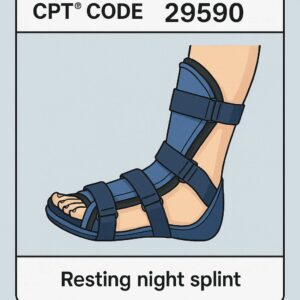
CPT Code Resting Night Splint
What is a Resting Night Splint?
Before we dive into the numbers, let’s clarify what we are talking about. A resting night splint (often called a wrist splint, cock-up splint, or volar splint) is an orthotic device designed to immobilize the wrist and hand.
Unlike a working splint, which allows movement during daily activities, a night splint holds the wrist in a neutral or slightly extended position. The goal is to prevent the patient from bending their wrist while they sleep, which can aggravate conditions like median nerve compression.
Common Conditions Treated
Clinicians typically prescribe these splints for:
-
Carpal Tunnel Syndrome: The most common reason. Keeping the wrist neutral prevents pressure on the median nerve.
-
Arthritis (Osteoarthritis or Rheumatoid): Reduces joint pain and inflammation by limiting movement during rest.
-
Tendonitis/Tenosynovitis: Allows inflamed tendons to rest.
-
Post-Operative Recovery: Used after procedures like carpal tunnel release or fracture fixation to protect the surgical site during sleep.
The Primary CPT Code: L3806 vs. L3807 vs. L3808
When we talk about the “cpt code resting night splint,” we are actually venturing into HCPCS (Healthcare Common Procedure Coding System) Level II codes. While the term “CPT” is often used generically for medical codes, these specific orthotic codes fall under the HCPCS umbrella.
For resting hand/wrist splints, the codes are defined by two key factors:
-
Material: Is it rigid (metal stays) or soft?
-
Fabrication: Is it off-the-shelf (prefabricated) or custom fabricated?
Here is the breakdown of the three main codes you will encounter.
| HCPCS Code | Description | Material | Fabrication |
|---|---|---|---|
| L3806 | Wrist-hand-finger orthosis (WHFO), rigid, without joints, prefabricated, off-the-shelf | Rigid (e.g., metal, hard plastic) | Prefabricated |
| L3807 | Wrist-hand-finger orthosis (WHFO), rigid, without joints, custom fabricated | Rigid (e.g., metal, hard plastic) | Custom Fabricated |
| L3808 | Wrist-hand-finger orthosis (WHFO), soft, prefabricated, off-the-shelf | Soft (e.g., neoprene, fabric with stays) | Prefabricated |
Which Code Fits a “Night Splint”?
Most standard resting night splints—the kind a patient buys at a pharmacy or receives from a therapist—are soft prefabricated splints. Therefore, the most commonly used code is L3808.
However, this is where medical necessity becomes critical. If a patient requires a rigid splint (for example, post-surgery to prevent any flexion), and the orthotist or therapist molds a thermoplastic material directly to the patient’s arm, you would use a rigid code—either L3806 (prefab rigid) or L3807 (custom rigid).
Important Note: The “KX” modifier is often required for these codes depending on the payer (Medicare, for instance). This modifier indicates that the supplier has a specific documentation on file demonstrating medical necessity.
Prefabricated vs. Custom Fabricated: A Billing Nightmare
One of the biggest sources of denials in orthotic billing is the misuse of prefabricated versus custom fabricated codes. Payers are exceptionally strict about this distinction.
Prefabricated (Off-the-Shelf)
A device is considered prefabricated if it requires minimal modification (such as trimming a strap or heating a small area to adjust a curve) to fit the patient.
-
Codes: L3806 (rigid) or L3808 (soft)
-
Modifier: Often requires a “KX” modifier for Medicare.
-
Reimbursement: Generally lower, but easier to get approved for straightforward diagnoses like mild to moderate carpal tunnel syndrome.
Custom Fabricated
A device is considered custom fabricated if it involves substantial work, such as taking a plaster cast, creating a positive model, or using a flat sheet of thermoplastic material that is cut and molded to the patient’s anatomy.
-
Code: L3807
-
Requirements: Requires extensive documentation (photos, casting notes, detailed medical necessity).
-
Reimbursement: Higher reimbursement rate, but subject to strict medical necessity reviews.
How to Avoid Denials
To ensure you are billing correctly, ask yourself: Did we use a pre-made kit that we simply adjusted, or did we create this from raw materials based on a unique mold?
If you answer “pre-made kit,” you cannot bill a custom code.
Modifiers and Documentation: The Key to Payment
Submitting the correct code is only half the battle. To get paid, you need the right modifiers and the right paper trail.
Essential Modifiers
When billing for a resting night splint, you will likely use one or more of the following modifiers:
-
RT (Right) / LT (Left): Essential for unilateral splints. Always specify which side.
-
KX: Used for Medicare and some commercial payers. This modifier states that the supplier has documentation on file that the medical necessity requirements for the specific code have been met.
-
RA: Replacement of a DME (Durable Medical Equipment) item. If the patient lost or broke their original splint and you are providing a new one, use this.
Documentation Requirements
Payers expect to see three key elements in the medical record:
-
The Diagnosis: A clear diagnosis linking the orthosis to the condition (e.g., G56.01 for Carpal Tunnel Syndrome).
-
The Clinical Necessity: A note explaining why the splint is needed. “Patient presents with nocturnal paresthesia. Resting splint required to maintain neutral wrist alignment during sleep to relieve median nerve compression.”
-
The Encounter: Evidence of a face-to-face encounter where the patient was evaluated and fitted.
Common Payer Policies (Medicare and Commercial Insurers)
Reimbursement policies vary wildly between Medicare and private insurers. Understanding these nuances is vital for revenue cycle management.
Medicare (DME MAC)
Medicare treats most resting night splints under the Durable Medical Equipment (DME) benefit. They have strict Local Coverage Determinations (LCDs).
-
L3808 (Soft Prefab): Generally covered for Carpal Tunnel Syndrome (CTS) if conservative treatment has failed. They often require documentation of a 3-month trial of conservative therapy (rest, NSAIDs) unless there are extenuating circumstances.
-
L3807 (Custom Rigid): Almost never covered for CTS alone. It is typically reserved for severe contractures, post-traumatic conditions, or neurological conditions where a prefabricated device cannot accommodate the patient’s anatomy.
Commercial Insurers (Blue Cross, Aetna, UnitedHealthcare)
Private payers often follow Medicare guidelines for DME, but they can vary.
-
Many require prior authorization for custom-fabricated splints (L3807).
-
Some have “all-inclusive” policies where the splint is covered under the major medical benefit rather than DME, meaning the cost is subject to the patient’s deductible.
-
Tip: Always verify if the payer requires the provider to be a licensed DME supplier. In some states, physical therapists and occupational therapists must enroll as DME providers to bill for orthotics.
Documentation Checklist for Providers
To ensure your claim doesn’t end up in a denial loop, use this checklist before submitting:
-
Patient Demographics: Correct name, DOB, and insurance ID.
-
Diagnosis Code: Specific code (e.g., G56.01, M19.041). Avoid unspecified codes (G56.00).
-
HCPCS Code: L3806, L3807, or L3808.
-
Modifiers: RT, LT, KX (if required), RA (if replacement).
-
Prescription: A signed order from the treating physician (this is a Medicare requirement).
-
Medical Notes: Documentation of the encounter, measurements, and fitting.
-
Proof of Delivery: For DME, you need a signed proof of delivery form (e.g., ABN or delivery slip) showing the patient received the item.
Cost Analysis: What to Expect
While the codes dictate what the provider bills, patients often ask about the actual cost. Here is a rough estimate of the difference between the codes.
| Code | Type | Average Reimbursement (Estimate) | Patient Out-of-Pocket (with deductible) |
|---|---|---|---|
| L3808 | Soft Prefab | $50 – $120 | $20 – $60 |
| L3806 | Rigid Prefab | $80 – $200 | $30 – $100 |
| L3807 | Custom Fabricated | $250 – $600 | $100 – $300+ |
Note: These are estimates. Actual reimbursement depends heavily on geographic location and payer contracts.
Frequently Asked Questions (FAQ)
1. Can I bill for the fitting and the splint together?
It depends on the setting.
-
In a DME/Clinic: Usually, the splint (HCPCS code) includes the cost of fitting. You do not typically bill a separate E/M (Evaluation and Management) code for the fitting unless a separate medical decision-making visit occurs.
-
In a Therapy Setting (PT/OT): You can often bill the splint (HCPCS) along with a therapeutic procedure code (e.g., 97530 or 97110) if skilled therapy is provided during the same visit for a different purpose (e.g., strengthening or neuromuscular re-education). You cannot bill for “splint application” as a separate CPT code if it is included in the orthotic allowance.
2. What is the difference between L3808 and L3908?
L3908 is a code for a “hand finger orthosis” (HFO), specifically a wrist splint with an outrigger or a static progressive stretch device. L3808 is for a wrist-hand-finger orthosis (WHFO) without joints. If the splint just stabilizes the wrist and leaves the fingers free (like a standard night splint), L3808 is correct. If it has finger components, you might need L3808 or a different code.
3. How often can I bill for a replacement splint?
Most payers, including Medicare, allow for a replacement splint if the device is lost, irreparably damaged, or the patient’s condition changes (e.g., significant weight gain/loss affecting fit). For L3808, the reasonable useful lifetime is usually considered 3 to 5 years. If you bill for a replacement before that timeframe, you must use the RA modifier and document why the replacement is necessary.
4. Does insurance cover a resting night splint for prevention?
Generally, no. Insurance covers splints for the treatment of a diagnosed condition (like Carpal Tunnel Syndrome or Arthritis). “Preventive” splinting for individuals with no current symptoms is typically a self-pay service.
5. What if my patient just buys one online?
If the patient purchases a splint from a pharmacy or online without a prescription and does not involve a medical professional, it is generally not billable to insurance. A prescription and a face-to-face encounter are required for third-party reimbursement.
Additional Resources
For the most up-to-date information, always refer to the official resources:
-
CMS (Centers for Medicare & Medicaid Services) DME Center: https://www.cms.gov/medicare/durable-medical-equipment-dme
-
AOA (American Orthotic & Prosthetic Association) Coding Guides: Provides industry standard guidance on orthotic coding.
-
Local Coverage Determination (LCD) Lookup: Search your state’s DME MAC (e.g., Noridian, Palmetto GBA) for LCDs related to “Wrist Hand Orthosis” to view specific coverage criteria for your region.
Conclusion
Understanding the correct CPT (HCPCS) code for a resting night splint is essential for accurate reimbursement and patient satisfaction. The primary codes—L3806, L3807, and L3808—differentiate between material rigidity and fabrication method, with L3808 being the most common for standard soft night splints. Successful billing hinges on proper documentation, the use of necessary modifiers like KX, and strict adherence to payer-specific medical necessity policies regarding prefabricated versus custom devices.
Final Note: Medical coding is a dynamic field. Always verify code specifications with your current CPT/HCPCS manual and payer contracts before submitting claims. When in doubt, a consultation with a certified orthotist or a DME billing specialist can save significant time and revenue.