Biopsies are critical diagnostic procedures used to detect cancer, infections, and other pathological conditions. Accurate coding of biopsy procedures using Current Procedural Terminology (CPT) codes ensures proper reimbursement and compliance with healthcare regulations.
This guide provides an in-depth exploration of CPT codes for biopsy procedures, covering different biopsy techniques, anatomical sites, and coding nuances. Whether you’re a medical coder, healthcare provider, or billing specialist, this article will help you navigate biopsy coding with precision.
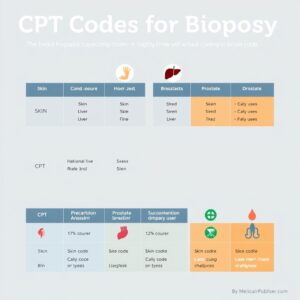
CPT Codes for Biopsy
2. Understanding CPT Codes for Biopsies
What Are CPT Codes?
CPT codes, maintained by the American Medical Association (AMA), standardize medical procedures for billing and insurance claims. Each biopsy technique has specific CPT codes based on:
-
Method (needle, punch, shave, excisional)
-
Location (skin, breast, prostate, liver)
-
Guidance (ultrasound, MRI, CT)
Importance of Accurate Biopsy Coding
-
Ensures proper reimbursement from insurers
-
Reduces claim denials due to incorrect coding
-
Helps in tracking disease prevalence and treatment outcomes
3. Types of Biopsies and Their Corresponding CPT Codes
Needle Biopsy (Fine Needle Aspiration and Core Needle Biopsy)
-
Fine Needle Aspiration (FNA) (CPT 10021, 10022)
-
Uses a thin needle to extract cells
-
Often guided by imaging (ultrasound/CT)
-
-
Core Needle Biopsy (CPT 19081-19086 for breast, 20206 for muscle)
-
Removes a small tissue cylinder for histopathology
-
Incisional vs. Excisional Biopsy
| Type | CPT Code | Description |
|---|---|---|
| Incisional | 11102-11107 | Partial removal of suspicious tissue |
| Excisional | 11400-11471 | Complete removal of lesion with margins |
Punch Biopsy (CPT 11104, 11106)
-
Uses a circular blade to extract a deep skin sample
Shave Biopsy (CPT 11300-11313)
-
Shaves off the top layer of a skin lesion
Endoscopic and Image-Guided Biopsies
-
Liver biopsy (CPT 47000)
-
Prostate biopsy (CPT 55700)
-
Lung biopsy (CPT 32405)
4. CPT Code Selection Based on Biopsy Method and Anatomical Site
| Biopsy Type | CPT Code | Common Anatomical Sites |
|---|---|---|
| Fine Needle Aspiration | 10021-10022 | Thyroid, lymph nodes |
| Core Needle Biopsy | 19081-19086 | Breast, soft tissue |
| Punch Biopsy | 11104-11106 | Skin, mucosal lesions |
| Bone Marrow Biopsy | 38221 | Iliac crest, sternum |
5. Common CPT Codes for Biopsies
Soft Tissue Biopsies
-
Skin biopsy (CPT 11102-11107)
-
Breast biopsy (CPT 19081-19086)
Bone Marrow Biopsy (CPT 38221)
-
Used for hematologic disorders
Prostate Biopsy (CPT 55700-55706)
-
Often performed via transrectal ultrasound (TRUS)
6. Coding Challenges and How to Avoid Denials
Documentation Requirements
-
Pathology reports must match CPT codes
-
Specify imaging guidance (e.g., CPT 76942 for ultrasound)
Modifiers for Multiple Biopsies
-
-59 (Distinct Procedural Service) for separate lesions
-
-76 (Repeat Procedure) for follow-up biopsies
7. Reimbursement and Insurance Considerations
-
Medicare covers most diagnostic biopsies
-
Private insurers may require prior authorization
8. Case Studies: Real-World Examples
-
Case 1: Incorrect coding of a shave biopsy as excision (denied claim)
-
Case 2: Proper use of CPT 10022 for FNA with imaging guidance (approved claim)
9. Future Trends in Biopsy Coding
-
AI-assisted coding for accuracy
-
Expanded CPT codes for liquid biopsies
10. Conclusion
Accurate CPT coding for biopsies ensures proper reimbursement and compliance. Understanding different biopsy techniques, anatomical sites, and documentation requirements is essential. Stay updated with AMA’s annual CPT changes to avoid claim denials.
11. Frequently Asked Questions (FAQs)
Q1: What is the CPT code for a breast core needle biopsy?
-
A: CPT 19081-19086, depending on guidance.
Q2: Can I bill separately for imaging-guided biopsy?
-
A: Yes, use codes like 76942 (ultrasound guidance).
Q3: What modifier is used for multiple biopsies?
-
A: Modifier -59 for distinct lesions.