Imagine a scenario where a patient presents to the emergency department with a thunderclap headache, photophobia, and a stiff neck. The clinical suspicion is high for a subarachnoid hemorrhage—a life-threatening bleed in the brain. The definitive diagnostic test to confirm or rule out this condition is a lumbar puncture (LP), a procedure where a needle is carefully inserted into the spinal canal to collect cerebrospinal fluid (CSF) for analysis. This single procedure can alter the entire trajectory of a patient’s care, guiding life-saving interventions.
Now, shift your perspective from the clinical drama to the administrative engine that makes modern healthcare possible: medical coding. For the physician who performed the LP, the hospital where it was done, and the coder translating the event into data, this critical procedure is represented by a five-digit number: a Current Procedural Terminology (CPT) code. The accurate selection and application of this code, and its associated modifiers and guidance codes, are not merely an administrative task. It is a complex language that communicates medical necessity, dictates appropriate reimbursement, and generates the data used for public health tracking, research, and quality improvement.
This article delves deep into the world of CPT coding for lumbar punctures, moving far beyond a simple code lookup. We will dissect the primary code 62270, explore the nuanced but crucial modifiers like -52 and -59, unravel the complexities of billing for fluoroscopic guidance with 77003, and examine the symbiotic relationship between CPT and ICD-10-CM codes. Through detailed explanations, practical case studies, and clear tables, this guide aims to be an indispensable resource for medical coders, billers, physicians, nurse practitioners, and practice administrators, empowering them to navigate this area with confidence and precision, ensuring both clinical excellence and financial integrity.
CPT Codes for Lumbar Puncture
2. Understanding the Lumbar Puncture Procedure
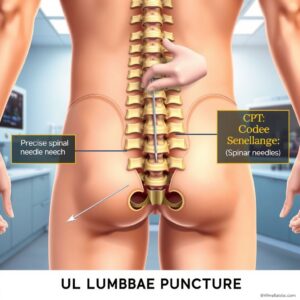
Before one can accurately code a procedure, one must understand what it entails clinically. A lumbar puncture, also known as a spinal tap, is a diagnostic and/or therapeutic procedure where a special needle is inserted into the subarachnoid space in the lumbar region (lower back) to access the cerebrospinal fluid (CSF).
Key Anatomical and Clinical Concepts:
-
Cerebrospinal Fluid (CSF): The clear, colorless fluid that surrounds the brain and spinal cord, providing cushioning, nutrients, and waste removal. Its composition can reveal a wealth of information about neurological health.
-
Subarachnoid Space: The area between the arachnoid membrane and the pia mater (the inner membranes covering the brain and spinal cord) that contains the CSF.
-
Lumbar Vertebrae (L3-L4, L4-L5): The procedure is typically performed between these vertebral spaces, well below the termination of the spinal cord (which ends around L1-L2 in adults), to avoid injury to the spinal cord itself.
Indications for a Lumbar Puncture:
-
Diagnostic:
-
Suspected meningitis or encephalitis (infection)
-
Suspected subarachnoid hemorrhage (bleeding)
-
Suspected autoimmune or inflammatory disorders (e.g., Guillain-Barré syndrome, Multiple Sclerosis)
-
Suspected carcinomatous meningitis (cancer spread to the CNS)
-
Measuring intracranial pressure (ICP)
-
Administering radiologic contrast for myelography or cisternography
-
-
Therapeutic:
-
Administering spinal anesthesia or analgesia
-
Administering intrathecal chemotherapy
-
Administering antibiotics
-
Performing a therapeutic tap to reduce elevated ICP in conditions like Idiopathic Intracranial Hypertension (IIH)
-
The Procedural Steps (Simplified):
-
Positioning: The patient is placed in a lateral decubitus position (lying on their side with knees curled to the chest) or seated and leaning forward.
-
Identification and Sterilization: The physician palpates the iliac crests to identify the L3-L4 or L4-L5 interspace, marks it, and thoroughly sterilizes the area.
-
Anesthesia: Local anesthetic (e.g., lidocaine) is injected into the skin and subcutaneous tissues to numb the area.
-
Needle Insertion: A spinal needle with a stylet is inserted slowly through the skin, subcutaneous tissue, ligaments, and dura mater into the subarachnoid space. A “pop” is often felt upon entering the space.
-
CSF Collection: The stylet is removed, and CSF is collected into sterile tubes for various analyses (e.g., cell count, glucose, protein, culture, specific tests).
-
Pressure Measurement: An manometer may be attached to the needle to measure the opening pressure.
-
Needle Removal and Dressing: The needle is withdrawn, and a small bandage is applied to the site.
-
Post-Procedure Care: The patient is often instructed to lie flat for a period to reduce the risk of a post-LP headache.
3. The Cornerstone of Medical Billing: An Introduction to CPT Codes
CPT codes are a uniform coding system created and maintained by the American Medical Association (AMA). They are used to describe medical, surgical, and diagnostic services provided by healthcare professionals. These codes are the standard language for communicating with payers (insurance companies, Medicare, Medicaid) about what services were performed, forming the basis for reimbursement.
The CPT code set is updated annually to reflect advancements in medicine. It is critical for coders to use the current year’s codebook to ensure accuracy. Codes are typically five digits long and are categorized into three types:
-
Category I: These codes represent procedures and services that are widely performed, approved by the FDA (if applicable), and have proven clinical efficacy. This is where the main lumbar puncture code resides.
-
Category II: These are optional tracking codes used for performance measurement. They are not used for billing but can help providers collect data on quality of care.
-
Category III: These are temporary codes for emerging technologies, services, and procedures. They allow for data collection on new services that may eventually become Category I codes.
For a lumbar puncture, we are squarely within the realm of Category I codes, specifically in the Surgery section and the Nervous System subsection.
4. Deconstructing the Primary Lumbar Puncture CPT Code: 62270
The foundational CPT code for a standard lumbar puncture is 62270: Spinal puncture, lumbar, diagnostic.
Official CPT Description: This code’s descriptor is intentionally broad. According to the AMA, it encompasses the complete service of performing a lumbar puncture for diagnostic purposes.
What is Included in 62270? (The “Global” Service)
CPT guidelines operate on the principle of “bundling.” This means that a single code often represents a package of services. Code 62270 is considered a “global” service that includes:
-
Local anesthesia: The administration of lidocaine or similar agent at the puncture site.
-
Pre-procedure evaluation: The immediate assessment of the patient and the puncture site.
-
The actual puncture: Inserting the needle into the subarachnoid space.
-
Measurement of pressure: The use of a manometer to obtain an opening pressure reading.
-
Collection of CSF: Withdrawal of fluid for analysis.
-
Dressing the puncture site: Applying a bandage.
-
Typical patient positioning and supervision.
It is crucial to understand that you cannot separately bill for the local anesthetic injection or the manometer pressure measurement when using 62270. These are integral components of the procedure.
When to Use 62270:
This code is appropriate for a standard diagnostic lumbar puncture performed in an office, emergency department, or hospital bedside without the use of advanced imaging guidance (e.g., only using anatomical landmarks). The medical record must support that the procedure was performed for a diagnostic purpose, such as collecting CSF to analyze for infection.
5. Beyond the Basics: Essential Modifiers for Lumbar Puncture Coding
Modifiers are two-digit codes (e.g., -25, -59, -52) that provide additional information about a procedure or service without changing the definition of the code itself. They are essential for accurately describing the circumstances of a service and avoiding denials for “bundled” services.
Common Modifiers Used with 62270:
-
-52 Reduced Services: This is one of the most important modifiers for lumbar punctures. It is used when a procedure is attempted but not completed in its entirety.
-
Example: A physician attempts an LP but is unsuccessful after multiple attempts due to patient anatomy (e.g., severe osteoarthritis, obesity) and aborts the procedure. The work of the attempt is significant, so reporting 62270-52 is appropriate to indicate a reduced service. Payment will be adjusted accordingly.
-
-
-59 Distinct Procedural Service: This modifier indicates that a procedure or service was distinct or independent from other services performed on the same day. It is used to bypass National Correct Coding Initiative (NCCI) edits that would otherwise bundle two codes together.
-
Example: A patient has an LP (62270) performed and, during the same encounter, also has a separate, unrelated procedure like an incision and drainage of an abscess elsewhere on the body. The -59 modifier appended to the second procedure indicates it was distinct from the LP.
-
-
-25 Significant, Separately Identifiable Evaluation and Management Service: This modifier is appended to an E/M code (e.g., 99283 for a Level 3 ER visit) when, on the same day as a procedure (like 62270), the provider performs a separate and significant E/M service that was above and beyond the usual pre- and post-procedure work.
-
Example: A patient comes to the ER with a headache. The physician performs a comprehensive history and exam, develops a differential diagnosis, and decides an LP is necessary. After the LP is performed and results are back, the physician must then reassess the patient, interpret the new data, make a new diagnosis (e.g., bacterial meningitis), and initiate a complex treatment plan including hospital admission and IV antibiotics. This post-procedure decision-making constitutes a significant, separately identifiable E/M service. You would bill both the E/M code with modifier -25 and 62270.
-
-
-TC Technical Component: Used when billing for the technical aspects of the procedure (e.g., the equipment, supplies, technician’s salary) but not the professional work. This is common in hospital/facility billing.
-
-26 Professional Component: Used when billing only for the physician’s professional work of performing and interpreting the procedure, but not for the equipment or facility. This is used by physicians performing services in a hospital they do not own.
Essential Modifiers for Lumbar Puncture Coding
| Modifier | Description | Use Case with 62270 |
|---|---|---|
| -52 | Reduced Services | Procedure attempted but unsuccessful after multiple attempts. |
| -59 | Distinct Procedural Service | LP performed with another unrelated procedure on the same day. |
| -25 | Significant, Separately Identifiable E/M | A separate E/M service was provided the same day as the LP (e.g., complex decision-making after results). |
| -TC | Technical Component | Facility/hospital bills for use of their equipment and supplies for the LP. |
| -26 | Professional Component | Physician bills only for their work performing the LP in a hospital setting. |
6. Navigating Diagnostic and Therapeutic Lumbar Punctures
A common point of confusion is the difference between diagnostic and therapeutic lumbar punctures. The primary code 62270 is explicitly for diagnostic purposes. So, what about therapeutic procedures?
Therapeutic Lumbar Puncture:
A therapeutic LP is performed to treat a condition, not just to diagnose it. The most common examples are:
-
Administration of medication: Injecting intrathecal chemotherapy, antibiotics, or analgesia (anesthesia).
-
Therapeutic drainage: Removing a large volume of CSF to reduce critically elevated intracranial pressure.
Coding for Therapeutic Injections:
The administration of a drug via lumbar puncture is not coded with 62270. Instead, you must use codes from the Spinal Injection Procedures section of CPT.
-
62320: Injection(s), of diagnostic or therapeutic substance(s) (e.g., anesthetic, antispasmodic, opioid, steroid, other solution), not including neurolytic substances, including needle or catheter placement, interlaminar epidural or subarachnoid, cervical or thoracic; without imaging guidance
-
62321: … with imaging guidance (e.g., fluoroscopy or CT)
-
62324: … interlaminar epidural or subarachnoid, lumbar or sacral (caudal); without imaging guidance
-
62325: … with imaging guidance
Important Note: Code 62270 is for draining CSF for analysis. Codes 62320-62325 are for injecting a substance. If a procedure involves both draining CSF and injecting a drug, you must code for the injection (62320-62325) as it is the more comprehensive service; the drainage is considered an integral part of accessing the space to deliver the medication. You would not report both 62270 and 6232x.
7. The Critical Role of Fluoroscopic or CT Guidance (77003 & 62270)
Many lumbar punctures are performed “blindly” using only anatomical landmarks. However, in complex cases, image guidance is medically necessary to ensure accurate and safe needle placement.
When is Guidance Medically Necessary?
-
Patient Factors: Obesity, severe scoliosis, prior spinal surgery (with hardware or altered anatomy), or advanced degenerative joint disease that obscures landmarks.
-
Failed Attempts: A previous unsuccessful attempt at a landmark-guided LP.
-
Specific Procedure Requirements: Procedures like myelography, which require precise contrast placement, always necessitate fluoroscopic guidance.
Coding for Guidance:
Image guidance is not included in the base code 62270. It is a separately identifiable service that can be billed with its own CPT code, provided the documentation supports its medical necessity.
-
CPT Code 77003: Fluoroscopic guidance and localization of needle or catheter tip for spine or paraspinous diagnostic or therapeutic injection procedures (epidural, transforaminal epidural, subarachnoid, paravertebral facet joint, paravertebral facet joint nerve, or sacroiliac joint), including neurolytic agent destruction.
How to Bill 77003 with 62270:
This is a complex area governed by NCCI edits. The general rule is:
-
You can report 77003 with 62270 if the guidance is performed.
-
However, you must append a modifier to 77003 to indicate it was a separate service. Modifier -59 (Distinct Procedural Service) or, more appropriately for radiology, modifier -26 (if the physician is only interpreting the fluoro) is typically used.
-
Documentation is King: The procedure note must explicitly state that fluoroscopic guidance was used. It should detail the use of the C-arm, the number of images or time spent, and how guidance aided in the successful completion of the procedure. A simple note saying “fluoro was used” is insufficient.
![Image: A fluoroscopic (X-ray) image showing the correct placement of a spinal needle tip in the lumbar spine during a guided procedure.]
*Caption: Fluoroscopic guidance provides real-time visualization, ensuring accurate needle placement, especially in patients with challenging anatomy. This must be clearly documented to support billing code 77003.*
8. Bundling and Unbundling: Knowing What’s Included
The National Correct Coding Initiative (NCCI) is a set of guidelines developed by the Centers for Medicare & Medicaid Services (CMS) to prevent improper coding that leads to inappropriate payment. These guidelines define which CPT codes can and cannot be billed together.
NCCI Edits and Lumbar Puncture:
NCCI creates “edit pairs.” If two codes are bundled into one, they form an edit pair. If you bill them together without a valid modifier, the column two code will be denied.
-
77003 and 62270: These codes have an NCCI edit. 77003 is considered a component of many spinal procedures. To bill them together, you must use a modifier (like -59) on 77003 to show that the guidance was a separate, distinct, and medically necessary service from the standard LP.
-
E/M Codes and 62270: There is an NCCI edit that bundles E/M services into procedures. To bill an E/M code on the same day as 62270, you must append modifier -25 to the E/M code to prove it was a significant, separately identifiable service.
-
Local Anesthesia: The injection of local anesthetic is always bundled into 62270. You cannot separately bill for it (e.g., with J2001 for lidocaine injection).
Unbundling, or separately reporting codes that are supposed to be bundled, is a serious issue and can be construed as fraud. Understanding NCCI edits is non-negotiable for compliant coding.
9. A Day in the Life: Real-World Coding Scenarios and Case Studies
Let’s apply the knowledge to practical examples.
Case Study 1: The Standard Diagnostic LP
-
Scenario: A 28-year-old female presents to the ER with fever, severe headache, and neck stiffness. The physician performs a level 4 ER E/M (99284), suspects meningitis, and performs a lumbar puncture using anatomical landmarks. CSF is sent for cell count, culture, and protein/glucose analysis.
-
Coding: 99284-25, 62270
-
Rationale: The -25 modifier on the E/M code is justified because the decision for the procedure (the LP) required significant work beyond the base E/M service. 62270 is for the diagnostic LP without guidance.
Case Study 2: The Failed Attempt
-
Scenario: An elderly, obese patient with a history of spinal fusion presents for an LP. The neurologist attempts the procedure at the bedside but is unable to access the CSF space after three attempts due to body habitus and scar tissue. The procedure is aborted.
-
Coding: 62270-52
-
Rationale: The physician performed a substantial portion of the work (positioning, sterilizing, injecting local anesthetic, attempting needle insertion). Modifier -52 indicates reduced services, warranting reduced payment.
Case Study 3: LP with Fluoroscopic Guidance
-
Scenario: The patient from Case Study 2 is sent to the radiology suite. Under continuous fluoroscopic guidance, a radiologist successfully performs the lumbar puncture. The report details the use of fluoro to visualize the needle passing between the L4-L5 vertebrae.
-
Coding: 62270, 77003-26 (or 77003-59 if the radiologist is also billing for the professional component of the LP)
-
Rationale: 62270 captures the puncture. 77003 captures the guidance. The modifier (-26 for professional interpretation or -59 to indicate a distinct service) is required to bypass the NCCI edit. The documentation must support the medical necessity for guidance.
Case Study 4: Therapeutic Intrathecal Chemotherapy
-
Scenario: An oncologist performs a lumbar puncture to administer methotrexate chemotherapy into the CSF of a patient with leukemic meningitis. No imaging guidance is used.
-
Coding: 62324 (Injection, lumbar, subarachnoid; without imaging guidance), J9250 (code for Methotrexate, if applicable)
-
Rationale: This is a therapeutic injection, not a diagnostic drainage. Therefore, 62324 is the correct code, not 62270. The drug itself is billed separately with a HCPCS Level II code (J-code).
Coding Summary for Common LP Scenarios
| Scenario | Procedure Performed | CPT Code(s) | Key Modifiers | Rationale |
|---|---|---|---|---|
| Routine Diagnostic LP | LP at bedside for CSF analysis | 62270 | (None) | Standard diagnostic procedure. |
| LP with Separate E/M | ER visit with decision for LP, then LP performed | 9928x, 62270 | -25 on E/M | E/M was significant and separate from procedure. |
| Unsuccessful LP | Multiple attempts, procedure aborted | 62270 | -52 | Reduced service performed. |
| Guided LP | LP performed using fluoroscopy | 62270, 77003 | -59 or -26 on 77003 | Guidance is separately reportable with modifier. |
| Therapeutic Injection | Administration of intrathecal chemo | 62324 or 62325 | (None) | Code describes injection, not drainage. |
10. Documentation: The Unseen Backbone of Accurate Coding
A code is only as good as the documentation that supports it. The physician’s procedure note is the legal record of the event and the coder’s primary source of information. Inadequate documentation is a leading cause of denials and audit failures.
Key Elements that MUST Be in the Note:
-
Indication/Medical Necessity: Why was the procedure performed? (e.g., “rule out meningitis,” “therapeutic drainage for IIH”).
-
Informed Consent: A note that risks, benefits, and alternatives were discussed with the patient.
-
Patient Position: (e.g., lateral decubitus, seated).
-
Sterile Technique: Mention of prepping and draping.
-
Local Anesthetic: Type and amount used (e.g., “1% lidocaine”).
-
Specific Interspace: (e.g., “L4-L5 interspace identified”).
-
Description of Attempt: Number of attempts, any difficulties encountered.
-
CSF Appearance & Opening Pressure: (e.g., “clear CSF obtained, opening pressure 18 cm H2O”).
-
Amount of Fluid Removed: (e.g., “12 mL of CSF removed in 4 sterile tubes”).
-
Tolerance: How the patient tolerated the procedure.
-
For Guidance: Explicit mention of fluoroscopy or CT, the number of images, time, and how it was used to guide placement.
A note that simply says “LP performed, CSF sent” is clinically and legally inadequate and will almost certainly lead to a coding denial.
11. Common Pitfalls and How to Avoid Denials
-
Pitfall 1: Using 62270 for a therapeutic injection. Fix: Use 62320-62325 for injections.
-
Pitfall 2: Billing an E/M service on the same day as 62270 without modifier -25. Fix: Ensure the documentation supports a separate E/M and append modifier -25.
-
Pitfall 3: Billing 77003 with 62270 without a modifier or without documentation. Fix: Always use a modifier (-59, -26) and ensure the report details the use and medical necessity of guidance.
-
Pitfall 4: Billing for a successful LP after a failed attempt by the same provider. Fix: You can only bill for the successful procedure. The failed attempt is not separately billable. If one provider fails and another succeeds, each bills for their work (the first with 62270-52, the second with 62270).
-
Pitfall 5: Poor documentation. Fix: Educate physicians on what needs to be in the note. Coders should query providers for clarification when documentation is lacking.
12. The Intersection of CPT and ICD-10-CM: Medical Necessity
CPT codes tell the what (the procedure performed). ICD-10-CM codes tell the why (the diagnosis, the reason for the procedure). The two must align to establish medical necessity—the overarching principle that a service is reasonable and needed for the diagnosis or treatment of an illness.
Examples of ICD-10-CM Codes for Lumbar Puncture:
-
R51.x: Headache (a symptom, often not sufficient alone)
-
G00.9: Bacterial meningitis, unspecified
-
A87.9: Viral meningitis, unspecified
-
I60.xx: Subarachnoid hemorrhage
-
G93.2: Benign intracranial hypertension (IIH)
-
C79.49: Secondary malignant neoplasm of other parts of nervous system (e.g., carcinomatous meningitis)
-
Z51.11: Encounter for antineoplastic chemotherapy
The ICD-10-CM code must justify the CPT code. Billing 62270 with a diagnosis of a routine headache (R51.9) will likely be denied as not medically necessary. The same procedure billed with a diagnosis of suspected bacterial meningitis (G00.9) is clearly justified.
13. Conclusion
Accurate coding for a lumbar puncture extends far beyond memorizing CPT code 62270. It requires a deep understanding of procedural nuances, the strategic application of modifiers, adherence to NCCI bundling rules, and the seamless linkage of CPT to ICD-10-CM codes to prove medical necessity. Mastery of this process, grounded in impeccable clinical documentation, is essential for ensuring compliant reimbursement, maintaining financial stability for healthcare providers, and upholding the integrity of the healthcare data ecosystem. It is a complex but critical skill where clinical care and administrative precision intersect.
14. Frequently Asked Questions (FAQs)
Q1: Can I bill 62270 if the LP is traumatic (bloody tap)?
A: Yes. A traumatic tap is still a completed diagnostic lumbar puncture. The code 62270 is based on the performance of the procedure, not the quality of the sample obtained. The diagnosis might change based on the results, but the procedure code remains the same.
Q2: How do I code for a lumbar puncture that is part of a myelogram?
A: Myelography involves an LP to inject contrast dye. This is a therapeutic injection. You would use code 62302 (Injection for myelography) or 62305 (Injection for myelography, with CT guidance). The radiological supervision and interpretation of the myelogram itself is billed separately with codes 72265 (Myelography, lumbar) and 77003 for the guidance. The diagnostic LP code 62270 is not used.
Q3: What if two physicians from the same group practice attempt the LP on the same day?
A: If the first physician attempts and fails (and documents it with 62270-52), a second physician from the same group and same specialty cannot then bill a full 62270 for the successful attempt. Under Medicare’s “same group/same specialty” rule, this is considered one service by one provider. The group would only bill one unit of service, likely the successful one. If the physicians are of different specialties (e.g., an ER physician and then a neurologist), different rules may apply, but payer policies vary widely.
Q4: Is there a separate code for measuring the opening pressure?
A: No. The measurement of CSF pressure is an integral part of the lumbar puncture procedure and is included in the description of 62270. It cannot be billed separately.
Q5: How do I bill for the CSF lab tests?
A: The collection of the fluid is included in 62270. However, the actual laboratory analysis of the CSF (e.g., cell count: 85025, culture: 87015, glucose: 82947, protein: 84155) is billed separately by the laboratory performing the tests using its own set of CPT codes.
15. Additional Resources
For the most accurate and up-to-date information, always consult the primary sources:
-
The AMA CPT Professional Edition Codebook: The definitive source for CPT codes, guidelines, and modifiers. Updated annually.
-
CMS National Correct Coding Initiative (NCCI) Policy Manual: Provides detailed explanations of bundling edits. Chapter 9 covers Nervous System procedures.
-
CDC ICD-10-CM Official Guidelines for Coding and Reporting: The official rules for applying diagnosis codes.
-
Local Carrier Determinations (LCDs): Medicare Administrative Contractors (MACs) often publish LCDs that specify under what circumstances they consider a service like fluoroscopic guidance for an LP to be medically necessary. Always check your local MAC’s policies.
-
American Health Information Management Association (AHIMA): A premier association for medical coders, offering resources, education, and updates on coding standards.
-
American Academy of Professional Coders (AAPC): Another leading organization offering certification, training, and networking opportunities for medical coders.