A sharp, debilitating pain shoots down your leg, making it difficult to stand or walk. A persistent, dull ache has taken up residence in your lower back, a constant reminder of a forgotten injury or the slow wear of time. You schedule a doctor’s appointment, and after a physical examination, the physician utters a phrase familiar to millions: “Let’s start with an X-ray of your lumbar spine.” This simple, non-invasive test is often the first step in a diagnostic journey, a window into the complex architecture of the vertebrae, discs, and joints that support our very mobility. But for the healthcare providers, radiologists, and medical coders behind the scenes, that “simple X-ray” is translated into a precise, alphanumeric language that dictates everything from scheduling to reimbursement: the Current Procedural Terminology (CPT) code.
Navigating the world of CPT codes, particularly for common procedures like lumbar spine radiography, is a critical skill. It’s a junction where clinical medicine, administrative precision, and healthcare economics collide. Using the wrong code can lead to claim denials, delayed payments, audits, and even allegations of fraud. This article serves as an exhaustive guide, delving deep into the specific CPT codes used for lumbar spine X-rays. We will move beyond a simple code list to explore the anatomical and clinical rationale behind each view, the intricacies of proper coding, the paramount importance of documentation, and the common pitfalls that practices must avoid. Whether you are a medical student, a seasoned coder, a radiologic technologist, a practicing physician, or an intrigued patient, this comprehensive resource aims to demystify the process and provide a foundational understanding of how this essential diagnostic tool is documented, billed, and understood in the modern healthcare ecosystem.
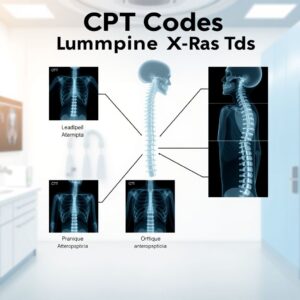
CPT Codes for Lumbar Spine X-Rays
Understanding the Lumbar Spine: A Clinical Foundation
Before a single code can be understood, one must first appreciate the structure being imaged. The lumbar spine is a marvel of biomechanical engineering, designed for both strength and flexibility. It typically consists of five large vertebrae, labeled L1 down to L5, which sit upon the sacrum (S1). These vertebrae are the load-bearing pillars of the upper body, transmitting forces from the head and torso to the pelvis and legs.
Key anatomical structures within the lumbar spine include:
-
Vertebral Bodies: The large, cylindrical anterior parts of the vertebrae that bear most of the body’s weight.
-
Intervertebral Discs: Situated between each vertebral body, these act as shock absorbers. Each disc has a tough, fibrous outer ring (annulus fibrosus) and a soft, gel-like center (nucleus pulposus).
-
Spinal Canal: The hollow, protective tunnel formed by the vertebral arches through which the delicate spinal cord and nerve roots pass.
-
Facet Joints (Zygapophyseal Joints): Paired joints at the back of the spine that link vertebrae together and guide their movement, providing stability and limiting excessive motion.
-
Pars Interarticularis: A small, critical segment of bone connecting the upper and lower facet joints. This is a common site for stress fractures (spondylolysis).
The primary functions of the lumbar spine are to support the upper body, allow for a wide range of motions (flexion, extension, lateral bending, and rotation), and protect the cauda equina—the bundle of nerve roots descending from the spinal cord.
Common pathologies that prompt a lumbar spine X-ray include:
-
Degenerative Disc Disease: The natural, age-related wear and tear of the intervertebral discs, often leading to disc space narrowing and bone spur (osteophyte) formation.
-
Spondylolysis: A stress fracture in the pars interarticularis, common in adolescent athletes.
-
Spondylolisthesis: The forward slippage of one vertebra over the one below it, often a consequence of spondylolysis.
-
Osteoarthritis: Degeneration of the facet joints, leading to pain and stiffness.
-
Compression Fractures: Often due to osteoporosis, where the vertebral body collapses, losing height.
-
Scoliosis: An abnormal lateral (side-to-side) curvature of the spine.
-
Infection (Osteomyelitis/Discitis) or Neoplasms (Tumors): Though less common and often requiring advanced imaging for full evaluation.
Understanding these conditions is crucial because the specific clinical suspicion directly influences which X-ray views—and therefore which CPT code—the ordering physician will request.
The Role of Radiography in Diagnosing Lumbar Pathologies
Plain film radiography, the oldest and most widely available form of medical imaging, remains the first-line investigative tool for most musculoskeletal complaints involving the lumbar spine. Its enduring utility lies in its speed, low cost, wide availability, and ability to provide a excellent overall structural assessment of bony anatomy.
The fundamental principle of an X-ray involves passing a small, controlled dose of ionizing radiation through the body. Dense structures like bone absorb more radiation, preventing it from reaching the detector and appearing white on the resulting image. Softer tissues like muscles and discs absorb less, allowing more radiation through and appearing in shades of gray or black. This creates a high-contrast image ideal for evaluating fractures, alignment, bone density, and joint spaces.
Strengths of Lumbar Spine Radiography:
-
Excellent for Bony Detail: Highly effective at identifying fractures, dislocations, and subluxations.
-
Assessment of Alignment: Clearly shows the overall curvature and alignment of the vertebral column, diagnosing conditions like spondylolisthesis and scoliosis.
-
Evaluation of Disc Space: While the disc itself is radiolucent (appears black), the space it occupies is visible. Narrowing of this space is a key indicator of disc degeneration or herniation.
-
Detection of Bone Spurs and Arthritic Changes: Readily identifies osteophytes and sclerosis associated with osteoarthritis.
-
Instability Assessment: Dynamic views (flexion/extension) can reveal abnormal movement between vertebrae that isn’t apparent on static images.
Limitations of Lumbar Spine Radiography:
-
Poor Soft Tissue Resolution: Cannot directly visualize the spinal cord, nerve roots, ligaments, or intervertebral discs. A herniated disc pressing on a nerve, a leading cause of sciatica, is typically invisible on a standard X-ray.
-
Limited 3D Perspective: Provides a two-dimensional projection of a three-dimensional structure, which can sometimes obscure pathology.
-
Radiation Exposure: While the dose is low, it is not zero, a consideration particularly for pregnant women and children.
Because of these limitations, a normal lumbar X-ray does not rule out all causes of back pain. If clinical suspicion remains high for a soft tissue injury, nerve compression, or infection, advanced imaging like Magnetic Resonance Imaging (MRI) or Computed Tomography (CT) is typically the next step.
Introduction to CPT Codes: The Language of Medical Billing
The Current Procedural Terminology (CPT®) code set is maintained and published by the American Medical Association (AMA). It is the uniform language used to describe medical, surgical, and diagnostic services provided by physicians and other healthcare professionals. CPT codes are essential for communicating with payers (insurance companies, Medicare, Medicaid) about what services were performed, forming the basis for billing and reimbursement.
Each CPT code is a five-digit numeric code that corresponds to a specific procedure or service. The codes are organized into three categories:
-
Category I: The largest body of codes, representing procedures and services widely performed by physicians. All codes discussed in this article (72100, 72110, etc.) are Category I codes.
-
Category II: Supplemental tracking codes used for performance management and data collection. They are optional and not used for billing.
-
Category III: Temporary codes for emerging technologies, services, and procedures. They allow for data collection and are often eventually converted to Category I codes.
For radiological services, the CPT code describes the anatomic area imaged and the number and/or type of specific views obtained. This is a critical distinction. The code is not for the “X-ray” itself, but for the specific radiologic examination, which is defined by its protocol. This is why multiple codes exist for the lumbar spine—each represents a different examination with a different clinical purpose and a different associated work value (which influences reimbursement).
Decoding the Specific CPT Codes for Lumbar Spine X-Rays
The CPT manual contains specific codes for radiographic examinations of the lumbar spine. Choosing the correct one is not a matter of preference; it is a direct reflection of the work performed. The codes are mutually exclusive, meaning only one code should be reported for an encounter, representing the most comprehensive examination performed.
CPT Code 72100: Radiologic Examination, Spine, Lumbar; 2 Views
Description: This code represents the most basic lumbar spine series, typically consisting of a single Anteroposterior (AP) view and a single Lateral view.
-
AP View: The X-ray beam enters the patient’s anterior (front) abdomen and exits through the posterior (back) spine to hit the detector. This view provides a coronal plane image, excellent for assessing the alignment of the vertebral bodies, the pedicles, the transverse processes, and the overall curvature (e.g., for scoliosis screening).
-
Lateral View: The beam passes from one side of the patient to the other, providing a sagittal plane image. This is the most important view for assessing vertebral body height (ruling out compression fractures), evaluating the disc spaces for narrowing, checking the alignment of the posterior elements, and looking for spondylolisthesis (slippage).
Clinical Use Case: This is often used as an initial screening exam for acute trauma (e.g., a fall), a quick check for obvious fractures, or a baseline study for non-specific low back pain. Its limited scope means it may miss more subtle pathologies, particularly those involving the facet joints or pars interarticularis.
CPT Code 72110: Radiologic Examination, Spine, Lumbar; Minimum of 4 Views
Description: This code is reported for an examination that includes at least four distinct images. The standard protocol typically includes the AP, Lateral, and both Oblique (right and left) views.
-
Oblique Views: For these views, the patient is rotated approximately 45 degrees. This rotation projects the facet joints and the pars interarticularis into clear view, free of overlapping structures. The classic “Scottie dog” appearance is seen on a lumbar oblique film—a useful mnemonic for radiologists where the dog’s “neck” represents the pars interarticularis. A fracture in the pars (spondylolysis) will appear as a collar on the Scottie dog.
Clinical Use Case: This is a more definitive diagnostic exam. It is ordered when there is clinical suspicion for pathology involving the posterior elements of the spine. This is the go-to study for evaluating young athletes with back pain (suspected spondylolysis), assessing facet joint arthritis in older adults, or providing a more complete evaluation when a 2-view series is inconclusive.
<a id=”72114″></a>CPT Code 72114: Radiologic Examination, Spine, Lumbar; Complete, Including Oblique and Flexion and/or Extension Views
Description: This is the most comprehensive routine radiographic exam of the lumbar spine. It includes all the views from a 4-view series (AP, Lateral, Right & Left Obliques) and adds dynamic or stress views.
-
Flexion View: The patient is asked to bend forward as far as possible while the lateral image is taken.
-
Extension View: The patient bends backward as far as possible for another lateral image.
These views are compared to the neutral lateral view to assess for abnormal motion or instability between vertebrae. Instability, such as in certain cases of spondylolisthesis or post-surgical pseudoarthrosis, may only become apparent when the spine is under the stress of movement.
Clinical Use Case: This exam is specifically reserved for evaluating spinal instability. It is not a routine screening tool. Common indications include persistent pain following trauma, evaluating the progression of a known spondylolisthesis, or assessing fusion integrity after spinal surgery.
CPT Code 72170: Radiologic Examination, Spine; Lumbosacral, 2-3 Views
Description: This code is often a source of confusion. It is specifically for imaging the lumbosacral junction—the transition between the lumbar spine and the sacrum. The sacrum is a triangular bone formed by five fused vertebrae (S1-S5). The standard views are an AP and a Lateral view, with a spot lateral of the lumbosacral junction sometimes added as a third view to better visualize this area without overlap from the iliac bones.
Key Distinction: Code 72170 is not for a standard lumbar spine exam. It is focused on the L5-S1 level. It would be used if the specific clinical question pertains to this junction, such as evaluating for transitional anatomy (lumbarization/sacralization), a fracture at L5 or the sacral ala, or specific pain isolated to the sacroiliac (SI) joint region. If a full lumbar spine exam (e.g., 3 or 4 views) that includes the lumbosacral junction is performed, you report the lumbar spine code (72100, 72110, etc.), not 72170.
CPT Code 72190: Radiologic Examination; Spine, Lumbosacral, Bending Views Only (Flexion/Eextension)
Description: This code is used only when solely the flexion and extension views are performed, without any routine AP, lateral, or oblique views. This is a highly specific scenario.
Clinical Use Case: This might be ordered as a follow-up study for a patient who has had a full lumbar series in the recent past, and the physician now wants to specifically assess for instability without repeating the entire radiation exposure. For example, a patient with a known stable spondylolisthesis who presents with new pain after a minor injury. If bending views are performed in conjunction with a full set of routine views, you report the comprehensive code 72114, not 72100/72110 + 72190.
Summary of Lumbar Spine X-Ray CPT Codes
| CPT Code | Description | Typical Views Included | Primary Clinical Indication |
|---|---|---|---|
| 72100 | Radiologic Examination, Spine, Lumbar; 2 Views | AP, Lateral | Initial screening for trauma, non-specific pain, obvious fracture. |
| 72110 | Radiologic Examination, Spine, Lumbar; Minimum of 4 Views | AP, Lateral, Right Oblique, Left Oblique | Evaluation of posterior elements (pars interarticularis for spondylolysis, facet joints for arthritis). |
| 72114 | Radiologic Examination, Spine, Lumbar; Complete | AP, Lateral, Right & Left Obliques, Flexion & Extension | Assessment of dynamic spinal instability. |
| 72170 | Radiologic Examination, Spine; Lumbosacral, 2-3 Views | AP, Lateral (often with a spot lateral of L5-S1) | Focused evaluation of the lumbosacral junction (L5-S1). |
| 72190 | Radiologic Examination; Spine, Lumbosacral, Bending Views Only | Flexion and Extension views ONLY (no routine views) | Follow-up study to specifically assess instability without repeating full series. |
Modifiers: Refining the Narrative of Service
Modifiers are two-digit codes (numeric or alphanumeric) appended to a CPT code to provide additional information about the service performed. They can indicate that a service was altered in some way without changing the definition of the code itself. Their correct use is essential for accurate billing and preventing denials.
Common modifiers used with lumbar spine X-ray codes include:
-
-LT (Left Side) and -RT (Right Side): These are generally not used for lumbar spine codes. The lumbar spine is considered a single, midline anatomic structure. You would not image only the “left” lumbar spine. These modifiers are for paired structures like knees, hands, or eyes.
-
-26 (Professional Component) and -TC (Technical Component): This is a critical distinction, especially in radiology.
-
The Professional Component covers the physician’s work: supervising the exam (for a radiologist), interpreting the images, and generating a written report.
-
The Technical Component covers the equipment, supplies, technologist’s time, and overhead costs of performing the exam.
-
The Global Service is the complete package—both the professional and technical components.
-
Who bills what? A radiologist in a hospital who only interprets an X-ray taken by the hospital’s equipment would bill 72100-26. The hospital would bill 72100-TC. A private imaging center that owns the equipment, employs the technologist, and has a radiologist on staff would bill the global service, 72100 (no modifier).
-
-
-59 (Distinct Procedural Service): This modifier indicates that a procedure or service was distinct or independent from other services performed on the same day. Use with extreme caution and only when supported by documentation. For example, if a patient has a lumbar spine X-ray (72110) and a separate, distinct X-ray of the sacrum (72220) performed for a different clinical reason during the same encounter, modifier -59 might be appended to one of the codes to indicate they are separate procedures. Payer rules on -59 are very strict, and misuse is a common audit trigger.
Documentation is King: Linking Medical Necessity to the Code
The medical record must tell a clear and consistent story that justifies the service provided. The cornerstone of this is medical necessity. Insurance payers will not reimburse for services they deem not medically necessary. The burden of proof is on the provider.
The Order: The physician’s order is the starting point. It should be specific, not vague. An order for “L-spine X-ray” is ambiguous. A better order is “Lumbar spine X-ray, 4 views to rule out spondylolysis in a 16-year-old gymnast with 3 months of low back pain.” This directly links the clinical indication (pain in a young athlete) to the specific type of exam (4 views to see the pars).
The Report: The radiologist’s final report is the definitive document. The coders rely entirely on this report to select the correct CPT code. The report must clearly state:
-
The examination performed: e.g., “Radiographic examination of the lumbar spine.”
-
The number and names of the views obtained: e.g., “AP, lateral, and right and left oblique views were obtained.” This is the direct link to the CPT code (e.g., 72110 for 4 views).
-
The clinical history: As provided by the ordering physician.
-
The findings: A detailed description of what was seen.
-
The impression/ conclusion: A summary diagnosis or differential diagnosis.
If the report only lists “AP and lateral views,” the coder must assign 72100, even if the technologist shot obliques. If the obliques are not mentioned in the radiologist’s official report, they were not officially interpreted and cannot be billed for. The documentation must support the code level chosen.
Linking Clinical Scenario to CPT Code and Documentation
| Clinical Scenario | Likely Order | Appropriate CPT Code | Key Documentation Elements in Report |
|---|---|---|---|
| 75-year-old female with osteoporosis trips and has acute mid-back pain. | Lumbar spine X-ray, 2 views to rule out compression fracture. | 72100 | “Clinical history: Fall, rule out fracture. Views: AP and lateral. Finding: Compression fracture of L2.” |
| 17-year-old baseball pitcher with 2 months of unilateral low back pain, worse with extension. | Lumbar spine X-ray, 4 views to evaluate for pars defect. | 72110 | “Clinical history: Young athlete with unilateral pain. Views: AP, lateral, R & L obliques. Finding: Lucency through the pars interarticularis at L4, consistent with spondylolysis.” |
| 60-year-old male status-post lumbar fusion 1 year ago, now with new onset of pain and feeling of “shifting.” | Lumbar spine X-ray, complete with flexion and extension views to assess for hardware failure or instability. | 72114 | “Clinical history: s/p L4-L5 fusion, evaluating for instability. Views: AP, lateral, obliques, flexion, extension. Finding: 4mm of motion at L4-L5 on flexion views, suggestive of pseudoarthrosis.” |
| 40-year-old with persistent pain localized to the very top of the buttock crease. | Lumbosacral junction X-ray to evaluate SI joints and L5-S1. | 72170 | “Clinical history: Pain at lumbosacral junction. Views: AP, lateral, and spot lateral L5-S1. Finding: No acute fracture. Mild degenerative changes at L5-S1.” |
Common Billing and Reimbursement Challenges
Even with perfect coding, claims can be denied. Understanding common pitfalls is key to a clean revenue cycle.
-
Lack of Medical Necessity: This is the most common reason for denial. The diagnosis code (ICD-10-CM) on the claim must justify the procedure code (CPT). Using a generic code like M54.50 (Low back pain, unspecified) may not be sufficient for a 4-view study. A more specific code like M43.07 (Spondylolisthesis, lumbosacral region) or M48.062 (Spondylolysis, lumbar region) provides a stronger link to medical necessity for the more complex exam.
-
Incorrect Code Selection: Using 72100 when 72110 was performed (or vice versa) is a frequent error. This is often due to the radiology report not explicitly listing all views obtained.
-
Bundling Edits (NCCI): The Centers for Medicare & Medicaid Services (CMS) maintains the National Correct Coding Initiative (NCCI) edits, which are pairs of codes that should not be billed together by the same provider for the same patient on the same day. For example, you cannot bill a global lumbar code (72100) and a professional component code (72100-26) together. NCCI edits are complex and constantly updated.
-
Duplicate Billing: Billing for the same exact service twice. This can happen by accident if a claim is submitted multiple times.
-
Incorrect Use of Modifiers: Appending modifier -59 inappropriately to bypass an NCCI edit is a major red flag for auditors.
To avoid these issues, practices must invest in ongoing coder education, perform regular internal audits, and ensure clear communication between referring physicians, technologists, radiologists, and the coding/billing team.
The Future of Spinal Imaging: Beyond Plain Film Radiography
While X-rays remain a vital first step, the future of spinal diagnosis lies in more advanced modalities that overcome the limitations of plain films.
-
Computed Tomography (CT): CT scans use a rotating X-ray tube and a computer to create incredibly detailed cross-sectional (axial) images of the spine. They are superb for evaluating complex fractures, bony anatomy, and post-surgical changes. The radiation dose is significantly higher than a simple X-ray.
-
Magnetic Resonance Imaging (MRI): MRI uses a powerful magnetic field and radio waves, not radiation, to create images. It is the gold standard for evaluating soft tissues: discs, nerves, the spinal cord, ligaments, and muscles. It is indispensable for diagnosing disc herniations, spinal stenosis, infections, and tumors.
-
Dual-Energy X-ray Absorptiometry (DEXA/DXA): While not for anatomical diagnosis, DEXA scans are the standard test for measuring bone mineral density to diagnose and monitor osteoporosis, a major risk factor for vertebral fractures.
The diagnostic pathway often begins with an X-ray. If the X-ray is negative but pain persists, or if the clinical picture strongly suggests a soft tissue problem, the patient will likely be referred for an MRI. If a complex fracture is seen or suspected on X-ray, a CT scan is often ordered for surgical planning. Each modality plays a complementary role in the complete care of the patient with spinal pain.
Conclusion
Accurately coding for a lumbar spine X-ray is far more than a clerical task; it is a precise translation of clinical medicine into administrative language. Mastering codes 72100, 72110, 72114, 72170, and 72190 requires a foundational understanding of spinal anatomy, pathology, and radiological principles. Success hinges on impeccable documentation that irrefutably links medical necessity to the level of service billed, ensuring compliant reimbursement and safeguarding the financial health of medical practices while accurately reflecting the crucial diagnostic work being performed.
Frequently Asked Questions (FAQs)
1. Why was I billed for a 4-view X-ray (CPT 72110) when I only remember having three pictures taken?
It’s common for patients to miscount, especially if they are in pain or the technologist works quickly. The “views” refer to the number of distinct images saved and interpreted by the radiologist. The standard 4-view series is AP, Lateral, Right Oblique, and Left Oblique. The technologist may take more than four shots to get four perfect images, but only the final, diagnostic images are counted. Your bill should always match the number of views listed in the radiologist’s official report.
2. My doctor ordered a lumbar spine X-ray, but the bill has code 72170 for “lumbosacral.” Is this a mistake?
Not necessarily. While the lumbar spine and lumbosacral junction are distinct anatomical terms, they are closely related. Many standard lumbar spine X-rays naturally include the top of the sacrum (S1) in the field of view. However, coders must use the code that best describes the intent of the exam as documented in the order and report. If the focus was on the general lumbar area, 72100 or 72110 is correct. If the order specifically mentioned pain at the “base of the spine” or the “L5-S1 level,” 72170 may be appropriate. If you have concerns, ask your provider’s office or the billing department for clarification based on the order.
3. What is the difference between a radiologist and a radiology technologist?
This is a crucial distinction. A Radiologic Technologist (or X-ray tech) is the highly skilled medical professional who operates the X-ray equipment. They position the patient, set the technical parameters (kVp, mAs) to obtain a clear image with the lowest necessary radiation dose, and actually take the pictures. A Radiologist is a medical doctor (MD or DO) who specializes in interpreting medical images. They supervise the technologist (often indirectly), analyze the images, diagnose conditions, and write the formal report that is sent to your ordering physician. You are billed for both their services (the technical and professional components).
4. Can I get a copy of my X-ray report?
Absolutely. You have a legal right to access your medical records, including radiology reports. You can request them from your ordering physician’s office or directly from the radiology department where the X-ray was performed. The report will contain the radiologist’s findings in medical terminology. It’s best to review this report with your treating physician, who can explain what it means in the context of your health.
5. How much radiation is involved in a lumbar spine X-ray, and is it safe?
The effective radiation dose from a lumbar spine X-ray is relatively low, but it is one of the higher-dose routine X-ray exams due to the thickness of the torso. A typical 2-view series is roughly equivalent to the natural background radiation everyone receives from the environment over a period of several months to a year. The benefits of obtaining a necessary diagnosis almost always outweigh the small, potential long-term risk of the radiation exposure. Radiology facilities adhere to the “ALARA” principle (As Low As Reasonably Achievable) to minimize dose without compromising image quality. If you are pregnant or think you might be pregnant, you must inform your doctor and the technologist before the exam.
Additional Resources
-
The American Medical Association (AMA): The official publisher of the CPT code set. They offer code books, online data files, and educational resources. https://www.ama-assn.org/
-
The American College of Radiology (ACR): A professional society for radiologists. They publish practice guidelines and appropriateness criteria that help physicians choose the right imaging exam for a clinical condition. https://www.acr.org/
-
The American Society of Radiologic Technologists (ASRT): The premier professional association for radiological technologists, providing education and practice standards. https://www.asrt.org/
-
RadiologyInfo.org: A public-facing website co-sponsored by the ACR and the Radiological Society of North America (RSNA). It provides easy-to-understand information on all types of radiology procedures, including lumbar spine X-rays. https://www.radiologyinfo.org/
-
Centers for Medicare & Medicaid Services (CMS): The official source for NCCI edits, Medicare coverage policies, and billing guidelines. https://www.cms.gov/