In the intricate world of healthcare, a single number can represent a complex symphony of skill, decision-making, and patient care. For surgeons, the focus is rightly on the procedure itself—the delicate dissection, the preservation of healthy tissue, and the successful resolution of a patient’s condition. However, for the financial stability of a practice and the integrity of the healthcare system, accurately translating that surgical intervention into a billable code is paramount. This is the domain of the CPT code, a universal language that communicates what was done, why it was done, and how it was done.
The CPT code for ovarian cystectomy, specifically 58661 and 58662, is a prime example of this need for precision. An ovarian cystectomy is not a single, monolithic procedure. It can be performed laparoscopically or via open laparotomy, on one ovary or both, and is often accompanied by other necessary steps like lysing adhesions or performing a biopsy. Choosing the correct code is not a matter of guesswork; it is a direct reflection of the clinical documentation and a thorough understanding of CPT guidelines. An error can lead to claim denials, audits, underpayment, or even allegations of fraud.
This comprehensive guide is designed to demystify the coding process for ovarian cystectomy. It is intended for surgeons, medical coders, billers, practice managers, and healthcare administrators who seek a deep, nuanced understanding of how to accurately and ethically report these procedures. We will move beyond a simple definition of the codes and delve into the surgical context, documentation requirements, associated procedures, common pitfalls, and the evolving landscape of reimbursement. By mastering these details, you can ensure that your practice is compensated appropriately for the valuable services it provides while maintaining the highest standards of compliance.
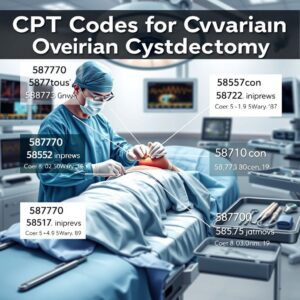
CPT Codes for Ovarian Cystectomy
2. Understanding the Fundamentals: Ovarian Cysts and Cystectomy
Before assigning a code, one must understand the medicine behind it.
What is an Ovarian Cyst?
An ovarian cyst is a fluid-filled sac that forms on or within an ovary. They are incredibly common and, in many cases, are a normal part of the menstrual cycle (functional cysts like follicular or corpus luteum cysts). These often resolve on their own without any intervention. However, other types of cysts can cause symptoms and require surgical management. These include:
-
Dermoid Cysts (Mature Cystic Teratomas): Benign tumors that can contain tissue like hair, skin, or teeth.
-
Cystadenomas: Benign tumors that develop from ovarian tissue and can be filled with a watery (serous) or mucous-like (mucinous) fluid. They can grow very large.
-
Endometriomas (“Chocolate Cysts”): Cysts formed as a result of endometriosis, where uterine lining tissue grows on the ovary. They are filled with dark, old blood.
-
Malignant Cysts: While less common, some cysts can be cancerous. The possibility of malignancy is a key factor in surgical planning.
Indications for Ovarian Cystectomy: When is Surgery Necessary?
Not all cysts require removal. Surgery is typically considered when:
-
The cyst is large (usually over 5-10 cm).
-
It is causing persistent symptoms like pelvic pain, pressure, or bloating.
-
It appears complex or suspicious for malignancy on ultrasound or other imaging.
-
It is persistent and does not resolve after several menstrual cycles.
-
It is related to an underlying condition like endometriosis that requires treatment.
-
It causes a complication, such as ovarian torsion (twisting of the ovary) or rupture.
Surgical Goals: Preservation vs. Removal
The primary goal of an ovarian cystectomy is to remove the cyst while preserving as much healthy ovarian tissue as possible. This is especially crucial for patients who wish to preserve their fertility. The surgeon carefully dissects the plane between the cyst wall and the normal ovarian cortex, enucleating the cyst intact if possible. This is in contrast to an oophorectomy (coded separately), which is the complete removal of the ovary and is reserved for cases where the ovary cannot be saved, the patient is postmenopausal, or cancer is confirmed or highly suspected.
3. The CPT® Coding System: A Primer for Precision
What is CPT and Why Does It Matter?
The Current Procedural Terminology (CPT®) is a medical code set created and maintained by the American Medical Association (AMA). It is used to describe medical, surgical, and diagnostic services and is designed to communicate uniform information about medical services and procedures among physicians, coders, patients, accreditation organizations, and payers for administrative, financial, and analytical purposes. CPT codes are the foundation of the healthcare reimbursement system in the United States.
The Structure of CPT Codes: Categories and Modifiers
CPT codes are five-digit numeric codes. They are divided into three categories:
-
Category I: The largest body of codes, representing procedures and services widely performed by physicians. Codes 58661 and 58662 are Category I codes.
-
Category II: Supplemental tracking codes used for performance measurement.
-
Category III: Temporary codes for emerging technologies, services, and procedures.
Modifiers are two-digit codes (e.g., -50, -51, -59, -22, -52) that are appended to a CPT code to indicate that a service or procedure has been altered by some specific circumstance but has not changed its definition. They provide additional information to the payer and are critical for accurate reimbursement. For example, modifier -50 (Bilateral Procedure) is essential for coding 58662 correctly.
4. The Core Codes: A Deep Dive into 58661 and 58662
This is the heart of the matter. The CPT codes for ovarian cystectomy are found in the Female Genital System subsection of the Surgery chapter, under the heading Oviduct/Ovary.
CPT 58661: Cystectomy, Ovarian
-
Definition: This code represents a cystectomy performed on a single ovary.
-
Key Consideration: The code is unilateral. It is used whether the procedure is performed on the right or the left ovary. It is reported once for a unilateral procedure.
CPT 58662: Cystectomy, Ovarian; with Cystectomy(s) of Other Ovary
-
Definition: This code represents a cystectomy performed on both ovaries.
-
Key Consideration: This is a bilateral code. It is reported once for the entire bilateral procedure. Do not report 58661 twice for a bilateral surgery. Code 58662 is specifically designed for this scenario and is valued accordingly.
Coding Decision Tree:
The decision-making process for selecting the primary code is straightforward but must be precise.
5. The Surgical Approach: Laparoscopic vs. Laparotomy
The approach is a critical factor in coding. The codes 58661 and 58662 are specific to the laparoscopic approach. This is a minimally invasive technique where the surgeon makes several small incisions in the abdomen to insert a camera (laparoscope) and long, thin instruments. The abdomen is inflated with gas (CO₂) to create a working space.
The Open Approach: Laparotomy (58925)
If the surgeon performs an open cystectomy through a larger abdominal incision (laparotomy), a different code is used:
-
CPT 58925: Ovarian cystectomy, unilateral or bilateral.
This code is approach-specific for laparotomy. It is used for an open procedure, whether one or both ovaries are involved. The description itself includes the phrase “unilateral or bilateral,” meaning it is reported only once regardless of laterality.
Comparing Techniques:
-
Laparoscopic (58661/58662): Typically involves less blood loss, shorter hospital stay, faster recovery, and smaller scars. It is the preferred approach for most benign cysts.
-
Laparotomy (58925): Used for very large cysts, when cancer is strongly suspected (as it allows for a more comprehensive staging procedure), or in cases where the patient has extensive adhesions from prior surgeries that make laparoscopy unsafe. It may also be necessary if a complication occurs during a laparoscopic procedure.
6. Navigating Complex Scenarios and Associated Procedures
A cystectomy is rarely performed in isolation. The surgeon may need to address other issues encountered during the operation. Understanding which procedures are included (bundled) and which can be reported separately is crucial.
Lysis of Adhesions (58740)
Adhesions are bands of scar tissue that can bind organs together. They are common in patients with prior surgery or endometriosis.
-
CPT 58740: Lysis of adhesions (salpingolysis, ovariolysis).
-
Coding Rule: This can often be reported separately if the adhesions were dense, required significant time and effort to lyse, and are well-documented. Simple, incidental lysis of flimy adhesions that are a necessary part of gaining access to the ovary is considered part of the main procedure and is not separately reportable. Use modifier -59 (Distinct Procedural Service) if necessary to indicate that the lysis was a separate and identifiable service.
Biopsy of Ovary (58900)
-
CPT 58900: Biopsy of ovary, unilateral or bilateral (separate procedure).
-
Coding Rule: The phrase “separate procedure” in the descriptor means this code is bundled into more comprehensive procedures (like a cystectomy) when performed on the same ovary. If a biopsy is taken from the contralateral (opposite) ovary during a unilateral cystectomy (58661), it may be separately reportable with modifier -59. If a biopsy is taken from an other structure (e.g., peritoneum, omentum), it may be separately reportable.
Oophorectomy (58571, 58573, 58940, 58943)
If the surgeon plans a cystectomy but finds that the ovary cannot be saved and must be completely removed, the procedure becomes an oophorectomy.
-
Laparoscopic: CPT 58571 (unilateral) or 58573 (bilateral).
-
Laparotomy: CPT 58940 (unilateral) or 58943 (bilateral).
-
Coding Rule: You cannot report a cystectomy code (58661/58662) and an oophorectomy code for the same ovary. The oophorectomy code replaces the cystectomy code. The intent of the procedure and the outcome as documented in the operative report dictate the code.
Diagnostic and Operative Laparoscopy (49320, 49321)
-
CPT 49320: Laparoscopy, abdomen, peritoneum, and omentum, diagnostic.
-
CPT 49321: Laparoscopy, surgical; with biopsy (single or multiple).
-
Coding Rule: A diagnostic laparoscopy (49320) is always bundled into any surgical laparoscopic procedure (like 58661) performed at the same time. It is never reported separately. If the procedure begins as diagnostic and then turns into an operative procedure, only the operative procedure is coded.
When to Code Separately: The Concept of Bundling
The National Correct Coding Initiative (NCCI) edits are a set of rules developed by the Centers for Medicare & Medicaid Services (CMS) to prevent improper coding. They define which procedures are considered “bundled” into others. Coders must use NCCI edits to determine if two procedures can be reported together. For example, a biopsy of the same ovary is bundled into a cystectomy on that ovary. Reporting it separately would be incorrect without a valid modifier and documentation supporting the distinct nature of the service.
7. The Critical Role of Documentation: Building the Audit-Proof Chart
The operative report is the foundation of accurate coding. Without clear, specific documentation, the coder cannot assign the correct codes, and the practice is vulnerable in an audit.
The Operative Note: A Blueprint for Coding
A well-written operative note for an ovarian cystectomy should clearly state:
-
Preoperative and Postoperative Diagnoses: (e.g., Preop: Complex left ovarian cyst. Postop: Benign ovarian cyst.)
-
Procedure Performed: The title should be precise (e.g., “Laparoscopic left ovarian cystectomy and lysis of adhesions”).
-
Surgeon(s) and Assistant:
-
Anesthesia:
-
Indications for Surgery: Why was the procedure done?
-
Description of Procedure (The Body):
-
Approach: “Laparoscopic” or “laparotomy” must be explicitly stated.
-
Findings: “The uterus was normal. The right ovary was normal. The left ovary contained a 6 cm smooth-walled cyst. Dense adhesions were noted between the left ovary and the pelvic sidewall.”
-
Laterality: Specify “right,” “left,” or “bilateral.”
-
Steps Taken: Describe the incision, insertion of trocars, identification of structures, aspiration of cyst (if any), dissection of the cyst plane, removal of the cyst, control of bleeding, and reconstruction of the ovary.
-
Management of Other Issues: Describe any lysis of adhesions, biopsies, or other procedures in detail, including the location and complexity.
-
Specimen Removed: What was removed? (e.g., “The ovarian cyst was placed in a bag and removed from the abdomen.”)
-
Sponge, Needle, and Instrument Counts:
-
Blood Loss:
-
Complications:
-
Condition of Patient:
-
Linking Diagnosis to Procedure: ICD-10-CM Codes
The medical necessity of the procedure is established by the diagnosis code. Common ICD-10-CM codes linked to ovarian cystectomy include:
-
N83.0- Follicular cyst of ovary
-
N83.1- Corpus luteum cyst of ovary
-
N83.2- Other and unspecified ovarian cysts (e.g., N83.29 Other ovarian cyst)
-
N83.3- Acquired atrophy of ovary and fallopian tube
-
D27 Benign neoplasm of ovary
-
N80.1 Endometriosis of ovary (endometrioma)
The diagnosis code must align with the surgeon’s documented preoperative diagnosis and the pathological findings.
8. Coding Challenges and Pitfalls: Avoiding Common Denials
-
Unbundling Incorrectly: Reporting a laparoscopic cystectomy (58661) with a diagnostic laparoscopy (49320) is a common and incorrect unbundling that will lead to a denial.
-
Misrepresenting the Surgical Approach: Using a laparoscopic code (58661) for an open procedure (which should be 58925) is a serious error.
-
Inadequate Documentation: The most common cause of denials and audit failures. If the report doesn’t specify “bilateral,” you cannot code 58662. If it doesn’t describe the adhesions as “dense” and requiring “extensive lysis,” you cannot report 58740.
-
Incorrect Modifier Use: Failing to append modifier -50 to 58662 (though many payers accept the bilateral descriptor in the code itself) or misusing modifier -59 to override bundling edits without justification.
9. The Financial Landscape: Reimbursement and Payer Policies
Reimbursement is based on the concept of Relative Value Units (RVUs). Each CPT code is assigned RVUs that measure the relative resource costs (physician work, practice expense, and malpractice insurance) required to perform it. These RVUs are multiplied by a conversion factor to determine the payment amount.
2024 Relative Value Units (National Average, adjusted for locality)
| CPT Code | Procedure Description | Work RVUs | Total RVUs* |
|---|---|---|---|
| 58661 | Laparoscopic ovarian cystectomy, unilateral | 10.50 | 20.50 |
| 58662 | Laparoscopic ovarian cystectomy, bilateral | 13.79 | 26.50 |
| 58925 | Ovarian cystectomy, unilateral or bilateral (laparotomy) | 11.52 | 22.50 |
| 58740 | Lysis of adhesions | 6.90 | 13.50 |
| *Total RVUs are approximate and vary by geographic location. |
Payer policies can vary. Medicare, Medicaid, and private insurers may have specific Local Coverage Determinations (LCDs) or policies that outline under what circumstances they consider an ovarian cystectomy medically necessary. They may also have rules about which modifiers they accept. Always check the specific payer’s policy before submitting a claim.
10. Case Studies: Applying Knowledge to Real-World Scenarios
Case Study 1: Unilateral Laparoscopic Cystectomy
-
Scenario: A 32-year-old female with a persistent 7 cm right ovarian cyst undergoes surgery.
-
Operative Report Findings: “Laparoscopic approach was used. A right ovarian cyst was identified. The cyst was carefully dissected off the ovarian cortex and removed intact via endoscopic bag. The left ovary was inspected and noted to be normal.”
-
Procedures Performed: Laparoscopic right ovarian cystectomy.
-
Correct Coding: 58661 (unilateral cystectomy). Do not report a diagnostic laparoscopy.
Case Study 2: Bilateral Cystectomy with Lysis of Adhesions
-
Scenario: A 28-year-old with endometriosis and chronic pelvic pain.
-
Operative Report Findings: “Laparoscopy revealed endometriotic implants and dense adhesions binding both ovaries to the pelvic sidewalls. Extensive sharp and blunt dissection was required to free both ovaries (lysis of adhesions). A bilateral ovarian cystectomy was then performed to remove endometriomas from both ovaries.”
-
Procedures Performed: Laparoscopic lysis of adhesions, laparoscopic bilateral ovarian cystectomy.
-
Correct Coding: 58662 (bilateral cystectomy) + 58740 (Lysis of adhesions). Append modifier -59 to 58740 if required by NCCI edits to indicate it was a distinct procedural service. The documentation supports the separate reporting due to the description of “dense adhesions” requiring “extensive… dissection.”
Case Study 3: Conversion from Laparoscopy to Laparotomy
-
Scenario: A surgeon begins a laparoscopic cystectomy for a large cyst but encounters uncontrolled bleeding and converts to an open procedure.
-
Coding Rule: When a procedure is converted from laparoscopic to open, only the open procedure is coded. The laparoscopic approach was attempted but abandoned due to a complication.
-
Correct Coding: 58925 (Ovarian cystectomy by laparotomy). You do not report any laparoscopic code.
11. The Future of Coding: Technology, Trends, and Telemedicine
Robotic-Assisted Surgery (Add-on Code 58578)
Robotic-assisted laparoscopic surgery is increasingly common. It is not a separate procedure but a different technique for performing a laparoscopic procedure.
-
Coding Rule: The primary procedure is still coded (e.g., 58662). The robotic assistance is reported by adding CPT 58578 (Laparoscopy, surgical, with total hysterectomy for uterus 250 g or less; with robotic assistance). Note: This is the correct add-on code for robotic assistance with ovarian procedures like cystectomy, as there is no specific robotic code for cystectomy itself. Always verify the most current CPT guidelines.
-
Documentation: The report must clearly state that the da Vinci Surgical System or other robotic platform was used.
The Role of AI in Coding and Documentation
Artificial intelligence is beginning to play a role in reading operative reports and suggesting CPT and ICD-10 codes. However, these tools are aids, not replacements for a skilled certified coder. The human coder is essential for interpreting context, applying guidelines, and resolving ambiguities.
12. Conclusion: Mastering the Details for Accuracy and Compliance
Accurate coding for ovarian cystectomy hinges on a precise understanding of CPT definitions and guidelines. The surgeon’s detailed operative report is the indispensable source of truth, dictating the selection of codes based on laterality, surgical approach, and any distinct ancillary procedures. By meticulously aligning documentation with the specific criteria of codes like 58661, 58662, and 58925, and by rigorously applying bundling rules and modifiers, healthcare providers can ensure full and compliant reimbursement for their complex surgical services.
13. Frequently Asked Questions (FAQs)
Q1: Can I report CPT 58661 twice if I remove two separate cysts from the same ovary?
A: No. CPT 58661 represents a cystectomy on a single ovary, regardless of the number of cysts removed from that ovary. It is reported only once per ovary.
Q2: How do I code a laparoscopic cystectomy that was converted to a laparotomy?
A: Code only the final, completed procedure. If the surgeon converted to a laparotomy to perform the cystectomy, you report 58925 (Ovarian cystectomy, laparotomy). The attempted laparoscopic approach is not reported.
Q3: Is the use of a trocar and endoscopic bag included in the laparoscopic cystectomy code?
A: Yes. The placement of trocars for access and the use of an endoscopic bag for specimen removal are considered integral components of the laparoscopic procedure and are not separately coded.
Q4: When can I report a biopsy (58900) with a cystectomy (58661)?
A: Typically, a biopsy of the same ovary is included in the cystectomy. It may be separately reportable only if a biopsy is taken from a different site (e.g., the contralateral ovary or the peritoneum) and the documentation supports it as a distinct procedure. NCCI edits and modifier rules must be followed.
Q5: What is the difference between 58662 and reporting 58661 with modifier -50?
A: CPT 58662 is a specific code for a bilateral procedure. You should use this code rather than 58661-50. While some payers may accept the modifier, using the designated bilateral code (58662) is the most accurate and preferred method according to CPT guidelines.
14. Additional Resources
-
American Medical Association (AMA): For the official CPT® code book, guidelines, and updates. https://www.ama-assn.org/
-
American College of Obstetricians and Gynecologists (ACOG): For clinical guidelines on managing ovarian cysts. https://www.acog.org/
-
Centers for Medicare & Medicaid Services (CMS): For National Correct Coding Initiative (NCCI) edits, Medicare fee schedules, and Local Coverage Determinations (LCDs). https://www.cms.gov/
-
American Academy of Professional Coders (AAPC) & American Health Information Management Association (AHIMA): For professional certification, continuing education, and coding resources. https://www.aapc.com/ | https://www.ahima.org/
Disclaimer
This article is intended for informational and educational purposes only and does not constitute medical coding, billing, or legal advice. The information provided is based on current CPT® codes and guidelines from the American Medical Association (AMA), which are subject to change. Medical coding is a complex field that requires certification and continuous education. Always consult the most current, official AMA CPT® code books, payer-specific policies, and federal coding guidelines for accurate code assignment. The ultimate responsibility for correct coding and billing lies with the healthcare provider. The author and publisher disclaim any liability for any errors or omissions or for any damages resulting from the use of the information contained herein.