A patellar tendon rupture is a devastating injury. It severs the critical link between the powerful quadriceps muscle and the tibia, rendering the knee incapable of weight-bearing or extension. For the orthopedic surgeon, repairing this rupture is a technically demanding procedure that restores a patient’s ability to walk. However, the journey from the operating room to successful reimbursement is paved not with sutures, but with accurate and precise medical coding. The language of this journey is built on Current Procedural Terminology (CPT) codes, the universal system for describing medical, surgical, and diagnostic services.
This article delves deep into the world of CPT Codes for Patellar Tendon Repair – Suture of infrapatellar tendon; primary. We will move beyond a simple code definition into a comprehensive exploration of the clinical, anatomical, and administrative context that surrounds it. For surgeons, understanding coding nuances ensures their complex work is accurately represented. For coders, billers, and practice administrators, a profound grasp of this procedure is essential for clean claim submission, appropriate reimbursement, and compliance with ever-evolving payer rules. This guide aims to bridge the gap between the operating table and the billing office, providing an exclusive, detailed, and indispensable resource for anyone involved in the care and management of patients with this significant knee injury.
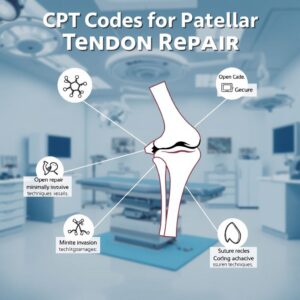
CPT Codes for Patellar Tendon Repair
2. Anatomy and Biomechanics of the Patellar Tendon: The Engine of the Knee
To truly appreciate the repair process and its coding, one must first understand the structure and function of the patellar tendon. Often mistakenly called a ligament (which connects bone to bone), the patellar tendon is indeed a tendon, connecting the patella (kneecap) to the tibial tuberosity, the prominent bump on the top of the shin bone.
Anatomy:
-
Origin: Apex of the patella.
-
Insertion: Tibial tuberosity.
-
Composition: Composed of dense, regular connective tissue primarily made of type I collagen fibers. These fibers are arranged in parallel bundles, providing tremendous tensile strength.
-
Blood Supply: The tendon receives its blood supply from the retinacular vessels and the inferior genicular arteries, a supply that is relatively poor, particularly in its mid-portion, which contributes to its susceptibility to degeneration and injury.
Biomechanics and Function:
The patellar tendon is the final, crucial link in the extensor mechanism of the knee. This mechanism includes the quadriceps muscle, quadriceps tendon, patella, patellar tendon, and tibial tuberosity.
Its primary function is to transmit the force generated by the quadriceps muscle to the tibia, resulting in knee extension. This action is fundamental to nearly every lower body movement: walking, running, jumping, climbing stairs, and simply rising from a chair. The patella itself acts as a fulcrum, increasing the mechanical advantage of the quadriceps by holding the tendon away from the axis of rotation of the knee joint.
The forces through the patellar tendon are immense. Studies show it can withstand forces of up to 8 times body weight during strenuous athletic activities. This incredible biomechanical demand is precisely why its failure is so catastrophic and its repair so vital.
3. Understanding the Injury: Mechanisms and Types of Patellar Tendon Ruptures
Patellar tendon ruptures are relatively uncommon, but they occur through specific mechanisms, often in predictable patient populations.
Traumatic Ruptures:
This is the most classic presentation. It typically occurs in athletes under 40 years of age during a forceful eccentric contraction of the quadriceps—where the muscle is contracting while being forcibly lengthened.
-
Mechanism: Imagine a basketball player landing from a jump shot or a sprorter accelerating out of the blocks. The foot is planted, the knee is partially flexed, and the quadriceps contracts violently to stabilize or extend the joint. The force required exceeds the tensile strength of the tendon, resulting in a rupture.
-
Location: The rupture most often occurs at the tendon’s origin on the inferior pole of the patella.
Degenerative and Systemic Ruptures:
In patients over 40, ruptures often occur without a significant traumatic event. These are frequently due to underlying tendon weakness.
-
Tendinopathy (Jumper’s Knee): Chronic repetitive stress leads to micro-tears, collagen disorganization, and neovascularization, a condition known as patellar tendinosis. This degenerated tendon is weak and prone to rupture with even minor trauma.
-
Systemic Diseases: Certain conditions predispose individuals to tendon weakness and rupture. These include:
-
Chronic Renal Disease: Associated with electrolyte imbalances and metabolic changes that weaken collagen.
-
Diabetes Mellitus: Collagen glycosylation alters its structure and strength.
-
Rheumatoid Arthritis: Systemic inflammation can affect tendon integrity.
-
Long-term Corticosteroid Use: Either systemic or local injections, can weaken collagen and mask pain that would otherwise signal overuse.
-
Connective Tissue Disorders: Like lupus or Ehlers-Danlos syndrome.
-
-
Post-surgical: Though rare, rupture can occur as a complication following total knee arthroplasty or anterior cruciate ligament (ACL) reconstruction where the central third of the patellar tendon is harvested as a graft.
Types of Rupture:
-
Complete vs. Partial: CPT 27380 is used for a complete rupture. Partial tears are typically managed non-operatively or with arthroscopic debridement (e.g., CPT 29877).
-
Acute vs. Chronic: An acute rupture is repaired within weeks of the injury. A chronic rupture (often >6 weeks old) presents a greater challenge. The tendon retracts, and the quadriceps muscle contracts and atrophies, often requiring a more complex reconstruction with graft augmentation, which can impact coding.
4. Clinical Presentation and Diagnostic Journey
Patient History and Physical Exam:
A patient with a complete rupture will present with a classic history.
-
History: A popping or tearing sensation in the knee followed by immediate pain and an inability to bear weight. They will report a feeling of the knee “giving way” and an inability to straighten the knee actively.
-
Physical Exam:
-
Visible Deformity: A palpable defect is often felt just below the patella.
-
High-riding Patella (Patella Alta): The patella is displaced superiorly compared to the unaffected knee.
-
Hemarthrosis: Swelling and effusion in the knee joint from bleeding.
-
Loss of Active Extension: The patient cannot straighten the knee against gravity. This is the most critical test.
-
Positive Extensor Mechanism Test: With the patient supine and the knee flexed to 90°, they cannot extend the knee. If they can extend it from a more flexed position but not hold it straight (extensor lag), it may suggest a partial tear.
-
Imaging Modalities:
Imaging is crucial to confirm the diagnosis, assess the rupture’s location and severity, and rule out other injuries (e.g., fracture).
-
X-Ray (Radiography): While it doesn’t show the tendon itself, it is the first-line imaging study. It will show patella alta. The Insall-Salvati ratio (ratio of patellar tendon length to patellar length) will be greater than 1.2. X-rays also rule out patellar or tibial tuberosity avulsion fractures.
-
Ultrasound (Sonography): An excellent, dynamic, and cost-effective tool for evaluating tendon pathology. It can visualize the tendon fibers, identify the exact location of the tear, and differentiate between a complete and partial rupture. It allows for a dynamic exam, seeing how the tendon ends move with flexion and extension.
-
Magnetic Resonance Imaging (MRI): The gold standard for soft tissue evaluation. MRI provides exquisite detail of the rupture’s location, extent, and degree of retraction. It is invaluable for diagnosing partial tears and planning surgery for chronic ruptures, as it clearly shows the quality of the remaining tendon tissue. It also assesses the menisci, ligaments, and articular cartilage for any concomitant injury.
5. The Foundation: An Overview of the CPT Coding System
Before diving into the specific code, a brief primer on the CPT system is essential. Maintained by the American Medical Association (AMA), the CPT code set is a uniform language for coding medical services and procedures. It allows for accurate communication among physicians, patients, and third-party payers.
CPT codes are five-digit numeric codes categorized into three types:
-
Category I: These are the standard codes for procedures and services performed by physicians. Code 27380 is a Category I code.
-
Category II: Optional tracking codes used for performance management.
-
Category III: Temporary codes for emerging technologies, services, and procedures.
Codes are organized by anatomy and type of service. The code 27380 is found in the Surgery / Musculoskeletal System section, specifically under Knee Leg Area.
6. Primary CPT Code for Patellar Tendon Repair: 27380
This is the cornerstone code for this procedure.
CPT Code Descriptor: 27380 – Suture of infrapatellar tendon; primary.
Lay Description: This code describes the open surgical repair of a freshly torn patellar tendon. The surgeon makes an incision over the front of the knee, identifies the torn ends of the tendon, trims them of damaged tissue, and sutures them back together. The procedure often involves drilling tunnels or placing anchors into the patella to reattach the tendon securely to the bone.
Included Services (The “Global Package”):
The code 27380 is a “global” code. This means it includes not just the act of suturing but all the typical components of the procedure:
-
The surgical approach (incision through skin and subcutaneous tissue).
-
Identification and dissection to isolate the torn tendon.
-
Debridement of the frayed, non-viable tendon ends.
-
The placement of sutures (e.g., heavy non-absorbable sutures like #5 Ethibond or FiberWire).
-
The method of fixation (e.g., passing sutures through drill holes in the patella, using suture anchors, or using a cerclage wire or cable for protection).
-
Irrigation of the surgical site.
-
Closure of the surgical incision (sutures or staples for the skin).
-
Application of a sterile dressing and, typically, a knee immobilizer.
Excluded Services and NCCI Edits:
The National Correct Coding Initiative (NCCI) is a set of guidelines developed by the Centers for Medicare & Medicaid Services (CMS) to prevent improper coding. NCCI edits define which codes cannot be billed together because one service is inherently included in the other.
For 27380, the following are generally bundled and not separately reportable:
-
Surgical Exposure: The approach is included.
-
Minimal Debridement: Debridement of the tendon ends necessary to facilitate the repair is included.
-
Diagnostic Arthroscopy (29870): If an arthroscopy is performed solely to diagnose the rupture, it is not separately billable, as the diagnosis is already established and the open procedure is planned. This is a common denial trap.
7. The Surgical Spectrum: Techniques for Patellar Tendon Repair
The technique used depends on the acuity, location, and quality of the tissue.
Primary End-to-End Repair:
This is the standard technique for acute ruptures (<2-3 weeks old) with good tissue quality.
-
Incision: A longitudinal midline incision is made over the knee.
-
Exposure: The torn tendon ends are identified. The rupture is most commonly at the inferior pole of the patella.
-
Preparation: The torn ends are debrided of hematoma and frayed tissue.
-
Suture Placement: Heavy, non-absorbable sutures are woven through the distal tendon stump using a locking technique like Krackow or Bunnell.
-
Bone Preparation: The inferior pole of the patella is abraded to create a bleeding bone surface to encourage healing.
-
Fixation: Three longitudinal drill holes are created in the patella. The sutures from the tendon are passed through these holes and tied securely over the superior pole of the patella, pulling the tendon snugly to its anatomic position.
-
Closure: The repair is tested by flexing the knee to ensure security. The paratenon (sheath around the tendon) is closed if possible, followed by standard wound closure.
Repair with Augmentation:
In cases where the tissue quality is poor or there is concern about the strength of the repair, surgeons may augment it with additional materials to protect the suture repair during healing.
-
Suture Tape/Cord: High-strength sutures like FiberTape can be used in a cerclage configuration around the patella and through the tibial tuberosity to offload the primary repair.
-
Wire/Cable: A cerclage wire or cable (e.g., Dall-Miles cable) can be used in a similar fashion, though they are more prone to irritation and often require later removal.
-
Important Coding Note: The use of augmentation is not a separate CPT code. It is considered an integral part of the repair procedure and is included in 27380.
Chronic Rupture and Reconstruction Techniques:
For chronic ruptures, the tendon is scarred, retracted, and cannot be pulled back to its normal length. This requires a more complex reconstruction, not a simple repair.
-
Techniques: These often involve using autografts (patient’s own tissue) or allografts (cadaver tissue) to bridge the gap. Common techniques include using semitendinosus or gracilis tendon autografts, Achilles tendon allografts, or synthetic grafts.
-
Critical Coding Distinction: A true reconstruction for a chronic rupture is not coded with 27380. This code is explicitly for “primary” repair. Reconstruction falls under a different, unlisted procedure code (27599 – Unlisted procedure, femur or knee). The use of an unlisted code requires a submitted operative report and a cover letter comparing the procedure to the closest existing CPT code (e.g., 27380) to justify the fee. This is a complex coding scenario with a high risk of denial without thorough documentation.
8. Coding for Associated Procedures: When More Than One Code is Needed
Often, during the repair, the surgeon may address other intra-articular pathologies. Whether these can be billed separately depends on NCCI edits and the concept of “separate incision” or “separate site.”
Arthroscopic Debridement (29877):
-
Scenario: The surgeon performs an open patellar tendon repair (27380). Before closing, they perform a diagnostic arthroscopy and find and debride a small flap tear of the articular cartilage on the femoral condyle.
-
Coding: Can you bill 29877 (Arthroscopy, knee, surgical; debridement/shaving of articular cartilage (chondroplasty)) with 27380?
-
Answer: Possibly, but with a modifier. NCCI edits bundle 29877 into 27380. To bill both, you must append Modifier 59 (or a X{EPSU} modifier) to 29877 to indicate that the chondroplasty was a distinct procedural service performed on a different anatomical site (the femoral condyle) through a separate portal incision. The medical record must clearly document the separate nature of the procedure.
Arthroscopic Meniscectomy (29881, 29882):
-
The same logic applies. If a meniscal tear is found and treated arthroscopically during the same surgical session, it may be billed with a modifier if it is a truly separate procedure performed through a separate arthroscopic portal.
Hardware Removal (20680):
-
If the patient has previous hardware (e.g., from a prior fracture) that is removed during the same surgery to access the tendon, this can typically be billed separately with modifier 59, as it is a distinct procedure.
Table 1: Common Associated Procedures and Coding Guidance with 27380
| CPT Code | Descriptor | Typically Bundled? | Separately Billable? | Modifier Required | Rationale |
|---|---|---|---|---|---|
| 29870 | Diagnostic Arthroscopy | Yes | Rarely | N/A | Diagnosis is established by open procedure. |
| 29877 | Chondroplasty | Yes | Yes, if distinct | 59 / X{S} | Must be in a separate compartment/area and documented. |
| 29881 | Meniscectomy, medial | Yes | Yes, if distinct | 59 / X{S} | Must be a addressed tear, not just a trivial finding. |
| 29882 | Meniscectomy, lateral | Yes | Yes, if distinct | 59 / X{S} | Must be a addressed tear, not just a trivial finding. |
| 27385 | Suture of patellar tendon, secondary | No | N/A | N/A | This is an alternative code for delayed repair, not an add-on. |
| 20680 | Hardware Removal | Yes | Yes | 59 / X{S} | If hardware is removed via separate work to access the site. |
9. The Role of Modifiers: Telling the Full Story
Modifiers are two-character suffixes (numeric or alphanumeric) added to a CPT code to indicate that a service or procedure was altered in some way without changing the definition of the code itself.
Modifier 50 – Bilateral Procedure:
-
Use Case: An extremely rare scenario, but if a patient sustained bilateral patellar tendon ruptures (e.g., in a fall from a great height), the surgeon would repair both in the same session.
-
Coding: Report 27380-50. Payers will typically reimburse 150% of the allowable fee (100% for the first side, 50% for the second).
Modifier 59 / X{EPSU} – Distinct Procedural Service:
-
Use Case: As discussed above, for reporting a chondroplasty (29877) or meniscectomy (29881) performed during the same session as the 27380.
-
Coding: Report 27380 and 29877-59 (or 29877-XS). The XS modifier specifically denotes “Separate Structure,” which is often the clearest way to communicate this to payers.
Modifier 22 – Increased Procedural Services:
-
Use Case: This modifier is for when the work required to perform the surgery is substantially greater than typically required. For a patellar tendon repair, this could be due to:
-
Extreme obesity (BMI > 50) requiring extensive dissection.
-
Severe scarring from multiple previous surgeries.
-
A complex reconstruction for a chronic rupture that is not quite an unlisted procedure but took significantly more time and effort than a standard primary repair.
-
-
Coding: Report 27380-22. Crucially, this must be supported by detailed documentation in the operative report explaining the extra work. A separate cover letter should be sent with the claim justifying the increased fee. Payment is at the payer’s discretion.
Modifier 51 – Multiple Procedures:
-
Use Case: When multiple procedures are performed during the same surgical session, the primary procedure is billed at full value, and subsequent procedures are appended with modifier 51, indicating a reduced reimbursement rate.
-
Coding: In our example with chondroplasty, some payers may want it billed as 27380 and 29877-51. However, the use of modifier 59/XS is now generally preferred to indicate the specific reason for unbundling.
10. ICD-10-CM Diagnosis Coding: Justifying Medical Necessity
The CPT code tells the payer what was done. The ICD-10-CM code tells them why it was done. The “why” is medical necessity. Inaccurate or nonspecific diagnosis coding is a leading cause of claim denials.
Specificity is Key:
ICD-10-CM requires a high level of specificity: laterality (left, right) and encounter type (initial, subsequent, sequela).
Common Diagnosis Codes for Patellar Tendon Rupture:
-
S76.111A – Strain of right quadriceps muscle, tendon and fascia, initial encounter.
-
This is the most common and accurate code for an acute patellar tendon rupture. The patellar tendon is functionally part of the quadriceps mechanism.
-
-
S76.112A – Strain of left quadriceps muscle, tendon and fascia, initial encounter.
-
S76.111D – … subsequent encounter.
-
S76.111S – … sequela.
-
M66.271 – Spontaneous rupture of extensor tendons, right lower leg.
-
This code is used for ruptures that occur due to systemic disease or degeneration without significant trauma.
-
-
M66.272 – Spontaneous rupture of extensor tendons, left lower leg.
Coding Example:
A 45-year-old male with a history of diabetes presents with an acute, complete rupture of the left patellar tendon after slipping on ice.
-
Primary Diagnosis: S76.112A (Strain of left quadriceps muscle, tendon and fascia, initial encounter)
-
Secondary Diagnosis: E11.9 (Type 2 diabetes mellitus without complications) – This explains the underlying cause and justifies medical necessity.
11. The Global Surgical Package: Understanding Pre-, Intra-, and Post-Op Care
CPT code 27380 has a 90-day global surgical period. This means the reimbursement for 27380 includes payment for all related services provided by the surgeon during the following time frames:
-
Preoperative Care: The day before the surgery (e.g., final history and physical).
-
Intraoperative Care: The surgery itself, including normal follow-up care in the post-anesthesia care unit (PACU).
-
Postoperative Care: All related follow-up visits, dressing changes, cast/splint removal, and pain management for 90 days following the surgery.
What is NOT Included (and can be billed separately with an appropriate E/M code and modifier 24)?
-
Unrelated E/M Services: An office visit for an unrelated problem (e.g., a sinus infection) during the global period.
-
Treatment of Complications: If the patient requires a return to the operating room (RTO) for a complication like a deep infection, this is billed separately with a modifier 78.
-
Staged Procedures: A planned second procedure (e.g., hardware removal) is billed separately with modifier 58.
12. Navigating Payer Policies and Avoiding Denials
Different insurance companies may have unique policies or interpretations of NCCI edits.
Medical Necessity Documentation:
The operative report is the most important document for justifying the code. It must be detailed and include:
-
Indication for Surgery: Description of the injury and failure of conservative management (if applicable).
-
Findings: Detailed description of the rupture (location, completeness, retraction, tissue quality).
-
Technique: A step-by-step description of the procedure, including the type of sutures used, the method of bone fixation (e.g., “three drill holes were placed in the patella”), and any augmentation.
-
Description of any additional procedures: If a chondroplasty was performed, it must be clearly described in a separate paragraph.
Bundling Issues and How to Appeal:
If a claim is denied for bundling (e.g., 29877 bundled into 27380), an appeal is necessary.
-
Review the Op Report: Ensure the documentation clearly supports two separate procedures.
-
Write an Appeal Letter: Quote from the op report, specifying that the chondroplasty was performed in a different anatomical area (e.g., medial femoral condyle) through a separate arthroscopic portal and was not part of the exposure or repair of the patellar tendon.
-
Submit Records: Include the full operative report and any relevant office notes.
13. The Financial Perspective: RVUs and Reimbursement for 27380
The value of a CPT code is determined by its Relative Value Units (RVUs), which are set by CMS and often adopted by private payers. RVUs account for:
-
Work RVU (wRVU): The physician’s time, skill, effort, and stress.
-
Practice Expense RVU (peRVU): The cost of overhead (staff, equipment, supplies).
-
Malpractice RVU (mRVU): The cost of professional liability insurance.
The total RVU is multiplied by a conversion factor (dollar amount) to determine the reimbursement.
Example RVU Breakdown for 27380 (2024 National Facility Values):
-
Work RVU: 18.05
-
Practice Expense RVU: 10.69
-
Malpractice RVU: 1.86
-
Total RVU: 30.60
This high wRVU reflects the procedure’s significant complexity and technical demand. The total reimbursement will vary by geographic region and payer contract.
14. Case Studies: Applying Knowledge to Real-World Scenarios
Case Study 1: Acute Traumatic Rupture
-
Presentation: A 28-year-old professional basketball player lands awkwardly after a dunk. He feels a “pop” and cannot bear weight. Exam shows patella alta and a palpable defect. MRI confirms a complete, acute rupture at the inferior patellar pole.
-
Procedure: Open primary repair using #5 FiberWire sutures passed through three drill holes in the patella.
-
Coding: 27380-RT (assuming right knee). Diagnosis: S76.111A.
-
Note: Clean and simple. No modifiers needed.
Case Study 2: Chronic Rupture with Reconstruction
-
Presentation: A 60-year-old diabetic male with a 3-month-old neglected rupture. He presents with a extensor lag and severe quadriceps atrophy. MRI shows a retracted, scarred tendon.
-
Procedure: The surgeon performs a reconstruction using an Achilles tendon allograft. The graft is woven through the residual tendon and secured through drill holes in the patella and tibial tuberosity.
-
Coding: This is not 27380. This is an unlisted procedure: 27599. The coder must submit the op report and a letter comparing the work to 27380 + 20924 (tendon graft procurement) to justify the fee. This will require pre-authorization and likely involve discussions with the payer.
Case Study 3: Repair with Associated Arthroscopic Debridement
-
Presentation: A 40-year-old construction worker falls from a ladder. He has an acute patellar tendon rupture and reports prior knee pain.
-
Procedure: The surgeon makes a standard midline incision. Before repairing the tendon, they use an arthroscope inserted through a separate superolateral portal to inspect the joint. They find and debride a full-thickness chondral lesion on the lateral femoral condyle using a mechanical shaver. They then proceed with the open patellar tendon repair.
-
Coding:
-
27380 (Patellar tendon repair)
-
29877-59 or 29877-XS (Chondroplasty, distinct procedural service)
-
-
Diagnosis: S76.111A (or S76.112A), M24.171 (Other articular cartilage disorders, right knee).
-
Documentation Key: The op report must have separate sections clearly detailing the arthroscopic findings and debridement as a procedure distinct from the open approach for the tendon repair.
15. The Future of Orthopedic Coding: Trends and Considerations
The world of medical coding is dynamic. Key trends include:
-
Increased Specificity: ICD-10-CM will continue to add more specific codes. CPT may eventually introduce more specific codes for augmented or reconstructed repairs.
-
Value-Based Care: Reimbursement will increasingly be tied to outcomes and quality metrics, not just procedural volume.
-
Artificial Intelligence (AI): AI will play a larger role in auditing claims and predicting denials, forcing even greater accuracy in documentation and coding.
-
Telehealth: Global periods may evolve to include more telehealth follow-up visits as a standard bundled service.
16. Conclusion
Accurately coding a patellar tendon repair, represented by CPT code 27380, requires a synergy of clinical knowledge and administrative expertise. It extends far beyond memorizing a five-digit number, demanding a deep understanding of surgical techniques, anatomy, NCCI bundling rules, modifier application, and diagnosis coding specificity. Mastering this process ensures that the significant skill and effort expended in the operating room are justly compensated, securing the financial health of the practice while maintaining strict compliance. Ultimately, precise coding is the final, critical step in the successful treatment of a patient with this life-altering injury.
17. Frequently Asked Questions (FAQs)
Q1: What is the difference between CPT 27380 and 27385?
A: 27380 is for a primary repair of a fresh rupture. 27385 is for a secondary repair, which typically implies a delayed repair that may require more dissection due to scarring but is not a full reconstruction with a graft. The line between a complex secondary repair and a reconstruction is blurry, and documentation is key.
Q2: Can I bill for the suture anchors or other implants used in the repair?
A: In the hospital outpatient setting, implants are billed separately by the facility under their own revenue codes. However, the physician does not get separate reimbursement for the cost of implants; their use is considered part of the procedure and is included in the practice expense component of the code’s RVU.
Q3: A repair was started arthroscopically but had to be converted to an open procedure. How is this coded?
A: Code only the open procedure (27380). The attempted arthroscopic approach is considered part of the surgical decision-making and is not separately reportable. Do not bill for a diagnostic arthroscopy (29870) in this scenario.
Q4: How long after the injury can 27380 be used?
A: There is no strict timeline defined in the CPT manual. The code is based on the technique, not the number of days. If the surgeon can perform a primary suture repair without needing a graft, 27380 is typically appropriate. If a graft is required, you are likely in unlisted procedure (27599) territory. This is a clinical determination made by the surgeon.
Q5: What is the most common denial for 27380 and how do I prevent it?
A: The most common denials are for:
-
Lack of Medical Necessity: Ensure the diagnosis code is specific and matches the procedure (e.g., S76.111A for an acute rupture).
-
Bundling of Arthroscopic Procedures: If you perform an arthroscopic procedure, document it as distinct and use modifier 59/XS appropriately. Avoid “routine” arthroscopy when the diagnosis is already clear.
18. Additional Resources
-
American Medical Association (AMA): For the official CPT® code set and guidelines. https://www.ama-assn.org
-
Centers for Medicare & Medicaid Services (CMS): For NCCI edits, Medicare policies, and ICD-10-CM guidelines. https://www.cms.gov
-
American Academy of Orthopaedic Surgeons (AAOS): Often provides coding and reimbursement resources for its members. https://www.aaos.org
-
American Health Information Management Association (AHIMA): A premier resource for health information management and coding professionals. https://www.ahima.org
-
American Academy of Professional Coders (AAPC): Provides certification, training, and resources for medical coders. https://www.aapc.com
Disclaimer: This article is for informational and educational purposes only. It is not intended as medical coding, billing, or legal advice. The content is based on guidelines available at the time of writing, which are subject to change. Medical coding is complex and highly specific to individual patient encounters. Always consult the latest official CPT® manuals from the American Medical Association (AMA), ICD-10-CM guidelines, and payer-specific policies for accurate coding. The ultimate responsibility for correct coding lies with the healthcare provider based on the complete clinical documentation of the service rendered.