Yoga, an ancient practice with origins stretching back thousands of years on the Indian subcontinent, has undeniably entered the mainstream of modern Western wellness. From storefront studios to corporate retreats, its benefits for stress reduction, flexibility, and general well-being are widely celebrated. However, a quiet revolution is occurring within the clinical corridors of hospitals, physical therapy clinics, and behavioral health centers. Here, yoga is shedding its purely wellness-oriented image and being recognized for what a growing body of scientific evidence confirms it to be: a powerful, evidence-based therapeutic modality.
This clinical integration presents a critical challenge and opportunity for yoga therapists, physical therapists, occupational therapists, and mental health professionals who utilize yogic techniques: how does one translate this ancient practice into the language of modern healthcare economics? The answer lies in a five-digit alphanumeric system known as the Current Procedural Terminology (CPT®) code set. Understanding and correctly applying these codes is the essential bridge that allows qualified providers to be reimbursed for delivering therapeutic yoga interventions, thereby increasing patient access to these beneficial services.
This comprehensive guide delves deep into the complex world of CPT codes for therapeutic yoga. It moves beyond simplistic and often incorrect online advice to provide a nuanced, detailed, and professionally-vetted framework. We will explore the specific codes that can be applied, the rigorous documentation required to justify their use, the paramount importance of practitioner credentials and scope of practice, and the strategic navigation of the payer landscape. Our goal is to empower healthcare providers to ethically and effectively integrate yoga into patient care, ensuring sustainability for their practice and, most importantly, improved outcomes for their patients.
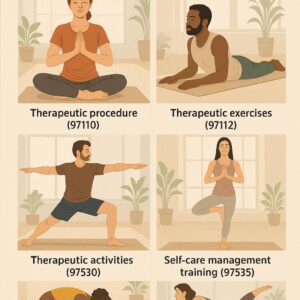
CPT Codes for Therapeutic Yoga
2. Understanding the Fundamentals: CPT Codes, Medical Necessity, and Scope of Practice
Before examining specific codes, one must grasp three non-negotiable concepts that form the bedrock of all medical billing: CPT codes themselves, medical necessity, and scope of practice.
What are CPT Codes?
Current Procedural Terminology (CPT) codes, maintained and published by the American Medical Association (AMA), are a uniform coding system used to describe medical, surgical, and diagnostic services. They provide a standardized way for healthcare providers to communicate to payers (insurance companies, Medicare, etc.) what services were performed during a patient encounter. Think of them as a universal language that tells the story of the patient’s care in a concise, numerical format. It is illegal to use CPT codes without a license from the AMA, which is why every billing entity must purchase the annual CPT codebook.
The Primacy of Medical Necessity
A CPT code is meaningless without the foundation of medical necessity. Insurance companies do not reimburse for services that are merely “good for you” or “preventative” in a general sense (unless specifically covered under preventative care benefits). They reimburse for services that are deemed medically necessary to diagnose or treat a specific illness, injury, disease, or its symptoms.
For therapeutic yoga, this means you must be treating a specific, diagnosed condition. A physician’s referral or a clearly established plan of care (POC) within your own scope of practice is typically the starting point. The medical record must explicitly link the yoga interventions to the patient’s functional deficits and treatment goals. For example:
-
Not Medically Necessary: “Provided yoga for relaxation and general wellness.”
-
Medically Necessary: “Performed therapeutic yoga maneuvers focused on lumbo-pelvic stabilization and graded neuromuscular re-education to address impaired core strength and proprioception secondary to chronic low back pain (diagnosis M54.50).”
Scope of Practice: The Legal Boundary
Your professional license defines what you are legally permitted to do. A certified yoga therapist (C-IAYT) must work under a different set of rules than a licensed physical therapist (PT) or a clinical psychologist (PhD/PsyD). You can only bill under your own license and credentials.
-
A Physical Therapist can use yoga-based movements as tools within their established PT plan of care because improving range of motion, strength, and functional mobility is within their scope.
-
A Licensed Mental Health Counselor can integrate yoga breathing and mindfulness to regulate the nervous system as part of treating an anxiety disorder.
-
A Certified Yoga Therapist (C-IAYT), depending on state laws, may need to operate under a physician’s referral or within a collaborative care model, and must bill using codes that accurately reflect the therapeutic—not instructional—nature of the service.
Billing for a service outside your scope of practice is considered fraud.
3. The Cornerstone of Reimbursement: CPT Code 97112 (Therapeutic Procedure)
This is the most common and often most appropriate code for the physical application of therapeutic yoga.
CPT Code 97112 Official Description: “Therapeutic procedure, 1 or more areas, each 15 minutes; neuromuscular reeducation of movement, balance, coordination, kinesthetic sense, posture, and/or proprioception for sitting and/or standing activities.”
Why it fits: The description reads like a direct list of the physical benefits of yoga. Yoga is inherently a practice of neuromuscular reeducation. It teaches the body new patterns of movement, improves balance and coordination, heightens kinesthetic awareness (sense of body in space), corrects postural dysfunctions, and fine-tunes proprioception (the sense of the relative position of one’s own body parts).
How to Apply 97112 to Yoga:
The key is in your documentation and verbal cues. You are not “teaching a yoga class”; you are “implementing a therapeutic procedure.”
-
Instead of cueing: “Now move into Warrior II pose.”
-
Therapeutic cueing: “I want you to slowly step your right foot back, maintaining a stable pelvis. As you bend your left knee, focus on keeping your right hip internally rotated and your right heel grounded to reeducate the gluteus medius and maximize stability in a single-leg stance activity. Hold this position to challenge your dynamic balance and lower extremity coordination.”
The service is billed in units of 15 minutes. A typical 45-minute one-on-one session would be billed as 3 units of 97112.
Documentation Requirements:
-
Subjective: Patient’s report of symptoms (e.g., “Patient states she feels unsteady when walking on uneven surfaces.”).
-
Objective: Measurable, observable data. This is critical.
-
Examples: Timed Single-Leg Stance balance test results, goniometer measurements of hip internal rotation, noting compensatory strategies like trunk sway, Berg Balance Scale score.
-
-
Assessment: Your professional analysis of the objective findings and their relation to the diagnosis.
-
Plan: The specific therapeutic yoga interventions you will use to address the deficits, including dosage (hold times, repetitions), progression, and functional goals.
4. The Mind-Body Connection: CPT Code 90837 (Psychotherapy with Integrated Yoga)
For mental health professionals, yoga’s breathing practices (pranayama), meditation (dhyana), and mindfulness are powerful tools. These can be billed under psychotherapy codes when they are an integrated part of the therapeutic session.
CPT Code 90837 Official Description: “Psychotherapy, 60 minutes with patient and/or family member.” (Note: 90834 is for 45 minutes).
Why it fits: If the yogic techniques are used as a vehicle to achieve psychotherapeutic goals—such as emotional regulation, trauma processing, anxiety reduction, or developing distress tolerance—then the entire session is psychotherapy. The yoga is not a separate service; it is the method by which the psychotherapy is delivered.
How to Apply 90837 to Yoga:
The session must be conducted by a licensed mental health professional (psychologist, LCSW, LMHC, etc.). The notes must focus on the psychological process, not just the physical execution of breathing or meditation.
-
Documentation Example: “Utilized guided diaphragmatic breathing (viloma pranayama) to help patient identify somatic sensations of anxiety (racing heart, shallow breath). Processed how the act of consciously slowing the breath provided a sense of agency and control. Patient practiced this technique as an in-vivo coping skill to manage acute panic symptoms, linking the physiological change to cognitive restructuring around the belief ‘I can’t handle this feeling.'”
The yoga technique is documented as the intervention, and the therapeutic dialogue and processing around it are the psychotherapy.
5. Beyond the Individual: Group Therapy Codes (90853) and Their Application
Group therapy can be an efficient and clinically effective way to deliver therapeutic yoga, especially for conditions like stress management, chronic pain, and PTSD.
CPT Code 90853 Official Description: “Group psychotherapy (other than of a multiple-family group).”
How it Applies: A therapeutic yoga group run by a licensed mental health professional for a specific clinical population (e.g., a “Yoga for Anxiety Group”) can be billed under 90853. The focus must be on the therapeutic interaction and process within the group, not just simultaneous instruction.
Other Group Codes: For physical functioning, some payers may accept 97150, “Therapeutic procedure(s), group (2 or more individuals).” However, coverage for this code is highly variable and often restricted. It is essential to check each payer’s policy.
6. The Foundational Code: 97530 (Therapeutic Activities) – A Viable Alternative?
CPT Code 97530 Official Description: “Therapeutic activities, direct (one-on-one) patient contact (use of dynamic activities to improve functional performance), each 15 minutes.”
Comparison to 97112: This code is more focused on functional performance than on the neuromuscular re-education of 97112. It involves dynamic activities that are directly related to functional tasks.
When it Might Be Used: If the yoga poses are being very directly simulated to functional activities—for example, using a modified squat (utkatasana) to improve the ability to sit and rise from a chair or toilet—97530 could be argued. However, 97112 is generally the more precise and defensible code for yoga-based interventions, as it specifically mentions balance, coordination, and proprioception.
7. The Crucial Documentation: How to Chart for Medical Necessity and Compliance
Your documentation is your defense in an audit and your primary tool for communicating medical necessity. It must tell a clear, logical story.
Key Elements of Bulletproof Documentation:
-
Specific Diagnosis Code (ICD-10): Link every session to a specific code (e.g., M54.59 Low back pain, F41.1 Generalized anxiety disorder).
-
Baseline Functional Status: Quantify the deficit at the start of care.
-
Skilled Intervention: Explain why your skilled presence was required. What did you cue, correct, modify, or protect? This demonstrates that the patient could not have performed this effectively alone from a video or book.
-
Active Patient Participation: Document the patient’s response, effort, and any difficulties.
-
Objective Progress: Show change over time. “Improved Single-Leg Stance time from 10 seconds to 25 seconds with minimal support.”
-
Plan for Future Care: Outline the next steps, indicating that continued skilled therapy is needed.
Sample Documentation for CPT 97112:
| Documentation Element | Example for a Patient with Chronic Low Back Pain |
|---|---|
| Subjective | “Patient reports 5/10 aching pain in lower back after sitting for 30 minutes. States he avoided walking the dog due to fear of pain.” |
| Objective | Palpation: Tenderness L4-L5 paraspinals. AROM: Lumbar flexion 50% of expected, pain at end range. Strength: Poor trans abdominis activation with abdominal drawing-in maneuver. Balance: Timed Single-Leg Stance: Left 12 sec with sway, Right 8 sec with loss of balance. |
| Assessment | Patient presents with impaired lumbar mobility, core stability, and dynamic balance consistent with chronic low back pain. Deficits contribute to fear-avoidance behavior and reduced community participation. |
| Plan (Intervention) | 3 units of 97112: Performed therapeutic yoga maneuvers for neuromuscular re-education. Focused on: 1. Cat-Cow (Marjaryasana-Bitilasana): For graded, pain-controlled lumbar AROM. Cued patient to initiate movement from pelvis. 2. Modified Bridge (Setu Bandhasana): With emphasis on hamstring/glute engagement vs. lumbar extension. Held for 3 sets of 10-second holds to improve hip stability. 3. Warrior II (Virabhadrasana II): For dynamic single-leg stance balance and coordination. Provided manual cues at pelvis to maintain neutral alignment. Response: Patient tolerated well, demonstrated improved control with verbal cues. SLS balance improved to 15 sec on Left with minimal support. |
| Goal | Patient will independently perform a home program to improve SLS balance to >30 sec and report reduced pain (</=2/10) during prolonged sitting within 4 weeks. |
8. Navigating the Payer Landscape: Medicare, Medicaid, and Private Insurance
Payer policies are the law of the land for reimbursement. They are not all created equal.
-
Medicare: Strict. Requires that services be “reasonable and necessary.” The provider must be enrolled in Medicare. Medicare will never reimburse a C-IAYT directly unless state law grants them independent licensure (extremely rare). A PT providing yoga therapy within their PT plan of care to a Medicare beneficiary is typically covered under the PT’s benefits. Always check the Local Coverage Determination (LCD) for your region.
-
Medicaid: Varies dramatically by state. Some states may have more flexible policies, while others are very restrictive. Research your specific state’s Medicaid program policies.
-
Private Insurance: This is where the most opportunity exists, but it also requires the most legwork.
-
Credentialing: You must be credentialed with each insurance panel you wish to bill to.
-
Verification of Benefits (VOB): Before seeing a patient, you must call their insurance to verify if the codes you plan to use (97112, 90837) are covered benefits under their plan, if pre-authorization is required, and what their copay/coinsurance/deductible is.
-
Policy Lookup: Most large insurers have online provider portals where you can search their clinical payment policies for specific codes.
-
9. The Practitioner’s Credentials: Why Your Qualifications Matter More Than Your Asana
Your 200-hour or even 500-hour yoga teacher training is excellent, but in the eyes of an insurance payer, it is likely insufficient. They reimburse based on clinical licensure.
Key Credentials:
-
Clinical License (PT, OT, PhD, LCSW, LMHC, etc.): This is the primary credential that allows you to bill insurance. Your yoga training enhances your clinical skillset; it does not replace your license.
-
Certified Yoga Therapist (C-IAYT): This certification from the International Association of Yoga Therapists represents over 1,000 hours of training, including significant clinical practicum hours. It is the gold standard for yoga therapy credentials. While it may not allow for direct billing in most states, it provides crucial credibility and demonstrates advanced competency. It is often required for a physician to feel confident referring to you.
-
Other Certifications: Certifications in related areas (e.g., Pain Neuroscience Education, Trauma-Informed Yoga) further strengthen your clinical rationale and documentation.
10. Operationalizing Yoga Therapy: From Patient Intake to Claim Submission
-
Patient Intake: Collect thorough history, including medical diagnosis and physician referral if required.
-
Initial Evaluation: Perform a comprehensive assessment, establish baselines, and create a Plan of Care (POC) with measurable, functional goals.
-
Treatment Sessions: Provide skilled, one-on-one therapy, documenting as you go using the SOAP note format.
-
Superbill/Claim Creation: Using your practice management software, link the CPT code (e.g., 3 units of 97112) to the patient’s specific ICD-10 diagnosis code.
-
Claim Submission: Submit the claim electronically (via HIPAA-compliant 837p transaction) to the payer.
-
Payment Posting & Follow-Up: Post payments and address any denials or underpayments with follow-up calls and appeals.
11. Case Studies: Real-World Scenarios of Coding Application
Case Study 1: The Post-Surgical Knee Patient
-
Patient: 68 y/o female, s/p total knee arthroplasty, referred to outpatient physical therapy.
-
Therapist: Licensed Physical Therapist (PT), C-IAYT.
-
Intervention: Uses modified yoga poses (supported standing poses, supine stretches) to improve knee ROM, quadriceps activation, weight-bearing tolerance, and balance.
-
CPT Code: 97112 (Neuromuscular Re-education). This is clearly within the PT’s scope and the post-surgical POC. Documentation focuses on measurable gains in degrees of knee flexion, gait stability, and reduction in assistive device use.
Case Study 2: The Patient with Generalized Anxiety Disorder
-
Patient: 35 y/o male, diagnosed with F41.1 by his psychiatrist, referred to a therapist for coping strategies.
-
Therapist: Licensed Clinical Social Worker (LCSW), 500-hour RYT.
-
Intervention: Integrates breath awareness (pranayama) and body-scan meditation (yoga nidra) within talk therapy sessions to help the patient identify anxiety triggers in the body and regulate the nervous system.
-
CPT Code: 90834 (45-min psychotherapy). The entire session is psychotherapy. The notes focus on the cognitive and emotional processing that occurred while using the yogic tools, not the instruction of the tools themselves.
12. Common Pitfalls and How to Avoid Them: Audits, Denials, and Fraud
-
Pitfall 1: Billing for Instruction, Not Therapy. Teaching a generic yoga class is not billable. Avoid this by ensuring every session is one-on-one, based on a POC, and documented with skilled intervention notes.
-
Pitfall 2: Insufficient Documentation. Vague notes like “did yoga for back pain” will be denied. Use specific, objective, and measurable language.
-
Pitfall 3: Ignoring Payer Policies. Assuming all payers cover a code the same way is a recipe for denial. Always perform a VOB.
-
Pitfall 4: Billing Outside Your Scope. A yoga teacher without a clinical license cannot bill 97112. Doing so is fraud.
-
Pitfall 5: Upcoding. Billing for 60 minutes when only 45 minutes of skilled therapy were provided.
13. The Future of Yoga in Healthcare: Emerging Trends and Advocacy
The future is bright but requires continued advocacy.
-
Outcomes Research: More randomized controlled trials (RCTs) are needed to solidify the evidence base for specific yogic protocols for specific conditions.
-
Recognition of the C-IAYT Credential: Advocacy efforts are ongoing to have the C-IAYT recognized as a reimbursable provider by more state Medicaid programs and private insurers.
-
Integrated Care Models: Yoga therapists are increasingly being hired into hospital systems, VA hospitals, and pain clinics as part of integrative care teams, working under the umbrella of referring physicians.
-
Value-Based Care: As healthcare shifts from fee-for-service to value-based care (paying for outcomes rather than volume), yoga therapy’s focus on patient empowerment, self-management, and holistic care positions it as a highly valuable model.
14. Conclusion: Integrating with Integrity
The integration of therapeutic yoga into modern healthcare represents a powerful synergy of ancient wisdom and contemporary science. Navigating the complexities of CPT coding—primarily through 97112 for physical rehabilitation and 90837 for psychotherapy—is essential for making these services financially sustainable and accessible. Success hinges not on manipulating codes, but on a steadfast commitment to medical necessity, impeccable documentation, adherence to scope of practice, and a deep understanding of the payer landscape. By proceeding with clinical integrity and a patient-centered focus, providers can ethically unlock reimbursement and build a practice that truly heals.
15. Frequently Asked Questions (FAQs)
Q1: Can I, as a certified yoga teacher (RYT-500), get reimbursed by insurance using these codes?
A: Almost certainly not. Without an underlying clinical license (PT, OT, LCSW, etc.) or working directly under the billing number of a supervising physician or licensed provider, you cannot legally bill insurance CPT codes. Your path is typically private pay, or working as part of a team in a clinic where a licensed provider bills for your services as an “incident to” or ancillary service under their direct supervision.
Q2: What’s the difference between CPT code 97112 and 97530 for yoga?
A: 97112 is specifically for “neuromuscular reeducation” of movement, balance, coordination, and proprioception, which aligns perfectly with yoga. 97530 is for “therapeutic activities” that are more directly focused on improving functional performance (e.g., practicing getting in/out of a car). While there is overlap, 97112 is generally the more precise and appropriate choice for yoga therapy.
Q3: Do I need a doctor’s referral to bill for therapeutic yoga?
A: It depends on your license and the payer. For physical and occupational therapists, many states allow direct access, meaning a referral is not legally required, but the patient’s insurance plan might require one for reimbursement. For mental health services, a referral is often not needed. For a Yoga Therapist (C-IAYT), a referral is almost always necessary to establish medical necessity and to operate within a collaborative care model. Always check your state practice acts and individual payer policies.
Q4: How do I handle insurance denials for these codes?
A: Don’t give up. Denials are common. First, understand the reason for the denial (e.g., “medical necessity not proven,” “bundled with another service,” “incorrect modifier”). Then, file an appeal. Your appeal should include a copy of your detailed clinical notes that highlight the skilled intervention and a well-written letter of medical necessity that connects the dots between the patient’s diagnosis, the skilled therapy provided (yoga), and the functional goals.
16. Additional Resources
-
American Medical Association (AMA): For purchasing the official CPT codebook and accessing coding resources. https://www.ama-assn.org/
-
International Association of Yoga Therapists (IAYT): The premier organization for yoga therapy, setting educational standards and offering resources for practitioners and researchers. https://www.iayt.org/
-
Centers for Medicare & Medicaid Services (CMS): For official Medicare policies, LCDs, and guidance. https://www.cms.gov/
-
Your State’s Licensing Boards: For definitive rules on scope of practice for PTs, OTs, Mental Health Counselors, etc.
-
Payer Provider Portals: Websites for Anthem, UnitedHealthcare, Aetna, etc., contain their specific clinical payment policies for each CPT code.
Date: September 12, 2025
Author: The Health Policy & Reimbursement Team
Disclaimer: This article is for informational and educational purposes only. It does not constitute medical, legal, or coding advice. CPT® is a registered trademark of the American Medical Association (AMA). The application of CPT codes is complex and payer-specific. Providers must consult the latest official AMA CPT code books, payer policies, and potentially legal counsel for definitive guidance on billing and reimbursement.