For decades, accessing the intricate landscape of the thorax—the home to the lungs, heart, esophagus, and great vessels—required a formidable approach: the thoracotomy. This procedure, involving a large, muscle-cutting incision between the ribs and often necessitating rib spreading or even fracture, was the gold standard. While effective, it came at a significant cost to the patient: severe postoperative pain, a prolonged recovery period measured in months, high rates of pulmonary complications, and a prominent, lifelong scar.
Then came the revolution. Video-Assisted Thoracic Surgery (VATS) emerged as a paradigm shift in thoracic care. By utilizing small, keyhole incisions, a miniature camera (thoracoscope), and specialized long-handled instruments, surgeons could now perform complex intrathoracic procedures with unparalleled visualization and precision, but without the trauma of a large open incision. The benefits were immediately clear and profound: reduced postoperative pain, shorter hospital stays, faster return to normal activities, improved cosmetic results, and preserved pulmonary function.
However, this technological and clinical advancement introduced a new layer of complexity into the world of medical coding and billing. Translating the nuanced, minimally invasive work of a thoracic surgeon into the standardized language of Current Procedural Terminology (CPT®) codes became a critical and challenging task. Accurate coding is not merely an administrative function; it is the essential bridge between the delivery of advanced surgical care and the financial viability of a surgical practice. It ensures that providers are appropriately reimbursed for their expertise and resources while maintaining strict compliance with ever-evolving payer rules and regulations.
This comprehensive guide is designed to be an authoritative resource for surgeons, coders, billers, and healthcare administrators navigating the complex terrain of VATS CPT codes. We will move beyond simple code lists and delve into the strategic nuances, compliance imperatives, and future trends that define successful thoracic surgery coding today.
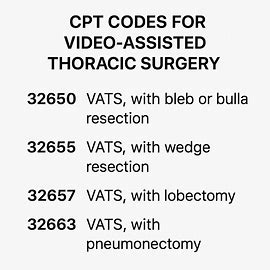
CPT Codes for Video-Assisted Thoracic Surgery
2. Understanding the Foundation: What is VATS and Why CPT Codes Matter
What is VATS?
Video-Assisted Thoracic Surgery (VATS) is a minimally invasive surgical technique used to diagnose and treat conditions within the chest cavity (thorax). The procedure typically involves:
-
General Anesthesia: With single-lung ventilation (where one lung is collapsed to create working space).
-
Port Placement: Making 2 to 4 small incisions (usually 1-2 cm each) between the ribs, known as ports.
-
Insertion of Instruments: One port is for the thoracoscope (a thin tube with a light and high-definition camera), and the others are for surgical instruments like graspers, dissectors, staplers, and energy devices.
-
Visualization: The camera transmits a magnified view of the internal thoracic structures onto large monitors in the operating room, guiding the surgeon’s movements.
-
Procedure Execution: The surgeon performs the intended operation, such as a biopsy, wedge resection, or lobectomy, by manipulating the instruments while watching the monitors.
-
Specimen Removal: Resected tissue is often placed in a small bag and removed through one of the slightly enlarged port sites.
-
Closure: The procedure concludes with the placement of one or more chest tubes through a port site to drain air and fluid, followed by the closure of the small incisions.
Why CPT Codes are Critical for VATS
CPT codes are the universal language used to describe medical, surgical, and diagnostic services to insurers for reimbursement. Their accuracy is paramount for several reasons:
-
Precise Communication: They provide a standardized way to communicate exactly what service was performed to payers, regulators, and researchers.
-
Appropriate Reimbursement: Each CPT code is linked to a value (Relative Value Unit or RVU) that determines the payment level. Using an incorrect code can lead to significant underpayment or denial of claims.
-
Compliance and Legal Integrity: Incorrect coding, whether due to error or intent, can be construed as fraud or abuse, leading to audits, hefty fines, recoupments, and even legal action.
-
Data Analytics and Quality Reporting: Accurate coding generates reliable data that is used for public health reporting, quality improvement initiatives, and practice management analysis.
For VATS, this is especially crucial because many procedures have both an open approach code and a distinct, typically higher-valued, VATS-specific code. Correctly applying the VATS code is how a practice is compensated for the specialized skill, technology, and time involved in minimally invasive surgery.
3. Navigating the CPT® Manual: Key Sections for Thoracic Coding
Thoracic procedures are not confined to a single chapter in the CPT manual. A proficient coder must be familiar with several sections.
The Respiratory System (30000系列)
This is the primary home for most thoracic surgery codes. It is subdivided anatomically:
-
Lungs and Pleura (32601-32674): This is the most critical subsection for VATS, containing the dedicated thoracoscopy (VATS) codes for diagnostic and therapeutic procedures on the lungs and pleura.
-
Trachea/Bronchi (31600-31661): Includes bronchoscopy codes, which may be performed concurrently with VATS.
-
Chest Wall (19260-19272, 21750-21825): Includes codes for chest wall resection or reconstruction, which may be necessary for tumor involvement.
The Cardiovascular System (33000-37799)
This section is relevant for procedures on the pericardium, great vessels, and thoracic sympathetic chain.
-
Pericardium (32659-32662, 33010-33050): Contains both open and VATS codes for pericardial window or resection.
-
Sympathectomy (32664, 64820-64823): CPT 32664 is the VATS-specific code for thoracic sympathectomy.
The Integumentary System (10000系列)
This section covers the initial incision and closure. However, for VATS, the work of placing the ports is not separately coded. It is considered an integral part of the main VATS procedure. Codes from this section would only be used if a separate, unrelated procedure was performed on the skin.
The Digestive System (40000系列)
This section contains codes for esophageal procedures, some of which have VATS applications.
-
Esophagectomy (43180): This is the open code. A VATS-assisted approach would typically use this code along with modifiers and detailed documentation, as there is no specific VATS code for esophagectomy. Some approaches are hybrid (VATS + laparoscopy).
-
Esophageal Myotomy (43280, 43281, 43282): Laparoscopic codes, sometimes used in conjunction with a VATS approach for Heller myotomies.
4. The Core VATS Procedural Codes: A Deep Dive
This section provides a detailed analysis of the most commonly used VATS-specific CPT codes.
Lung Resection Codes (CPT 32663-32674)
This family of codes represents the most complex and highest-value VATS procedures. It is vital to understand the hierarchy and specific definitions.
Anatomy Refresher:
-
Lobe: A major division of a lung. The right lung has three lobes (upper, middle, lower); the left has two (upper, lower).
-
Segment: A functionally independent unit of a lobe, with its own bronchus and blood supply. There are 10 segments in the right lung and 8-10 in the left.
-
Wedge: A small, non-anatomic resection of a wedge-shaped piece of lung tissue, without regard to segmental boundaries.
The Codes:
-
CPT 32663: Thoracoscopy, surgical; with lobectomy (single lobe).
-
CPT 32664: with lymph node dissection(s).
-
CPT 32665: with lymph node sampling.
-
CPT 32666: with segmentectomy.
-
CPT 32667: with wedge resection(s), single or multiple.
-
CPT 32668: with excision of pericardial cyst, tumor, or mass.
-
CPT 32669: with excision of mediastinal cyst, tumor, or mass.
-
CPT 32670: with resection of a single lung metastasis.
-
CPT 32671: with resection of multiple lung metastases.
-
CPT 32672: with total pulmonary decortication (for severe empyema).
-
CPT 32673: with partial pulmonary decortication.
-
CPT 32674: with pleural abrasion.
Coding Logic and Hierarchy:
A fundamental principle is that these codes are comprehensive. The code for a major resection (e.g., lobectomy) includes all lesser procedures performed on the same lung. You cannot separately code a wedge resection and a lobectomy for the same lung.
-
Example 1: A surgeon performs a VATS right upper lobectomy for cancer and also takes a wedge biopsy of a suspicious nodule in the right lower lobe to rule out a second primary cancer. The correct code is 32663 (for the lobectomy). The wedge resection of the second nodule is included in the lobectomy code because it was performed on the same lung.
-
Example 2: A surgeon performs a VATS wedge resection of a nodule in the right upper lobe and a separate VATS wedge resection of a nodule in the right lower lobe. The correct code is 32667. The code description explicitly states “single or multiple,” meaning one code covers all wedge resections on that lung.
-
Example 3: A surgeon performs a VATS left lower lobectomy and also performs a systematic mediastinal and hilar lymph node dissection for staging. The correct code is 32663. The lymph node dissection is a standard and integral part of an oncologic lobectomy. You would not add code 32664 or 32665. Codes 32664 and 32665 are only reported when a lymph node dissection or sampling is performed as a standalone procedure without a lung resection.
When to use 32664/32665: These are for diagnostic staging procedures, such as when a patient with lung cancer undergoes VATS solely to remove lymph nodes for staging purposes before a definitive decision on resection is made.
VATS Lung Resection Coding Logic
Diagnostic Thoracoscopy (CPT 32601-32609)
These codes are used when the procedure is primarily exploratory or for biopsy. They are mutually exclusive from the surgical resection codes above.
-
CPT 32601: Thoracoscopy, diagnostic; separate procedure.
-
CPT 32606: with biopsy(ies) of pleura.
-
CPT 32607: with biopsy(ies) of lung or mediastinal mass.
-
CPT 32608: with partial pleurectomy.
-
CPT 32609: with control of pleural hemorrhage.
Key Point: If a diagnostic thoracoscopy is performed and then, based on findings, the surgeon proceeds to a more definitive surgical procedure (e.g., lobectomy 32663), you code only the surgical procedure. The diagnostic component is bundled into the larger service.
Pleural Procedures (CPT 32650-32662)
These codes cover common procedures for managing pleural space diseases.
-
CPT 32650: Thoracoscopy, surgical; with pleurodesis (e.g., talc poudrage). This is done to cause the lung to stick to the chest wall, preventing recurrent pleural effusions or pneumothorax.
-
CPT 32651: with drainage of pleural effusion. (Note: This is for surgical management. Simple chest tube placement is coded separately with 32551).
-
CPT 32652: with drainage of empyema.
-
CPT 32653: with removal of intrapleural foreign body.
-
CPT 32654: with partial decortication.
-
CPT 32655: with total decortication.
-
CPT 32656: with parietal pleurectomy.
-
CPT 32657: with excision of pleural tumor.
-
CPT 32658: with open flap drainage of empyema.
-
CPT 32659: with creation of pericardial window.
-
CPT 32660: with pericardietomy.
-
CPT 32661: with excision of mediastinal tumor.
-
CPT 32662: with excision of mediastinal cyst.
Pericardial Procedures (CPT 32659-32662)
As seen above, these are included in the pleural section but are distinct.
-
CPT 32659: Creation of a pericardial window. This is done to drain a pericardial effusion (fluid around the heart) into the pleural space.
-
CPT 32660: Pericardietomy, a more extensive removal of the pericardium.
Mediastinal Procedures (CPT 32661-32662, 39400系列)
-
CPT 32661: Excision of mediastinal tumor (e.g., thymoma).
-
CPT 32662: Excision of mediastinal cyst.
-
CPT 39400: Mediastinoscopy, cervical; with biopsy. (This is a different approach, through the neck, and is not a VATS code).
Sympathectomy (CPT 32664)
-
CPT 32664: Thoracoscopy, surgical; with sympathectomy. This is used to treat hyperhidrosis (excessive sweating) by dividing the sympathetic nerve chain in the chest.
Esophageal Procedures
There are no specific VATS codes for esophageal surgery. Procedures like VATS-assisted esophagectomy or Heller myotomy are typically reported using the standard open or laparoscopic codes (e.g., 43180 for esophagectomy, 43280 for laparoscopic myotomy). The operative report must meticulously document the VATS approach to justify the service. Some payers may have specific policies on this.
5. The Critical Role of Modifiers in VATS Coding
Modifiers are two-digit codes that provide additional information about a service or procedure, altering its description without changing the core code itself. They are essential for accurate VATS coding.
-
Modifier 50 – Bilateral Procedure: Used when the same procedure is performed on both lungs during the same operative session.
-
Example: A patient with bilateral spontaneous pneumothoraces undergoes a VATS bleb resection and pleurodesis on the right lung (32667, 32650) and the same on the left lung. Coding: 32667-50, 32650-50. Note: Some payers prefer the 50 modifier on the first code; others want it on the second. Always check payer policy.
-
-
Modifier 51 – Multiple Procedures: Indicates that multiple procedures were performed during the same session. The primary procedure is listed first without modifier 51. The secondary procedure(s) are appended with modifier 51. This typically results in a reduced payment for the secondary procedures.
-
Example: A VATS lobectomy (32663) is performed, and during the same session, the surgeon also performs a VATS pericardial window (32659) for a malignant effusion. Coding: 32663, 32659-51.
-
-
Modifier 59 – Distinct Procedural Service: Used to indicate that a procedure or service was distinct or independent from other services performed on the same day. It is most commonly used to bypass National Correct Coding Initiative (NCCI) edits that would otherwise bundle two codes together. Use this modifier sparingly and only when the procedures are performed at different anatomic sites or different patient encounters.
-
Example: A patient has a VATS wedge resection of a nodule in the right lung (32667) and a separate, unrelated mediastinal tumor excision from the anterior mediastinum (32661) during the same session. These are distinct anatomic sites. Coding: 32667, 32661-59.
-
-
Modifier 78 – Unplanned Return to the Operating Room: Used when a patient must return to the OR for a related procedure during the postoperative period of the initial surgery.
-
Example: A patient who had a VATS lobectomy 5 days ago returns to the OR for a VATS exploration and control of postoperative bleeding. The code for the control of hemorrhage (32609) would be appended with modifier 78.
-
-
Modifier SG – Ambulatory Surgery Center (ASC) Procedure: This is a HCPCS Level II modifier used by ASC facilities to indicate that a service was performed in an ASC setting. It is not used by physicians.
6. Coding Scenarios: From Operative Report to Clean Claim
Let’s apply the knowledge to real-world examples.
Scenario 1: VATS Lobectomy with Lymph Node Dissection
Operative Report Summary:
-
Pre-op Dx: NSCLC, right upper lobe.
-
Post-op Dx: Same.
-
Procedure: VATS right upper lobectomy with systematic mediastinal and hilar lymph node dissection (stations 2R, 4R, 7, 10, 11).
-
Description: Three ports placed. Right upper lobe was isolated, vessels and bronchus stapled. Lobe removed in a bag. Lymph nodes from stated stations were dissected and removed separately. Chest tube placed.
Coding Analysis:
-
The primary procedure is a lobectomy (32663).
-
The lymph node dissection is extensive but is an integral part of the cancer surgery. It is not a separate, standalone procedure.
-
Correct CPT Code: 32663 only.
Scenario 2: VATS Wedge Resection for Nodules in Multiple Lobes
Operative Report Summary:
-
Pre-op Dx: Multiple pulmonary nodules, right lung.
-
Post-op Dx: Same.
-
Procedure: VATS wedge resection of two nodules in the right upper lobe and one nodule in the right lower lobe.
-
Description: Three ports placed. Three separate wedge resections performed using endoscopic staplers. Specimens sent to pathology in separate containers.
Coding Analysis:
-
Code 32667 is defined as “with wedge resection(s), single or multiple.”
-
All wedge resections were on the same lung (right).
-
Correct CPT Code: 32667 only. One code covers all wedge resections on that lung.
Scenario 3: Conversion from VATS to Open Thoracotomy
Operative Report Summary:
-
Pre-op Dx: Suspected lung cancer, left upper lobe.
-
Post-op Dx: Same.
-
Procedure: Attempted VATS left upper lobectomy. Converted to open thoracotomy due to dense adhesions and bleeding. Completed open left upper lobectomy.
-
Description: VATS ports placed. Significant adhesions and bleeding encountered. Decision made to convert. A standard posterolateral thoracotomy incision was made. Lobectomy completed via open approach.
Coding Analysis:
-
This is a critical scenario. The golden rule is: You code only the approach that was completed.
-
Since the procedure was started with VATS but could not be completed, you do not code the VATS approach (32663).
-
The definitive procedure was performed via an open thoracotomy.
-
Correct CPT Code: 32440 (Lobectomy, pulmonary, open). You would not code 32663 or any code for the attempted VATS.
7. Billing and Reimbursement: Navigating the Financial Landscape
Understanding the financial impact of coding is crucial.
RVUs and Reimbursement Calculations:
The Centers for Medicare & Medicaid Services (CMS) assigns three types of Relative Value Units (RVUs) to each CPT code:
-
Work RVU (wRVU): Measures the physician’s time, skill, effort, and stress.
-
Practice Expense RVU (peRVU): Covers overhead (staff, equipment, supplies).
-
Malpractice RVU (mRVU): Covers the cost of malpractice insurance.
The total RVU is multiplied by a geographic practice cost index (GPCI) and a conversion factor (CF) to determine the dollar amount of reimbursement. VATS codes generally have higher peRVUs than their open counterparts due to the cost of specialized equipment (e.g., staplers, energy devices, video towers).
Bundling and NCCI Edits:
The National Correct Coding Initiative (NCCI) is a CMS program designed to prevent improper coding. It creates “edits” that pair codes that should not be billed together. If two codes have an edit, the column 2 code is bundled into the column 1 code and is not separately payable unless a valid modifier (like 59) is used. Coders must use NCCI editing software to check claims before submission.
Payer-Specific Policies:
Private insurers (e.g., Blue Cross, Aetna, UnitedHealthcare) often have their own policies that may differ from Medicare’s. They may have specific documentation requirements or unique rules for reporting new technologies. It is imperative to obtain and review the specific policy for thoracic surgery for each major payer.
8. Audit Triggers and Compliance: Protecting Your Practice
Inaccurate VATS coding is a high-risk area for audits.
Common Red Flags:
-
Upcoding: Reporting a lobectomy (32663) when only a wedge resection (32667) was performed.
-
Unbundling: Separately reporting a lymph node dissection (32664) with a lobectomy (32663).
-
Lack of Medical Necessity: Performing a VATS procedure for an indication not supported by clinical documentation (e.g., a vague progress note without imaging results).
-
Misuse of Modifier 59: Using it incorrectly to bypass NCCI edits without a valid reason.
-
Inconsistent Coding: Frequent changes in coding patterns for the same procedure.
Documentation is King:
The operative report is the foundation of defense in an audit. It must be detailed and unambiguous. It must include:
-
Indication: Clear medical reason for the surgery.
-
Approach: Explicit statement that the procedure was performed using video-assisted thoracoscopy (VATS).
-
Findings: Detailed description of the anatomy, pathology, and any anomalies.
-
Technique: Step-by-step description of the procedure, including structures divided (vessels, bronchi), instruments used (staplers), and specimen handling.
-
Lymph Nodes: Specific stations sampled or dissected.
-
Conversion: If converted to open, the reason must be clearly documented.
-
Conclusion: What was accomplished.
Developing a Robust Compliance Plan:
A proactive approach includes internal audits, ongoing coder education, regular communication between surgeons and coders, and staying updated on CPT and payer policy changes.
9. The Future of VATS Coding: Robotics, Bundled Payments, and AI
The field continues to evolve, and coding must keep pace.
Robotic-Assisted Thoracic Surgery (RATS):
Robotic systems (e.g., da Vinci) are increasingly used. The coding is currently identical to VATS. There is no specific CPT code for the robotic approach itself. The work is reported using the same VATS codes (32663, 32666, etc.). The robotic system is considered a tool, not a distinct procedure. The facility can bill for the use of the expensive robotic equipment.
The Shift Towards Value-Based Care:
The healthcare system is moving from fee-for-service (paying for volume) to value-based care (paying for outcomes). This includes:
-
Bundled Payments: A single payment for an entire episode of care (e.g., from diagnosis through surgery and 90 days post-op). Accurate coding is still vital for defining the episode and assessing costs.
-
MIPS/APMs: Quality reporting programs that can affect reimbursement. Codes are used to identify patient populations and report quality measures.
Artificial Intelligence (AI):
AI is beginning to impact coding through:
-
Computer-Assisted Coding (CAC): Software that reads operative reports and suggests codes, improving efficiency but still requiring human review.
-
Audit Analytics: AI can analyze vast datasets to identify aberrant coding patterns for targeted audits.
10. Conclusion: Mastering the Art and Science of VATS Coding
Accurate VATS coding is a sophisticated discipline that requires a deep understanding of thoracic anatomy, surgical techniques, and intricate CPT guidelines. It hinges on the seamless collaboration between the surgeon, who must provide impeccable documentation, and the coder, who must interpret that documentation with precision and strategic awareness. By moving beyond mere code assignment to grasp the underlying principles, compliance imperatives, and future trends, healthcare practices can ensure they are justly compensated for providing cutting-edge, minimally invasive care while steadfastly maintaining their ethical and legal integrity. In the dynamic world of healthcare reimbursement, knowledge is not just power—it is protection and prosperity.
11. Frequently Asked Questions (FAQs)
Q1: Can I bill for both a diagnostic thoracoscopy (32607) and a surgical thoracoscopy (32667) if I start with the diagnostic and then decide to do a wedge resection?
A: No. The diagnostic procedure is considered an integral part of the surgical procedure. You only code the definitive surgical service performed—in this case, CPT 32667.
Q2: How do I code a VATS procedure that is performed bilaterally?
A: Report the CPT code for the procedure performed on one side, and append it with modifier 50 (Bilateral Procedure). For example, a bilateral pleurodesis would be coded as 32650-50. Always check individual payer guidelines, as some may want the code listed twice on the claim form with the modifier 50 on the second line.
Q3: Is there a specific code for a robotic-assisted VATS lobectomy?
A: No. The current CPT coding structure does not distinguish between manual VATS and robot-assisted VATS. Both approaches are reported using the same code, 32663. The use of the robot is considered a technical aspect of the procedure and not a separately coded service by the physician.
Q4: What is the difference between a lymph node “sampling” (32665) and “dissection” (32664)?
A: Sampling typically involves the removal of a few representative lymph nodes from specific stations for staging purposes. A dissection (or systematic resection) involves the complete removal of all lymph node tissue from defined anatomic stations (e.g., a full mediastinal lymphadenectomy). The operative report must clearly document which was performed.
Q5: How do I handle coding if a VATS procedure is converted to an open thoracotomy?
A: You code only the open procedure that was ultimately performed. The attempted VATS approach is not reported. For example, if a VATS lobectomy is converted to an open lobectomy, you code only 32440 (Lobectomy, pulmonary, open). The medical reason for the conversion must be well-documented in the operative note.
12. Additional Resources
-
The American Medical Association (AMA): The official publisher of the CPT® code set. Essential for purchasing the annual CPT manual and accessing official resources.
-
Website: www.ama-assn.org
-
-
The Centers for Medicare & Medicaid Services (CMS): Provides access to the National Correct Coding Initiative (NCCI) edits, the Medicare Physician Fee Schedule (MPFS) Look-Up Tool, and local payer policies (LCDs/NCDs).
-
Website: www.cms.gov
-
-
The American College of Surgeons (ACS): Offers resources and education for surgeons, including coding and billing workshops.
-
Website: www.facs.org
-
-
The American Association for Thoracic Surgery (AATS): A professional organization for thoracic surgeons that often provides coding updates and guidance relevant to the specialty.
-
Website: www.aats.org
-
-
The Society of Thoracic Surgeons (STS): Another key professional society with resources on practice management, including coding and reimbursement.
-
Website: www.sts.org
-
Date: September 5, 2025
Author: The Medi-Codex Team
Disclaimer: This article is for informational and educational purposes only. It is not a substitute for professional medical coding, billing, or legal advice. CPT® is a registered trademark of the American Medical Association (AMA). Medical coders must consult the most current, official AMA CPT® code books and payer-specific guidelines for accurate coding and reimbursement. The author and publisher assume no responsibility for errors, omissions, or any liability related to the use of this information.